Feature
Research Report
The 2026 State of CX Outsourcing

Call centers have long served as the front line of brand trust. When a customer reaches out with a billing dispute or a product failure, the experience they receive shapes how they describe the brand to everyone they know.
That dynamic hasn’t changed.
What has changed, considerably, is how quickly the underlying infrastructure of that experience is being rebuilt around AI — and how uneven the results have been.
The promise of AI-powered contact centers is no longer theoretical. Agentic AI, conversational models, real-time sentiment analysis and intelligent routing have moved from pilot programs into production environments.
Yet a striking gap has emerged between adoption announcements and actual operational integration. That gap — between organizations that have deployed AI and those that have made it work — defines the most important strategic question in contact center leadership heading into 2026.
This article includes key call center statistics with fresh data from 2025 and 2026 research and examines what the AI integration gap means for customer experience strategy, and outlines what contact center and CX leaders should do to close the distance between their technology investment and measurable outcomes.
Trends for traditional call center infrastructure have indicated a transition to cloud-based Contact Center as a Service (CCaaS) platforms.
According to Fortune Business Insights, the global Contact Center as a Service market size was valued at $7.08 billion in 2025 and is projected to grow from $8.33 billion in 2026 to $30.15 billion by 2034, exhibiting a CAGR of 17.40% during the forecast period. North America dominated the global market with a share of 39.00% in 2025.
For marketing and CX leaders, this infrastructure shift matters because it changes the scope of what’s possible in personalization, routing intelligence and real-time analytics. CCaaS platforms can do more than replace on-premise phone systems. They provide the data layer through which AI models receive context, agents receive guidance and customer journeys get evaluated.
Teams still operating on a fragmented legacy stack will find an AI integrations slower to deploy, harder to govern, and less likely to scale without the CCaaS infrastructure for data.
The Puzzel State of Contact Centres 2026 report found that only 3% of contact centers operate on a single, unified platform, while the average organization now manages 3.9 different contact center technologies. That fragmentation is a structural drag on AI performance — and on the customer experience that depends on it.
Reliable orchestration is the heart of systems that highlight voice intelligence that engages customers.
Matt Beucler, CEO of Plura AI, noted the Apple-Google partnership for Siri. “I’ve spent decades working in voice, telephony and large-scale A.I. systems,” Beucler explains. “… From where I sit, the Apple-Google Gemini partnership is introducing a quieter subtext for how voice intelligence will be reaching consumers.”
Related Article: Is This the Year that Artificial Intelligence Dominates the Call Center?
AI adoption in contact centers accelerated sharply through 2024 and 2025. McKinsey reported that 78% of organizations are using AI in at least one business function, up from 72% in early 2024.
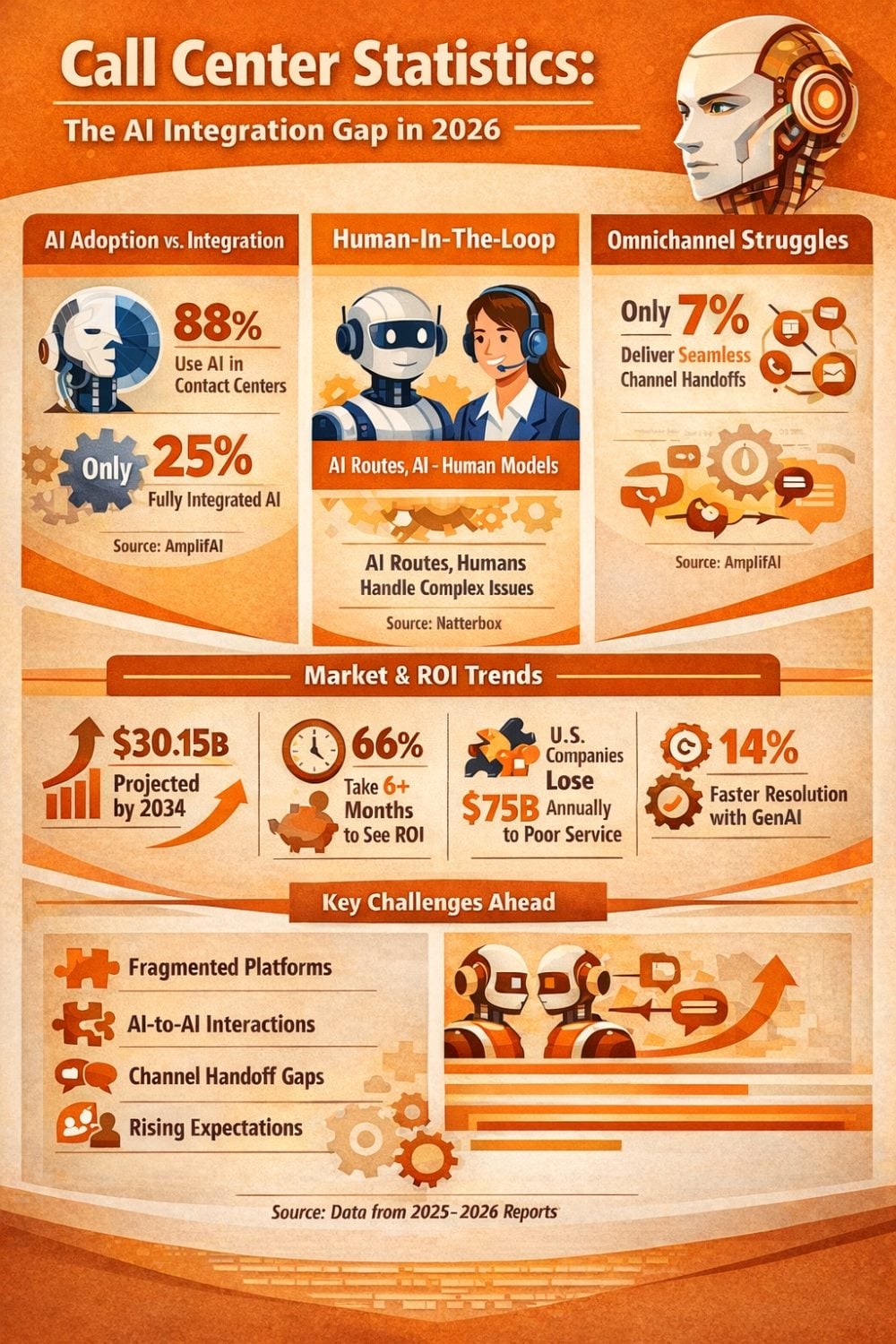
Yet a sobering counterpoint has emerged from operational data. Recent research published by AmplifAI found that only 25% of call centers have successfully integrated AI automation into their daily operations — meaning 75% of organizations own AI tools they have not fully operationalized within their workflows.
That gap between deployment and operationalization explains why U.S. companies still lose an estimated $75 billion annually due to poor customer service, a figure that has not moved even as AI investment has accelerated. The issue, according to AmplifAI’s analysis, is that most organizations are adopting AI faster than they can integrate it into the coaching, quality processes and workforce management systems that actually determine service outcomes. Speed of purchase has outpaced depth of implementation.
Verint data drawn from a survey of 500 contact center leaders adds precision to the picture. For 66% of businesses, it took more than six months to begin seeing ROI from recent AI implementations. Less than a third — 30% — are using AI to generate insights, and just over a quarter — 27% — are utilizing AI within knowledge management.
Meanwhile, 62% of contact center leaders say that the successful implementation of AI is critical to their roles, and 27% believe their jobs are at risk if AI initiatives fail to deliver results. The business pressure is real. The execution gap is equally real.
Related Article: Microsoft AI CEO Says Marketing Will Be Automated in 18 Months
| Category | Statistic | Source |
|---|---|---|
| CCaaS Market Growth | The global Contact Center as a Service (CCaaS) market was valued at $7.08 billion in 2025 and is projected to reach $30.15 billion by 2034, growing at a CAGR of 17.40% | Fortune Business Insights |
| Regional Market Share | North America accounted for 39% of the global CCaaS market in 2025 | Fortune Business Insights |
| Platform Fragmentation | Only 3% of contact centers operate on a single unified platform, while the average organization manages 3.9 different contact center technologies | Puzzel |
| AI Adoption Across Businesses | 78% of organizations report using AI in at least one business function, up from 72% in 2024 | McKinsey |
| AI Integration Gap | 88% of contact centers report using AI, but only 25% have fully integrated AI automation into daily workflows | AmplifAI |
| AI ROI Timeline | 66% of businesses required more than six months to see measurable ROI from AI implementations | Verint |
| AI Insight Usage | Only 30% of contact centers are using AI to generate operational insights | Verint |
| AI in Knowledge Management | 27% of organizations currently apply AI within knowledge management systems | Verint |
| Leadership Pressure | 62% of contact center leaders say successful AI implementation is critical to their role, and 27% believe their job is at risk if AI initiatives fail | Verint |
| Human-in-the-Loop Adoption | 76% of contact center leaders have formally adopted human-in-the-loop models combining AI routing with human handling of complex interactions | Natterbox |
| Routing Efficiency | AI-powered routing reduced customer “hunting time” in IVR systems by 54% | Natterbox |
| Agent Productivity Gains | GenAI-enabled agents achieved a 14% increase in issue resolution per hour and a 9% reduction in handle time | McKinsey |
| Omnichannel Gap | Only 7% of contact centers deliver truly seamless transitions between communication channels | AmplifAI |
| Cost of Poor Customer Service | U.S. companies lose an estimated $75 billion annually due to poor customer service | AmplifAI |
| Speech Analytics Market | The speech analytics market is growing at a 15.61% CAGR (2024–2029) and is projected to exceed $6 billion by 2029 | Research and Markets |
| Conversational AI Market | The global conversational AI market is projected to grow from $17.05 billion in 2025 to $49.8 billion by 2031 | Research and Markets |
These figures tell a coherent story when read together. AI is creating measurable operational wins — Natterbox’s benchmark data on routing efficiency and the McKinsey finding that Gen AI-enabled agents achieved a 14% increase in issue resolution per hour and a 9% reduction in handle time are real gains.
At the same time, the data on integration depth and ROI timelines reveals that these gains are not yet the norm. They belong to the 25% — organizations that have worked through the implementation complexity that stalls everyone else. The consensus on the value of agent-assist tools is particularly instructive: it suggests that the field has largely moved past debating whether AI belongs in the contact center, and toward the harder question of how to deploy it in ways that actually improve agent performance rather than merely adding to the technology stack.
The emergence of AI-to-AI interactions deserves separate attention. Customers are increasingly using AI tools of their own to navigate IVR systems, summarize service issues before a call, and generate escalation language.
The 2026 data landscape provides a clearer map for where to act than prior years offered. The following considerations are drawn from the patterns visible across research and represent practical starting points for teams looking to move from deployment to integration.
The statistics assembled here will continue to shift as AI maturity curves advance and CCaaS adoption deepens. What the latest data makes clear is that the baseline has moved. Customers who once marveled at a chatbot that could answer a billing question now expect that same system to know their history, escalate gracefully, and hand them to a human who is already briefed.
Meeting that expectation requires more than technology investment. It requires operational integration deep enough to make AI the connective tissue of the entire customer service workflow — not a layer applied on top of it.
Pierre DeBois is the founder and CEO of Zimana, an analytics services firm that helps organizations achieve improvements in marketing, website development, and business operations. Zimana has provided analysis services using Google Analytics, R Programming, Python, JavaScript and other technologies where data and metrics abide. Connect with Pierre DeBois: 
