Editorial
Research Report
Building the Case for Modern Public Sector Messaging

For 20 years, customer experience strategy rested on one stable assumption: the customer initiates. They search, browse, compare, click and arrive. Every funnel, every customer journey map, every landing page was built on that behavior. That assumption is now breaking — in B2C, in B2B, and in a third territory most CX organizations have not yet named: interactions where the customer is not human at all.
The platforms themselves tell the story. ChatGPT, Claude, Gemini, Copilot and Perplexity are no longer chat tools that occasionally answer questions — they have become the new search engines, the new front door to markets. Customers increasingly do not search. They ask. And soon, many will not even ask: their agents will ask for them.
McKinsey’s research on the age of AI search found that half of consumers already use AI-powered search in their buying journeys, forecasts $750 billion in US revenue flowing through AI search by 2028, and warns unprepared brands face 20–50% declines in traditional search traffic. The most uncomfortable number: a brand’s own website typically represents just 5–10% of the sources an AI engine consults when assembling an answer about that brand. Your story is being told by data you do not control.
Trust has moved with usage. Yext’s global consumer study found 62% of people now trust AI tools to guide brand discovery — yet only 10% trust the first answer alone, and nearly half cross-check across platforms. Inconsistency anywhere in your information ecosystem is now a discoverable defect.
And the shift is structural, not Western. Samsung’s Galaxy AI expansion toward 400 million devices is backed by data showing 47% of consumers say their daily routines would be disrupted without AI-powered search and assistance — and 45% now use voice as often as they type. When a South Korean device maker rebuilds its entire portfolio around assistance rather than apps, the direction of travel is settled.
Related Article: The Mirror Problem: Why Generic Content Can't Win in AI Search
Google’s analysis of the AI-era decision journey shows what replaces the keyword: long, situational queries carrying budget, constraints, urgency and emotion — answered in a single synthesized step. Brands are no longer evaluated as products within a category, but as solutions to a person’s specific situation.
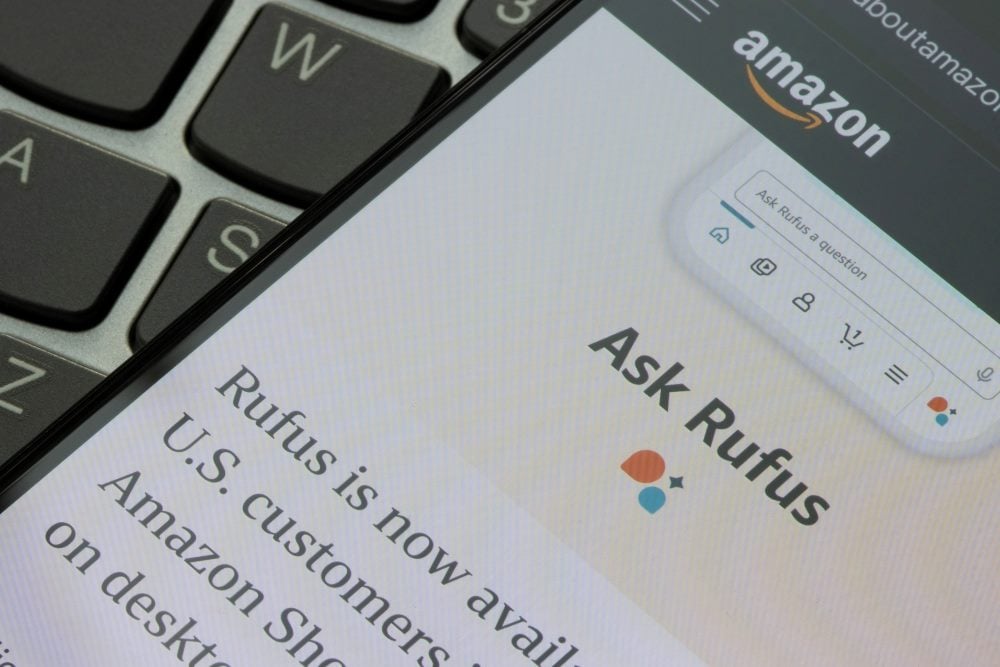
The world’s largest retailers are rebuilding around exactly this behavior. Amazon’s AI shopping assistant Rufus was used by more than 250 million customers in a single year, with monthly users up 149% — and its “Buy for Me ” button already executes purchases agentically on the customer’s behalf. In Japan, Rakuten’s full-scale agentic AI launch placed a conversational concierge across its ecosystem and into Rakuten Ichiba — ending, after nearly three decades, the reign of the keyword search bar on Japan’s largest marketplace. Shoppers describe purpose, budget and context by text, voice or camera; the agent does the rest.
The transaction itself is following the conversation. OpenAI’s Instant Checkout lets the 700 million people who use ChatGPT weekly complete purchases without leaving the chat, built on the open Agentic Commerce Protocol co-developed with Stripe. The customer may never see your website, your funnel, or the experience you spent a decade perfecting.
Treating this as a retail story is the costliest misread available to executives. Gartner predicts that 40% of enterprise applications will feature task-specific AI agents by the end of 2026, up from less than 5% in 2025. The enterprise buying journey — RFPs, demos, discovery calls — is being compressed by assistants that read documentation, compare specifications and shortlist vendors before a human ever contacts sales.
Industrial Europe shows what this looks like in production. Siemens’ Industrial Copilot, built with Microsoft, is used by more than 100 customers and reaches over 120,000 engineers, with thyssenkrupp rolling it out globally across battery production engineering. Note what changed: Siemens’ B2B customers no longer search manuals, portals or support queues. They ask, inside their workflow — and the vendor’s experience is delivered through an assistant, not a channel.
That creates an unforgiving dependency. Research on rethinking enterprise search is blunt: assistants are only as useful as the information they can reach. Fragmented data and outdated product information do not merely degrade the answer — the customer blames the brand for the AI’s mistake. Data quality has quietly become a CX discipline.
When humans search through AI assistants — rather than delegating to agents — governance becomes the discipline that decides whether the right opportunity is even findable. Without standards for how information is structured, verified and kept current, discovery turns arbitrary: B2C customers cannot separate the right product from a confidently wrong answer, and B2B buyers can miss the right vendor entirely because an assistant grasped an outdated signal. Governance is becoming the key differentiator of this era — not a compliance afterthought.
The practice is concrete. Establish one owned source of truth for product, pricing and capability data, and feed every channel from it. Test and simulate weekly as we did in Samsung (editor's note: the author worked with Samsung), how the major assistants answer the questions your customers actually ask. Build a correction loop: trace wrong answers to the data that misled the assistant and fix the source, not the symptom. And name an accountable owner for answer integrity across marketing, product and IT — because in AI-mediated discovery, accuracy is no longer a hygiene factor. It is the storefront.
Governance also runs inward. Define which AI search platforms your teams use — and how: verification standards before decisions, query discipline and clear rules on what data never enters public tools. Run internal pilots on the same assistants your customers use, so the company learns their behavior before the market teaches it the expensive way — and set a review cadence, because these platforms change monthly and last quarter’s rules are already stale. Preparedness is a governance outcome, not an accident.
And when the inquiry is agentic, you need a different set of direct parameters entirely — because agents will not care about your customer experience at all. No design, no tone, no relationship warmth registers. What registers is machine-readable precision: structured pricing and availability, documented APIs, response latency, authentication and mandate handling, explicit error states.
In B2B and B2C alike, these parameters are the experience. Publish agent-facing terms the way you publish human-facing policies: what an agent may query, transact and automate, at what rate limits, under what guarantees. The companies that document this first will become the default choice of every agent that compares them — which is exactly where the third customer enters.
In their book When Machines Become Customers, Don Scheibenreif and Mark Raskino put it plainly: there are already more machines with the potential to act as buyers than there are humans on the planet. First they will shop for us; later they will act for themselves. That future stopped being theoretical in September 2025, when Google announced the Agent Payments Protocol (AP2) with more than 60 partners — Mastercard, American Express, PayPal, Salesforce and Etsy among them — an open standard letting AI agents transact through cryptographically signed mandates.
It sits alongside Anthropic’s Model Context Protocol, the open standard — since adopted by OpenAI, Google and Microsoft and now governed under the Linux Foundation — through which agents connect to business systems and data. The B2B use cases are written into these protocols themselves: autonomous procurement, automatic scaling of software licences, agent-led replenishment.
This customer does not feel delight. It evaluates machine-readable accuracy, response latency, transparent pricing and API reliability. BCG’s analysis of brands meeting AI bots names the strategic cost of ignoring it: a thinner inflow of customer data, fewer moments to differentiate, and shrinking opportunity to apply your own expertise — unless brands deliberately design for relevance inside third-party agents. Experience for this customer is protocol quality. Most CX organizations have no owner for it.
Map your AI-mediated entry points. Ask ChatGPT, Claude, Gemini and Perplexity about your company the way your customers do. Impact today: in B2C, brands absent from AI answers are losing shelf presence invisibly; in B2B, vendors are being shortlisted — or silently excluded — before sales ever knows the deal existed.
Treat (agent) machine-readable accuracy as a CX KPI. Structured product data, current specifications, transparent pricing, clean APIs. Impact today: B2C assistants skip products they cannot parse; B2B agents drop vendors whose documentation cannot be read — to an agent, an unreadable offering does not exist.
Fix enterprise search and data before deploying assistants. An assistant grounded in fragmented data manufactures confident errors at scale. Impact today: B2C brands face public, screenshot-able wrong answers; B2B suppliers face procurement decisions made on stale specifications — and absorb the blame either way.
Design the human boundary deliberately. Decide which moments are assistant-first and which are irreducibly human — before economics decides for you. Impact today: B2C service is bifurcating into instant AI resolution and premium human care; in B2B, account managers are shifting from information providers to trust architects.
Assign ownership for agentic customers. Someone must own the experience of non-human buyers: protocol readiness, agent-facing documentation, mandate and payment flows. Impact today: early B2B movers are winning autonomous procurement contracts competitors never see; in B2C, agent-executed purchases are already flowing through chat.
Rebuild metrics around outcomes, not visits. Traffic, pageviews and form fills are collapsing as proxies. Impact today: B2C marketing is shifting budget from clicks to answer presence; B2B pipelines are filling with buyers who completed 80% of their journey invisibly.
Pilot agent-to-agent commerce now, at small scale. Join one protocol, expose one product line, learn the failure modes while errors are cheap. Impact today: the standards being set in 2025–2026 will be the commercial rails of the next decade; the companies at the table are writing rules the rest will inherit.
The customer who searches is not disappearing tomorrow. But the customer who asks — and the agent who asks for them — is already here, already transacting, and already forming durable preferences about which companies answer well. CX was never about the website or the survey. It was always about being genuinely useful at the moment of need. That moment has moved inside the conversation. Move with it.
 Learn how you can join our contributor community.
Ricardo Saltz Gulko is the Managing Director of Eglobalis, the co-founder and visionary of the European Customer Experience Organization. He is a global strategist, thought leader, and customer experience practitioner, perceptive design analyses creator for Samsung and his clients, with a focus on customer adoption, experience and growth. Connect with Ricardo Saltz Gulko: 
