Editorial
Research Report
The 24 Hours That Define Your CX Program

While the industry obsesses over chatbots and automation, the most surprising competitive move of 2026 is showing up. Something quietly counterintuitive is happening in customer experience right now. While boardrooms debate AI deployment, agentic strategies and self-service automation, a substantial portion of the consumers those strategies are meant to serve are actively seeking something different — something physical, sensory and unmistakably human.
This is not a backlash. It is not nostalgia. It is a measured, data-backed consumer response to the most automated moment in commercial history. And the brands that read it correctly are building a form of loyalty that no algorithm can replicate.
Capgemini Research Institute’s 2026 What Matters to Today’s Consumer report, based on a survey of 12,000 consumers across 12 countries, found that consumers are increasingly favoring brands that combine digital convenience with in-person support — and that 7 in 10 consumers actively seek small indulgences to provide emotional relief amid financial stress. Value, in 2026, is not purely functional. It is emotional. And physical experience is one of the most direct routes to emotional value a brand has.
The question for CX leaders is not whether this shift is real. The data confirms it is.
The question is whether your experience strategy accounts for it — or whether your entire CX investment is flowing into digital channels while your customers are quietly craving something else.
I recently visited an Apple Store and a sports equipment store called Schuster here in Munich, close to Marienplatz and Viktualienmarkt, just to place it on the map. I was there with my family. We also had cake at Rischart a very traditional café and bakery in Munich. That became the subject of our morning: interacting with humans instead of only dealing with things digitally.
The research signal on physical experience is not subtle in 2026. It is emphatic.
The Harris Poll’s Return of Touch report, conducted for Quad and covering more than 2,000 respondents, found that 79% of consumers say online shopping lacks the “magic” of an in-person find. Nearly 90% say it is easy to remember physical store experiences that make a genuine effort to engage them. And 71% say experiencing a brand in a physical store deepens their connection and customer loyalty to it in ways that digital channels do not. These are not marginal preferences. They describe the emotional architecture of how people form lasting brand relationships.
The generational data is particularly striking. Among Gen Z and Millennials, 77% have planned travel or outings specifically around visiting a store or branded location, according to data from the ANA Masters of Marketing Conference. 73% say shopping at a pop-up or curated event feels like being part of a cultural moment. 81% of Gen Z say they wish they could disconnect from digital devices more easily and believe digital detoxes should be a routine activity.
The generation that grew up entirely online is not the generation pushing back hardest on digital saturation. But it is one of them — and the fact that they are doing so matters enormously for any brand that assumed digital-first meant digital-only.
According to research from the ANA Masters of Marketing Conference, physical brand encounters are now serving as social signals. They create opportunities for content, community, and connection — making them powerful amplifiers of digital storytelling rather than competitors to it.
Related Article: The Future for Your Consumers Isn't Social Media — It's Social Life
The physical-first renaissance is not happening despite the AI moment. It is happening because of it.
When every brand interaction begins to feel automated, the interactions that are not automated become rare. And scarcity creates value. A genuine human conversation with a knowledgeable store associate, a product you can hold and assess with your own hands, an event built around shared experience rather than transaction — these are not ancient brand rituals. They are, in 2026, genuinely differentiating.
Capgemini’s research captures the emotional dimension of this shift clearly. Consumers are seeking what they call “intentional indulgences” — spending decisions made not out of habit or convenience but out of desire for genuine emotional reward. Physical experience delivers this in ways digital cannot easily replicate. The sensory dimension of being somewhere, touching something, being served by a person who actually listens, carries emotional weight that persists in memory.
Harris Poll data shows that 42% of consumers say physical events are the highlight of their week — compared to only 15% who cite digital experiences. That gap should be visible in every CX strategy document that presents investment decisions between physical and digital channels.
The mechanism behind this shift is also structural. Digital experiences are abundant. Physical experiences are constrained by geography, capacity and cost. This means that as digital scales infinitely, in-person scales up as a differentiator by staying finite. You cannot algorithmically replicate what it feels like to stand in a space designed for you.
The most instructive cases are not luxury outliers. They are mainstream brands that have made the deliberate decision to treat physical experience as a strategic asset rather than a legacy cost.
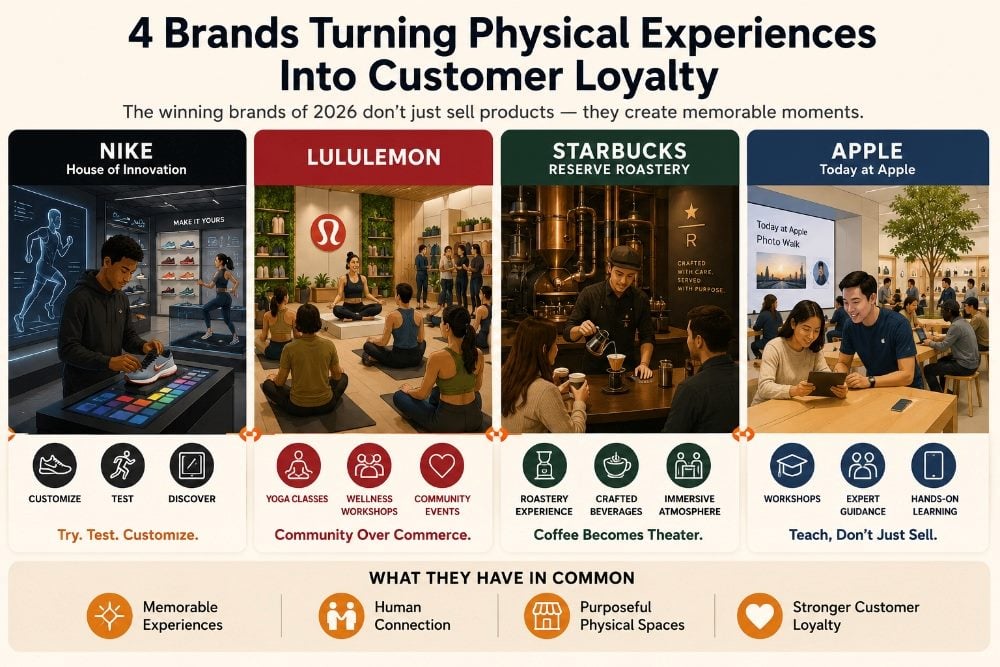
Nike House of Innovation in New York and Shanghai operates less like a traditional store and more like a product laboratory and community space. Customers can customize products, test performance gear in simulation zones and engage with the brand in a way that no ecommerce journey can approach. The physical space is not a distribution channel. It is a belief statement about what Nike thinks its customers deserve when they show up.
Lululemon has built one of the most studied community-driven physical experience models in retail. Stores routinely host yoga classes, fitness workshops and wellness events — not as promotional gimmicks but as the actual reason customers come back. Research shows that 65% of Lululemon customers feel more connected to the brand specifically because of these community events. The store is not where the product is sold. The store is where the relationship is built.
Starbucks Reserve Roasteries represent perhaps the clearest articulation of the principle at scale. In a category defined by speed, convenience and automation, Starbucks created a format where coffee becomes theatre — where the entire physical environment is designed to make the customer feel that this experience is worth the time, the attention and the premium price. That strategic inversion — making the physical experience the premium, not the product — is exactly what the data says consumers in 2026 are willing to pay for.
Apple Stores have long understood this, but the “Today at Apple” programming — free workshops and sessions delivered by trained specialists inside every store — remains a masterclass in using physical space to build the kind of relationship that no app, however well designed, can create. The store is not where you go to buy a device. It is where you go to feel that the brand values your time with it.
The common thread across all four: the physical experience is designed not around what is convenient for the company but around what is memorable for the customer.
The physical renaissance is not purely a B2C story. In B2B, where relationships are longer, decisions are more complex, and trust takes longer to earn, the human touchpoint carries even greater strategic weight.
Industry events, executive briefing centres, customer advisory boards, and in-person workshops are not legacy relationship tools waiting to be replaced by video calls and AI-summarised follow-ups. They are, for many enterprise buyers, the moments where trust actually crystallises — where a company stops being a vendor and starts being a partner.
Research consistently shows that memory and loyalty are disproportionately built through physical encounters. 88% of consumers remember engaging physical store experiences that go out of their way to connect. The B2B equivalent is the executive who remembers the dinner conversation at a customer summit years later, when it comes time to renew.
Working across global technology companies through enterprise transformation, the pattern is consistent: digital tools create efficiency, but physical moments create commitment. The two are not interchangeable. A beautifully designed customer portal does not replace the moment when a senior leader sits across from a customer and listens without an agenda.
This does not mean physical investment at any cost. It means understanding which moments in the customer relationship carry enough emotional weight to justify the physical investment — and making sure those moments are designed with the same care and intent as any digital experience.
The mistake most CX strategies make when confronted with this data is treating it as a choice. Physical or digital. In-store or online. The research does not support that framing.
84% of Gen Z and Millennials value brands that blend technology and physical experiences seamlessly, according to the Harris Poll Quad study. 78% appreciate digital touchpoints that enhance, rather than replace, the physical shopping experience. The preference is not for analogue over digital. It is for integration that feels intentional — where each channel does what it does best.
Physical is best at: emotional resonance, sensory engagement, trust acceleration, community formation, and memory creation. Digital is best at: scale, speed, consistency, access and data intelligence. These are complementary strengths, not competing ones.
Capgemini describes this integration as the essential architecture of 2026 customer experience: digital convenience and in-person support are not alternatives but layers of the same strategy. The brands winning are the ones that have stopped asking “physical or digital?” and started asking “what does this customer need from this moment — and what is the best medium to deliver it?”
That question, applied systematically across the customer journey, is what separates the brands building durable loyalty from the ones building efficient processing.
Every trend in customer experience technology for the past decade has pointed toward reduction of the physical. Fewer stores, shorter queues, faster resolution, digital self-service. All of it has value. None of it has made the experience of being genuinely welcomed, helped, and remembered by another human being feel any less powerful.
The brands that will win the next wave of customer loyalty are not necessarily the ones with the best AI. They are the ones that understand where AI creates value and where being present, in person, creates something AI cannot — the feeling that a customer matters enough to be there for.
In 2026, that feeling is increasingly rare. Which means it is increasingly powerful.
 Learn how you can join our contributor community.
Ricardo Saltz Gulko is the Managing Director of Eglobalis, the co-founder and visionary of the European Customer Experience Organization. He is a global strategist, thought leader, and customer experience practitioner, perceptive design analyses creator for Samsung and his clients, with a focus on customer adoption, experience and growth. Connect with Ricardo Saltz Gulko: 
