Editorial
Research Report
Building the Case for Modern Public Sector Messaging


Marketing budgets are tighter than they've been in years, and it's coming at a time of increasing noise in every industry market. Not only that, but prospect's attention span, whether they be a consumer or business executive, is shrinking. It's against this backdrop that the pressure to show ROI is now constant.
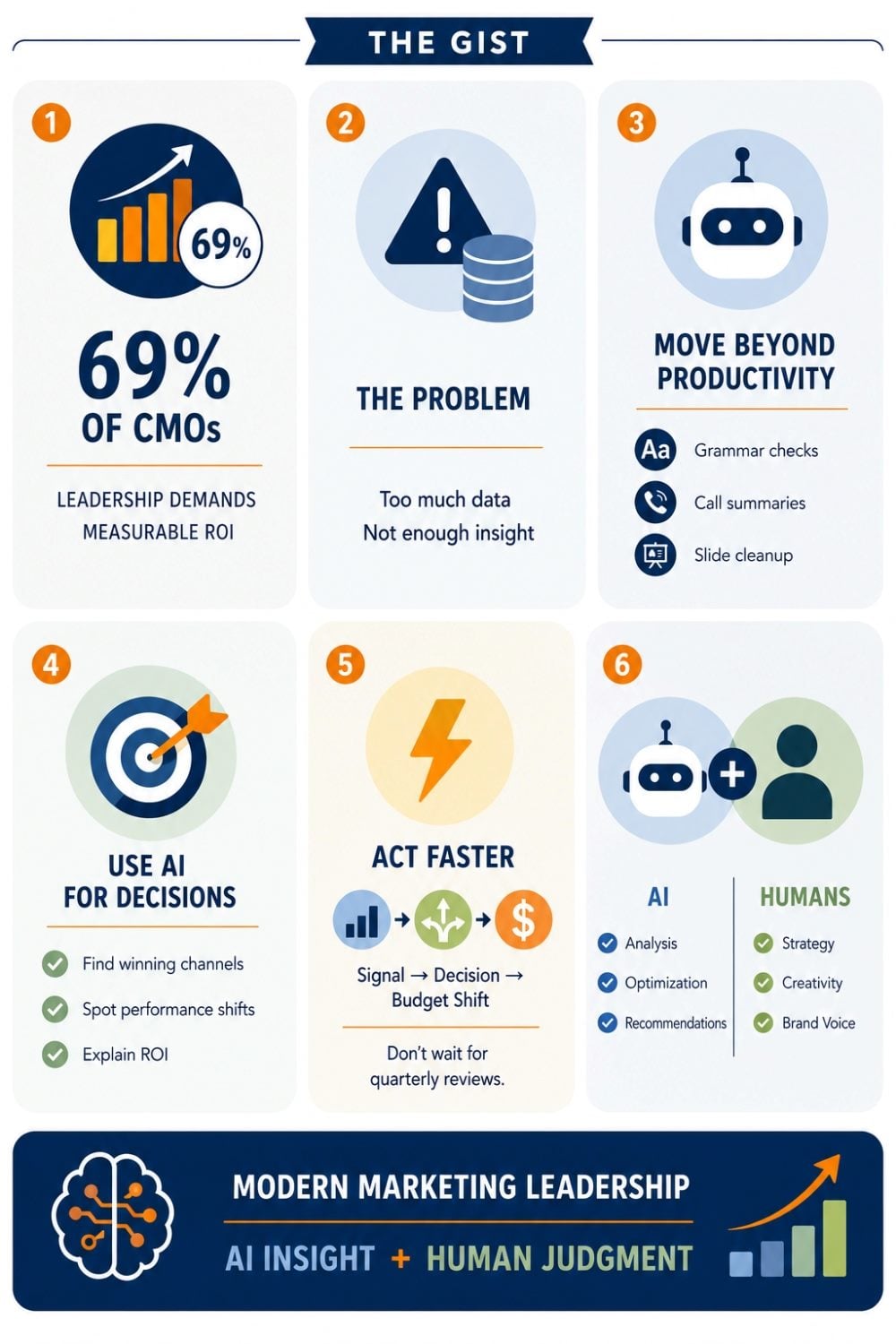
A recent industry study found that 69% of CMOs say leadership now demands measurable results for every initiative they take on. This results in marketers spending hours reconciling numbers before every executive conversation, to demonstrate the reason behind decisions made weeks ago and explain the different results.
The problem isn't that marketing leaders are at a loss for data; it's the sheer amount of it. With so many different points of reference to pull from, many get overwhelmed and push off the task of examining metrics to infer results until asked for it from executives. And by that time, so much has accumulated it's almost impossible to get a strategic reading of what's working and what's not before the market once again shifts.
That's where AI is starting to change the role of marketing inside the company. Used well, AI can serve as a constant monitor and analyst, giving marketing leaders the ability to understand what's working in real time, redirect investment as the data shifts and walk into executive meetings ready to lead rather than justify.
I've spent over a decade watching how technology either gives leaders more authority or quietly takes it away. The companies treating AI as a productivity tool are getting marginally faster reports. The companies using it to back every marketing decision with evidence are reshaping how marketing trends show up across the business.
Here are three ways that marketers can leverage AI strategically in order to drive better results.
Most marketing teams are still using AI for small everyday tasks such as checking the grammar in copy, summarizing calls and ensuring format in presentation is all aligned. While this is useful, it doesn't even begin to touch what will actually transform a marketing strategy.
Leaders can get more out of AI by utilizing it to inform decisions that change the trajectory of campaign performance. This means leveraging AI to answer questions like,"Was engagement up on this campaign?" and "If so, what was different about it and what was the most common conversion point?". According to Slingshot's Digital Work Trends Report, 56% of managers now use AI to analyze business and team data.
With AI giving real-time insight into not only what results are, but why those shifts in performance are occurring, marketing leaders can give executives a clear picture of the ROI associated with initiatives. Tools that support marketing analytics are increasingly central to making that case.
Related Article: AI Is Making Marketing Better at Watching Problems Happen
Beyond reporting and understanding metrics, AI should be used to drive action. Most teams use AI to describe what happened. The leaders pulling ahead are using it to decide what to do next.
When AI surfaces an underperforming channel, an adjustment shouldn't wait until an end-of-quarter review. When a particular campaign significantly outperforms, the team shouldn't wait until the next planning cycle to double down. AI can compress the time between signal and decision, but only if marketing leaders use it to redirect budget and attention as conditions shift.
That's how a tight budget starts working harder. The dollar that was about to go to an underperforming channel gets shifted to one that's gaining traction. The campaign that was about to be moved away from gets the second look it deserved. The CFO sees a marketing team that doesn't just churn out campaigns— it actively manages them.
With every dollar under scrutiny, marketing leaders can't afford to have their team using AI in ways they can't explain. In a lot of organizations, AI use is happening quietly as people slip it into their workflow without telling anyone.
In marketing — where originality is part of the brand — that quiet use can feel especially loaded. Using AI to refine a campaign concept can feel like cheating when no one has spelled out what's acceptable.
Despite this hesitancy, in reality executives want teams to be using AI. It's not seen as a shortcut, it's seen by the majority as a strategic advantage. That shift in perception is part of a broader evolution in agentic marketing — where AI doesn't just assist but actively participates in decision-making loops.
Marketing leaders need to ensure that AI use is visible both on their end and from their teams. That means drawing a clear line between AI's role and the human's role. AI can run multi-channel performance analysis and surface budget reallocation opportunities while humans stay accountable for brand voice, creative ideation and strategic direction. When that line is drawn clearly, AI strengthens marketing's credibility instead of undermining it.
AI has the potential to become marketers' biggest strength if they can learn how to work alongside it, blending the tech's analytic power with their creativity. The ones who get there first won't just move faster. They'll set the standard for what modern marketing leadership looks like.
 Learn how you can join our contributor community.