Editorial
Research Report
Building the Case for Modern Public Sector Messaging


A nutrition label doesn't tell you whether to eat the cookie. It tells you what's inside so you can decide for yourself. TikTok is now building something close to a nutrition label for AI-generated content.
TikTok's AI label introduction arrives as AI models rapidly transform what outcomes consumers expect from their prompts. Generative tools have made synthetic video, audio and images cheap enough that they fill feeds faster than most people can vet them. When a viewer can't tell whether a product demo, a testimonial or a founder's message was filmed or generated, the viewer questions how much they can trust the authenticity behind the creativity.
That trust question is moving into the customer experience layer. TikTok's growing system of AI labels, invisible watermarks, Content Credentials and a new in-app literacy hub shows where social platforms are heading. Provenance is becoming a standard part of what customers see rather than a backend compliance detail. Marketers who treat AI disclosure as an experience design choice, instead of a legal checkbox, will hold onto audience trust as feeds fill with synthetic media.
I wrote this article to examine how TikTok's provenance features change the feed experience marketers work within, the consumer trust gap driving the shift and the mechanics of the labeling and literacy stack itself. It closes with the questions marketing teams should be asking now, before unlabeled content starts to carry a cost. It draws on an email interview with Sara McCord, founder and CEO of Sara McCord Communications and Fractional Head of Social Media and Visual Creative Director at Esther Perel.
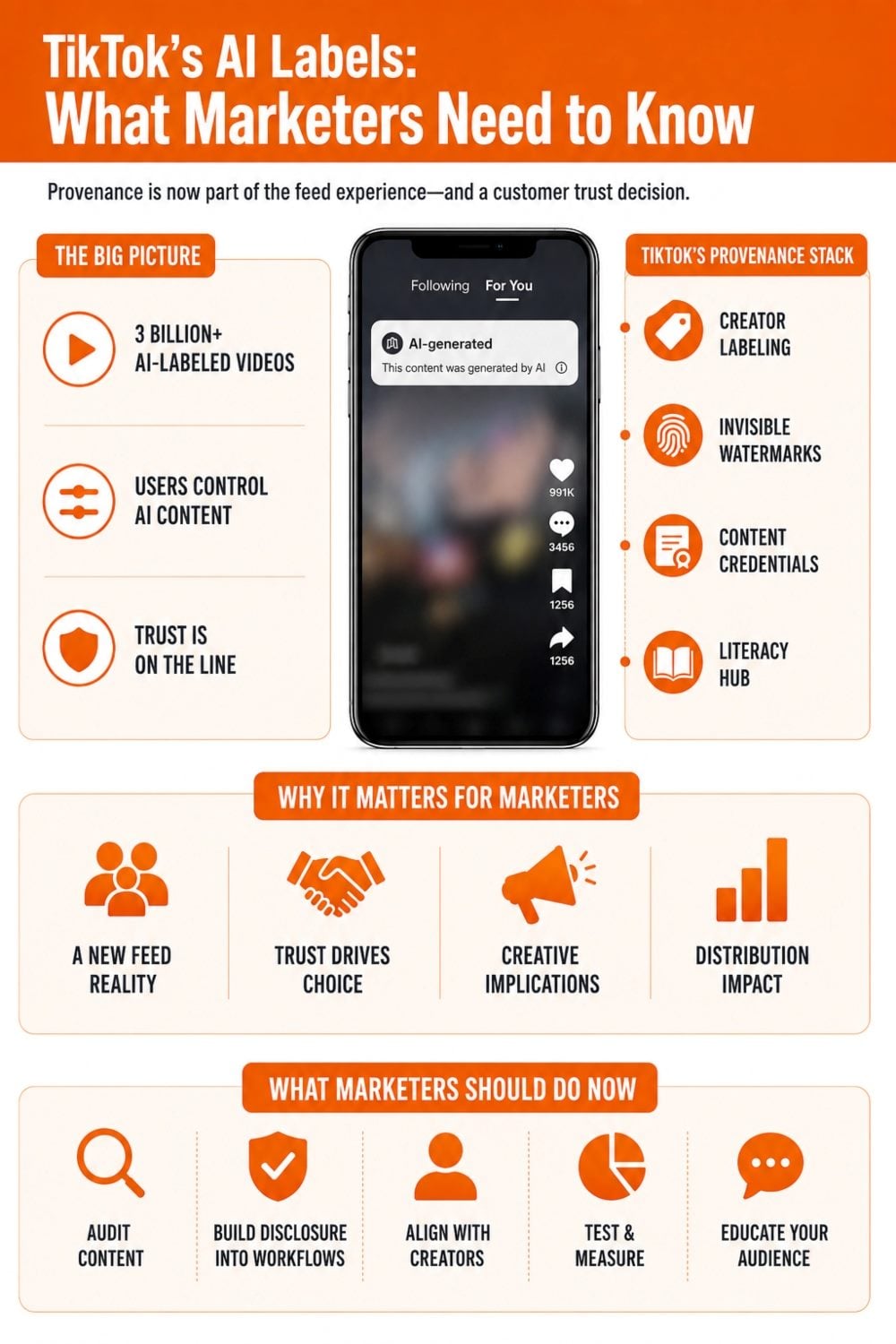
TikTok has labeled more than 3 billion videos as AI-generated and added a feed control that lets users dial AI content up or down. That shifts disclosure into a distribution and creative-review decision for brands, not just a compliance step.
TikTok has labeled more than 3 billion videos as AI-generated, using a mix of Content Credentials, creator labeling tools and its own watermarking technology, according to TikTok. That scale matters because it changes what a typical scroll looks like. Labels that were once rare now sit alongside ordinary content as a routine signal, and viewers are learning to read them the way they learned to read verified badges and sponsored tags.
The platform is also testing an AIGC control inside its Manage Topics feature, which lets people choose how much AI-generated content shows up in their "For You" feed. Someone who loves AI history explainers can see more of it. Someone who'd rather see less can turn it down.
For a marketer, that dial becomes a distribution variable. Branded content built with generative tools may reach parts of an audience less often when those users have chosen to limit AIGC, so the creative choice and the reach outcome are now linked.
The harder problem sits beneath the labels. Volume and velocity, not any single clip, shape the feed a customer scrolls, and Sara McCord frames the danger plainly.
The greatest threat with AI content is the rapid proliferation of seemingly-real content with the very real knowledge that algorithms reward rage bait. Consider Spencer Pratt's obviously AI campaign videos or even those which come out of the White House; label or not, real or not; they can be made at record speed, they inflame and divide; and as they garner views, those who desire attention in the attention economy will keep using it.
— Sara McCord
A label does nothing to slow the flood around a post. That puts the burden on branded content to earn attention without leaning on the inflammatory tactics that travel fastest, which is a customer experience choice as much as a creative one.
In other words: labeling doesn't slow the spread — so brands have to win attention through trust, not by chasing the same outrage tactics that spread fastest.
Related Article: TikTok Deal Finally Closes a Chapter — But Opens New Questions for Marketers
This pushes disclosure decisions upstream into the creative process. A team can no longer treat AI use as an invisible production shortcut. Whether a video carries a label, and how that label reads, becomes part of the first impression a customer forms. The experience of encountering branded content now includes the provenance signal wrapped around it, and that signal arrives before the message does. Creative reviews that used to end at brand safety and legal now need a disclosure step, and that step belongs to the people who understand the customer, not just the people who understand the platform's rules.
The stakes rise at the touchpoints where authenticity already does the selling. Product demos, customer testimonials, unboxings and get-ready-with-me clips work because they feel witnessed rather than manufactured. A visible AI label on that kind of content changes how a viewer reads it, sometimes for the better when the disclosure signals honesty, sometimes for the worse when it suggests the moment was fabricated.
Marketers need to know which of their formats depend on that sense of a real person in a real moment, because those are the formats where a provenance signal will move customer perception the most.
Platforms aren't adding these features for show. They're responding to a measurable erosion of confidence in what people see online. A Gartner survey of 1,539 U.S. consumers found that 68% frequently wonder whether the content they encounter is real, and 61% question whether the information they use for everyday decisions is reliable. Doubt has become the default posture people bring to their feeds.
The pressure builds from both sides of the feed. Synthetic media is multiplying while the tools to detect it lag behind, so platforms face a credibility problem that touches every brand posting on them. Gartner expects deepfake risk and rising misinformation to push authenticity to the center of influencer strategy, making verified, trustworthy creator content more valuable than raw reach.
That shift rewires how marketers pick partners and measure them. A creator's follower count says less than whether their audience believes what they post, and provenance signals are becoming one of the few reliable ways to back that belief with something a viewer can check.
That doubt now attaches to brands. The same research found half of consumers say they'd prefer to give their business to companies that avoid AI in customer-facing content. The finding reads less as a verdict on AI itself and more as a signal about accountability, since people trust content more when it feels like it came from someone with a real stake in it. Labeling speaks directly to that instinct. Gartner also found that 78% of consumers rate clear labeling of AI-generated content as very important or the single most important factor in maintaining trust.
Gartner found 78% of consumers rate clear AI labeling as essential to trust, and half say they'd prefer brands that avoid AI in customer-facing content. That makes disclosure a customer experience decision, though labeling alone won't change minds already made up.
The limits of labeling deserve honest attention, because a label informs without compelling. McCord draws a pointed comparison.
TikTok labeling AI content that looks real to someone who chooses to believe it is, is not unlike cigarette companies labeling cigarettes as causing cancer. People who choose to smoke will do so regardless. People who will believe AI-generated content is real will do so regardless of the label. To continue the metaphor, cigarette companies didn't stop making their product because it was harming people, if anything the ‘warning labels’ allowed them to continue on. You could make a similar argument for AI content.
— Sara McCord
The comparison is uncomfortable and worth sitting with. Labeling shifts responsibility onto the viewer, which helps the honest brand and does little to stop a determined bad actor. For marketing teams, the takeaway is that disclosure builds trust with the customers who already care about it, and those are the customers worth keeping.
For marketing strategy, this reframes AI content as a trust decision as much as a production one. The efficiency case for generating video at scale runs straight into a customer base that verifies more and extends less benefit of the doubt. Provenance features give brands a way to answer the “is this real?” question before a customer has to ask it. Teams that lean on labeling and disclosure can convert a moment of suspicion into a moment of clarity, and clarity is where customer experience gets won on social.
TikTok layers Content Credentials, invisible watermarking, creator self-labeling and an AI literacy hub to establish and explain content origin. The literacy hub is the layer that determines whether audiences actually understand what the labels mean.
TikTok's approach isn't a single label. It's a layered system that combines automated detection, creator tools, cross-industry standards and consumer education. Each layer does something different, and each carries a distinct implication for how customers experience branded and creator content. The literacy piece is newer and easy to overlook, yet it may matter most for marketers, because a label only works when the person seeing it knows what it means.
The table below breaks the components apart and maps each to its effect on the customer experience.
TikTok's provenance system works in layers, from technical watermarks to consumer education. Each addresses a different point where trust can break down, and each shapes how customers read branded and creator content in the feed.
| Layer | What It Does | How It Works | Customer Experience Impact |
|---|---|---|---|
| Content Credentials (C2PA) | Attaches tamper-evident origin data to content | Embeds metadata that TikTok and other platforms can read to auto-label AI content | Gives customers verifiable context on where content came from, across platforms |
| Creator labeling tools | Lets creators self-disclose AI-generated content | An in-app toggle applies an AIGC label when creators post generated or heavily edited work | Sets a norm where disclosure reads as credibility rather than a red flag |
| Invisible watermarking | Marks TikTok-made AI content durably | Adds a machine-readable watermark that survives re-uploads and edits better than visible tags | Reduces mislabeled or stripped content that would otherwise confuse viewers |
| AI literacy hub & guide | Teaches people to spot and interpret AI content | Surfaces educational resources when users search AI-related terms, built with media literacy experts | Raises the audience's fluency, so labels carry meaning instead of noise |
| Manage Topics AIGC control | Lets users set how much AI content they see | A feed setting dials AIGC up or down without removing it entirely | Turns AI exposure into a customer preference marketers have to design around |
Read together, the layers form a chain from creation to comprehension. Content Credentials and watermarking establish where a piece came from. Creator tools and detection apply the label. The literacy hub teaches viewers what the label means.
TikTok reinforced the technical end by joining the C2PA Steering Committee, and it's testing sharper detection for AI-driven spam in sensitive areas like politics, health and finance, having already removed more than 86 million fake accounts in a single quarter, according to TikTok. For marketers, the takeaway is that provenance now works as an interpretive frame the audience is being trained to use, and that frame will govern how branded content lands.
The detection push matters because the same capability cuts both ways. McCord keeps the framing simple.
AI is a force multiplier that increases output and perhaps results. In the hands of good people trying to do good, it's supportive. In the hands of those with malicious intent, it's also supportive.
— Sara McCord
That symmetry is the reason provenance exists at all. The technology won't sort intent on its own, so labels and credentials give customers a way to weigh it for themselves.
Related Article: 8 Social Media Trends Redefining Marketing Strategy in 2026
The literacy layer deserves particular attention because it decides whether the rest of the stack means anything. TikTok built its AI literacy guide with media literacy experts and is rolling out an in-app hub that surfaces guidance when people search AI-related terms, according to TikTok.
An audience that understands what an AIGC label signals will treat a disclosed brand video as ordinary, even reassuring. An audience left to guess may read the same label as a warning. Marketers benefit when viewers are fluent, because fluency turns a label from a liability into a neutral fact about how the content was made. The education effort quietly raises the value of honest disclosure.
Editor's note: Answers to common questions about TikTok's AI content labeling system and what it means for marketing teams.
Marketing teams should confirm vendor and creator support for C2PA Content Credentials, write a clear internal standard for AI-generated versus AI-assisted content, and assign an owner who reviews disclosure performance weekly rather than quarterly.
The direction is set, even as the specifics keep shifting. Other platforms are building similar systems, and consumer expectations are hardening around disclosure. Marketing teams have a window to get ahead of it rather than react to it later. A few practical moves can turn provenance from a risk into a trust advantage.
Start by auditing where AI already lives in your content pipeline and how it's disclosed today. Most teams underestimate how much AI-assisted work already ships without a clear standard behind it. Once you can see the pipeline, pressure-test your tools and partners with questions like these:
None of this requires abandoning generative tools. It requires treating disclosure as part of the experience you design, the same way you'd treat page speed or checkout friction. Run a small test to make it concrete. Label a batch of AI-assisted posts clearly, hold another batch as a control and watch engagement and sentiment over a few weeks. The results give you evidence for a labeling standard instead of a guess.
Governance decides whether any of this holds up. Someone needs to own the disclosure standard, keep it current as platform rules change and make sure creative, legal and creator-relations teams read it the same way.
Gartner advises brands using AI in customer interactions to measure customer journeys weekly rather than quarterly, because AI-driven experiences shift faster than traditional campaigns. Applied to provenance, that cadence means watching how labeled content performs and how audience sentiment around AI moves, then adjusting before a problem hardens into lost trust. Treat the standard as a living document tied to a clear owner, not a policy memo filed once and forgotten.
It helps to stay clear-eyed about what AI does well and where it stops short. McCord puts the boundary this way.
Will AI replace human creativity and ingenuity when a special idea or innovation is needed? I don't believe so. Will it when an average idea is needed quickly? Yes. It won't surprise you but it will answer you.
— Sara McCord
That line marks where disclosure effort should concentrate. Average, fast-turn content is where AI shows up most, and it's where clear labeling costs little while protecting trust.
Gartner projects that by 2027 brands will steer half of their influencer budgets toward authenticity and creator credibility, so the teams building disclosure habits now are practicing for where the market is already moving. On a platform where eMarketer expects a majority of U.S. social buyers, 51%, to shop this year, the cost of getting trust wrong compounds fast.
 Learn how you can join our contributor community.

Pierre DeBois is the founder and CEO of Zimana, an analytics services firm that helps organizations achieve improvements in marketing, website development, and business operations. Zimana has provided analysis services using Google Analytics, R Programming, Python, JavaScript and other technologies where data and metrics abide.