Editorial
Research Report
Building the Case for Modern Public Sector Messaging


A vision without a strategy is just a dream. Strategy without execution is just a nice story. Execution without alignment is just chaos.
Three sentences. Most leadership teams can recite something close to them. Far fewer can answer what happens when all three are working — and fewer still can tell you why it still does not last.
Years ago, I was in a meeting with the late Mark Hurd — then CEO of HP, later Oracle — alongside a customer who was pushing back hard on a competitor's strategy. The argument was polished. The roadmap was compelling. The vision was ambitious.
Mark listened. Then he said something I have never forgotten.
"A strategy without execution is just a nice story."
The room went quiet. Not because the line was clever — it was not trying to be. It landed because everyone present had lived it. They had sat in the presentations. They had believed the story. They had watched the clock run out on delivery.
I took it further after that meeting. Strategy, I came to believe, is a story designed to get influencers on board — investors, customers, partners, employees. But stories have a shelf life. The moment execution stalls, the story starts aging. It loses credibility quietly, then all at once. People stop believing. And once belief goes, it does not return on its own.
That observation became the foundation of how I think about companies at inflection points. Not just what they believe — but whether what they believe is still alive.
Strategy functions as a story used to win over investors, customers, partners and employees — and that story ages quickly once execution falls behind, causing belief to erode quietly until it collapses all at once.
This is not a soft problem. The data is unambiguous.
According to Harvard Business Review, 67% of well-formulated strategies fail — not because the strategy was wrong, but because execution never followed. A McKinsey survey from late 2024 found that only 21% of executives felt their strategies met four or more quality tests — a 40% decline from the previous decade. Only half of executives say their companies effectively align budgets with the strategies they declare.
Meanwhile, Gallup's 2025 State of the Global Workplace report found that just 21% of employees worldwide are actively engaged at work. Only 41% strongly agree that their work is important to their organization's mission. The cost of that disconnection: $8.9 trillion in lost productivity annually — roughly 9% of global GDP.
These are not HR statistics. They are operating failures. And they share a common root: the gap between what leadership declares and what people actually believe.
Harvard Business Review reports that 67% of well-formulated strategies fail because execution never followed through, while Gallup estimates disengagement costs the global economy $8.9 trillion annually in lost productivity.
Every framework I have encountered treats belief as an output. Do the strategy right, execute the plan, belief follows. That is backwards.
Belief is not what you earn at the end. It is what you have to maintain throughout. And it is fragile in ways that strategy documents never capture.
There is a meaningful difference between being convinced and truly believing. Convinced is intellectual — it is what happens when the logic of a vision is sound, the strategy is coherent, and the numbers make sense. People nod. They sign on. They say the right things at the all-hands.
Belief is different. Belief is what survives the first missed deadline. It is what keeps people running when the strategy has to pivot. It is what separates the teams that push through difficult execution from those who quietly disengage and wait for the next reorganization.
Convinced is a moment. Belief is a commitment. And unlike conviction, belief has to be continuously earned.
You can feel it before you can measure it. The manager who used to run toward problems starts navigating around them. The high performer who was evangelizing your strategy to customers goes quiet in the next product review. The customer experience erodes when customers stop engaging at renewal — not because the product failed, but because they stopped believing the company knew where it was heading.
Nobody files a report when belief erodes. There is no column for it in the dashboard. But it shows up in the room — in the questions people stop asking, in the energy that drains from a leadership offsite, in the widening gap between what the all-hands deck declares and what people say to each other on the way out.
That is what the data cannot capture. And that is exactly what leadership has to watch for.
Related Article: What's Ahead for Customer Experience Leaders in 2026?
In practice, I use a connected cascade to diagnose where companies are breaking down — and more importantly, where the handoffs between layers are failing.
Vision must be credible, not merely aspirational. It needs to be grounded in facts, market evidence and predictions derived from data. But credibility alone is not enough. It must also be relatable and inspiring. People need to see themselves in it, feel its pull and believe it is achievable — not just logical. A vision that cannot be felt is a slide, not a direction.
Strategy is the plan and the journey — the connected set of paths that move the organization toward the vision. The operative word is connected. Strategies that run in parallel but do not reinforce each other create competing priorities and diluted beliefs. Short-horizon and long-horizon strategies must link. Each one must be traceable back to the vision.
Execution is not a task list. Every action must carry timing, ownership, metrics tied to outcomes and a learning trigger — the signal that tells the organization when to adjust and feeds that learning back into strategy.
Belief is where most frameworks stop. It is where this one starts over.
Because execution evidence is what feeds belief. When people see real, visible, measurable progress — tracked through tools like customer analytics and operational data alike — they move from intellectually convinced to emotionally committed. That shift is the difference between a company that executes because it has to and one that executes because it wants to.
And then the loop restarts. Every time. The feedback loop is not a bonus feature. It is the operating system.
A learning trigger is the specific signal built into an execution step that tells the organization when to adjust course, feeding what's learned back into strategy so the vision-to-belief loop keeps running rather than stalling.
Not everyone in an organization operates at the full strategic level. They do not need to. A software engineer, a customer success manager, a field sales rep — each operates on a specific plane of the business. What they contribute is real and necessary, regardless of whether they can recite the five-year plan.
But there is one question every person in every role must be able to answer:
How does what I do connect to where we are going?
When people can answer that — genuinely, not from a values poster — the framework is working. When they cannot, the loop is already broken somewhere. The vision is too lofty. The strategy is not visible. The execution metrics are not meaningful to the people doing the work. Or the feedback is not reaching back up the chain.
Gallup's research points to exactly where this breaks most often: managers drive 70% of the variance in team engagement. Not the CEO's vision. Not the strategy deck. The immediate leader — the person who translates strategy into daily reality for their team. This is where the belief loop either holds or breaks, every day, at every level of the organization.
Being convinced is an intellectual reaction to a sound strategy, while belief is the emotional commitment that survives missed deadlines and pivots — and unlike conviction, it must be continuously re-earned rather than achieved once.
In working across Fortune 500 enterprises and PE-backed growth businesses, the breakdown is rarely at a single layer. It is in the handoffs.
Vision without strategy leaves people inspired but directionless. They believe in what is possible. They just cannot see the path from here to there.
Strategy without execution is exactly what Mark Hurd named in that room: a nice story. The clock is always running. Every quarter that strategy does not translate into visible progress, the story ages — and with it, the credibility of the leadership telling it.
Execution without alignment is chaos. Teams work hard. Results do not compound. People exhaust themselves running in different directions, and gradually stop believing the effort is worth it.
And the most dangerous failure mode: a belief loop that has gone silent. No visible evidence of progress. No feedback from execution back into strategy. No reminder of why the vision matters. People do not announce when they stop believing. They simply stop running.
The most dangerous failure is a belief loop that goes silent — no visible progress, no feedback from execution into strategy — because people don't announce when they stop believing; they simply stop running.
The following table highlights the most important lessons, actions and strategic considerations emerging from the quarterly vision-to-belief audit process.
| Key Area | What Happened | Why It Matters | Recommended Action |
|---|---|---|---|
| Vision | Vision statements can quietly turn into "wallpaper" — repeated but no longer felt by the people executing the strategy. | A vision that isn't credible or felt stops functioning as a direction and becomes decoration instead. | Ask whether the vision still reflects current market reality and whether the people running the strategy can still feel it, not just recite it. |
| Strategy | New initiatives can creep in with no traceable link back to the vision. | Disconnected strategies are an early warning sign that the loop is quietly breaking. | Confirm every active strategy still connects to the vision and retire or re-anchor any that don't. |
| Execution | Progress is sometimes visible only to the board, and lessons learned can sit unread in debrief documents. | Metrics tied to activity instead of outcomes, and learning that never reaches strategy, stall the feedback loop. | Make execution progress visible to the teams doing the work and ensure lessons learned feed back into strategy. |
| Belief | Teams can execute out of obligation rather than genuine belief in the direction. | Belief is the leading indicator of whether the loop is healthy — obligation-driven execution signals the loop is at risk. | Ask directly whether people believe in where the company is going, and treat the honest answer as the audit's real outcome. |
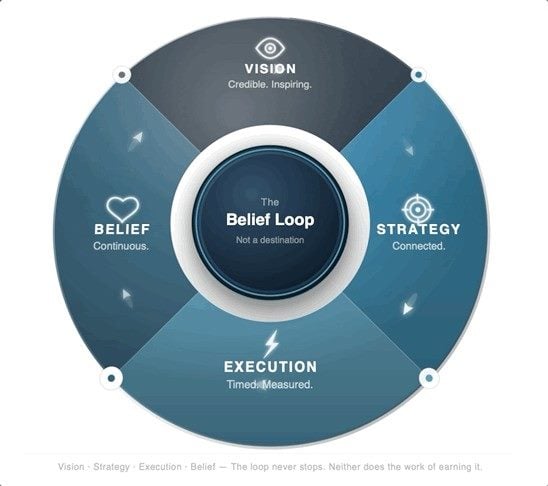
The audit should run four times a year, reviewing Vision, Strategy, Execution and Belief in sequence — not the metrics themselves, but whether each layer still connects to the one before it.
Editor's note: Answers to common questions about why corporate strategies stall and how belief functions as the missing link between planning and execution.
A learning trigger is a built-in signal within an execution step that tells the organization when something needs to change. It feeds what's learned back into strategy, which is what keeps the vision-strategy-execution-belief loop functioning as an ongoing cycle rather than a one-time plan.The belief gap is the space between people being intellectually convinced by a strategy and actually believing in it. Convinced is a one-time reaction to a sound argument; belief is an ongoing commitment that has to survive missed deadlines, pivots and setbacks — and unlike conviction, it must be continuously re-earned.Vision is the credible, felt direction a company is heading toward. Strategy is the connected set of paths that move the organization toward that vision. Execution is the specific, owned, timed actions that carry the strategy forward. Belief is the sustained conviction — beyond intellectual agreement — that keeps people executing even when plans have to change.According to Gallup, managers — not the CEO's vision statement or the strategy deck — drive 70% of the variance in team engagement. The immediate manager is where a strategy gets translated into daily reality, making that layer the most common point where belief either holds or breaks.Harvard Business Review reports that 67% of well-formulated strategies fail, and the cause is usually execution, not a flawed plan. Strategy operates like a story that persuades investors, customers and employees to buy in — and that story loses credibility the moment delivery falls behind schedule.
The companies that sustain momentum over time are not the ones with the most inspiring vision statements. They are the ones that treat belief as an operating discipline — something that must be fed, reinforced, and evidenced continuously.
That discipline starts with honesty about where the loop is breaking. Three questions get there faster than any diagnostic framework.
Can your frontline employees answer — genuinely, without a prompt — how their work connects to where the company is going? Not the mission statement on the wall. The actual direction, right now. If most cannot, the vision is not landing. It is being declared, not felt.
When did your leadership team last show visible evidence of execution progress to the people doing the work — not just to the board? Evidence is not a slide. It is a story of what changed, what it cost, and what it produced. People need to see it to believe it.
And when the strategy was last adjusted, did anyone close the loop on why? Did the people affected know what was learned, what changed, and what it means for the path they are on? A strategy that pivots in silence teaches one thing: leadership does not trust us with the truth.
Those three questions do not require a consultant or a framework. They require honesty. The gap between what you believe your organization understands and what it actually does — that is where belief breaks, quietly, before anyone names it.
When it works, belief builds customer loyalty. It drives retention of customers and employees alike. It creates the integrity that separates companies people trust from company's people merely tolerate.
Vision is where it starts. Belief is what keeps it alive.
And it never stops needing to be earned.
Think about the last time you were inside an organization and felt the belief go out of the room. You probably knew it before anyone named it.
The question worth sitting with is this: are you seeing the same signs right now — and what are you going to do about it?
 Learn how you can join our contributor community.

For more than two decades, Gary Lyng has shaped how enterprise technology categories come into being — naming markets before they fully exist and translating deep technology into commercial outcomes that endure.
His point of view comes from that work.