Editorial
Research Report
Building the Case for Modern Public Sector Messaging


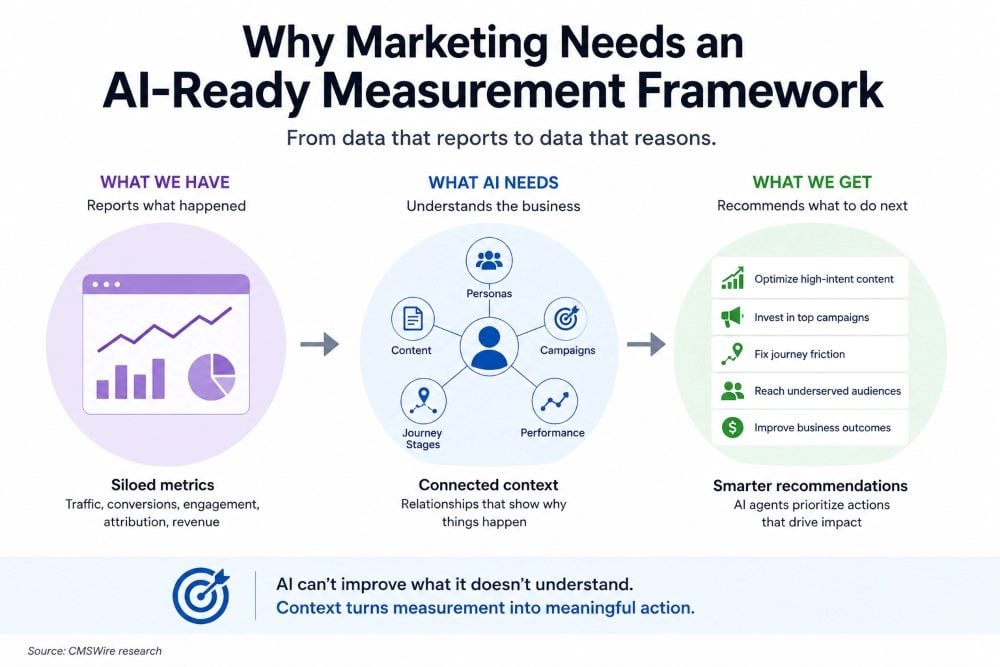
Marketing teams have spent the last decade building better dashboards. We can measure almost everything: traffic, conversions, engagement, attribution, revenue.
Yet the most valuable questions still require a strategist to connect the dots. Why did this campaign succeed? Which content should we optimize next? Where should we invest? Dashboards report activity. Strategists create hypotheses.
The challenge is that strategy doesn't scale.
Every week, marketing teams are forced to make thousands of prioritization decisions. Which pages should be optimized first? Which campaigns deserve additional investment? Which customer journeys need attention? Which audiences are being underserved?
Even the best strategists can only analyze so much. Time becomes the limiting factor. Decisions are made with incomplete information, opportunities are inevitably missed and many optimizations never happen because there simply aren't enough hours in the day.
This is exactly the promise of AI agents.
Imagine every product line having its own optimization strategist. Every campaign continuously evaluated. Every page monitored for opportunities. Every customer journey analyzed for friction. Not once a quarter, but continuously.
Editor's note: The following FAQ addresses common questions about building marketing measurement frameworks that support AI agent reasoning and recommendations.
AI gives us the potential to scale strategic thinking in a way that's never been possible before.
Yet many organizations experimenting with AI agents quickly discover the recommendations are often generic, obvious, or lack the business context needed to be actionable.
It's tempting to blame the models.
I think the problem runs much deeper.
A report from MIT's Project NANDA found that despite billions of dollars in enterprise AI investment, 95% of organizations report no measurable business impact from their AI initiatives. The study concludes that the problem isn't model capability. It's organizational readiness. AI projects stall because of brittle workflows, a lack of contextual learning, and poor integration into how organizations actually operate.
I touched on this idea in my previous CMSWire article about AI-native marketing workflows. The core argument was that humans and AI agents need a shared context layer to collaborate effectively over time. Without it, every interaction starts from scratch, limiting an agent's ability to learn, improve and build on previous work.
But collaboration is only one piece of the puzzle.
Once an AI agent moves beyond helping execute work and begins analyzing marketing performance or recommending strategic actions, the conversation is no longer enough. It also needs to understand the business.
It needs to know how content relates to campaigns, how campaigns support business objectives, how customer journeys connect to personas and how all of that ties back to performance data. That's context today's marketing measurement frameworks rarely capture.
Marketing measurement has matured significantly over the past two decades, but organizations sit at very different points along the journey. Some still rely on dashboards filled with page views, sessions and other vanity metrics. Others have progressed to measuring engagement, conversions, attribution and pipeline. More mature organizations have begun connecting CRM, marketing automation, commerce and analytics data to understand how marketing contributes to business outcomes.
Regardless of where an organization sits on that maturity curve, the objective has remained largely the same: provide marketers with the information they need to evaluate performance and make better decisions. Dashboards and reports help answer questions like, "What happened?" and, for more mature organizations, begin to connect those outcomes back to campaigns, channels and revenue.
Related Article: Your Marketing Strategy Is Just Boring
Even then, there are limits to what the data can tell us. Many of the connections that drive strategic decisions still happen in the minds of experienced marketers. They combine data with an understanding of business priorities, customer intent, campaign objectives, competitive pressures and organizational knowledge to develop hypotheses, prioritize investments and decide what to do next.
In other words, we've spent decades building systems that help marketers answer one question: “What happened?”
Everything beyond that has largely relied on human experience.
If AI is going to help us answer the next questions:
Then our measurement frameworks need to evolve beyond reporting. It's no longer enough to simply collect data or even connect it across systems. We need to contextualize it by capturing the relationships, intent and business meaning that marketers instinctively use every day. That shift is what transforms a traditional measurement framework into one that's ready for AI.
Marketing dashboards excel at reporting outcomes but can't capture the business context — personas, campaigns, intent — that explains why results occurred, leaving that reasoning to human strategists alone.
If traditional measurement frameworks were designed to help marketers understand performance, AI-ready measurement frameworks must do something more. They need to provide enough context for an AI agent to reason about performance.
That doesn't mean collecting more metrics or building more dashboards. It means evolving the measurement framework from a collection of observations into a representation of how your marketing organization actually thinks.
Consider how an experienced strategist evaluates an underperforming page. They don't look only at traffic and conversions. They immediately begin asking questions that span multiple systems and multiple domains of knowledge. Which campaign is this page supporting? Who is the intended audience? Where does it sit within the customer journey? Which keywords is it targeting? Has the messaging changed recently? How does it compare to similar pages? Is this a strategic initiative or a lower priority?
Very little of that context exists in a traditional analytics platform. Some of it may exist elsewhere in your CMS, CRM, campaign planning tools or SEO platform. Some of it exists only as institutional knowledge inside your marketing team.
An AI-ready measurement framework brings that context together. It connects marketing data to the business relationships that give it meaning, making it possible for AI to move beyond reporting what happened toward understanding why it happened, recognizing patterns, and recommending what to do next.
There are two complementary ways to approach building that framework. One starts with the data you already have. The other starts with the decisions you want AI to make.
Editor's note: AI-ready measurement isn't about collecting more data. It's about adding the business context that allows AI agents to reason, prioritize and recommend actions.
| Traditional Measurement | AI-Ready Measurement |
|---|---|
| Reports what happened | Explains why it happened |
| Focuses on metrics | Focuses on relationships between metrics |
| Built for human analysts | Built for humans and AI agents |
| Data lives in separate systems | Business context is connected across systems |
| Supports reporting | Supports reasoning and recommendations |
Context like campaign alignment, audience intent and journey stage typically lives in CRM, CMS or SEO tools — or only as institutional knowledge — rather than inside the analytics platform itself.
Traditional measurement frameworks helped marketers understand what happened.
AI-ready measurement frameworks have a different job. They need to help both marketers and AI understand why it happened, identify patterns worth acting on, and determine what should happen next.
That doesn't require more dashboards. It requires a different way of thinking about measurement.
The purpose of a measurement framework has never been to collect data. Its purpose is to improve business outcomes.
Whether you're trying to increase organic visibility, improve campaign performance, optimize landing pages, increase conversion rates, strengthen customer journeys, or uncover new opportunities for growth, every measurement framework exists to answer a simple question:
“How do we create more business value?”
Once you've identified the outcome you're trying to improve, work backwards.
Suppose your goal is to identify the next ten landing pages that should be optimized to generate the greatest business impact.
An experienced marketing strategist wouldn't rely on traffic and conversion rates alone. Before making a recommendation, they would start asking questions. Which campaigns do these pages support? Which personas are they targeting? Where do they fit in the customer journey? Which opportunities have the greatest potential impact on pipeline or revenue?
As they investigate further, even more context becomes important. Which keywords is each page intended to rank for? How is it performing in AI search? Have similar pages responded well to previous optimizations? Are there emerging search trends that create new opportunities?
That exercise quickly reveals an important reality. The information needed to maximize business impact rarely exists in a single system.
Some of it comes from analytics. Some lives in your CRM. Some exists within your CMS or DXP. Some comes from SEO platforms, AI visibility monitoring, or site search analytics. But some of the most valuable context may not be captured in any operational system at all.
Take something as simple as a target keyword. Every SEO strategy begins with identifying the terms a page should rank for. Yet in many organizations, that information lives in a spreadsheet, a planning document, or simply in the mind of the marketer who developed the strategy. The page itself may have no knowledge of the keywords it's intended to target, making it difficult to connect strategy with execution or measure whether the original objective was achieved.
The same challenge exists across marketing. We know which personas we're trying to reach, which stage of the customer journey we're supporting, which campaigns a piece of content belongs to, and what business outcome we're trying to influence. But those relationships often exist outside the systems measuring performance. They live in planning documents, campaign briefs, project management tools, or institutional knowledge, disconnected from the content and analytics they are meant to inform.
This is where an AI-ready measurement framework begins to diverge from a traditional one. Rather than simply measuring what happened, it captures the relationships between strategy, content, and performance. It provides the context needed to understand not only whether an outcome occurred, but why it occurred, what patterns can be learned, and where the greatest opportunities for business impact exist.
Target keywords are often stored in spreadsheets or planning documents rather than attached to the page itself, making it hard to connect strategy with execution or measure whether the goal was met.
Editor's note: Much of the information marketers rely on every day exists outside analytics platforms. Bringing these relationships together is what enables AI reasoning.
| Context Element | Typical Source | Why AI Needs It |
|---|---|---|
| Target Persona | CRM or CMS | Determines audience relevance |
| Journey Stage | Customer journey maps | Prioritizes optimization opportunities |
| Campaign Alignment | Campaign planning tools | Connects content to business initiatives |
| Target Keywords | SEO strategy documents | Measures strategic search performance |
| Business Objective | Marketing plans | Ranks recommendations by business impact |
| Success KPIs | Analytics & BI | Evaluates recommendation quality |
Editor's note: Organizations don't need to build a fully autonomous AI marketing stack overnight. Most will mature their measurement framework in stages.
| Stage | Primary Goal | Key Focus |
|---|---|---|
| Crawl | Enrich content metadata | Personas, keywords, journey stages and business objectives |
| Walk | Connect marketing systems | CRM, CMS, analytics, SEO and campaign platforms |
| Run | Enable AI reasoning | Relationship-aware retrieval, semantic search and knowledge graphs |
| Optimize | Create learning loops | Capture AI recommendations, marketer feedback and business outcomes |
Once you begin working backward from business outcomes, the implications for your data become clear.
An AI-ready measurement framework isn't simply a new dashboard or another reporting layer. It requires a richer data model, one that captures not only performance data but also the business context that gives that performance meaning.
Traditionally, marketing data has focused on describing what happened. Events, dimensions, metrics, conversions, attribution, and revenue remain essential, but they only tell part of the story. To understand why something happened, and what should happen next, that performance data needs to be enriched with additional context.
That context comes in many forms. Some of it already exists across your marketing ecosystem: analytics, CRM, your CMS or Digital Experience Platform (DXP), marketing automation, commerce platforms, SEO tools, site search analytics and emerging GEO or AI visibility platforms. Other context may need to be modeled explicitly for the first time by extending your content model, strengthening your taxonomy, or introducing metadata that captures the strategic intent behind your content.
Imagine every landing page carrying not only performance metrics, but also information about the persona it targets, the customer journey stage it supports, the campaigns it contributes to, the keywords it's intended to rank for, its primary business objective, and the KPIs used to measure its success. Suddenly, performance is no longer just a collection of metrics. It becomes understandable within the context of your marketing strategy.
The goal isn't simply to centralize data. It's to create a connected model where strategy, content, customer behavior, and business outcomes reinforce one another. That context transforms raw marketing data into information that's ready to support recommendations, prioritization, and ultimately better decisions.
Modern data architectures, such as lakehouses, provide a strong foundation for this approach because they allow organizations to bring together structured and unstructured data from across the marketing ecosystem. But technology alone isn't the answer. The real value comes from enriching that data with the relationships and metadata that enable it to be understood, not just reported.
Attaching persona, journey stage, campaign, target keyword and business objective metadata to each landing page turns raw performance data into information an AI agent can reason with.
Once marketing data becomes more contextual, the next challenge is access.
It is tempting to assume that if all the data exists in a lakehouse, database, or reporting layer, the problem is solved. But simple SQL-style retrieval is not enough for the kinds of questions marketers will increasingly expect AI agents to answer. SQL is effective when the question is structured, the relationships are known, and the answer can be found in a predictable table. Many marketing questions do not work that way.
Consider a prompt like:
“Which landing pages should we optimize next quarter to increase qualified pipeline?”
That question requires more than pulling a list of pages sorted by conversion rate. The agent may need to understand page performance, journey stage, target persona, strategic keywords, campaign alignment, AI search visibility, historical optimization activity, CRM influence, and business priority. Some of that data may be structured. Some may be embedded in briefs, content models, SEO plans, or strategy documents. Some may require following relationships across multiple entities before the agent can even determine what data is relevant.
This is why an AI-ready measurement framework needs a retrieval layer designed for reasoning, not just reporting.
RAG, or retrieval-augmented generation, is one part of that layer. RAG helps an AI agent retrieve relevant information from a defined body of knowledge before generating a response. For example, if a marketer asks why a campaign was created, RAG could retrieve the campaign brief, related content plan, target audience definition, and historical performance summary. This is powerful when the agent needs relevant context from documents or a well-organized knowledge base.
But traditional RAG has limits. It is often strongest when retrieving relevant chunks of information from a single index or collection of content. It may find the right document, but it does not automatically understand the deeper relationships between a campaign, the landing pages it supports, the personas it targets, the keywords those pages were built around, and the opportunities influenced in the CRM.
That is where graph-based approaches become important.
A knowledge graph models relationships explicitly. It can represent that a landing page supports a campaign, targets a persona, aligns to a journey stage, promotes a product, ranks for a keyword, contributes to a pipeline opportunity, and belongs to a broader content cluster. Instead of retrieving isolated pieces of information, the agent can traverse relationships and understand how marketing activity connects to business outcomes.
For example, if an agent is asked which content gaps are limiting pipeline growth for a specific persona, a graph can help it move from persona to journey stage, from journey stage to relevant content, from content to performance, from performance to CRM outcomes, and from CRM outcomes back to business priority. That relationship-aware retrieval is difficult to achieve through simple keyword search or standalone RAG.
Related Article: Model Context Protocol (MCP): Boosting AI in Marketing Workflows
Semantic approaches add another important capability: meaning.
Marketing language is rarely consistent. One team may refer to “enterprise buyers,” another may call them “strategic accounts,” and another may map them to a formal persona in the CMS. Semantic search helps connect concepts that are related even when the words are not identical. It allows an agent to retrieve information based on meaning, not just exact matches.
For example, if a marketer asks for opportunities to improve “mid-funnel content for healthcare decision makers,” semantic retrieval can help connect that request to content tagged as “consideration stage,” personas such as “clinical operations leader,” related campaign briefs, relevant service-line pages, and site search queries that indicate unmet demand.
In practice, these approaches often work together. RAG retrieves supporting documents and knowledge. Semantic search helps identify related concepts across inconsistent language. Graphs help the agent understand relationships between entities. Together, they create an access layer that allows AI to retrieve the right context, follow the right relationships, and assemble enough understanding to make a useful recommendation.
The key point is that the measurement framework cannot stop at storing data. It must make the data usable for reasoning. If agents are going to identify patterns, prioritize opportunities, and recommend actions, they need more than access to tables. They need a way to understand how strategy, content, performance, and business outcomes relate to one another.
SQL works for structured, predictable questions, but prioritization questions require following relationships across personas, campaigns and CRM data that a simple query can't traverse.
The following table highlights the most important lessons, actions and strategic considerations emerging from this piece on AI-ready marketing measurement frameworks.
| Key Area | What Happened | Why It Matters | Recommended Action |
|---|---|---|---|
| AI adoption gap | MIT's Project NANDA found 95% of enterprise AI initiatives show no measurable business impact | The barrier is organizational readiness and missing context, not model capability | Audit workflows and context gaps before investing in more AI tooling |
| Measurement maturity | Most frameworks still only answer "what happened," not "why" | AI agents can't reason about performance without relational business context | Map how content, campaigns and personas connect, not just what they measured |
| Content model context | Strategic metadata like target keywords and personas often lives outside operational systems | Disconnected context prevents AI from linking strategy to execution | Extend the content model to capture business objectives, personas and journey stage |
| Retrieval architecture | Traditional RAG and SQL retrieval struggle with relationship-heavy marketing questions | Agents need to traverse relationships, not just query tables | Layer knowledge graphs and semantic search on top of RAG for reasoning-ready retrieval |
| Learning loop | Most frameworks stop at generating a recommendation | Capturing whether recommendations were accepted or corrected builds institutional AI knowledge | Log agent reasoning and marketer feedback as first-class data |
An AI-ready measurement framework shouldn't stop once an agent produces a recommendation. In many ways, that's where the most valuable data begins.
Traditional measurement frameworks capture what customers do. An AI-ready measurement framework should also capture how AI reasons.
What question was asked? What information was retrieved? Which relationships were followed? What recommendation was generated? Was the recommendation accepted, modified, or rejected by a marketer? What action was ultimately taken? Did it achieve the intended business outcome?
Those interactions become valuable data in their own right.
Over time, organizations can begin identifying patterns in how agents reason, where recommendations consistently succeed, where they fall short, and what additional context produces better outcomes. Just as importantly, marketers should be able to provide explicit feedback by rating recommendations, correcting assumptions or explaining why a different course of action was taken. That feedback becomes institutional knowledge that improves future recommendations.
This creates a continuous learning loop. Every interaction enriches the organization's understanding, making future recommendations more informed, more contextual, and more aligned with how the business actually operates.
The result is a measurement framework that no longer measures only marketing performance. It also measures and improves the effectiveness of the AI systems built on top of it.
The conversation around AI often focuses on models, copilots, and agents. Yet, as the MIT Project NANDA study suggests, the biggest barriers to realizing business value are often organizational, not technological. Marketing measurement is one of those barriers.
An AI-ready measurement framework isn't about replacing marketers. It's about scaling the work that great marketers already do. Connecting information across systems. Forming hypotheses. Identifying patterns. Prioritizing opportunities. Determining where to invest next.
Those same capabilities benefit people as much as they benefit AI.
A richer contextual model gives human strategists a more complete view of the business. It reduces the time spent gathering information, makes hidden relationships easier to identify, and helps teams focus on the opportunities most likely to create business impact. AI simply allows that thinking to scale beyond what any individual or team could accomplish on their own.
Fortunately, this doesn't require starting over.
Many organizations are already investing in data modernization, Lakehouse architecture, customer data platforms and content operations. An AI-ready measurement framework builds on those investments. It's about enriching the data you already have, strengthening the relationships between it, and adding the contextual metadata that transforms reporting data into decision-ready information.
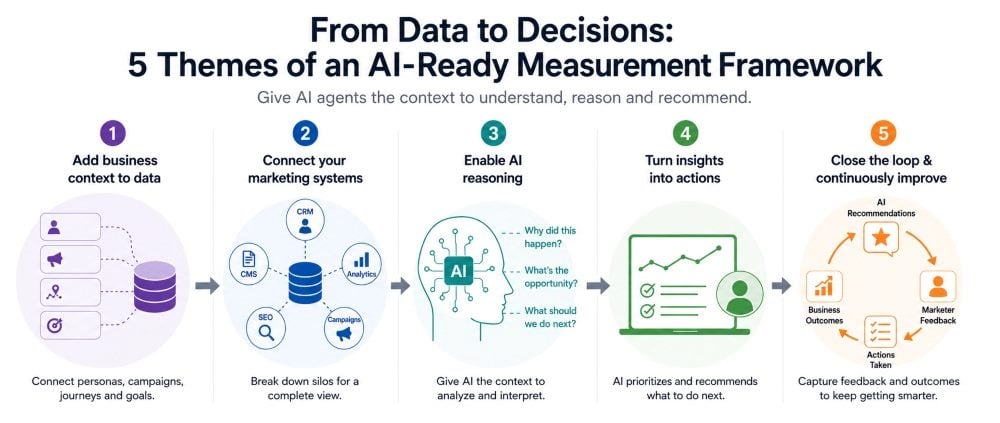
For many organizations, one of the easiest places to begin is the content model itself. Ask what additional information would help explain why a piece of content exists, not just what it is. Business objectives, personas, journey stages, campaign alignment, target keywords, strategic priority and success metrics all provide valuable context that can be connected back to performance over time.
Most importantly, design with your future use cases in mind. Think about the agents, workflows, and marketing capabilities you want to enable over the next several years, then work backwards. If the context you're capturing allows those future agents to reason the way your best marketing strategists do today, you're building the right foundation.
Like every marketing transformation, this is a journey. Crawl by enriching the context around your most important content and campaigns. Walk by connecting strategy, content, customer behavior, and business outcomes across your marketing ecosystem. Run by introducing retrieval and reasoning layers that allow both marketers and AI to make better decisions from that connected knowledge.
For decades, marketing measurement has been about helping us understand what happened.
The next generation of measurement will help us understand why it happened, what we can learn from it, and what should happen next.
That's how strategy begins to scale.
The organizations that move beyond the AI adoption bottleneck won't necessarily have the most advanced models. They'll be the ones that have built the richest understanding of their business.
 Learn how you can join our contributor community.

David San Filippo is the Senior Vice President of Digital Content and Experience at Altudo. He is focused on helping clients get more value out of their digital experience platform investments.