Editorial
Research Report
Building the Case for Modern Public Sector Messaging


The trending "it" solution for enterprise growth is more technology, particularly AI in every conceivable flavor. The predominant market belief is that more is inherently better, but this approach has a stark downside that is actively undermining both organizational execution and the customer experience. Too many digital transformation initiatives are simply layered on top of incongruent, ineffective operations, resulting in increased internal friction and disappointing returns.
To focus on what actually matters, leaders have a distinct alternative to improve operational velocity without heavily relying on an overloaded tech stack. When you view your operating framework as a holistic entity engineered to drive value, the strategic use of predictive signals replaces institutional noise with deep customer intimacy and sustained market momentum.
Organizations that move with unified momentum not only execute at best-in-class velocity, but they typically know their customers more intimately with higher rates of retention. Since that is the position many leaders aspire to, the standard go-to strategy is to take the technology path. However, there is a distinct danger with this approach: disconnected departments equipped with new technology do not bridge institutional gaps, but simply amplify functional noise.
We typically align our operations and processes around functional repeatability, and our organizational structures mirror that design. This traditional approach creates disparate silos where the CMO focuses on acquisition, product on feature adoption and support on reactive resolution. To fix the resulting friction, today's standard response is to inject modern tools like AI into the organizational seams where our structures ultimately fail the customer at specific touchpoints. The reality is that this approach actually fragments our ability to holistically serve the customer.
Because these operations are inherently engineered to focus exclusively on their own function and no further, adding technology only deepens the divide. Ultimately, we forgo unifying our actual operating system and instead automate the very gaps that pull us away from the customer at the moment they directly need us.
Compounding our structural limitations is our dependence on traditional, historical performance metrics that struggle to communicate the true customer story. We typically lean on lagging measurements like acquisition cost, churn and first contact resolution, which have a place but completely lack the "why." By failing to include the customer context that brings meaning and actionable execution, we waste the precious opportunity to actually know our market better.
We mistakenly believe that if these internal signals are favorable, we are providing what the customer wants. In reality, hiding behind "green" metrics risks missing the keen insights required to capitalize on specific customer opportunities and mitigate near-hidden risks. Ultimately, when we rely on signals that lack genuine customer resonance, we are simply managing spreadsheets instead of orchestrating experiences.
The most effectively run organizations are the ones that uniformly and seamlessly tie their business strategy to operational execution. In other words, the entire organization drives to the intended cadence and direction that leadership sets. However, there is a dangerous paradigm shift occurring in today's market: technology and AI are being introduced under a thinly veiled strategy of simply redeploying capital with resource reductions.
The result of throwing more automation at poorly designed, isolated operations only accelerates organizational drag and increases customer frustration. When automation is allowed to run untethered without governance, technology overrides the leadership and operating systems entirely. Ultimately, instead of scale, leaders unwittingly automate an operating cadence that distances the organization from its strategic vision and its customer.
Lagging indicators such as acquisition cost, churn and first contact resolution show internal performance but omit the customer context that explains why those numbers moved. Relying on them can create a false sense of alignment even as ungoverned automation deepens departmental silos.
A unified customer experience operating system is not relegated to simply reorganizing your department structures; it is about aligning how you work and what you work on with what your customers need to effectively grow their business. This framework pairs customer needs with value delivered in a forward-looking manner, enabling you to continuously identify friction points and shift your cross-functional workstreams to address them in real time.
Let's explore the three leading-edge benefits of a unified customer experience operating system that leverages predictive signals, rather than more technology, to protect your revenue and accelerate sustainable enterprise growth.
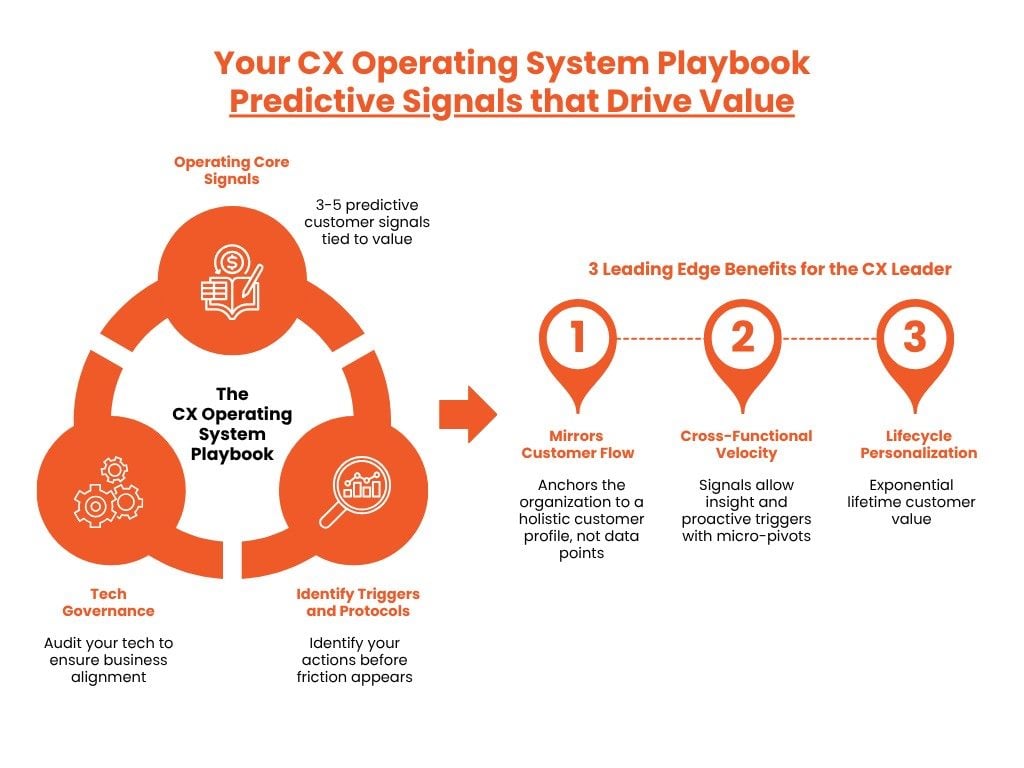
Traditional enterprise structures randomly engage with customers through a disjointed, functional standpoint; marketing targets the purchase, product pushes feature utilization and support manages what remains. The new CX Operating System dismantles this fragmentation by anchoring the entire organization to a holistic customer profile rather than isolated data points.
By synchronizing marketing campaigns, product deployments and service responses under a single operational cadence, the enterprise eliminates combative, cross-departmental static. This structural alignment transforms customer engagement from a series of reactive fire drills into a predictive, unified flow. Ultimately, when organizational execution mirrors the actual customer journey, value is unlocked through proactive signals rather than reactive crisis management.
The second benefit of a unified CX Operating System centers on real-time signal detection and the organization's capability to immediately pivot. Traditional operations rely heavily on lagging, historical indicators that satisfy internal reporting requirements but lack the contextual "why" needed to drive meaningful action. In contrast, a modern CX OS identifies subtle, behavioral micro-signals long before they manifest as quarterly performance deficits or spikes in customer churn.
Armed with these proactive triggers, the CMO, head of product, and VP of service move in lockstep, executing simultaneous adjustments across the entire customer lifecycle. This shared velocity repositions your organization to aggressively capitalize on emerging opportunities while neutralizing operational vulnerabilities before they quickly become corporate risks.
The final benefit of a unified CX Operating System delivers the highest strategic returns for both the organization and your customer. By anchoring operations to predictive signals, leadership transforms the customer journey from fragmented handoffs into a continuous loop of exponential value. This alignment redefines personalization, moving it past superficial marketing copy and into deep operational relevance.
Consider how your organization would function differently, and how your customer experience would improve, if your product function influenced outbound marketing context, brand marketing accurately presented service expectations, and service insights immediately recalibrated product priorities. By closing this operational loop, the organization shifts from merely responding to customer behavior to actively architecting its future value.
Related Article: What a CX Operating System Actually Coordinates (and Why It's Not a Tool)
A unified CX Operating System aligns organizational structure with the customer journey, enables predictive cross-functional velocity through shared behavioral signals and extends personalization across the full customer lifecycle. Together these replace reactive, siloed execution with proactive, coordinated action.
A CX operating system that uses predictive signals enables you to prioritize what matters to your organization and customer. The easy solution is 'more tech' but the right Playbook requires shifting to a system-first architecture by establishing a shared operational cadence that bridges your existing functional silos.
Let's explore the three strategies that don't lean on tech but rather turn predictive signals into sustained organizational velocity.
Rather than creating superficial committees or temporary tiger teams, the first step in deploying a true CX Operating System is to formalize a cross-functional core group comprising the CMO, head of product and head of service. Leadership must charge this core operating unit with establishing three to five primary, predictive customer behavioral signals that supersede any single department's internal KPIs.
For instance, the team might monitor cross-departmental triggers like a decline in feature utilization paired with rising support tickets (early churn risk), or increased feature adoption paired with high brand engagement (expansion opportunity). When you focus on shared behavioral triggers, you're continuing to strengthen internal alignment and customer intimacy without adding more tech or code.
A unified CX Operating System thrives on micro-signals that drive cross-functional velocity, requiring leadership to define explicit triggers and operational protocols well before success or failure becomes imminent. Once these triggers are established, the organization can proactively monitor the unified system to mitigate risks or capture expansion opportunities in real time.
For example, if support identifies a high spike in ticket volume over a newly released product feature, protocol states that Product remedies a solution while the CMO pauses market expansion campaigns. Triggers and protocols are foundational to a scalable system that replaces institutional friction with proactive communication.
Installing technology for the sake of technology is a losing strategy; organizations that scale effectively use technology specifically to enable scale. They achieve this by strictly aligning digital tools with a strategy and an operating system designed to ensure internal continuity and seamless customer execution.
Therefore, the final phase of the Playbook is to establish rigid governance over how automation and AI interact with your business. The core operating group must regularly review automated workstreams to ensure technology is reinforcing your system rather than overriding it. True operational maturity means auditing your automated workflows, guaranteeing that every piece of technology enables the predictive signals that build bridges toward your customers.
This table distills the article’s core concepts of Predictive Signals, a value driving part of your CX operating system.
| Strategy Element | Insight | Why It Matters |
|---|---|---|
| Traditional organizational structures | Our traditional departments and functions limit our customer insight and interaction to what responsibility we own. | This approach is reactive, disjointed, and provides the customer with the impression of working with many silos within the same organization. |
| Signals with no customer resonance | Our internal performance systems are traditional and reactive; worse, they don’t relate to our customer in ways that bring context or specific problem resolution. | Our internal metrics can be tracking “Green” while our customer’s perception of our organization is tracking “Red” because we track items that do not align with our customer’s needs or problems. |
| Flow and velocity | When there’s fragmentation, both your flow and velocity suffer and slow, many times outpaced by your customer’s demand for seamless action. | The new CX operating system aligns your functions, inherently increasing both flow and velocity to drive customer value. |
| Triggers and protocols | Traditional organization structures aren’t proactive and therefore, continually spend excessive time reacting rather than leading. | The new CX operating system identifies proactive triggers that enable early detection and pivots, to capitalize on opportunities and minimize risks. |
| Tech Governance | Many tech & AI initiatives are installed with little oversight or regard to the human/team impact or customer experience. | The new CX operating system uses governance to audit technology just as closely as you would your human teams. |
The playbook sequences a cross-functional operating core, defined triggers and protocols and rigorous technology governance so automation reinforces the operating system rather than overriding it. That order ensures AI and other tools serve predictive signals instead of replacing strategic decision-making.
Scaling high-growth organizations requires a definitive shift from how much technology you possess to how well your core operating system executes. True organizational momentum is realized only when cross-functional workstreams are tightly aligned to drive exceptional customer outcomes.
By replacing traditional, lagging performance metrics with predictive behavioral signals, you advance your operating model to a level that proactively and continually captures value and directly leads market behavior.
 Learn how you can join our contributor community.

Ryan Mayes is a transformation specialist with a distinguished track record of industrializing high-risk operations for Fortune 500 companies and PE-backed growth firms. As the Founder of Business Leaders Field Guide, he serves as an industry-recognized and trusted bridge between boardroom strategy and field execution, architecting the P&L rigor and scalable operating systems required to drive predictable, double-digit growth.