Feature
Research Report
Building the Case for Modern Public Sector Messaging


Picture a team rolling out something the leadership deck called transformative. The kickoff went well, the slides made sense, and the first weeks felt productive. Then the questions started arriving from the people doing the actual work.
That gap, between what gets announced and what holds up under daily use, is where this story lives. The pattern repeats across organizations and industries, and it rarely shows up in the metrics anyone is watching at the start.
When it comes to replacing brand, search, CMOs win by operationalizing brand trust across AI intermediaries and polluted media, not by optimizing channels. The center of gravity has shifted from campaigns to systems because AI agents and answer engines now interpret brands at machine speed.
I spoke with Gartner's Kate Muhl and Andrew Frank ahead of this week's Gartner Marketing Symposium/Xpo in Aurora, Colo., and their guidance isolates what must change as leaders arrive in the Centennial State. These were not isolated expert takes, but pre-conference conversations situated inside Gartner's research agenda for marketing leaders. One of their institutional messages is direct: design a brand operating system with TrustOps at its core, or watch algorithms reinterpret your promise without you.
Gartner's symposium creates the right context because it convenes CMOs at the exact moment intermediaries are rewriting selection logic. Conversations about media, brand trust, AI and consumer behavior will dominate the program because the operating questions are no longer theoretical. The path forward requires moving beyond fragmented playbooks toward a cross-functional system that governs signals, data, workflows and incident response.
I'll be in attendance, testing these ideas against what operators are actually doing under pressure. The goal is simple and non-negotiable: build a system that keeps the promise legible to both humans and machines.
AI has already changed how selection happens. Human journeys now run through synthesizers, feeds and agents that choose which snippets and narratives appear first. That change isolates a mistake in current practice, treating trust as a messaging problem rather than an operating constraint. The remedy is structural, not rhetorical, and it starts by upgrading brand management into a brand operating system. Marketing is still the steward, but ownership must be embedded where execution lives.
Related Article: The Toughest Love Letter Ever to Marketing Leaders
AI agents function as the new distribution referee, compressing research and framing options before a brand has a chance to speak. This is why AI agents sit in the middle of discovery and require brands to optimize for selection and citation, not only impressions. You can buy reach and still lose the decision because the agent did not carry your signal forward. Visibility without credible representation is leakage in the system. The issue is not tool scarcity; it is the absence of a system that machines can trust.
Industry rhetoric keeps promoting pet acronyms and one-off plays as if durable answers live at the channel edge. CMOs hear about the Age of AI and then face an unhelpful split between performance targets and enterprise risk. Specialists push tactics while governance languishes, creating false confidence in dashboards detached from incident reality. This is how brands drift into answer boxes with outdated or harmful framings. The remedy is a mandate that elevates trust architecture above channel optimization.
Roles must expand alongside accountability. As responsibilities evolve, the CMO remit now includes data structure, machine legibility and cross-functional incident response, not only creative and media. Skill sets change accordingly, with changing roles that blend narrative with technical fluency and governance. Vendor marketing promises to automate away judgment do not survive contact with answer-engine opacity and conversational AI hallucination. Judgment moves upstream when you build an operating model that anticipates failure and practices recovery.
Some leaders position AI as a universal multiplier of marketing genius. The better frame is operational leverage that exposes weaknesses faster if governance is thin. Even boosters concede that AI elevates the CMO's remit from messaging to system design, a theme repeated in Golden Era narratives that put brand integrity on the executive agenda. Treat that elevation as a responsibility, not a trophy. Systems without governance become accelerants for distortion.
Editor's note: AI agents, answer engines and generative search platforms are reshaping how customers discover, evaluate and verify brands. For CMOs, the challenge is no longer simply driving awareness. It is ensuring brands are accurately represented, cited and trusted across AI-mediated customer journeys.
| Priority Area | Action Step | Why It Matters |
|---|---|---|
| Audit AI Visibility | Regularly test how ChatGPT, Gemini, Claude, Perplexity and Google AI Overviews describe your brand, products and executives. | AI-generated answers increasingly influence customer decisions before visitors reach owned channels. |
| Build a Trust Council | Create a cross-functional team that includes marketing, IT, legal, communications, security and customer service. | Trust incidents often span multiple departments and require coordinated response. |
| Strengthen Owned Content | Update websites, FAQs, knowledge bases and support content to answer verification questions clearly. | Owned content is becoming the destination customers use to validate AI-generated claims. |
| Improve Machine Readability | Invest in structured data, metadata, schema markup and content governance. | AI systems rely on machine-readable signals to understand and represent brands accurately. |
| Monitor Emerging Narratives | Track not only brand mentions but also recurring themes, misinformation and evolving narratives. | Small inaccuracies can become widespread narratives across AI and social ecosystems. |
| Create TrustOps Playbooks | Develop response plans for misinformation, deepfakes, AI hallucinations and reputational threats. | Preparation reduces response times and limits damage during high-velocity incidents. |
| Measure Beyond Engagement | Add AI visibility, citation frequency, trust metrics and reputation indicators to executive dashboards. | Traditional marketing metrics do not fully capture performance in AI-mediated environments. |
| Validate Brand Promises | Ensure marketing claims align with product, service and customer experience realities. | AI systems can amplify inconsistencies between messaging and operational execution. |
| Implement Content Credentials | Evaluate provenance technologies such as C2PA and content credentialing standards. | Verification signals help distinguish authentic content from synthetic or manipulated assets. |
| Train for the AI Era | Develop organizational expertise in AI search, answer engines, governance and trust management. | Future competitive advantage will come from operational trust, not just campaign performance. |
Kate Muhl, VP Analyst at Gartner, described the reality CMOs face. Consumers are not rejecting brands; they are working around a degraded information supply. She put it plainly: leaders are competing with "slop and a large volume," not only other skilled marketers. That shifts the burden from persuasion to verification because people distrust what surfaces first. In practice, brand becomes the shortcut people use when noise rises and clarity declines.
Muhl's research shows that skepticism has rational roots. Surveys indicate growing concern that generative AI has reduced content quality, especially among younger cohorts living inside algorithmic feeds. Broader research on brand trust reaches the same conclusion, credibility erodes when synthetic speed overwhelms provenance. Authentic presence matters because people sense when the supply has been cheapened. They reward evidence and coherence over volume.
The culture talk about short attention spans misses the mechanism. Platforms like TikTok, Instagram, and YouTube force snap judgments because the UX penalizes lingering with distorted future recommendations. Muhl underscored how Gen Z "trains the algorithm" as a survival skill, not a preference for shallowness. The behavior is adaptive to the feed, not proof of indifference to quality. The media environment teaches speed, then punishes depth with more of the same.
Skepticism is not only generational. It scales with incentives that reward novelty over reliability and with how easily synthetic content floods feeds. Creative industries now debate authenticity as a core input, with analyses documenting authenticity under fire in the generative era. Consumer studies probe whether consumer trust rises or declines as AI mediates decisions. The answer is execution dependent, which is why operational trust beats interpretive branding. Understanding agentic customer experience is increasingly central to that calculus, as autonomous agents reshape how brands are encountered, evaluated and selected at every stage of the journey.
Related Article: Agentic Customer Experience: The CX Architecture Built for the World Customers Actually Live In
Muhl offered the line that clarifies the work: "Ultimately a brand is a heuristic, a way to shortcut my decision-making."
That reframes brand as a compressed signal of performance and reliability that reduces cognitive load in a polluted environment. The logo aids retrieval, but the heuristic does the work. In AI-mediated journeys, the heuristic must be legible to machines and persuasive to humans.
Brand as heuristic demands evidence, not only expression. People test the shortcut against behavior, policies, support and product performance. Machines test it against structured data, citation patterns and integrity signals they can parse. When those layers disagree, trust breaks and selection shifts. The fix is consistency across artifacts, workflows and metadata so both interpreters converge on the same meaning.
Creators and platforms now function as adjacent heuristics that borrow and lend credibility. A trusted creator can accelerate consideration, but only if the brand supplies substance that survives scrutiny. A platform with lax integrity can contaminate otherwise strong signals by association. This is where governance and distribution choices shape how well the heuristic travels. The system must defend signal quality across environments you do not control.
Muhl's point about journeys is precise. AI summaries do not eliminate the need for owned content; they reassign its job from first touch to verification. Heavy GenAI users still land on websites and brand-owned social channels to cross-check claims, decode policies and gauge seriousness. Owned properties therefore operate as assurance layers, not just catalogs or campaigns. If the verification layer is thin, the shortcut collapses and the agent routes elsewhere.
Model answers compress options and seed projections about strengths and tradeoffs, then humans verify against brand sources and third-party proof. Owned content must anticipate those verification questions and present structured, current, machine-readable truth. AI is not replacing brand, search, or owned content; it is reordering the path to proof. Design for that path and selection hardens in your favor.
Optimizing only for top-line inclusion misses a larger risk. Answer engines can frame strengths you do not operationalize, setting traps you trigger later. That is why brand must maintain a living corpus of product, policy and support data that AI systems can ingest and cite. Machines need consistency to recommend confidently, and humans need depth to confirm confidently. Design for both, or break both.
This is also where content authenticity matters. Design choices that foreground provenance and integrity turn verification into reassurance for humans and features for machines. Analyses of Generative AI design show how credibility decays when signals are weak or inconsistent. Credibility compounds when every artifact reinforces the same operating truth. Consistency compounds trust.
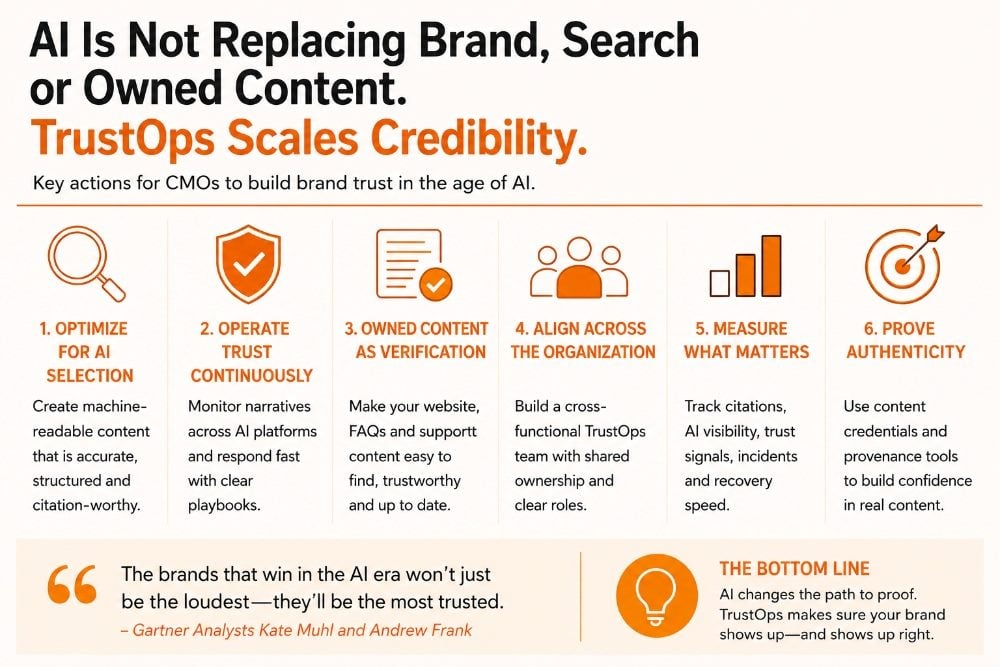
The brand operating system is the integrated set of content, data, governance and measurement that keeps meaning stable across human and AI interpreters. Expression without data structure fails machines. Data without governance fails when adversaries and errors arrive. Measurement without incident metrics becomes decoration. The system works only when these layers reinforce each other.
The expression layer states the promise and shows value in channels people use. The data and metadata layer encodes that value into schemas, attributes and machine-readable proofs that models can parse. The governance layer, anchored by TrustOps, owns risk, response and integrity. The measurement layer tracks selection, citation, incidents and recovery to drive improvement. Every layer answers the same question in a different language, can this brand be relied on.
Gartner's analysts are leaning into this system view because channel-level wins do not last in unstable interfaces. Smarter media buys will not rescue a brand that agents underrepresent or misstate. The operating model must survive opacity, adversaries, and velocity. That is the agenda I will carry into the sessions at the Gartner Marketing Symposium/Xpo. The North Star is operational trust at enterprise speed.
Translate that into role clarity and capability building. The CMO must convene partners across security, IT, legal, comms, product and service because the evidence of reliability lives in their workflows. The growth lever is not a new acronym; it is repeatable reliability under AI mediation, a principle that aligns with agentic customer experience thinking that places systems over sprints. Reliability compounds; novelty decays.
Andrew Frank, Distinguished VP Analyst at Gartner, removed any doubt about the required shift.
"TrustOps is a term we coined to move brand trust away from episodic reputation work into a continuous operational capability across the enterprise," he told us. His emphasis is execution, not posture. Messaging cannot extinguish a deepfake that travels through encrypted groups at 2 a.m. Answer engines will not correct themselves because you issued a press release. You need roles, playbooks, and authority before the incident starts.
Frank framed the ownership gap as the unresolved risk that keeps responses slow and fragmented. Many leaders know the stakes, yet no single owner coordinates cross-functional action when misinformation or harmful framing breaks containment. That vacuum guarantees delay and inflates cost. In his view, the pragmatic first step is formal governance, a trust council with representatives from marketing, communications, cybersecurity, IT, legal, contact center and the executive team. That is how you move from debate to control.
The trust council is not a meeting about narratives, it is a system that assigns tasks and defines escalation. It inventories existing tools, gaps, and handoffs, then writes the playbooks that teams rehearse. It also sets the measurement language so improvements target the right constraints. Treat it as you would an AI council, and in many organizations it should sit alongside or inside that body. Trust is now an operating domain with enterprise consequences.
"You really need to have a playbook in place so that you can respond quickly, because false narratives can spread very fast and are not timed for business hours," Frank told CMSWire.
Traditional social listening is table stakes. TrustOps requires narrative intelligence that maps where stories form, who amplifies them, how they mutate, and where they are headed. It also requires dark web and closed-channel visibility for precursors like credential sales and impersonation kits. You cannot fight coordinated campaigns with surface metrics. You need structure, actors, vectors, and intent.
Answer-engine monitoring is the missing pillar in most stacks. Teams must test how major systems describe products, policies, and executives, then log and remediate errors. Models are opaque, so systematic querying becomes your instrument panel. When hallucinations or outdated claims appear, the response path must blend content fixes, provider engagement, and public clarification. If you do not measure it, the agent will measure you instead.
Authenticity infrastructure now matters operationally. Frank pointed to C2PA and content credentials emerging across networks like LinkedIn as practical provenance tools that improve signal quality at scale. Trust nets, where newsrooms and verification partners coordinate fact-checking, add another layer when adopted. These are not silver bullets, but they raise the baseline for distinguishing authentic assets from synthetic forgeries. That baseline is now a competitive advantage.
Vendor categories are converging on this problem from multiple angles. Providers of AI agents in marketing and conversational AI ecosystems promise faster activation. Platforms detailing marketing agents focus on automating outreach and service. None of this removes the need for human judgment in trust incidents, which is why governance must own the baton. Automation without authority invites escalation at scale.
Editor's note: AI agents, answer engines and generative search experiences are changing how customers discover, evaluate and verify brands. Gartner analysts Kate Muhl and Andrew Frank argue that success depends less on channel optimization and more on building operational trust systems that improve how brands are selected, cited and validated across AI-mediated journeys.
| Trust Challenge | Traditional Approach | TrustOps Approach | Business Impact |
|---|---|---|---|
| Brand Discovery | Optimize channels and campaign reach | Optimize for AI selection, citation and accurate representation | Improves visibility in answer engines and AI-generated recommendations |
| Consumer Trust | Periodic brand campaigns and reputation management | Continuous trust monitoring and governance | Strengthens credibility across human and AI interactions |
| Owned Content | Destination for awareness and conversion | Verification layer for AI-generated claims | Supports customer validation and confidence-building |
| Brand Governance | Primarily owned by marketing | Shared across marketing, IT, security, legal and communications | Enables faster response to misinformation and AI-related risks |
| Measurement | Impressions, clicks and engagement | Citations, trust signals, incidents and recovery metrics | Provides visibility into brand health across AI ecosystems |
| Answer Engine Accuracy | Monitor rankings and traffic | Audit AI answers and monitor brand framing | Reduces risk of misinformation and outdated representations |
| Incident Response | Reactive communications efforts | Predefined TrustOps playbooks and cross-functional drills | Improves speed, consistency and effectiveness of response |
| Content Authenticity | Rely on brand reputation alone | Use content credentials, provenance tools and verification signals | Strengthens trust in AI-saturated information environments |
Speed without alignment creates new damage. TrustOps playbooks must define incident types, thresholds, initial actions, decision rights, and pre-cleared language so teams avoid improvising under heat. Legal and communications need a rhythm that preserves protection while enabling timely statements. Marketing must ensure responses reinforce the brand’s promise with clarity and evidence. The entire system should bias for rapid containment without sacrificing accuracy.
Cross-functional drills are the accelerator. Tabletop exercises surface slow approvals, vague ownership, and fragile handoffs before the real incident hits. They also strengthen relationships that prevent turf fights during escalation. After-action reviews close the loop and update playbooks with what the incident actually taught. Continuous practice turns theory into muscle.
Response scope should match the narrative’s reach and risk. Some claims die when corrected near their origin, others demand broad counter-messaging and direct platform collaboration. Narrative intelligence informs that call by revealing propagation paths and actor networks. Overreaction amplifies fringe claims; underreaction normalizes them. The playbook must encode criteria for scale and tone.
Do not neglect internal communications. Employees become secondary amplifiers of both truth and rumor, and they need guidance, language, and confidence.
Frank’s measurement blueprint turns trust from aspiration into managed performance. Quality signals matter as much as speed and cost. Integrate trust metrics with growth and retention.
Publish learning into the operating model.
Selection now begins inside model summaries and agent answers, so optimization shifts from visibility to credible inclusion and accurate framing. Verification then happens on owned properties. Alignment across the gateway and the destination is the hinge.
External guidance can sharpen practice, but internal ownership must run it.
Brand trust declines when supply floods surpass provenance, which is why operational signals now outweigh narrative flourishes. Industry work mapping brand distrust in AI-saturated markets flags the same drivers, opacity, inconsistency, and lagging response. Creators deserve a more disciplined approach as well.
Verify what machines say about you as a standing operating rhythm. Publish what you are willing to be held to.
CMOs now face a simple mandate that the Gartner interviews made unavoidable, build a brand operating system where TrustOps is native, owned and measured. AI intermediaries and polluted media have not eliminated brand, search, or owned content, they have inverted the order of proof. Make machines comfortable citing you and make people confident verifying you, then protect that loop with governance that moves faster than misinformation. The shift is from interpretive branding to operational reliability, from channel tricks to enterprise control. The winners will not be the teams that mastered the latest acronym, but the ones that made trust a system and ran it every day.