Editorial
Research Report
Building the Case for Modern Public Sector Messaging


An AI shopping assistant submits a purchase and returns an order reference. The customer sees a payment authorization, but no order appears. A later retry creates a duplicate the customer must cancel.
The dashboard may still record a completed checkout, successful API response and payment authorization. The customer experienced a failed journey.
This gap matters as AI becomes a more important shopping entry point. Adobe reported that traffic from AI sources to U.S. retail sites increased 393% year over year in the first quarter of 2026 and converted 42% better than non-AI traffic in March.
Higher conversion creates value only when the transaction behind it is correct. Qualtrics found that consumers reduced spending after 58% of bad online retail experiences, making transaction reliability a retention issue, not merely a backend concern.
Conversion metrics can register checkout, submission and payment authorization even when a payment exists without an order, a retry creates a duplicate, or a confirmation issues before an order is committed. These gaps surface as customer uncertainty and repeat service contacts rather than analytics failures.
Traditional analytics track checkout, request submission, payment authorization and confirmation. Those events can occur before the merchant knows whether one valid order exists.
They may overlook a payment without an order, a duplicate created during retry, a preventable reversal or a premature confirmation. The result is customer uncertainty, repeat contacts, cancellations and lost trust.
That is the gap conversion misses: whether the customer’s intent became one valid order.
The authoritative commitment boundary is reached only when a merchant confirms the request was serviceable, commercial terms were valid, exactly one order was created and the transaction reached a known outcome. If any condition can't be confirmed, the transaction should be classified as uncertain rather than successful.
The authoritative commitment boundary is the point where the merchant confirms that a request has become one valid, executable order—or has been rejected. It is not necessarily when an agent submits a request, an API responds or a payment provider approves an authorization.
At that boundary, the merchant should be able to confirm four things:
If the merchant cannot establish those facts, it should classify the transaction as uncertain, not successful.
Qualification Rate measures whether purchase intent can legitimately proceed, Clean Commit Rate measures whether a qualified request produced exactly one correct order, and First-Pass Clean Commit Rate measures whether that outcome was reached without retries or manual intervention.
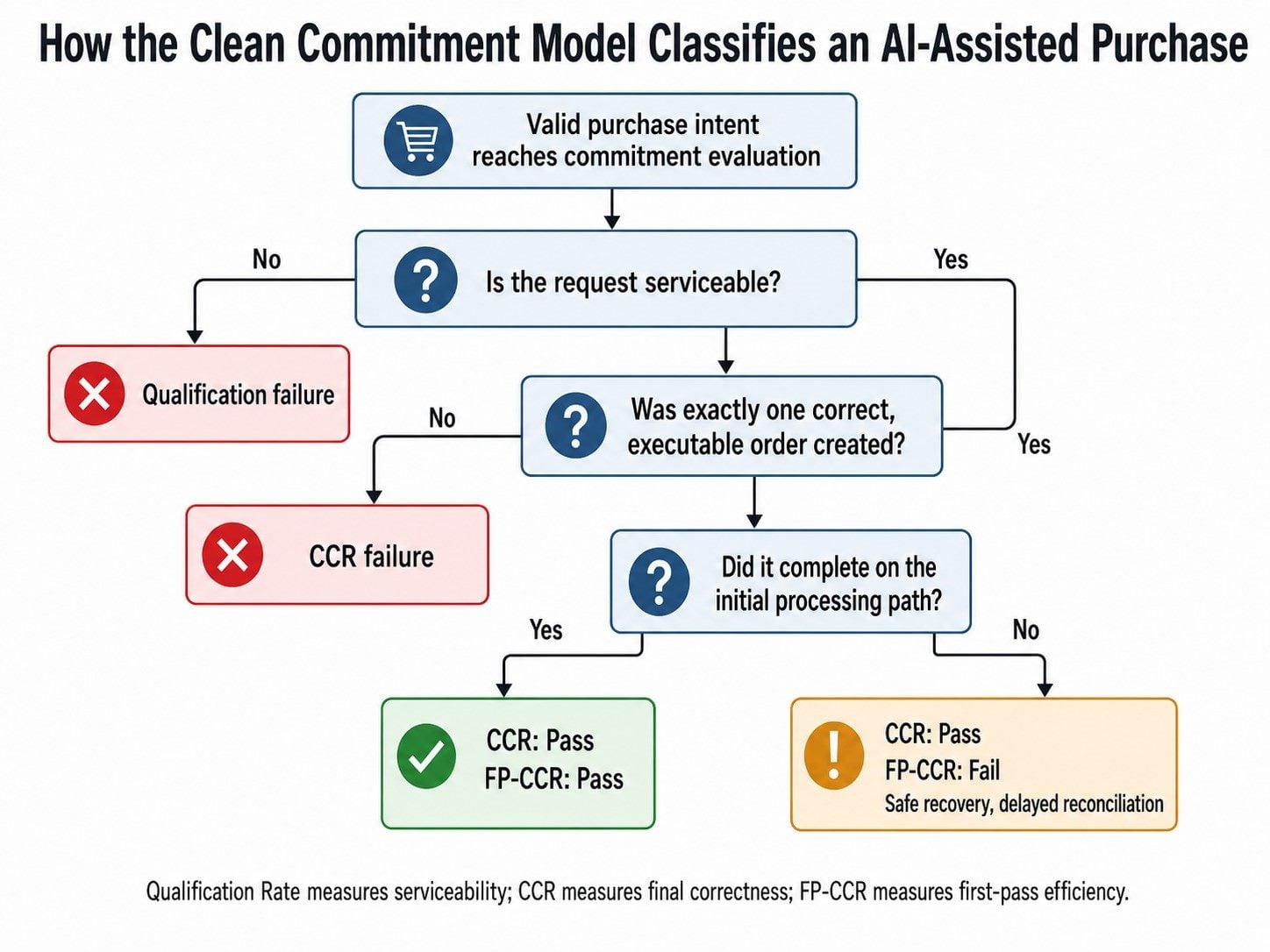
Intent-to-Commit Qualification Rate, shortened to Qualification Rate, measures whether apparent purchase intent can legitimately proceed.
Failures include unavailable inventory, unsupported delivery, invalid payment authority, fraud rejection or a stale offer.
In delegated or delayed AI-assisted journeys, the interval between customer approval and agent submission can outlast an inventory reservation or offer-validity window. That timing gap can turn a previously serviceable intent into a disqualified request, creating customer effort before an order is attempted.
Clean Commit Rate, or CCR, is the percentage of qualified requests producing exactly one correct, authoritative and executable order without preventable duplication, commercial-rule correction, data repair, inventory reversal or manual reconstruction.
A technically successful request can still be commercially wrong. It can pass payment authorization yet violate a pricing entitlement, fulfillment constraint or approval condition. Those controls must be enforced at the transaction layer, not only in the storefront, and revalidated at commitment rather than inferred from what was displayed.
CCR measures final commercial correctness, not technical perfection. A timeout followed by safe reconciliation can pass CCR when one correct order exists. A retry that creates a second order fails CCR even if the duplicate is later canceled.
First-Pass Clean Commit Rate, or FP-CCR, measures qualified requests reaching clean commitment without retry, delayed reconciliation, fallback processing or human intervention.
CCR asks whether the outcome was correct. FP-CCR asks whether it was reached efficiently.
Excluding early failures like payments without orders from the denominator inflates Clean Commit Rate through survivorship bias, even though customers still experience and report the missing outcome. Only noncommercial noise, such as sandbox activity or malicious traffic, should be excluded.
When a network failure interrupts checkout after submission, the customer and merchant may hold different beliefs about whether an order exists. Recovery must determine whether to return the existing order, retry safely or reject the request—without creating a second commercial obligation. HTTP standards recognize this ambiguity.
RFC 9110 explains that idempotent requests can be repeated after a communication failure even when the original may have succeeded. Requests that could create a new commercial obligation are different. They should not be retried automatically unless the system can confirm that the original request was never applied—or that repeating it is safe.
Safe retry design can prevent duplicate effects. It does not show whether the customer received a timely outcome or whether reconciliation was required.
Consider a checkout where the merchant creates the order, but the acknowledgment never reaches the agent. The merchant later finds the original order and returns it without creating another obligation.
| Outcome | Qualification | CCR | FP-CCR | Customer effect |
|---|---|---|---|---|
| Original order safely recovered | Pass | Pass | Fail | Delayed confirmation |
| Retry creates a duplicate | Pass | Fail | Fail | Cancellation or duplicate-charge effort |
| Payment authorized but no order exists | Pass | Fail | Fail | Uncertainty and service escalation |
| Correct order confirmed initially | Pass | Pass | Pass | Reliable journey |
The recovery worked. The first processing path did not.
CCR recognizes the correct final outcome, while FP-CCR exposes the delay and operating work behind it.
RFC 9110 allows repeating idempotent requests after a communication failure, but requests that could create a new commercial obligation should only be retried if the system can confirm the original request was never applied. This is why a safely recovered order can pass Clean Commit Rate but still fail First-Pass Clean Commit Rate.
Related Article: When AI Became Real in Commerce — and Why Experience Still Won
Qualification measurement should include valid intents reaching evaluation, including inventory unavailability, payment rejection, unsupported fulfillment and offer-revalidation failures.
A high CCR is meaningless if the hardest failures never enter the denominator.
All qualified requests belong in the denominator, not only orders that reached downstream systems. Otherwise, payments without orders and other early failures disappear through survivorship bias, even though customers may still contact service about the missing outcome.
Denominator integrity requires a complete record of every qualified commitment attempt, including what downstream systems received or acknowledged.
Exclude only noncommercial noise, such as sandbox activity, malicious traffic and payloads that never became valid purchase requests. Keep malformed production traffic visible through a separate request-quality measure. Use a defined observation window and prevent indefinite pending states.
Reliable CCR requires linking the AI request, customer authority, merchant transaction, payment authorization and order identifiers, along with retries, reconciliation time and repair cost. Without that trace and revalidation of commercial rules at commitment, teams can't calculate CCR consistently.
Enterprises may not need a new analytics platform, but they need consistent transaction identity and agreed outcome definitions.
Connect the AI request, customer authority, merchant transaction, payment authorization and authoritative order identifiers. Record retries, uncertain outcomes, reconciliation time, intervention and repair cost.
When teams cannot calculate CCR reliably, the problem is often deeper than analytics. Pricing, entitlement or fulfillment controls that live only in the storefront can leave other channels—including AI agents—without equivalent validation at the transaction layer.
Reliable CCR depends on checking commercial rules and order state again at commitment. Teams must then preserve that outcome across downstream systems. Without that trace, teams cannot calculate CCR consistently.
Assign one executive owner for metric integrity, while product, CX, service, payments and order operations own remediation.
The first 30 days define the commitment event and outcome classifications, the next 30 instrument agent, payment and order identifiers, and the final 30 publish the three metrics segmented by agent, channel, payment and fulfillment type.
Conversion remains an important growth metric. But it cannot establish whether the enterprise fulfilled the customer’s intent.
A purchase should count as a customer-experience success only when it becomes exactly one correct and executable order—and the customer receives a reliable outcome.
That is what Clean Commit Rate measures.
 Learn how you can join our contributor community.

Nixalkumar Patel is a senior product and digital transformation leader specializing in enterprise omnichannel digital commerce transaction execution and orchestration across D2C, B2C and B2B/SMB channels, including AI-enabled governed conversational commerce. With more than 13 years of experience, his work focuses on building the governance, validation and orchestration layers that help enterprise transactions execute correctly, reliably and auditably across customer journeys, fulfillment ecosystems and core business systems.