Editorial
Buyer's Guide
Your Legacy Systems Aren't the Problem. Leaving Them Alone Is.

AURORA, Colo. — I left the Gartner Marketing Symposium/Xpo at the Gaylord Rockies Resort & Convention Center last week with two competing reactions.
The first was genuine excitement, because the AI agent future Gartner described is not some silly sideshow, it is a serious reordering of how marketing work may get done.
The second was concern, because the operating conditions required to make that future work are not the operating conditions most marketing teams live in today. That gap, between the stage and the stack, was the real story of the conference.
The best summary I heard came not from a keynote, not from a vendor booth, and not from a slide about agentic orchestration.
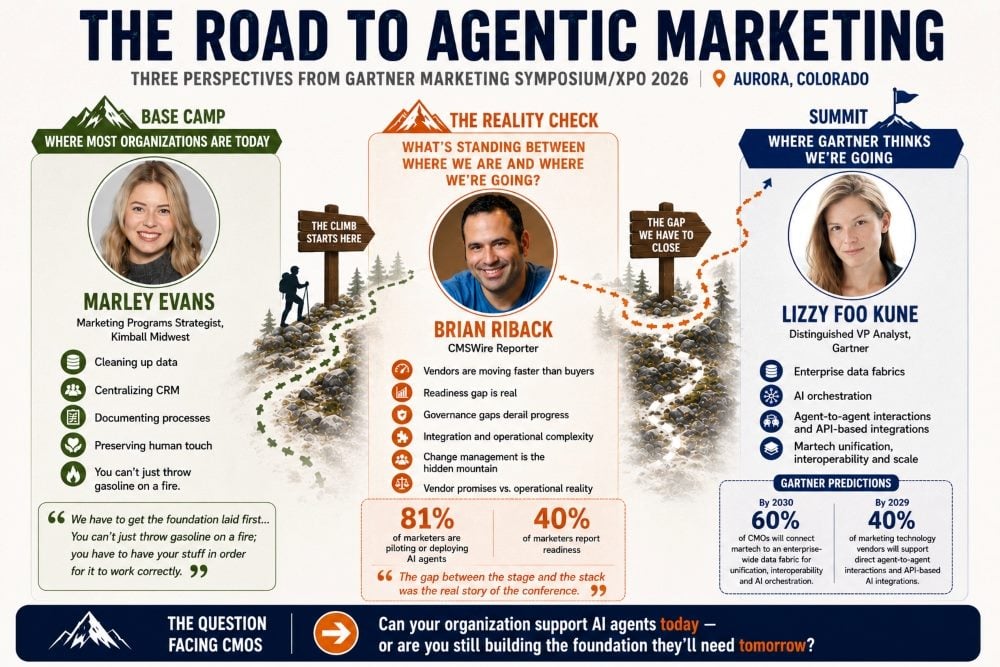
It came from Marley Evans, marketing programs strategist of Kimball-Midwest, who told me, "As we slowly adopt more tech and AI integration into our business, as a company, we are still pretty early in the stages of integrating these tools and resources, so we have a long way, and it's just educating ourselves on how we can bring value without minimizing human touch through the growth of technology."
I would say that we are in the process of cleaning up data, creating more of a centralized CRM, documenting processes, things like that. I don't think we're anywhere kind of really ready to start doing anything major with AI. We have to get the foundation laid first, which our company has been in the process of doing, but this conference just kind of reiterated you can't just throw gasoline on a on a fire; you have to have your stuff in order for it to work correctly.
- Marley Evans, marketing programs strategist
Kimball-Midwest
Those quotes became the lens through which I viewed almost every conversation after it. It is not anti-AI, and it is not a plea for marketing teams to hide from change. It is the sober voice of someone who understands that technology adoption is not just a procurement motion. It is data, governance, workflows, skills, integrations, partners, internal trust and the patience to clean up the mess before you automate the mess.
That is why the conference was so useful. It was not useful because it gave me a simple answer about what to buy. It was useful because it exposed the tension between the predicted future and the client reality marketing technology providers must sell into. The question I kept returning to was not whether AI agents will matter. The question was which vendors are aligned with the operational reality of the organizations they want to serve.
I had the chance to speak with Lizzy Foo Kune, distinguished VP analyst at Gartner, after her presentation on the impact of AI agents on marketing. Her keynote was one of the stronger sessions I attended, and I mean that in part because it was challenging. She discussed how AI agents can automate processes and improve personalized customer experiences. She also showed the expanding vendor landscape around agents, interoperability, orchestration and API-based AI integrations.
Two predictions stood out:
I do not reject the direction of travel. I reject the neatness of the timeline.
The problem is not that the vendor market cannot move quickly. Vendors can rebrand, bundle, partner and ship features at a pace that makes every analyst deck feel old within weeks. The problem is that buyers do not absorb capability at vendor speed. They absorb it at the speed of their data foundation, legal review, IT backlog, partner dependency, procurement cycle and change tolerance.
Gartner's own data, as presented at the conference, makes the tension hard to ignore. Only 40% of martech leaders report readiness across talent, technical and data foundations for AI agent deployment, while 81% have already begun piloting or deploying agentic technologies. In plain English, far more teams are starting than are ready. That is not a small gap, that is the whole story.
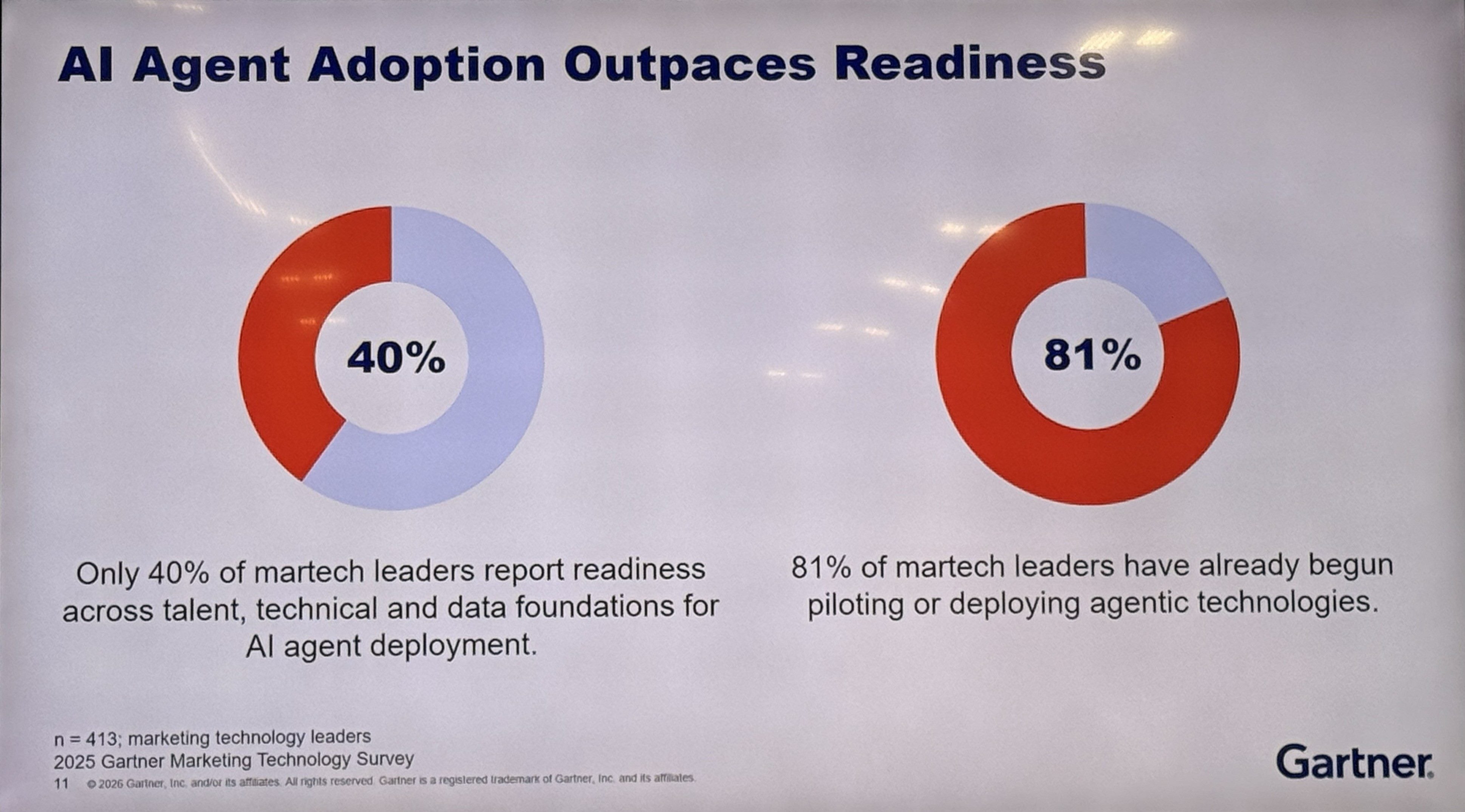
Editor's note: Gartner's data suggests many organizations are piloting agentic AI before foundational capabilities are fully in place.
| Capability Area | What AI Agents Need | Common Reality Today |
|---|---|---|
| Customer Data | Unified, trusted customer records | Duplicate profiles and fragmented systems |
| Process Documentation | Clearly defined workflows and ownership | Critical processes live in employee knowledge |
| Governance | Rules for approvals, permissions and oversight | Policies are inconsistent or still evolving |
| Integration | Connected systems with reliable APIs | Disconnected platforms and manual handoffs |
| Talent | Teams that understand AI operations | Skills development remains in progress |
| Measurement | Defined success metrics and accountability | Pilots without clear business outcomes |
The uncomfortable part is that the gap does not stop anyone from buying. In fact, it may accelerate buying, because executives feel pressure to show action. That is why the "Monday morning" action plan bothered me. Foo Kune advised CMOs to "Communicate to your leadership team that AI agents are a strategic capability shift, not just a productivity experiment." The statement is directionally true, but as a first step it puts the declaration before the diagnosis.
The better first conversation is with team leaders, operations leads, data owners, CRM admins, content leads, compliance partners and the people who know where the work breaks. If the CMO starts by telling leadership that AI agents are a strategic capability shift, the organization may hear a commitment before it has done the inventory. The first Monday morning move should be to map what agents would need in order to function safely and usefully. The second move should be to identify where the current operating model cannot support that.
Related Article: The Martech Landscape Has Plateaued. The Real Crisis? What AI Exposes Underneath It.
Another Gartner framing also deserves scrutiny. On a slide titled, "How did we get here," Foo Kune placed chatbots, LLM-augmented workflows and AI agents along a progression. She described the current stage as an LLM-augmented reality, where companies focus on tasks and processes that are static, less flexible and less adaptable. That may describe advanced teams, but it does not describe the median marketing organization I encounter.
Many teams are not yet living in an LLM-augmented workflow. They are experimenting with prompts, drafting copy, summarizing meeting notes, testing AI search tools and running pilots that sit beside the work rather than inside the work. The difference matters. A workflow that is truly LLM-augmented has governance, repeatability, roles, outputs, auditability and some connection to business systems.
Calling the market "LLM-augmented" can make the next step to AI agents feel more natural than it is. It implies that the stepping stone has been crossed. But the research picture around AI adoption remains uneven, with enterprise adoption, small business adoption and production-grade LLM use moving at different speeds across functions and company sizes; check out Mckinsey's state of AI. The issue is not whether people are using AI. The issue is whether organizations have absorbed it into the systems that run the business.
That distinction matters because technology adoption does not skip grades. Teams can test an assistant before they redesign a workflow. They can redesign a workflow before they delegate decisions. They can delegate low-risk decisions before they let agents coordinate across platforms.
If a company has not documented its processes, unified its core customer data, or cleaned up basic segmentation logic, it is not one keynote away from safe agent orchestration.
Related Article: Gartner Warns Marketing Leaders: Competence Is the Real AI Trap
The most useful way to challenge the 2030 martech vision is not cynicism. It is history. Email did not become a mature marketing channel just because email technology existed. It took years of adoption, misuse, regulation, trust rebuilding, platform maturation and operational learning before email became the disciplined channel we know now.
The early internet and email eras should humble anyone making fast adoption predictions. Email existed long before most brands had the systems, permission practices, deliverability discipline or content strategy to use it well. The later rise of spam, consumer frustration and regulatory response shows how quickly an exciting channel can become polluted when adoption outruns governance. The CAN-SPAM Act of 2003 became part of that correction, formalizing rules around commercial email after the market had already produced harm.
Martech itself tells the same story. Marketers have spent years buying platforms they only partially use. Gartner has reported that martech buyers use only 49% of their stack capabilities, which is a brutal reminder that acquisition and adoption are different things.
AI agents are not simpler than email platforms, marketing automation or CRM systems. They are more dependent on clean data, reliable permissions, system interoperability, business rules and clarity around human control. If marketers struggled to use existing stack capability, why would we believe they will smoothly connect that same stack to an enterprise-wide data fabric within four years? The answer cannot be "because AI will make it easier."
AI can reduce friction in some tasks, but it can also multiply damage when the foundation is weak. Bad segments can become bad customer journeys. Bad content can become bad content at scale. Bad permissions can become compliance exposure. Bad handoffs can become broken customer experiences that no dashboard explains cleanly.
Related Article: How CMOs Build Brand Trust Across AI Search, Agents and Answer Engines
I also had a strong conversation with a martech leader in healthcare and life sciences who has spent decades across both agency and in-house marketing environments. His view was that AI is not simply changing how work gets done; it is forcing organizations to rethink the operating model itself.
He argued that agencies can no longer assume the traditional structure of channel-specific teams will remain effective. Instead, he sees a future built around smaller, more agile teams organized around customer journeys rather than email, social, paid media, or other individual disciplines.
His broader point resonated throughout the conference: AI is exposing the fact that many marketing organizations are trying to modernize workflows built for a different era. The challenge is creating operating structures that can support clients with vastly different levels of data maturity, governance, integration and process discipline.
AI does not remove the need for expertise. It changes when expertise is needed, how it is deployed and how deeply it must connect to client systems. The agency of the near future may be less of a deliverable factory and more of an orchestration partner, but only if it understands the client's operating constraints as well as it understands the campaign brief.
Editor's note: The most important buying question at Gartner wasn't what a platform could do. It was what an organization must already have in place before the platform can succeed.
| Question | Why It Matters |
|---|---|
| Is our data trusted? | AI systems amplify data quality issues as quickly as they scale opportunities. |
| Are workflows documented? | Automation requires repeatable processes before tasks can be delegated. |
| Who owns governance? | Clear accountability reduces compliance and operational risk. |
| Can our systems communicate? | Disconnected platforms limit orchestration and agent effectiveness. |
| Do we have implementation resources? | Many modern platforms require technical and operational support. |
| Can we measure value? | Without measurement, AI remains experimentation rather than transformation. |
Another theme in the Rockies last week was impossible to miss. Companies are investing heavily in APIs to support AI initiatives and connections to other systems. API stands for Application Programming Interface. In plain language, an API is a controlled way for one software system to request, send or update information in another software system.
APIs matter because AI agents cannot orchestrate much if systems cannot talk to each other. An agent that drafts an email, updates a CRM record, checks consent, pulls product data, creates a segment, and triggers a journey needs governed access to each system involved. That access usually runs through APIs. This is why API strategy is increasingly becoming AI strategy API strategy is becoming AI strategy.
This also helps explain why the Gartner prediction about direct agent-to-agent interactions depends on more than the agents. It depends on integration architecture. It depends on authentication, permissions, rate limits, data contracts, error handling, observability and security. The agent can only be as useful as the pathways it is allowed to use.
The API investment wave is real, but it should not be confused with completed transformation. Building APIs is not the same as harmonizing data definitions. Connecting tools is not the same as aligning teams. Opening a pathway between systems can move bad data faster just as easily as it can move good data faster. Integration is necessary, but it is not the finish line.
This is where vendors can either help or hurt. A vendor that says, "we have an API," has not answered the implementation question. A vendor that explains what data must be clean, what events must be defined, what permissions must be set, what systems must be connected and what failure modes must be monitored is having the better conversation. AI orchestration will reward the vendors who treat integration as operating infrastructure, not checkbox theater.
By the end of the conference, I was less interested in which vendor had the most ambitious AI language. I was more interested in which vendor described the customer's responsibilities clearly.
Storyblok did this by acknowledging that headless CMS requires setup and developer involvement. Bynder did this by framing DAM as a system of record that requires taxonomy and centralization. Siteimprove did this by offering onboarding support and tying AI content work to accessibility and quality foundations.
Hightouch was exciting, but it also revealed the limits of activation without data preparedness. Ignitium was practical because its service model helps clients bridge strategy and execution, but it depends on mature ABM ecosystems and structured data from platforms like 6sense and Demandbase. Treasure AI came closest to Gartner's future-state vision, but even it still sits inside a broader stack that must be connected, governed and ready. Optimizely and Conductor showed where the market is heading, but Answer Engine Optimization (AEO) still depends on content operations discipline.
That is why "which vendors align with operational realities" is not a simple yes-or-no question. Some vendors align because they are honest about prerequisites. Some align because they provide services that help customers get from here to there. Some align only for mature buyers. Others may be impressive in demos but risky for organizations that are still cleaning their CRM.
The vendors that worry me are the ones that collapse the distance between demo and deployment. A demo can show the happy path. Real implementation reveals the exception path, the duplicate records, the missing fields, the unclear owner, the integration limit, the legal question, the old taxonomy and the campaign calendar that cannot wait. If a vendor cannot speak fluently about those problems, it is not ready for the buyer it is courting.
The vendors that impressed me most did not pretend AI removes the need for human judgment. They treated human judgment as architecture.
Editor's note: Beyond the keynotes, CMSWire spent time with vendors across the Gartner Marketing Symposium/Xpo show floor. A common theme emerged: The most compelling AI, content and data platforms still depend on strong operational foundations. Watch for our follow-up story, where we'll take a deeper look at what we learned from these vendor conversations and what marketing teams need in place before investing.
| Vendor | Category | What Stood Out | Biggest Readiness Requirement |
|---|---|---|---|
| Storyblok | Headless CMS | Flexible content delivery across websites, apps and future digital channels. | Developer resources, implementation support and API maturity. |
| Bynder | Digital Asset Management (DAM) | Positioning the DAM as the trusted system of record for content in an AI era. | Strong taxonomy, governance, metadata and asset management discipline. |
| Siteimprove | Content Intelligence | Connected accessibility, content quality and AI search readiness into one strategy. | Content governance, ownership and ongoing optimization processes. |
| Hightouch | Composable CDP | Powerful activation capabilities that move data from warehouses into marketing execution. | Clean customer data, trusted warehouse architecture and data engineering support. |
| Ignitium | ABX Orchestration | Demonstrated how AI can scale research and personalization across buying committees. | Structured account data, clear ICPs and mature account-based processes. |
| Treasure AI | Agentic Customer Data Platform | Came closest to Gartner's vision of AI-assisted segmentation, journeys and orchestration. | Stack-wide integration, governance and operational readiness across systems. |
| Optimizely + Conductor | Answer Engine Optimization (AEO) | Showed how content platforms and SEO technology are converging around AI discovery. | High-quality content, accessibility, metadata and content operations discipline. |
| Common Theme | The strongest vendors were not necessarily the ones with the flashiest AI demos. They were the ones most transparent about the customer preparation required before AI, automation and orchestration can deliver meaningful value. | ||
There is a strange pressure in the market right now to treat caution as weakness. I think that is backwards. The real risk is not that marketing teams move too slowly into AI agents. The real risk is that they move quickly into systems they cannot govern, measure, support or explain.
This is where Gartner's own readiness numbers should be treated as a warning, not a footnote. If 81% of martech leaders are already piloting or deploying agentic technologies while only 40% report readiness across talent, technical and data foundations, the market is not just innovating. It is overextending. That does not mean stop. It means slow the narrative down enough for the operating model to catch up.
Research around failed AI initiatives points to recurring causes, including weak data maturity, unclear ownership, poor business alignment and difficulty moving from pilots to value why AI initiatives fail. Other work has described an AI proof gap, where leaders invest but struggle to demonstrate value at the level the business needs AI proof gap. These are not abstract concerns. They are what happens when experimentation outruns operational design.
There is also a governance and risk dimension that marketers cannot ignore. Public companies are increasingly discussing AI-related risks in disclosures, which signals that AI is no longer just an innovation topic, it is a business risk topic AI risks disclosure. Marketing leaders should pay attention to that. Customer data, personalization, consent, content claims, accessibility and automated decisioning all sit close to reputational and legal exposure.
None of this makes the Gartner vision wrong. It makes the readiness path more demanding than the keynote format can fully express. By 2030, some CMOs will absolutely connect martech to enterprise data fabrics and coordinate agentic workflows across tools. Many others will still be rationalizing platforms, reconciling IDs, documenting journeys, retiring duplicate systems, and training teams to use the stack they already own.
Related Article: Meet the Newest Martech Member: Databricks, Via Agentic CDP
Editor's note: Before investing in agentic marketing, leaders should assess operational readiness across the business.
| Ask This Team | Key Question | What You're Looking For |
|---|---|---|
| CRM & Data | Where is customer identity weakest? | Data quality and duplication risks |
| Content Operations | Where do approvals slow down? | Workflow bottlenecks |
| Marketing Operations | Which processes are documented? | Automation readiness |
| IT & Architecture | Which systems are difficult to integrate? | Technical constraints |
| Legal & Compliance | Where does automation create risk? | Governance requirements |
| Channel Leaders | Which decisions can be delegated safely? | Low-risk AI opportunities |
If I were rewriting the Monday morning action plan, I would start with a different instruction. Do not begin by telling leadership that AI agents are a strategic capability shift. Begin by asking your leaders to identify where agents would break if they were deployed today. That question will surface more value than a confident declaration.
Ask the CRM leader where customer identity is weakest. Ask the content leader where approvals slow down or fail. Ask the data leader which fields cannot be trusted. Ask legal and compliance where automation would create unacceptable exposure. Ask channel owners which workflows are documented and which live in people's heads.
Then classify use cases by readiness. Some AI use cases can be safely tested now, such as content summarization, research assistance, brief development, accessibility remediation and internal analysis. Others require more structure, such as dynamic segmentation, journey orchestration, cross-channel personalization, automated offer selection and agent-to-agent coordination. The mistake is treating all AI use cases as if they carry the same operational risk.
CMOs also need a vendor readiness checklist that goes beyond feature comparison. What data does the vendor need? What state must that data be in? Who handles implementation? What does onboarding include? Where does support stop? Which partner ecosystem fills the gap? What happens when the customer's systems are messy?
That checklist would have changed how many vendor conversations sounded at the conference. It would reward Storyblok for being clear about developer involvement. It would reward Siteimprove for offering onboarding support. It would put sharper boundaries around Hightouch as an activation layer. It would help buyers understand that Treasure AI may be powerful, but still depends on the rest of the stack.
I loved the conference, and I hope I am fortunate enough to go next year. The Gartner team put serious ideas on the table, and the vendor floor showed just how quickly the market is moving. I left energized, intimidated in a good way and convinced that AI agents will reshape marketing work. I also left more convinced that the adoption story will be slower, messier and more uneven than the best predictions suggest.
Marley Evans, who we introduced at the outset of this piece, gave the conference its most practical thesis. You cannot throw gasoline on a fire and call it transformation. You need your stuff in order for it to work correctly. That sentence should sit beside every AI roadmap, every vendor evaluation, every CMO action plan and every board update about agentic marketing.
The future Gartner described may arrive for the most prepared organizations. It may arrive first in companies with mature data warehouses, clean CRM structures, strong governance, modern CMS architecture, accessible content, well-managed assets, documented workflows and teams that know how to work across functions. For everyone else, the next four years should not be a race to buy agents. They should be a race to become the kind of organization that can use agents without creating chaos.
The vendors that win will not be the ones with the loudest AI claims. They will be the ones that understand the buyer's current state and help them cross the gap honestly. They will explain prerequisites, provide support, integrate cleanly, respect human control and admit where partners or internal teams must do the work. That is the difference between selling the future and helping clients reach it.
So yes, AI agents are a strategic capability shift. But strategy is not a slogan, and capability is not a demo. The real work is not convincing leadership that the future matters. The real work is building the conditions under which that future can function.
 Learn how you can join our contributor community.
Brian Riback is a dedicated writer who sees every challenge as a puzzle waiting to be solved, blending analytical clarity with heartfelt advocacy to illuminate intricate strategies. Connect with Brian Riback, 2025 Contributor of the Year: 