News Analysis
Guide
8 CX Survey Templates Built to Get Answers, Not Just Scores

I've covered Scott Brinker's Martech Supergraphic for 12 years.
Proof: Buy or Build a Marketing Cloud? Circa August 2014.
In each of those years, the number was the story. How many marketing technology solutions out there this year? Did it grow? Consolidate? Is martech dying?
Ok, fine. The number is still the headline. Let's start here. It's the number you like called the most each year, even more so than at McDonald's at a busy rest stop on the Mass Pike, where, Brinker and I being Boston guys, have probably experienced once or twice.
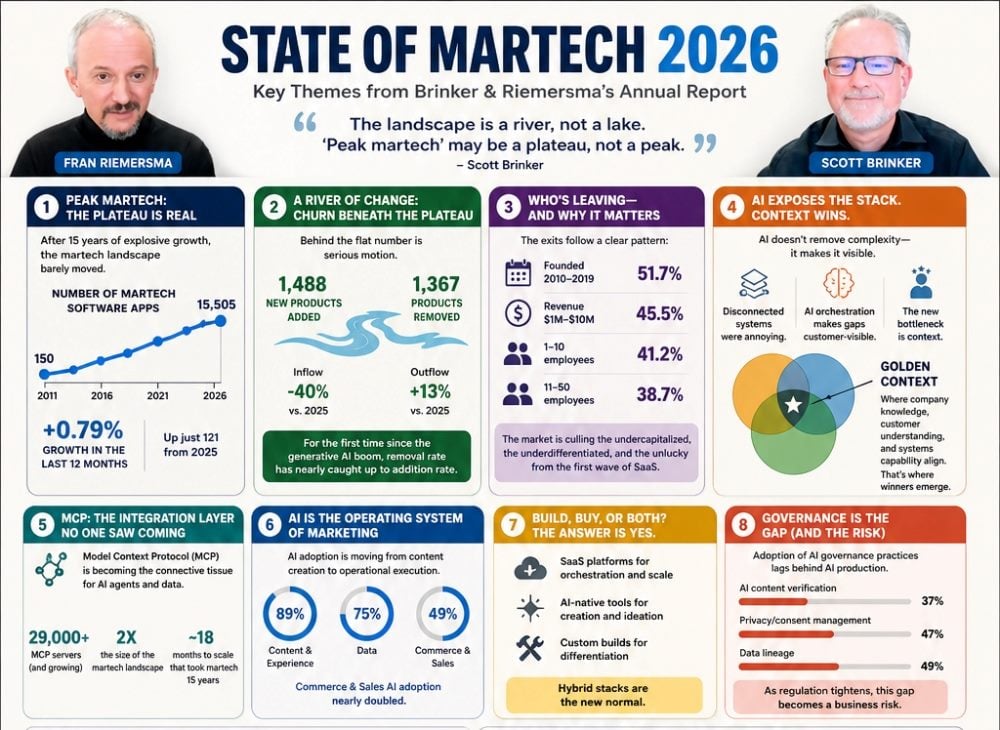
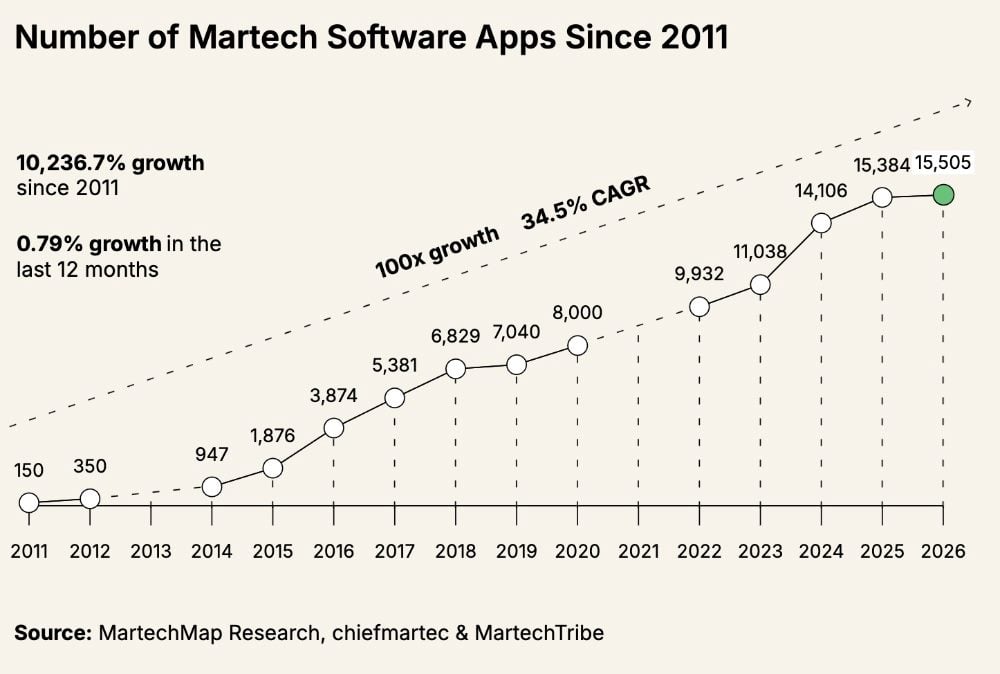
The State of Martech 2026, released today, May 5, and co-produced by Brinker's chiefmartec and Fran Riemersma's MartechTribe, counts 15,505 products in the marketing technology landscape — up just 121 from last year. That's 0.79% growth. Effectively zero.
That's big news, considering the 100x run for the landscape that became the defining data point of an era.
For 15 years, the annual marketing technology landscape has functioned as the industry's most-watched scoreboard. Every spring, the number went up. Sometimes dramatically. Sometimes absurdly. Pundits predicted collapse. The market ignored them.
By 2025, what started as 150 tools on a slide in 2011 had grown to 15,384 — a 100X run.
But in 2026, the number barely moved.
"You can say we have — finally — hit peak martech," Brinker told CMSWire in an exclusive interview.
But Brinker was quick to warn against reading too much into the headline number. The flat figure, he said, buries the real story — and the real story isn't about the count.
Under that near-zero net number, the martech market is in serious motion. The 2026 landscape added 1,488 new products while removing 1,367 — a churn rate that tells a more instructive story than the net total.
Inflow dropped 40% from 2025, when 2,489 new products qualified for the landscape. Outflow climbed 13%, from 1,211 to 1,367 removals. For the first time since the generative AI boom began, removal rate has nearly caught up to addition rate.
"The landscape is a river, not a lake," Brinker said in the interview with CMSWire ahead of Martech Day today. "And 'peak martech' may be a plateau, not a peak. The easy AI-wrapper phase is getting culled, while more durable AI-native and infrastructure-oriented categories are still emerging."
The exits cluster in a revealing pattern. Companies founded between 2010 and 2019 account for 51.7% of 2026 removals — nearly identical to the 56.1% from that same cohort last year. The first big SaaS wave is finally consolidating. By revenue, 45.5% of removed companies fell in the $1M–$10M band. By headcount, roughly 80% had 50 employees or fewer.
These were not flash-in-the-pan AI startups. They were companies that found early traction, survived past zero revenue and then ran out of runway before growing into a defensible position. The report describes the dynamic bluntly: the market is "systematically culling the undercapitalized, the underdifferentiated, and the unlucky from an era when martech still seemed like an easy place to make a business."
The 1,367 products removed from the 2026 martech landscape aren't random casualties. They cluster around a specific profile: small, first-wave SaaS companies that found early traction but couldn't grow into defensibility before the AI era reset the competitive bar.
| Exit Profile | % of 2026 Removals |
|---|---|
| Founded 2010–2019 | 51.7% |
| Revenue $1M–$10M | 45.5% |
| 1–10 employees | 41.2% |
| 11–50 employees | 38.7% |
Related Article: The Martech Supergraphic Has Grown Up: 15,000-Plus
But let's dig into the story behind the story here: AI. It's debatable now which is more closely watched: AI's impact on the martech supergraphic or the number of solutions in the martech supergraphic itself.
The plateau in product count and the shakeout in the vendor base share the same underlying cause, Brinker argues. AI is reorganizing the martech market — not just adding to it. And in doing so, it's surfacing the infrastructure problems that were always there.
The big gotcha is that AI doesn't make martech complexity go away. It exposes it. When AI is just helping you draft copy, disconnected systems are annoying. But when AI is orchestrating customer interactions, recommending products, answering questions, or triggering actions, your data quality, governance, integrations, and internal alignment become directly visible to the customer.
- Scott Brinker
Chiefmartec
The report frames this dynamic with a line that will resonate with anyone who has ever inherited a tangled stack: "Oops, your stack is showing."
The constraint, Brinker explained, has moved.
"The bottleneck used to be production: can we create enough content, connect enough systems, build enough automations? AI makes those things dramatically easier," Brinker told CMSWire. "But that creates a new bottleneck: context. Which content? Which customer? Which moment? Which data is trusted? Which agent is allowed to take which action? The winners won't simply be the companies using the most AI. They'll be the ones with the best context plumbing, governance and strategic coherence."
That framing — context as the new competitive constraint — runs through the entire 125-page report. Brinker and Riemersma introduce the concept of "golden context" as the triple intersection where company knowledge, customer understanding and systems capability all align. Most organizations, they argue, have limited overlap between those three circles. Closing the gap is the central job of marketing operations leadership in the next 12 to 18 months.
Related Article: Adobe Doubles Down on Agentic AI — But the Hard Work May Be the Operating Model
If context is the new constraint, MCP — the Model Context Protocol — may be the infrastructure most directly aimed at solving it.
Anthropic open-sourced MCP in late 2024. OpenAI, Google and Microsoft all subsequently adopted it. The protocol enables AI agents to connect to tools and data sources through a shared standard rather than bespoke integrations. Independent registries including PulseMCP, Glama, and mcp.so now index more than 29,000 unique MCP servers.
To put that in perspective: the commercial martech landscape took 15 years to reach 15,000 products. Agent integrations via MCP hit more than twice that in roughly 18 months, the martech researchers noted.
Martech is already one of the first industries showing up in force on both major AI platforms. ChatGPT's featured apps include Adobe, Airtable, Canva, Clay, HubSpot, Klaviyo, Notion, Semrush, Slack, and ZoomInfo, among others. Anthropic's Claude Connectors feature a similarly dense roster of martech and adjacent integrations.
The report describes a resulting shift in the fundamental integration question — from "can we connect these systems?" to "what do we do now that we can?" The answer, per Brinker and Riemersma, depends on context engineering: assembling the right data, policies, tools, permissions and instructions so that agents can act intelligently at the moment of decision.
The report's AI use cases chapter draws on a February 2026 survey of 208 marketing and marketing operations leaders — skewed toward technically sophisticated organizations, with 40% holding VP-level titles or above. Brinker noted that the results represent the leading edge more than the median.
Across all six martech landscape categories, AI adoption climbed meaningfully from 2024 to 2026. Nothing declined.
Two years ago, most of this was pilot-phase experimentation. The 2026 numbers reflect AI embedded in how work actually gets done — including categories, like Commerce & Sales, that were barely in the conversation in 2024.
| Category | 2024 Adoption | 2026 Adoption | Change |
|---|---|---|---|
| Content & Experience | 79% | 89% | +10pp |
| Data | 61% | 75% | +14pp |
| Management | 58% | 72% | +14pp |
| Social & Relationships | 33% | 49% | +16pp |
| Advertising & Promotions | 30% | 50% | +20pp |
| Commerce & Sales | 28% | 49% | +21pp |
Content & Experience remains the most widely adopted category — and for predictable reasons. "That's still the easiest place for teams to apply AI: ideation, copy, creative variation, personalization, and content operations," Brinker said.
But the more significant shift is in what he called the operating system of marketing. Commerce & Sales nearly doubled, from 28% to 49%. Data moved from 61% to 75%. Management from 58% to 72%. AI is no longer primarily a content tool for marketing organizations. It is increasingly embedded in how the work of marketing actually gets done.
One of the survey's more counterintuitive findings: organizations are not choosing between building AI solutions and buying them. They are doing both — often for the same use case.
"The pattern is not 'marketers are choosing build or buy,'" Brinker said. "They're doing both."
The split follows a consistent logic across categories. Existing SaaS platforms tend to hold the orchestration layer — places where workflow and data already live, such as lead scoring, campaign management, pipeline analytics and email deliverability. AI-native tools are winning the creation layer: copy ideation, pitch decks, visual production, competitive research, content strategy. Custom builds appear where proprietary data, brand voice or customer-facing differentiation genuinely matter.
In Content & Experience, for instance, only 14 of 163 respondents aren't using AI for copy ideation and production. Among those who are, AI-native tools (85 respondents) outpace existing SaaS (79) — a signal that bolted-on AI features in existing platforms aren't winning the creative layer even where they exist.
The governance picture, however, lags badly behind. Content Authenticity and AI Detection sits at just 37% adoption — meaning 103 of 163 respondents are doing nothing to verify the AI content they're generating at scale. In Data, coding and automation use cases run at 75–83% adoption, while Data Lineage sits at 49% and Customer Privacy and Consent Management at 47%.
"Everyone's learned to make the sausage with AI," the report states. "Almost nobody's bought a labeling machine."
The researchers also noted: Apologies to vegetarian readers for the sausage metaphor. The tofu equivalent would be: everyone’s pressing the tofu, nobody’s checking the expiration date. Actually, that works too.
Related Article: Marketing Technology Landscape Grows to 14,106 Solutions
AI production has hit high adoption across marketing. The governance layer built to verify, audit, and control that output hasn't kept pace — and the regulatory clock is running.
| Governance Use Case | Adoption Rate |
|---|---|
| Content Authenticity & AI Detection | 37% |
| Customer Privacy & Consent Management | 47% |
| Data Lineage & Cataloging | 49% |
| Data Compliance & Governance | 50% |
The EU AI Act is in effect. FTC scrutiny on AI-generated content is increasing. The report notes that the external forcing functions budget conversations have been able to ignore are getting harder to ignore.
The 2026 data introduces a market thermometer framework for reading martech subcategories: Growth (high inflow, low outflow), Renewal (active creative destruction), Stability (mature equilibrium), and Decay (low inflow, high outflow).
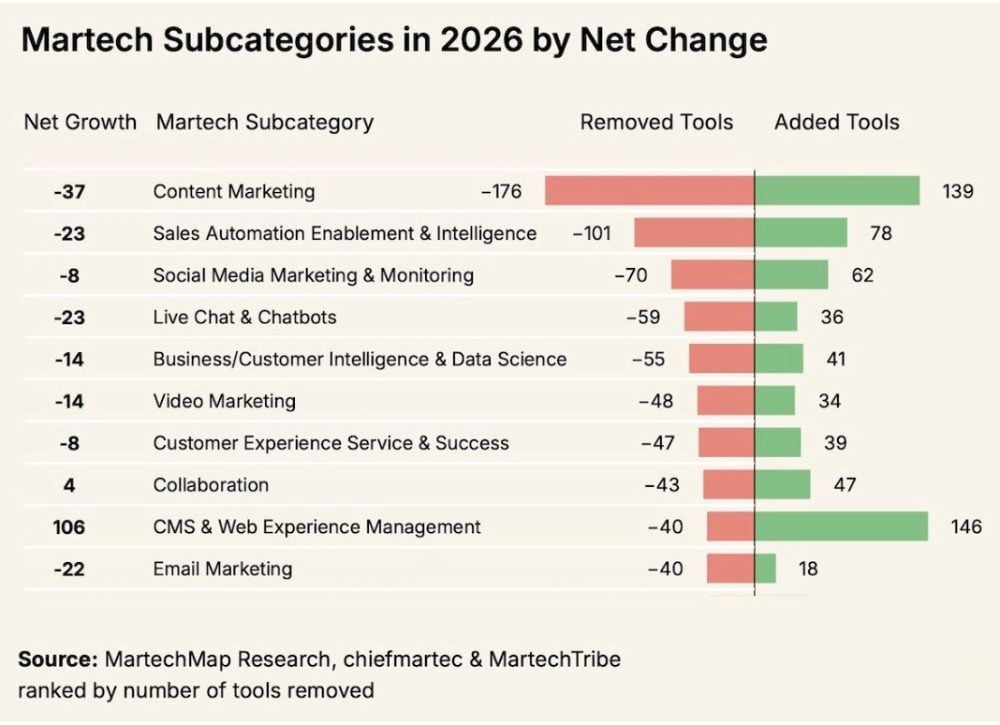
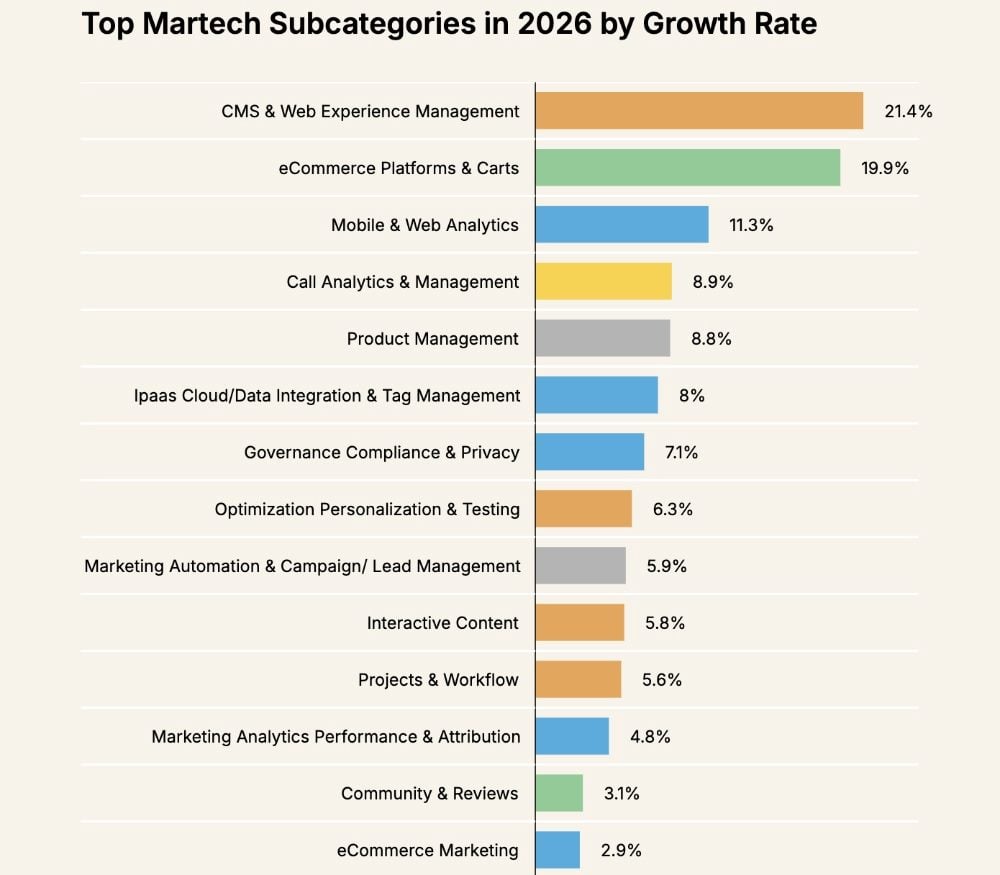
CMS and Web Experience Management and Ecommerce Platforms sit closest to classic growth — both posting their strongest expansion in years, at 21.4% and 19.9% respectively. The report attributes CMS growth to the website's expanding audience: no longer just humans and search crawlers, but AI search assistants, agentic browsers and procurement agents that arrive to extract and evaluate rather than browse. Ecommerce growth reflects pressure from two directions simultaneously — the need for machine-readable catalog data and rising customer expectations for real-time personalization.
Content Marketing is the clearest renewal case: 139 new entrants alongside 176 exits. The category that nearly doubled during the generative AI boom — from 575 tools in 2023 to 1,102 in 2025 — is now shedding the fastest, as AI labs commoditize the core features, incumbents embed AI into existing workflows and first-wave tools fail to answer harder questions about quality and brand consistency.
At the other end of the framework, Native/Content Advertising, Video Advertising and Print sit in Decay. The DMP category, the report notes drily, "isn't merely decaying. It's six feet under."
Reading inflow and outflow together tells a different story than net growth alone. CMS and Ecommerce are accelerating; Content Marketing is in creative destruction; the DMP is effectively gone.
| Category | 2026 Status | Net Change |
|---|---|---|
| CMS & Web Experience Management | Growth | +108 products (+21.4%) |
| Ecommerce Platforms | Growth | +109 products (+19.9%) |
| SEO/AEO | Renewal | +6 |
| Content Marketing | Renewal | -37 (176 removed, 139 added) |
| CRM | Stability | Modest movement |
| Native/Content Advertising | Decay | Declining |
| DMP | Decay | Effectively gone |
SEO's continued expansion — net positive again despite years of death declarations — reflects a category reinventing itself as AEO (Answer Engine Optimization) or GEO (Generative Engine Optimization). New tools including AirOps, Bluefish, Daydream, Profound, and Scrunch are building specifically for AI discovery.
But the report surfaces a harder truth: AEO is a discipline where the market is growing and the marketer's visibility is shrinking. When a customer researches inside an AI assistant, that conversation is invisible. No click data, no keyword path, no A/B test. Only 13.6% of survey respondents are measuring AI inclusion rate or agent-referred conversion.
From a 1,000-tool landscape debate in 2014 to a 15,000-product plateau in 2026, CMSWire has tracked Scott Brinker's annual martech report — and the questions it raised — from the very beginning.
| Article | Date | What It Covered |
|---|---|---|
| Buy or Build a Marketing Cloud? | August 21, 2014 | From the first MarTech Conference in Boston, CMSWire explored the defining debate of the era: whether marketing teams should consolidate around a single cloud suite or build their own stack from best-of-breed tools. More than 1,000 martech products existed at the time. The argument is still going. |
| The History of MarTech — In 16 Charts | September 24, 2015 | Before the landscape became the landscape, Percolate mapped 20 years of martech history across 1,400 companies — tracing how each wave of connectivity (search, social, mobile) spawned a new generation of marketing software. The piece positioned Brinker's landscape as the present-day culmination of that pattern. |
| Making Sense of the Crazy MarTech Landscape | 2016 | As the landscape crossed 3,500 products, CMSWire asked how marketers were supposed to make sense of it all. Brinker's annual supergraphic was already too dense to read — but too important to ignore. |
| Make It Stop: MarTech Landscape Hits the 5,000 Mark | 2017 | The landscape hit 5,000 tools for the first time, prompting CMSWire's exasperated-but-fascinated coverage of yet another annual milestone. Brinker's "much-anticipated yearly landscape graphic" had by then become required reading across the industry. |
| 6 Tips for a Smoother Marketing Technology Integration Process | 2018 | With thousands of tools in the market, the real problem had shifted from discovery to integration. CMSWire offered practitioners a framework for making disparate martech investments actually work together — an early articulation of what Brinker would later call the "context plumbing" problem. |
| Will Marketing Technology Tailwinds Help Power Through the COVID-19 Crisis? | 2020 | As the pandemic rewired marketing overnight, CMSWire examined whether martech's structural tailwinds — digital acceleration, remote everything, data-driven decisioning — would help organizations survive the disruption or expose how underprepared most stacks really were. |
| 5 Insights Into the 9,932 Marketing Technology Landscape | 2022 | The landscape nearly hit 10,000 products — and CMSWire broke down what that number actually meant for practitioners. Five takeaways from a milestone that would have seemed absurd a decade earlier when Brinker started with 150 logos on a slide. |
| Martech Stack Underutilization Is a Big Problem | 2023 | A growing landscape didn't mean a well-used one. CMSWire examined research showing that most organizations were only using a fraction of their martech investments — raising the question of whether the industry's obsession with adding tools had come at the expense of actually using them. |
| Marketing Technology Landscape Grows to 14,106 Solutions | 2024 | The landscape hit 14,106 — a 27.8% year-over-year jump fueled by the generative AI boom. CMSWire covered how the AI wave was minting new martech startups faster than the market could absorb them, particularly in content and sales categories. |
| The Martech Supergraphic Has Grown Up: 15,000+ | 2025 | At 15,384 products, the landscape crossed the 100X growth threshold from its 2011 origin. CMSWire examined how the supergraphic itself had become a cultural artifact of the martech era — the slide that started with 150 logos had become unreadable, and arguably unstoppable. |
| Scott Brinker: The Four AI Agents Every Marketing Team Needs to Know | 2025 | Brinker outlined the emerging taxonomy of AI agents in marketing — from those that assist to those that act autonomously — giving practitioners a framework for thinking about where agentic AI fits in their stack and org structure before the hype outpaced the strategy. |
The report opens and closes with a single metaphor: a chrysalis on the cover. What happens inside a chrysalis is dissolution. The caterpillar doesn't gradually improve. It breaks down into an undifferentiated soup, and from that soup, an entirely different organism assembles itself.
Brinker and Riemersma argue that marketing is somewhere in that messy middle. The old forms — campaign management, channel ownership, deterministic workflows, SEO as an instrumentable game — are dissolving. The new forms are assembling. Context engineering, agentic orchestration, MCP-connected stacks, value engineering as the discipline of finding where company goals and customer needs actually overlap.
The organizations that mistake the chrysalis for the destination, the report warns, will still be dissolving when their competitors take flight.
Dom Nicastro is editor-in-chief of CMSWire and an award-winning journalist with a passion for technology, customer experience and marketing. With more than 20 years of experience, he has written for various publications, like the Gloucester Daily Times and Boston Magazine. He has a proven track record of delivering high-quality, informative, and engaging content to his readers. Dom works tirelessly to stay up-to-date with the latest trends in the industry to provide readers with accurate, trustworthy information to help them make informed decisions. Connect with Dom Nicastro: 