News Analysis
eBook
Web Marketing Moneyball: How Web Operations Drive Marketing ROI

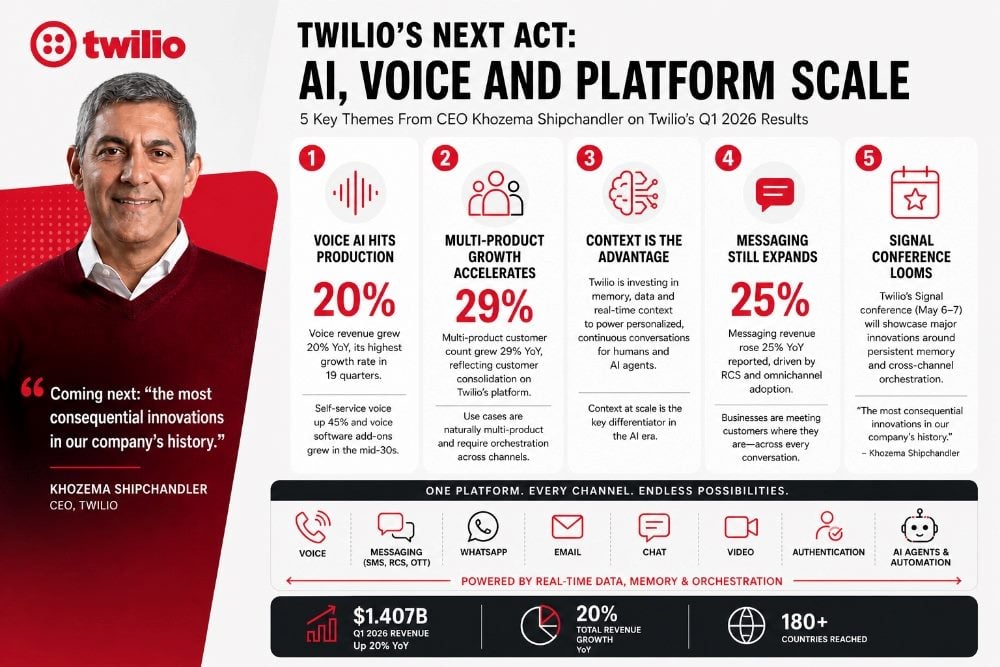
Twilio's Q1 2026 results reported yesterday told a financial story worth noting — $1.407 billion in revenue, up 20% year over year, its fastest organic growth rate since 2022.
But the more important story for customer experience leaders may be what's happening underneath those numbers: voice AI is moving from experimentation to production, customers are consolidating onto unified communication platforms, and San Francisco-based Twilio is positioning its combined channels-plus-data infrastructure as the foundation layer for the kind of cross-channel orchestration that CX leaders have been chasing for years.
We've heard that orchestration tune a lot in 2026 so far: Looking at you, Adobe and Sprinklr.
The results, reported April 30, come one week before Twilio's Signal conference in San Francisco, where CEO Khozema Shipchandler previewed announcements he called "the most consequential innovations in our company's history" — centered on persistent memory and context-rich conversations across every channel, for both humans and AI agents.
The headline product number is voice. Shipchandler said on the earnings call that voice revenue grew 20% year over year in Q1 — "the highest growth rate in that product in 19 quarters" — driven by AI use cases and accelerating adoption of software add-ons including Conversational Intelligence and Branded Calling, both of which grew more than 100% year over year.
Thomas Wyatt, Twilio's chief revenue officer, added texture to the voice numbers that CX leaders will recognize. Self-service voice was up 45% and voice software add-ons grew in the mid-30s. But Wyatt's more significant observation was about what customers are actually building on top of that infrastructure.
"It wasn't just the connectivity, it was the software layer on top of that," Wyatt said. "... Most of our customers are not going at it just single channel. They are expanding. If they started in voice, they're adding that messaging capability."
Wyatt described three use case buckets gaining traction: self-service AI agents helping small businesses handle customer interactions around the clock without human staff; AI co-pilots supporting live agents in contact centers; and AI-assisted inbound sales qualification with human handoff once a prospect is ready. That third bucket is notable — it signals voice AI crossing from customer service into revenue generation territory, a trend CCOs and CROs will increasingly navigate together.
Related Article: Twilio Launches Flex SDK, Salesforce Voice Integration to Unify CCaaS and CPaaS
The channel consolidation story is where Twilio's Q1 results connect most directly to the broader CX platform conversation. Multi-product customer count grew 29% in Q1, and Wyatt argued the dynamic is structural rather than a sales motion outcome.
"The use cases that customers want to roll out are naturally multi-product in nature," Wyatt said, "because you're talking about use cases where personalization and understanding of the relationship between a brand and a consumer requires software orchestration and memory that connects to the underlying communication channel, whether it be email, voice, or messaging."
The argument — that fragmented multi-vendor stacks cannot deliver the context and memory that AI-era CX requires — lands at a moment when the orchestration conversation is heating up across the industry. Vendors are converging on the same problem from different angles, each placing a distinct infrastructure bet.
Adobe used its Summit conference last week in Las Vegas to unveil CX Enterprise Coworker, an agentic AI layer designed to orchestrate customer experience workflows across its application suite — Real-Time CDP, Journey Optimizer, Customer Journey Analytics and Marketo Engage. Adobe even rebranded its entire business unit from "Digital Experience" to "Customer Experience Orchestration," a deliberate repositioning that signals how central the orchestration narrative has become. Forrester principal analyst Joe Cicman told CMSWire that agentic adoption isn't a technology problem — it's an operating model problem, and that organizations without strong data practices need to build them before the AI investment pays off.
Sprinklr, meanwhile, closed its fiscal year 2026 with $857 million in full-year revenue and is pitching what CEO Rory Read calls "the operating system for modern customer experience" — a single platform spanning social care, contact center, voice of the customer and marketing under one data layer and one AI engine. Read argued that "AI real AI unlock is driven by the use of contextual data" and that customers aren't cutting core software spend to fund AI — they expect it to be built onto platforms where their key data already resides.
Twilio's bet is that orchestration has to be solved at the infrastructure layer — below the application suite, below the CXM platform — at the place where channels and data actually converge. Shipchandler made the case explicitly on the call, previewing Signal announcements around Twilio's evolution from voice infrastructure to full multi-channel orchestration.
"You're using the channels, but then you're using data to inform how that happens, when it happens, what's the kind of context that's necessary, and then using that data to actually be able to go and solve the consumer's problem," Shipchandler said. "That full wrapper, I think, is a real advantage for Twilio that no other company on the planet has."
That data layer is Twilio's CDP technology, formerly known as Segment, which Shipchandler has repositioned away from a standalone product toward a communications intelligence layer. "If you don't have context, you're probably looking at a much higher cost in terms of your AI workloads, and you're not actually solving the customer's problem," he said.
Editor's note: The following reflects questions posed by Wall Street analysts during Twilio's Q1 2026 earnings call on April 30, 2026. Questions are paraphrased; responses are attributed to Twilio executives.
| Investor / Firm | What They Asked | What It Signals | Twilio's Answer |
|---|---|---|---|
| Aleksandr Zukin, Wolfe Research | What's driving voice acceleration, and what specific use cases are emerging on the AI side? | Investors want proof that voice AI is moving beyond experimentation into durable, production-scale revenue. | Wyatt cited self-service agents for SMBs, AI co-pilots for live contact center agents, and inbound sales qualification as the three emerging production use cases. Voice self-serve was up 45%; voice software add-ons in the mid-30s. |
| Taylor McGinnis, UBS | How durable is messaging growth, and how early are we in AI natives attaching messaging to voice use cases? | Investors are probing whether messaging acceleration is structural or a one-time carrier fee artifact. | Shipchandler said AI natives and RCS are contributing but not yet meaningfully to the revenue base. The bigger opportunity is cross-channel conversational AI — voice customers expanding into messaging and email over time. |
| Sitikantha Panagrahi, Mizuho | How broadly is multi-product adoption unfolding across the customer base? | Investors are tracking whether platform consolidation is a real trend or concentrated in a handful of large accounts. | Wyatt said multi-product customer count was up 29% and that the motion is accelerating because AI use cases are naturally multi-channel — personalization and memory require software orchestration across voice, messaging and email simultaneously. |
| Mark Murphy, J.P. Morgan | How far along are the largest voice AI customers — still in experimentation or fully in production? | Investors are trying to size the revenue opportunity and timeline for voice AI at enterprise scale. | Shipchandler said it depends on the industry. Ecommerce, retail and food service are moving pilots into production. Regulated industries — financial services, healthcare — remain in heavy experimentation, which he called a longer-term tailwind given the larger spend potential. |
| Koji Ikeda, Bank of America | What protects Twilio from disruption as voice AI matures and the market gets more competitive? | Investors are stress-testing the moat as AI-native competitors enter the communications infrastructure space. | Shipchandler pointed to 4,800 carrier interconnections across 180-plus countries, compliance and KYC complexity, brand recognition among developers, and the coming multi-channel orchestration platform as structural advantages no AI startup can replicate quickly. |
| Derek Wood, CG Cohen | Where does Segment fit in Twilio's strategy, and can we expect a revival of growth there? | Investors are trying to understand whether the customer data platform (CDP) acquisition is paying off or becoming a distraction. | Shipchandler said Segment as a standalone is no longer the focus. The data technology is being repositioned as the intelligence layer enriching every communication — enabling memory and context that makes AI workloads cheaper and more effective. |
| Arjun Bhatia, William Blair | Will messaging see a similar AI tailwind to voice, and is the sales force ready to sell the full software portfolio? | Investors want to know if the AI-driven growth story extends beyond voice and whether go-to-market execution can keep pace. | Shipchandler said messaging and email will benefit as conversational AI expands cross-channel. Wyatt said compensation plans and specialist sales motions are in place, and the percentage of deals closing with multiple products is increasing each quarter. |
Messaging revenue grew 25% year over year, though roughly seven percentage points of that came from carrier fee pass-throughs rather than organic volume growth. Stripping those out, messaging grew approximately 18% — still strong, and broad-based across geographies.
Shipchandler offered CX leaders a forward-looking frame on where AI-driven channel growth goes from here. Voice is leading now because most AI startups are starting there. But he drew a historical parallel: the way voice workloads migrated to text a decade or more ago, he expects conversational AI to eventually expand across every channel a customer wants to use.
"You're going to see conversational AI, where basically you're using the AI to be able to reach the customer through the channel that they want and using the context that they want," Shipchandler said. "That benefits not just messaging, but also email."
RCS volume more than doubled quarter over quarter, with notable enterprise deals including KPN Netherlands and Televox for regulated industries. It remains early-stage revenue but is a channel CCOs with heavy SMS programs should be tracking as a higher-engagement alternative.
Related Article: The State of Conversational AI in Customer Experience: 2026 Edition
For CX leaders who need a concrete before-and-after to take to a CFO, Twilio offered Scorpion, a digital marketing and technology partner for local businesses. By integrating voice, messaging, and Twilio's ConversationRelay, Scorpion developed an AI agent that boosted booking rates by 39%, captured 6,500 appointments that would otherwise have been lost, and generated $8.4 million in revenue — all within three months, the company reports.
AI-native companies including Sierra and Bland.AI deepened their Twilio relationships in Q1 as well, with Sierra signing a cross-sell deal for global expansion and Bland.AI committing to a multi-year partnership covering messaging, voice, and software add-ons.
What's Twilio been up to the past year? We checked.
Twilio's recent product moves reflect a strategy to unify communications and data, embed intelligence across touchpoints and establish scalable, trusted engagement as a foundation for modern enterprises. The company is positioning itself as a comprehensive platform for customer engagement, rather than a collection of standalone communication tools.
It expanded its Segment platform with new observability, alerting and automation features aimed at helping data teams manage customer information more reliably. The company also introduced modular contact center tools and scaled its messaging infrastructure, positioning itself as a more integrated player in enterprise communications.
The Segment platform updates include granular observability, centralized alerting, expanded APIs and auto-instrumentation capabilities. According to Twilio, these features aim to accelerate issue resolution and automate data management while integrating with existing martech stacks. The focus on real-time integration and API-first workflows addresses enterprise demand for unified customer data and trusted engagement.
Twilio launched the Flex SDK, a JavaScript toolkit that allows enterprises to embed contact center capabilities directly into web applications and CRMs. The company asserts this reduces the need to switch between multiple interfaces, streamlining agent workflows.
A new Salesforce Voice integration enables organizations to use Twilio's telephony infrastructure within Salesforce's Agentforce platform, supporting a bring-your-own-telephony model. Twilio also introduced a user-plus-usage pricing structure, which the company says makes it easier to scale AI-powered contact centers without seat-based contract constraints.
Twilio's Programmable Voice is enabling AI-driven applications such as Genspark's "Call for Me," which automates multilingual, real-time calls across more than 40 countries. The use case demonstrates Twilio's role in supporting practical AI applications in customer service at global scale.
The company also became the only CPaaS provider with direct 10DLC and toll-free connections across all major US and Canadian carriers. According to Twilio, this offers faster onboarding, higher throughput and improved compliance for enterprise messaging.
Dom Nicastro is editor-in-chief of CMSWire and an award-winning journalist with a passion for technology, customer experience and marketing. With more than 20 years of experience, he has written for various publications, like the Gloucester Daily Times and Boston Magazine. He has a proven track record of delivering high-quality, informative, and engaging content to his readers. Dom works tirelessly to stay up-to-date with the latest trends in the industry to provide readers with accurate, trustworthy information to help them make informed decisions. Connect with Dom Nicastro: 