Editorial
Research Report
Building the Case for Modern Public Sector Messaging


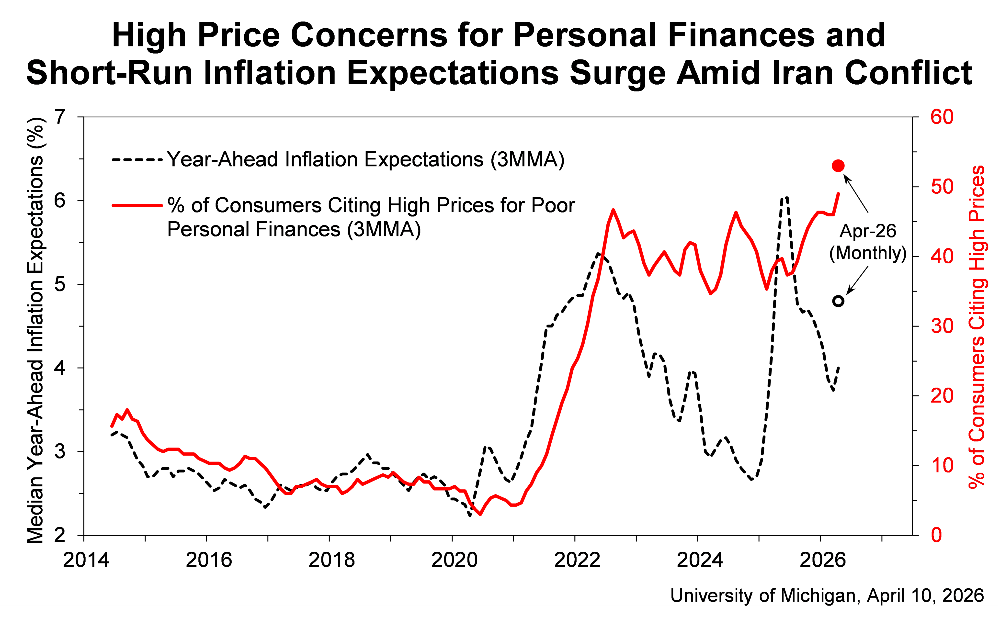
The University of Michigan Consumer Sentiment Index this month recorded a precipitous drop to a historic low of 47.6%, well below expectations. In fact, it's the lowest number ever recorded for this important measure of how consumers are reacting to and anticipating economic strains.
There is a great deal to unpack about what this means for the current state of the US economy but, also, what it means for customer experience and business leaders who are navigating these difficult waters and balancing what’s best for their business with what’s best for their customers.
The University of Michigan’s Consumer Sentiment Index consists of two sub-indexes: Current Economic Conditions Index (CECI) reflecting consumers’ current views of their financial situation and the Consumer Expectations Index (CEI) which measures their outlook for the future.
Prior to the April 2026 measurement of 47.6, the lowest ever reading (50) had occurred in the summer of 2022 triggered by the unease caused due to inflation.
Why is this important? Because policy makers, the Fed, businesses and investors use this as a leading indicator of how Americans are spending, saving and planning their finances. And right now, with both current conditions and expectations posting double digit declines month over month, the outlook is not positive.
According to the data, everyone. Age, income and political party demographics all had setbacks in sentiment, many citing the Iran conflict as the primary driver of unease. The volatility of the financial markets and increases at the gas pump are driving even middle- and higher-income demographics to large drops in sentiment.
Other indicators of widespread economic pain — unemployment, inflation and stock market performance — are all demonstrating resiliency which makes this consumer sentiment even more jarring. Folks who watch consumer behavior closely are likely noting that the psychological factors that come with geopolitical turbulence are blurring the line between objective, observable conditions and subjective perception that can best be described as negative “vibes.”
While maddening to some who view the measurable data as sacred, the unsettled undercurrent of political and psychological disarray is likely driving some of this uncertainty and anxiety. There’s also a clear gap, highlighted by the data in the Expectations Index, that shows that while many are weathering the current cost challenges, they are bracing for difficult times ahead. This leaves the Fed at a crossroads of trying to navigate rate policy while expectations point to longer term inflation.
Bad vibes indeed.
Related Article: End of the Price Game: What Marketers Must Do Next
To that end and despite the divergent signals, there are shifts we can expect to see. Discretionary and durables spending (vehicles, appliances, furniture, etc.) could go down along with spending on luxury goods and travel. More people are saving and waiting to spend, trying to control their own financial destinies. As gas prices rise, the cost of driving to the beach starts to get as daunting as a plane ticket might be. And your slightly out-of-date iPhone might start to seem more palatable than the cost of the upgrade.
Companies, and experience leaders, need to read the room. With customer trust being critical to consumers when it comes to brand loyalty, getting out ahead of these conditions with thoughtful strategies and deliberate messaging will be a critical differentiator. Meeting consumers in this moment, acknowledging the challenges and demonstrating that you are plugged in and want to provide strategies to help consumers maximize their finances and navigate this period of uncertainty: these are tactics that will resonate.
Specifically:
There is no better time to innovate around the specific needs of your customers than during times of challenge when consumers are already reacting in real time.
While consumer sentiment is just one of many indicators of the health of the economy, this recent dip reflects a population of consumers who are voicing real trepidation about inflation, political divisiveness and financial fragility. Business, political and financial leaders should be on notice that consumer psychology needs to be taken seriously. Investing in capabilities that can create deeper understanding of your target consumer might be the best investment you can make at a time when knowing what matters to them is mission critical.
Another, bigger question is what will it take to restore consumer confidence? You can safely bet that a lot of folks who never paid much attention to Michigan’s consumer benchmarking will be sitting up and taking notice when the May reading rolls in. The April surveys were nearly completed before the April 7 US-Iran cease fire with was announced, a data point that may have buoyed some people’s sentiment.
But with the hopes for quick resolution to that conflict now fading, could we see the reading sink even lower? It’s important to note that even if there is a rally in May with a much improved reading, the smart money (pardon the pun) will be on the organizations and leaders who are looking at a well-rounded range of economic, behavioral and psychological indicators that reflect the nature of consumers as more than data points.
 Learn how you can join our contributor community.

Trish is an experience and innovation executive, practitioner and speaker who has spent the past 15 years driving cultural transformation and customer advocacy and employee engagement across diverse industries such as insurance, pharmaceutical distribution and financial services. Trish has led research and insights teams, implementing and evolving customer strategy, consumer insights and competitive intelligence capabilities.