Editorial
Research Report
Building the Case for Modern Public Sector Messaging


Conversational voice AI doesn’t have a capability problem. It has a trust problem.
For many customers and employees, hesitation isn’t about what the technology can do today. It’s about what it didn’t do well in the past. Early voice AI experiences were often frustrating, rigid and ineffective. They failed to understand intent, trapped users in repetitive loops and frequently ended in escalation to a human anyway.
Those interactions didn’t just create inconvenience. They created skepticism. And once trust is lost, adoption becomes an uphill battle.
The irony is that conversational voice AI has evolved dramatically. According to Gartner, conversational AI is expected to reduce contact center labor costs by billions annually, while a growing percentage of customer interactions are already being handled through AI-assisted channels. Meanwhile, Forrester continues to identify AI-powered self-service as a key investment area for customer experience leaders focused on efficiency and satisfaction.
The technology is improving rapidly. But trust isn’t built by technology alone.
To understand why, it helps to look at another transformative innovation that faced the same challenge more than a century ago.
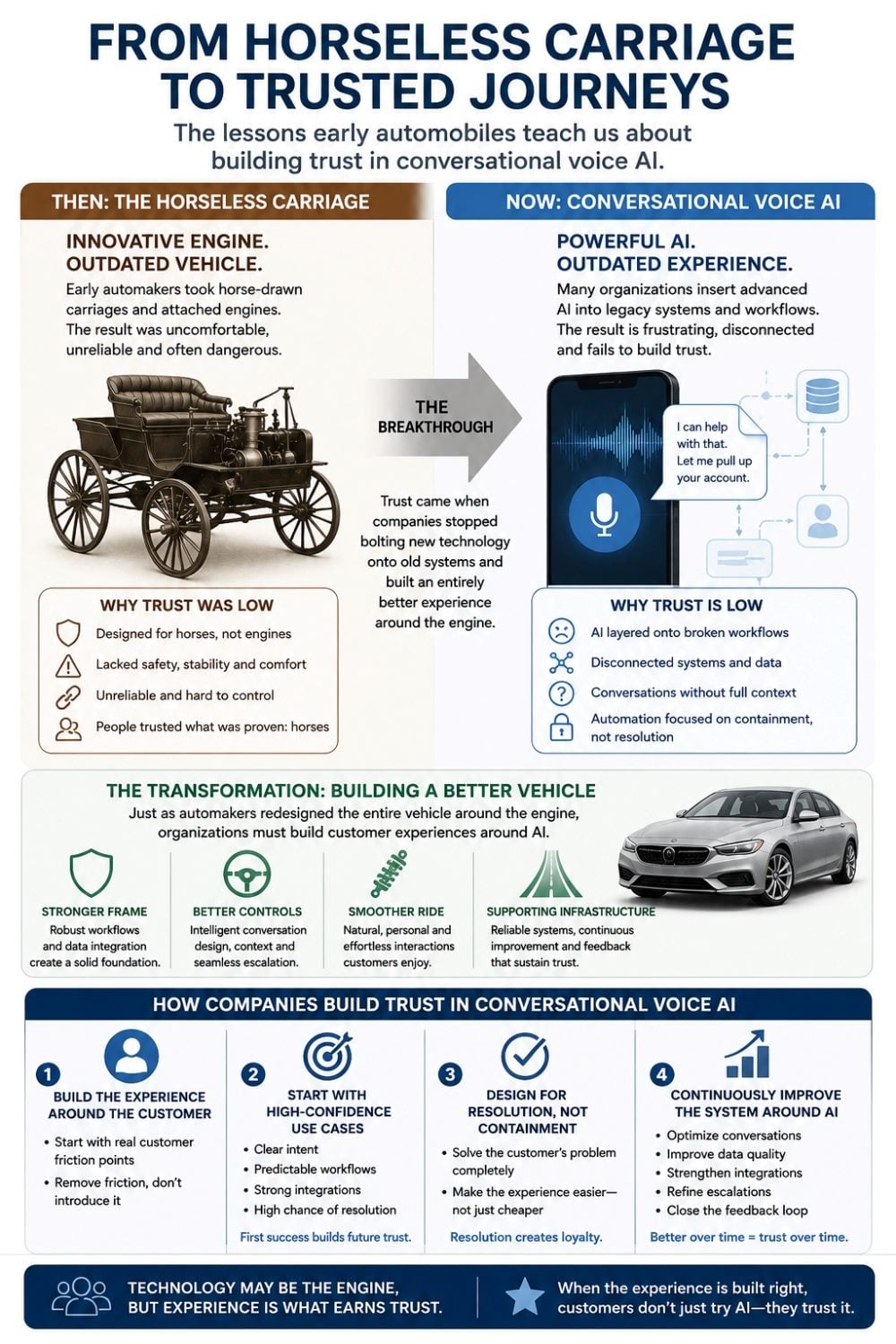
When automobiles first emerged in the late 1800s and early 1900s, manufacturers didn’t initially rethink transportation. They simply took existing horse-drawn carriages and attached engines to them. That’s where the term “horseless carriage” came from.
The problem was that those carriages had been designed for horses, not engines. They lacked the structure, stability and safety needed to handle speed and mechanical power. Early vehicles were unreliable, uncomfortable and often dangerous. People trusted horses because horses were proven.
The automobile engine may have represented innovation, but the experience surrounding it wasn’t ready for mainstream trust. The breakthrough didn’t come simply because engines became more powerful. It came because manufacturers eventually redesigned the entire experience around the engine:
In other words, trust came when companies stopped bolting new technology onto old systems and started building an entirely better structure around it. That’s the exact challenge organizations face with conversational voice AI today.
Related Article: The Acceleration of Voice AI: Where Customer Service Goes From Here
Many companies are approaching conversational AI the same way early automakers approached engines: by inserting powerful technology into outdated customer experience structures.
The result?
When that happens, even advanced AI feels frustrating. The issue isn’t the intelligence of the engine. It’s the design of the vehicle carrying it.
Modern AI is incredibly capable. Large language models and natural language understanding systems can now interpret intent, manage dynamic conversations and complete increasingly sophisticated tasks. McKinsey & Company has reported that organizations implementing AI thoughtfully in customer care are seeing meaningful gains in operational efficiency and customer satisfaction.
But customers don’t experience AI as a technical model. They experience the entire interaction. And trust is formed around the experience, not the underlying technology.
The trust deficit in conversational voice AI largely comes from first-generation implementations that prioritized efficiency over usability.
Customers remember:
These weren’t isolated inconveniences. They became emotional friction points.
And voice interactions are uniquely sensitive because they feel personal. When a system fails to understand someone verbally, frustration escalates faster than it does through digital channels.
Research from PwC has consistently shown that customers value convenience and speed, but repeated poor experiences quickly erode customer loyalty. That emotional memory lingers long after the technology improves.
Today’s conversational voice AI is fundamentally different from the systems that created those frustrations.
The shift includes several major advancements:
Modern systems interpret meaning and conversational context instead of relying solely on scripted phrase matching.
Generative AI enables adaptive dialogue that feels significantly more natural and responsive.
AI systems can now integrate across channels and backend platforms, retaining customer context throughout the interaction.
The best implementations don’t just route customers, they solve problems. They can process transactions, modify reservations, authenticate users and complete tasks without human intervention.
This is the difference between attaching an engine to a carriage and designing a true automobile. The AI itself matters, but the surrounding architecture matters just as much.
Organizations building trust in conversational AI focus less on the technology itself and more on creating reliable, friction-free customer experiences that improve over time.
| Trust Principle | What It Means | Key Focus Areas |
|---|---|---|
| Build Around the Customer | Design AI experiences around customer needs rather than technology capabilities. | Reduce friction, shorten wait times and solve repetitive customer pain points. |
| Start With High-Confidence Use Cases | Launch AI where success rates are highest to build early trust and adoption. | Clear intent, predictable workflows, backend integration and strong resolution rates. |
| Design for Resolution, Not Containment | Focus on fully solving customer problems instead of simply deflecting contacts away from human agents. | Complete issue resolution, seamless support and customer convenience. |
| Continuously Improve the System | Trust grows when AI experiences become consistently better over time. | Conversation flow optimization, data quality, escalation handling, integrations and feedback loops. |
We are entering the phase where conversational AI capability is advancing faster than public perception.
That gap creates opportunity.
The organizations that succeed won’t necessarily have the most advanced AI models. They’ll be the ones that build the best systems around them:
Just as the automobile became trusted when manufacturers stopped thinking about engines alone, conversational AI will become trusted when organizations stop thinking about AI as the product itself.
AI is the engine. Customer experience is the vehicle.
And trust is built when the entire ride feels safe, reliable and worth taking.
 Learn how you can join our contributor community.

Brian Jeppesen is the Director of Contact Centers for Fertitta Entertainment, which includes over 600 Landry’s Restaurant brands, Golden Nugget Hotels and Casinos and the Houston Rockets of the NBA.
Brian has over 30 years experience in the contact center industry, both internal contact centers and as a VP of operations in BPO contact centers, leading up to 2,500 agents both domestically and internationally.