Editorial
Research Report
Building the Case for Modern Public Sector Messaging


Most enterprise content models were not designed for machines to interpret. They were designed to render pages.
That distinction is becoming a problem.
As AI systems increasingly interact with enterprise platforms — through copilots, search assistants, AI agents and automated workflows — the gap between "structured enough for display" and "structured enough for reasoning" is becoming difficult to ignore.
Editor's note: Key questions surrounding how enterprise content architecture affects AI readiness, workflow orchestration and operational execution.
Not necessarily. Many organizations can improve AI readiness incrementally by restructuring high-value content types and introducing stronger modeling discipline. Entity modeling treats information as reusable objects with attributes, relationships and metadata instead of static webpage components.AI-ready content is explicit, structured and contextual. Critical information lives in defined fields, relationships are queryable and metadata provides operational context.Rich text works well for presentation but often obscures meaning for machines. AI systems struggle when business rules, dependencies or eligibility information remain buried inside paragraphs.Metadata provides context that helps AI systems determine applicability, relevance, priority and operational constraints.
Many organizations assume that having a headless CMS or structured fields makes their content AI-ready. In practice, that structure is often superficial. It supports layout and delivery, but not interpretation or action.
The result is predictable: AI systems can summarize content, but they struggle to use it.
This is not a limitation of AI. It is a limitation of how content is modeled.
Most content models still follow a page-centric mindset, even when implemented in modern systems.
A typical example might include:
This model works well for presentation. It allows teams to publish and manage digital experiences efficiently.
However, from an AI perspective, most of this content is ambiguous.
Key information is embedded inside text. Relationships between pieces of content are implied rather than defined. Business intent — such as who something is for, when it applies or what should happen next — is rarely explicit.
Humans can infer these details. AI systems cannot reliably do so without additional structure.
For content to be usable by AI systems, it must move beyond presentation and become explicit, structured and contextual. This is equally true for digital experience platforms that increasingly serve as the foundation for AI-driven interactions.
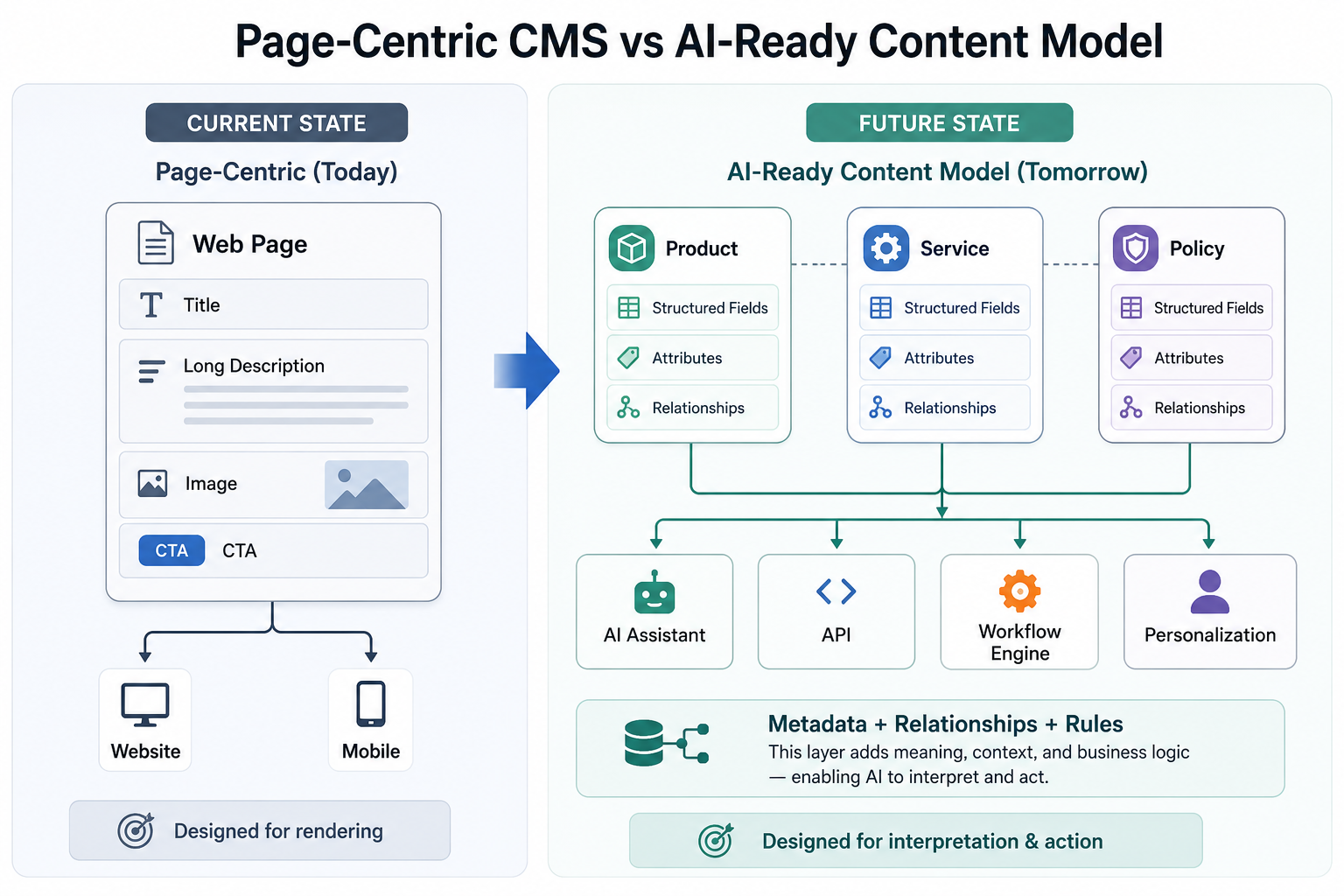
Editor's note: AI systems increasingly require content built for reasoning and action, not simply presentation. Three structural shifts help enterprise content become more usable for AI.
| Shift | Traditional Approach | AI-Ready Approach | Why It Matters |
|---|---|---|---|
| From Pages to Entities | Pages designed primarily for rendering and presentation. | Content modeled as entities — distinct objects with defined attributes such as:
| Allows content to be reused, queried and interpreted across multiple systems and interfaces. AI systems can work with discrete pieces of information instead of parsing entire pages. |
| From Rich Text to Meaningful Fields | Critical information buried inside rich text paragraphs describing features, conditions or limitations. | Instead of:
| Rich text offers flexibility for creators but obscures meaning for machines. Structured fields make key data points accessible and usable beyond presentation. |
| From Implicit to Explicit Relationships | Relationships exist only through hyperlinks or manual references inside content. | Define relationships explicitly:
| Explicit relationships help AI systems:
|
An AI agent cannot reliably orchestrate workflows if business rules, dependencies and operational context remain buried inside rich text fields.
Even with structured entities and defined relationships, one critical element is often missing: context.
AI systems need to understand not just what something is, but when and why it matters.
This is where metadata becomes essential.
Examples of contextual fields include:
These fields provide signals that help AI systems make decisions rather than simply retrieve information.
Related Article: Emotional Metadata for Martech: How Do You Feel About It?
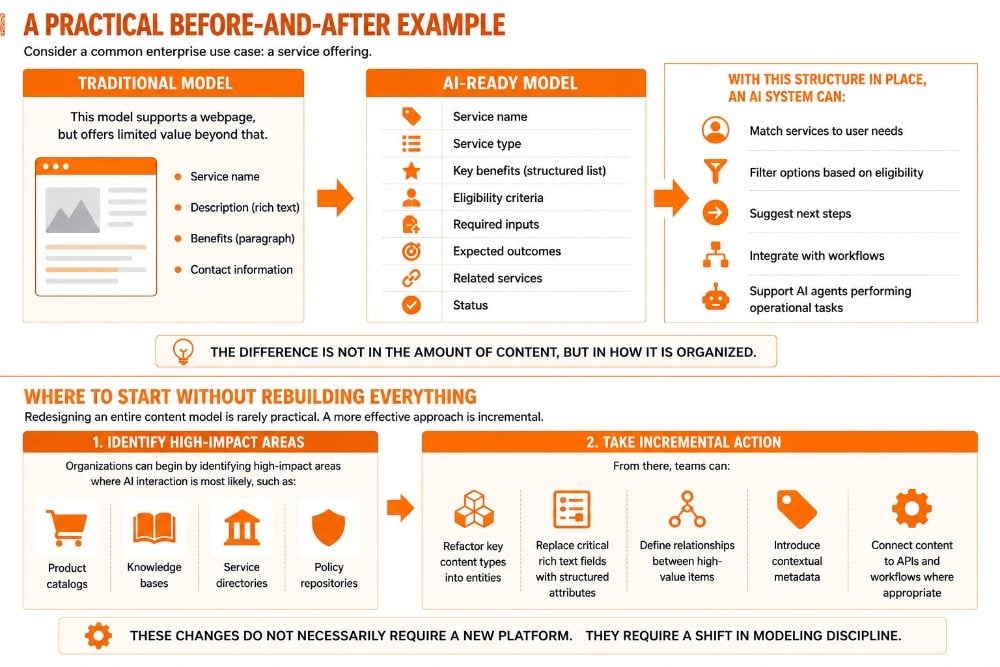
Consider a healthcare organization offering multiple diagnostic services across locations.
In many cases, service information is stored as webpage content:
While this works for publishing webpages, problems emerge when organizations introduce AI assistants or automated patient workflows.
For example, a patient may ask:
"Can I book this scan directly, or do I need a physician referral?"
If referral requirements, preparation rules and eligibility conditions are embedded inside paragraphs of rich text, the AI system may generate incomplete or inconsistent guidance.
Now consider the same service modeled as structured entities:
With explicit structure and relationships, AI systems can:
The difference is not the amount of content. It is the clarity of the content model.
The role of content within enterprise systems is changing.
It is no longer limited to informing users or supporting digital experiences. Increasingly, content is becoming an operational input for decision-making systems — and a core dependency for agentic customer experience strategies that rely on accurate, structured data to execute in real time.
AI does not simply consume content. It depends on it to function correctly. As organizations adopt AI copilots, orchestration layers and autonomous agents, the quality of AI outcomes becomes directly tied to the quality of content modeling.
Systems built primarily for presentation may still generate responses, but they will struggle to support accurate decisions, automation and workflow execution.
Organizations that invest in structured, contextual and connected content will enable AI systems to do far more — from guiding users to orchestrating operational processes.
AI readiness is often discussed in terms of models, infrastructure and integration. Content is frequently overlooked.
Yet content is where meaning resides.
Designing content models that AI can actually use is not a future concern. It is becoming a foundational requirement for organizations looking to move beyond basic automation toward intelligent execution.
The shift is subtle but significant:
The next generation of enterprise CMS platforms will not be evaluated only on publishing capabilities, but on how effectively their content models support machine reasoning, workflow orchestration and action.
The sooner content models reflect that shift, the more effective AI systems — and AI agents — will become.
 Learn how you can join our contributor community.

Ashutosh Kachot is Vice President at Addact Technologies, where he leads digital engineering partnerships and platform delivery across enterprise CMS and composable digital experience platforms. With over 17 years of experience spanning healthcare technology, enterprise software, and global product strategy, he brings a practitioner’s perspective to building scalable, real-world digital systems.