Editorial
Research Report
Building the Case for Modern Public Sector Messaging


Years ago, I sat in a meeting at a telecom software company, listening to the team walk through how we explained our product to customers. I am a relatively bright person. I could not understand a single thing they were saying.
The entire conversation was acronyms. Worse, half of them were acronyms we had invented ourselves. I kept thinking I needed some kind of translating tool just to follow along, let alone grasp the concept underneath.
And this was how we were explaining our product to the market.
Yes, we sold to engineers. But our product was a small piece of what those engineers cared about on any given day, and they did not speak our internal acronym language either. We had built a vocabulary that worked beautifully inside our four walls and almost nowhere else.
That was 25 years ago. I have watched the same scene play out numerous times.
This is what happens when smart people get comfortable talking to their own tribe and then get frustrated when the rest of the world cannot keep up.
This is the hardest conversation I have with marketing teams. Not how to write better copy. Not which channel to invest in. It is how to translate deep expertise into outcomes the customer recognizes and cares about.
By the time I sit down for a positioning workshop with a client, there is no shortage of material. Product sheets are thorough. Feature lists are detailed. The team can walk through exactly how everything works, often with impressive precision.
None of that is wrong. But it is almost always inward-facing. It reflects how the company understands the product, not how the customer experiences it.
Editor's note: Key questions surrounding why B2B messaging often fails to connect with customers and how marketing teams can improve positioning clarity.
Many organizations become too fluent in their own internal language, processes and product architecture. That familiarity creates messaging that makes sense internally but feels confusing or irrelevant to buyers. Strong positioning starts by translating technical capabilities into customer outcomes. Teams should focus on the problems customers are trying to solve and what changes after implementation.Customer conversations often provide the strongest positioning signals. Sales calls, support tickets, onboarding discussions and customer interviews reveal the language buyers naturally use to describe challenges and success.Features alone rarely communicate business value. Customers evaluate products based on outcomes like efficiency, reduced risk, improved customer experience or revenue impact.People outside the product organization are more likely to recognize confusing language, hidden assumptions and gaps between technical explanations and customer understanding.
So I start asking what should be straightforward questions. Why does this matter to your customer? What problem does this solve in their day-to-day world? What is different for them after they use it?
That is usually where the conversation shifts. Instead of answering directly, the team goes deeper into the product. More explanation. More detail. More features. Not because they are missing the point, but because that is where they feel most confident.
I understand that instinct because I have been on both sides of it.
When I first joined that telecom software company, I was the outsider in the room. The acronyms were unfamiliar, the internal language strange. I had to translate everything just to follow a meeting, and that translation work was an advantage. It forced me to keep asking the question every customer eventually asks. So what?
Then something subtle happened. The longer I stayed, the more fluent I became. The acronyms stopped feeling like code and started feeling like language. The internal way of describing the product started to feel normal.
And without realizing it, I stopped translating.
Related Article: The AI Content Reset: What B2B Marketers Must Stop and Start in 2026
That shift is small, but it is the whole problem. What feels clear internally is rarely clear externally. Customers are not evaluating your product in isolation. They are evaluating it against their own pressures, priorities and constraints. They are not buying features. They are buying outcomes. Time saved. Risk reduced. Revenue gained. Friction removed.
If your marketing does not connect those dots, it forces the buyer to do that work themselves. Most will not.
What is interesting is that the strongest messaging rarely comes from product documentation. It comes from conversations.
It shows up when a customer mentions how much time they used to spend before implementation. When a sales rep explains where deals stall. When a leader admits that the reason customers actually buy is not the reason the product was originally built.
Those moments are easy to overlook, and they are where the real insight lives. The work is listening for those signals and pulling them into the open. Not by asking what the product does, but by asking what was happening before, what was frustrating, what was at risk, and what is different now.
This kind of thinking requires a shift in perspective. You are asking teams to step outside of how they see their product and view it through someone else's reality. That is uncomfortable. It means letting go of internal language, questioning long-held assumptions and recognizing how easy it is to become fluent in your own point of view.
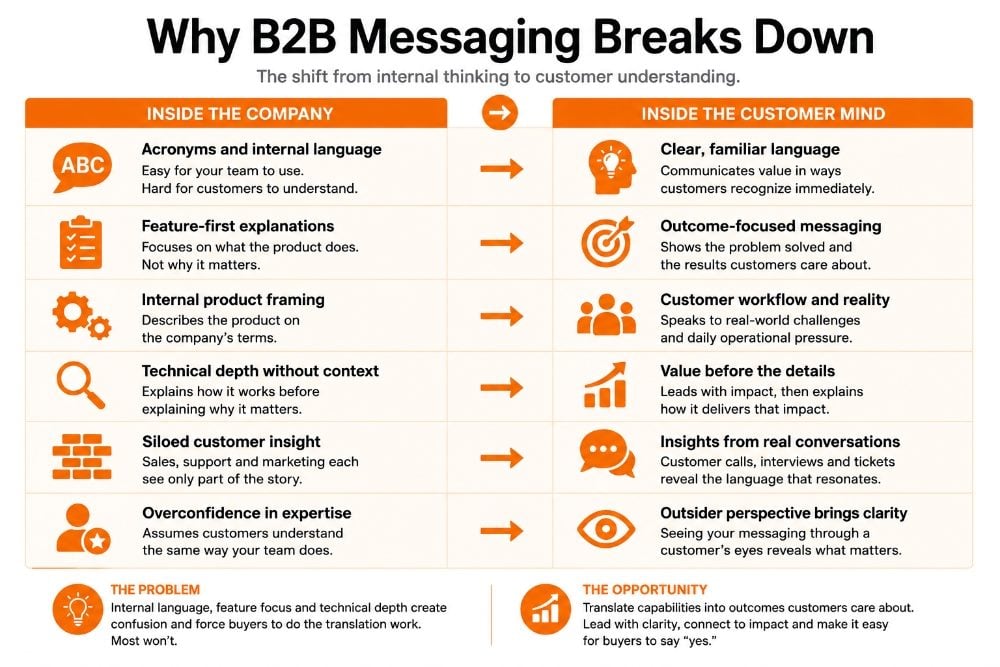
In most organizations, there is no structured way to do that. Sales sees one part of the story. Support sees another. Marketing is left trying to piece it together. So the default is to retreat back to the language of features. It feels safer. It is rarely effective.
The companies that stand out are not always the ones with the most advanced products. They are the ones that can clearly answer a much simpler question.
Why should anyone care?
Companies often default to explaining products through internal logic instead of customer reality.
| Internal Habit | What Customers Experience | Better Approach |
|---|---|---|
| Heavy acronym use | Confusion and cognitive overload | Use customer-facing language tied to business outcomes |
| Feature-first explanations | Difficulty understanding value | Lead with customer pain points and results |
| Internal product framing | Messaging disconnected from daily workflows | Anchor messaging in operational realities customers recognize |
| Technical depth without context | Buyers forced to interpret relevance themselves | Explain why the capability matters before explaining how it works |
| Siloed customer insight | Fragmented understanding of customer needs | Pull insight from sales, support and onboarding conversations |
| Overconfidence in expertise | Blind spots around clarity and accessibility | Review messaging through an outsider perspective |
| One-time positioning exercises | Messaging becomes stale and disconnected | Continuously refine positioning using customer feedback loops |
If this sounds familiar, the answer is not to simplify your product. It is to change your perspective.
Strong marketing does not come from explaining your product more clearly.
It comes from making your product matter more clearly.
And that only happens when you are willing to step outside of your own expertise and see it through the eyes of the people you are trying to reach.
 Learn how you can join our contributor community.

With over 20 years of experience, Colleen Lonsberry has built a career transforming B2B technology companies—whether manufacturers, distributors, or SaaS providers — into market leaders. As a strategic visionary, Colleen is known for bridging the gap between hard work and smart strategy, consistently architecting marketing teams, roles, and groundbreaking initiatives that drive business success.