Editorial
Research Report
Building the Case for Modern Public Sector Messaging


I just got back from a CX conference in San Diego. Every session, every booth, every hallway conversation was about AI. Agentic agents. Voice copilots. Generative everything. About an hour into a series of panels on autonomous agents, it hit me that I hadn’t heard the word “customer” in a while.
That’s not a knock on the agenda. The energy in our field is around AI right now, and that energy isn’t misplaced. AI is going to reshape how customer experience gets delivered. CRM did. The cloud did. Mobile did.
But I left the conference with a question I think more leaders should sit with. If AI is solving for speed and scale, what is the new scarcity?
Key questions CX leaders are asking as AI reshapes customer relationships and raises the value of human recognition.
Modern workflow automation and CRM-connected fulfillment tools make it easier to trigger personalized gestures like notes, cards or follow-ups without requiring large manual processes.AI should handle routine and low-emotion interactions while human agents focus on moments that shape relationships, such as service recovery, life events or emotionally sensitive situations.As AI makes speed, personalization and operational efficiency easier to scale, emotionally resonant customer recognition is becoming more valuable. Customers increasingly remember experiences that feel intentional and human.Points, discounts and perks are relatively easy for competitors to replicate. Emotional loyalty tends to be more durable because it is tied to recognition, trust and memorable interactions rather than transactional incentives.Customers often value gestures that appear thoughtful and intentional. Detectable effort signals that a real person cared enough to act, which creates stronger emotional connection than fully automated interactions.
My answer is recognition. Customers don’t actually need the next thing faster. They need to feel like a real person, somewhere, noticed them. As channels proliferate and content multiplies, the gestures that cut through are the ones that feel like a human chose to make them.
This isn’t a new idea. Bain has been writing for years about emotional connection as a stronger predictor of customer behavior than customer satisfaction. Forrester’s CX Index work points in the same direction.
'What’s changing is that AI is making the rational layer of CX a commodity. Resolution time, response time, personalization at scale, all of that is getting cheap fast. Which throws the things that don’t get cheap into much sharper relief.
For leaders building budgets and roadmaps right now, that shift is the one I’d argue matters most. Pour everything into the AI-able half of the experience and you’ll have a highly efficient customer base that feels nothing in particular about your brand. You can win in that mode for a while. You won’t win for long.
Related Article: The Evolution of Customer Loyalty Programs in an Always-on World
There’s a phrase I keep using with clients. Loyalty beyond reason. It’s the loyalty a customer can’t fully justify on a spreadsheet. The kind that survives a price hike, an outage or a slicker offer from a competitor. Most leaders want their brand to have it. Almost none of them have a deliberate program for building it.
The reason is that most loyalty programs sit in the rational layer. Points. Tiers. Discounts. Perks. Those work, up to a point. The ceiling is that they’re easy to copy. If your loyalty advantage is 12 cents back per dollar and a free birthday drink, the next brand that funds 12.5 wins. That isn’t loyalty. That’s a procurement decision your customer renews every month.
Loyalty beyond reason gets built somewhere else, in the emotional layer. And the emotional layer has its own structure. It depends on three things:
AI is excellent at the first one. It’s getting acceptable at the second. By design, it cannot really do the third. Detectable effort is exactly what disappears when something is generated. So the leaders who win on emotional loyalty over the next few years will be the ones who use AI to find the moments and then put something distinctly human into the response.
Growth and loyalty aren’t different problems. They’re the same problem on different time horizons. The cheapest customer to grow is the one you already have. Recognition is how you say so.
The second strategic mistake I see almost everywhere, and the one I’d most like leaders to revisit before they finalize their AI roadmap, is treating the contact center as a cost center.
For 20 years, contact center strategy has been driven by handle time, deflection and cost-to-serve. Every operational metric pulls in one direction. Get the customer off the phone faster. Get them into self-service. Get the human out of the equation. AI didn’t invent that incentive structure. It just made the math more aggressive.
But every contact center conversation is, secretly, a moment of truth. The customer just told you something. They’re moving. They lost a parent. They got the new job. The storm took out the power. The policy is up for renewal. That information is the most valuable signal your loyalty program will get this quarter, and at most companies it dies inside the call recording.
Reframe the frontline as a relationship venue and the strategic posture flips. AI handles the volume: the routine, the predictable, the low-emotion. Humans get matched to the moments that actually shape loyalty. The recovery. The celebration. The hard one. And the agent gets a way to extend that conversation past the call, with a follow-up gesture, a card, a note, that turns a single interaction into the start of a relationship.
There’s also been a shift in how teams operationalize that kind of follow-up. What used to require manual effort (drafting, printing, mailing) can now be triggered as part of the workflow, with pre-written messages and fulfillment handled behind the scenes. Whether through internal programs or external tools like Care by Hallmark, the mechanics have become much easier.
That matters less as a technology story and more as an organizational one. When the barrier to acting on a human moment drops, agents actually do it. And when they do, customers respond, often unprompted. We’re hearing from some teams that customers now reference those gestures in later conversations. They are calling, or even writing back just to say thank you, which leads me to the second problem this reframe helps with: frontline attrition.
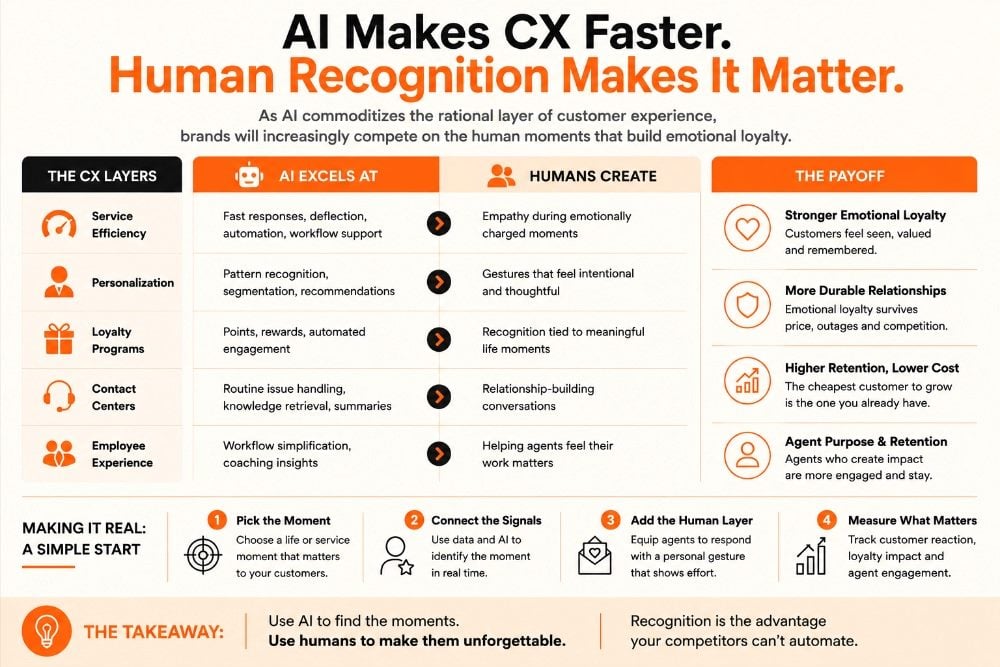
Agents who feel like script-readers leave. Agents who feel like the moment they just navigated mattered to someone, stay. The same intervention that lifts customer loyalty often lifts employee retention, and almost no one budgets it as both.
Related Article: What Really Defines AI-Mature Contact Centers in 2026
Every time I make this argument with a client, the first reaction is the same. They love it in principle. Then they imagine someone hand-addressing 400 envelopes a month, or scaling that across a national agent force, and the program dies before it starts. The romance of the handwritten note runs straight into the reality of an enterprise operating model.
That objection used to be valid. It mostly isn’t anymore. The same automation wave that’s commoditizing the rational layer of CX has, over the last few years, made the logistics of the emotional layer dramatically easier. Sending cards through platforms is a way to give every agent or advisor in an organization access to a branded card library, pre-written sentiments, CRM-connected lists and tools that digitize a person’s actual handwriting so it can be used at scale. Drop-ship and mail-for-me services handle the postage. What used to be a heroic ops project is, increasingly, a few clicks inside a workflow the team is already running.
The strategic point isn’t about any one platform. It’s that the operational excuse for not investing in human-feeling moments has aged out. If your last serious look at the category was three or four years ago, the math has changed. So has the question leaders should be asking. It’s no longer “can we afford to do this?" It’s “can we afford to keep treating recognition as something we don’t budget for?"
Most automation in our space promises to take the human out of the workflow. This kind of automation removes the friction that was preventing the human moment from happening in the first place.
Don’t start with the program. Start with the moment.
Pick one moment of truth in your customer journey where the relationship matters more than the transaction. Onboarding. Service recovery. A milestone. A first-year anniversary. Ask what a human gesture would look like in that moment. What would feel surprising. What would feel slightly more than the brand owed. That’s the test.
Then pilot it small. One segment. One occasion. One team. Measure what changes. Not just NPS, but the unprompted responses you start seeing. The loyalty programs that actually win aren’t the ones launched enterprise-wide on day one. They’re the ones that started with one card and earned the right to scale.
Speed has stopped being a real differentiator. Whether the response feels like it came from a human, or just a system, is. That’s the call CX leaders are making right now, whether they realize it or not.
 Learn how you can join our contributor community.

Sean Albertson works with leaders to strengthen experience, alignment, and execution across the organization. Through keynotes and workshops, he helps teams build shared language for customer and employee experience, decision-making, and business transformation.