Editorial
Research Report
Building the Case for Modern Public Sector Messaging


Marketers rarely struggle with a lack of data. The real challenge is knowing what to do with it.
Dashboards are full, reports are polished and KPIs are tracked down to the decimal. Yet many brands still miss the deeper signal hiding beneath all that activity: how customers actually feel, and why those feelings translate into loyalty, advocacy or indifference.
The CMOs who break through put data to work early and often, using it to shape ideas instead of simply evaluating results. In their hands, data becomes creative fuel, guiding teams toward emotional priorities and the experiences built around them. Every decision is more intentional, grounded in what their audience values, fears and wants to feel.
That’s where data shifts from measurement into direction.
Editor's note: Marketing leaders increasingly recognize that traditional engagement metrics only reveal part of the customer story. These questions explore how emotional insight and behavioral signals reshape modern customer experience strategies.
Traditional metrics do a good job of telling you what happened. Clicks, conversions and open rates all serve a purpose. But they rarely explain why a moment resonated or fell flat.
Jeff Snyder, founder and chief inspiration officer at Inspira, a marketing agency that specializes in helping brands with effective experiential marketing, put it this way: “The difference between a transaction and a relationship comes down to what you’re measuring. Conversations tell you what someone did, but emotional alignment tells you why it mattered to the consumer.”
That distinction matters more than ever as customer expectations evolve. People aren’t just evaluating brands based on utility or price. They’re asking, often subconsciously, “Does this feel like me?” and “Do they understand me?”
Answering those questions requires looking beyond surface-level engagement.
These signals often carry more weight than traditional metrics because they reflect intentional behavior, not passive interaction.
Related Article: Emotional Metadata for Martech: How Do You Feel About It?
One of the most overlooked shifts in customer behavior is happening off the public feed. Not every meaningful interaction shows up as a like, comment, or repost. Some of the strongest signals of affinity now happen in private spaces: direct messages, text threads, saved posts, screenshots and forwarded links.
This “quiet sharing” is easy to miss if you’re only tracking visible engagement. But it’s often where genuine advocacy lives.
Think about the last time you shared something that truly resonated. There’s a good chance you didn’t broadcast it to everyone. You sent it to a colleague, a friend, or a small group who would “get it.” That’s not simply engagement; it’s endorsement.
CMOs who rely solely on public metrics risk underestimating their most valuable moments of connection. The brands that recognize and measure these subtler behaviors gain a clearer picture of what actually builds belonging.
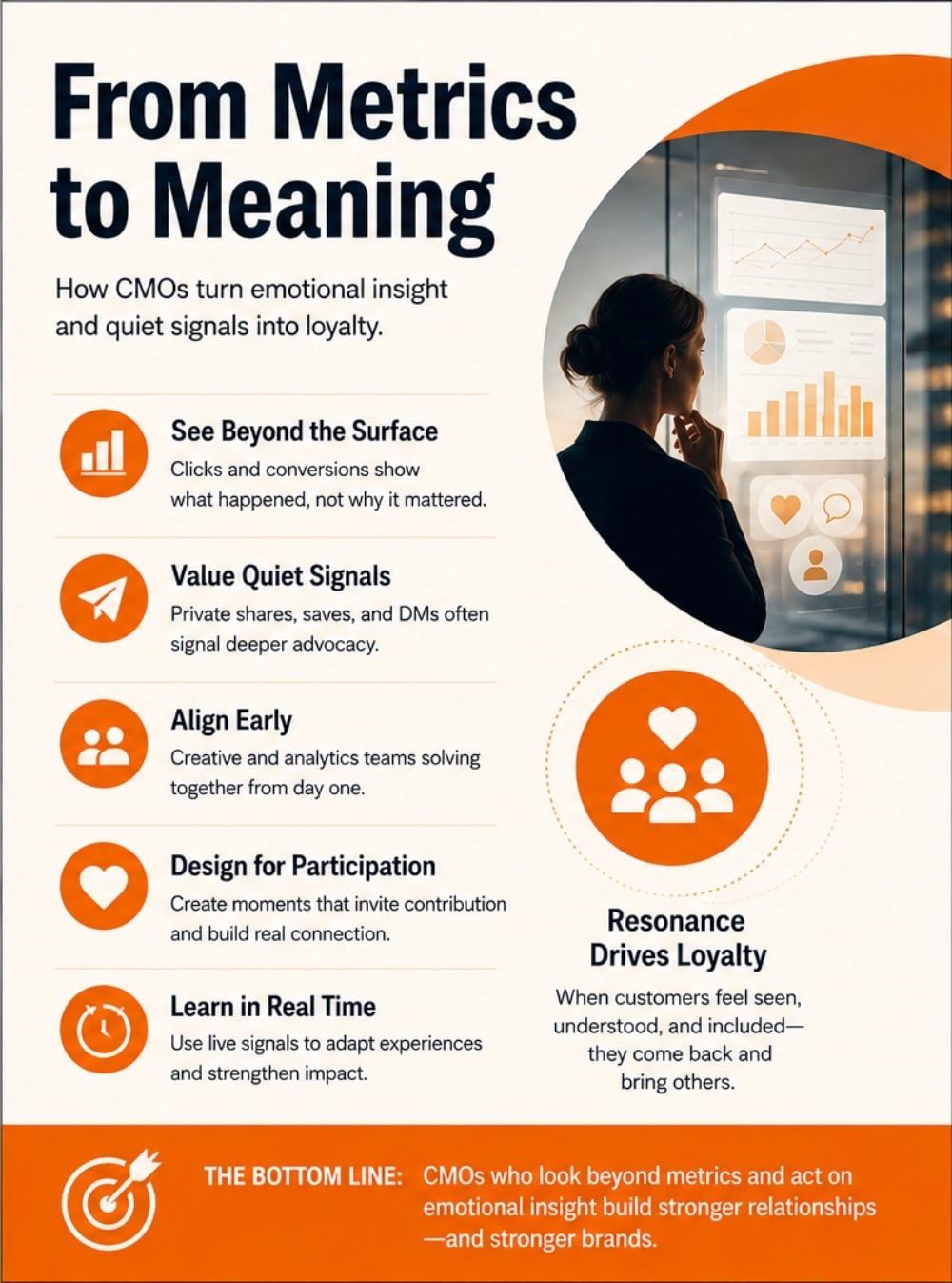
Understanding emotional signals is only useful if it informs what you do next. That starts by connecting behavioral data with emotional outcomes so teams can design experiences that resonate on a deeper level. It’s not about replacing analytics with intuition, but making sure the two are working together.
When applied effectively, this approach helps teams:
This is where creative and analytics teams need to stop operating in sequence and start operating in sync.
Too often, analytics enters the picture after the campaign is already live. At that point, it’s validating decisions rather than shaping them.
Snyder described a different approach: “The most effective campaigns are built when data and creative are solving for the same problem from day one: What will make someone feel something, and how will we know it worked?”
That mindset changes how teams collaborate. Instead of handing off insights to creative teams as a starting brief, data becomes part of the ideation process itself. It helps define not only the audience, but also the emotional outcome the campaign is designed to achieve.
Traditional engagement metrics still matter, but leading marketing teams are pairing them with emotional and behavioral signals that reveal deeper customer connection.
| Traditional Measurement | Deeper Emotional Signal | What It Reveals |
|---|---|---|
| Clicks and conversions | Time spent and repeat engagement | Whether customers find lasting value or emotional relevance |
| Public likes and comments | Private shares and forwarded links | Stronger advocacy and trusted recommendations |
| Campaign reach | Depth of participation | How personally invested audiences become |
| Post-campaign reporting | Real-time learning and adjustment | Ability to improve experiences while engagement is happening |
| Sequential team workflows | Creative and analytics collaboration | More intentional campaigns built around emotional outcomes |
When emotional insight drives the strategy, execution becomes more dynamic. Experiences can be designed with specific moments in mind:
Just as importantly, these moments can be measured in real time. Instead of waiting for a post-campaign report, teams can adjust while the experience is still unfolding.
This kind of agility keeps campaigns relevant and responsive. It also ensures that insight isn’t static, but evolves alongside the customer.
The brands that win long term aren’t the ones that capture the most attention. They’re the ones that keep it.
That requires a shift in how success is defined. Volume still matters, but depth matters more. Reach is important, but resonance is what drives loyalty.
As Snyder noted, when teams align around both behavior and belief, “You’re no longer chasing attention; you’re keeping it.”
That’s the difference between a moment and a relationship. In a landscape where customers are constantly deciding what deserves their time, that distinction is what turns insight into a lasting advantage.
 Learn how you can join our contributor community.

Brittany Hodak is an award-winning entrepreneur, author, and customer experience speaker who has delivered keynotes across the globe to organizations including American Express and the United Nations. She has worked with some of the world’s biggest brands and entertainers, including Walmart, Disney, Katy Perry, and Dolly Parton.