Editorial
Research Report
Building the Case for Modern Public Sector Messaging


Every major shift in technology is really a shift in trust.
As businesses give technology more control over how they operate and how they show up in customers’ lives, trust becomes the deciding factor between adoption and abandonment. Just because a technology works doesn’t mean people are ready to rely on it. And when AI fails in front of a customer, it’s not a technical issue, it’s a brand issue.
That’s the tension leaders are navigating right now. AI is moving fast, and companies across every industry are deploying it to create content, personalize experiences and automate decisions at unprecedented scale.
The promise is real. But so is the risk.
The most important question facing AI today isn’t whether it’s capable. It’s whether it’s trustworthy enough to represent a brand with minimal human oversight, and what it actually takes to earn that trust.
Editor's note: Businesses deploying AI are discovering that customer trust, explainability and governance now matter as much as automation itself.
We already trust technology with some of the most critical parts of modern life. Algorithms help direct air travel, manage financial markets and optimize supply chains, and it’s often in ways consumers don’t fully understand.
AI, however, occupies a different position on the trust spectrum. Even when its effectiveness is proven, confidence in its output remains fragile. In healthcare, for example, AI can significantly improve diagnostic accuracy, yet 69% of Americans remain uncomfortable with healthcare companies using AI to diagnose patients. Algorithms can be powerful, but they don’t replace human judgment or empathy.
For businesses, this creates a clear mandate: AI-driven experiences must meet (or quickly reach) the same quality bar that customers expect from human-led ones. When accuracy slips or outputs feel off-brand, trust erodes. And once trust is lost, customers don’t just disengage—they leave.
Related Article: Your Customers Trust Humans More Than AI — Even When AI Is Right
AI is powerful, and its capabilities are advancing across the enterprise and public sector. We know that. But to stand the test of time, it also needs to be worthy of our trust. That responsibility sits with the people building these systems, starting from the earliest building blocks of the model.
When people explore something new, they want to understand how outcomes are produced. Technology is no different. People want to see how AI models arrive at their conclusions.
Transparency is especially important when across AI industry giants like OpenAI, DeepSeek, and Google, platforms have a tendency to hallucinate, generating false information and sharing incorrect data with users. This remains a critical barrier that companies must overcome to prove to consumers that the product or service they seek is still the same quality.
But when AI agents show their work, humans can fact-check outputs and intervene when needed. Plus, evaluation capabilities like thumbs up and thumbs down feedback, for example, allows developers to better understand what’s working and what’s not in real time, so they can develop stronger models that better reflect users’ needs.
By exposing the reasoning behind AI outputs, businesses can identify and fix errors faster, improve transparency, and ultimately build greater trust with their customers.
As organizations ask AI to take on more responsibility, generic models are no longer enough. Trustworthy AI must be purpose-built for the task at hand.
Subjective work—like matching a brand’s tone of voice or ensuring content complies with internal guidelines—requires different guardrails than objective tasks. AI agents trained for brand compliance, for example, can review large volumes of content against specific standards, saving teams time while improving consistency and reducing risk.
The opportunity is significant, but only if quality remains the priority. AI systems that are technically reliable won’t deliver long-term value unless their outputs match the specificity, nuance, and standards businesses have spent years establishing.
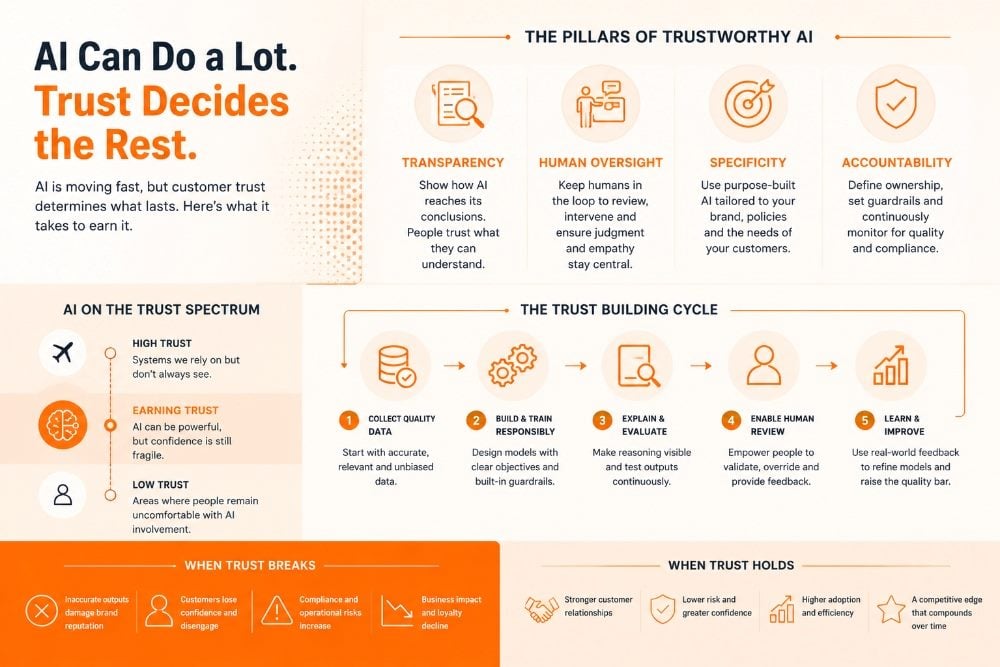
Organizations deploying AI at scale are discovering that trust, transparency and output quality are now business-critical concerns.
| Challenge | Why It Matters | Business Impact |
|---|---|---|
| AI hallucinations | Incorrect outputs reduce confidence in automated experiences | Brand damage and customer frustration |
| Lack of transparency | Customers and employees want to understand how AI reaches decisions | Lower adoption and skepticism |
| Generic AI models | Broad models may fail to reflect brand voice or compliance standards | Inconsistent experiences and operational risk |
| Weak human oversight | Unchecked AI outputs can amplify mistakes at scale | Escalating trust and governance concerns |
| Misaligned expectations | Customers expect AI experiences to match human-level quality | Customer churn and disengagement |
AI doesn’t need to be perfect to be useful. But it does need to be predictable, explainable and aligned with the expectations of the people it serves.
The companies that succeed with AI won’t be the ones that deploy it fastest. They’ll be the ones that treat trust as a core product requirement, not an afterthought. That means investing in transparency, designing for human oversight and building AI systems that reflect the realities of their customers and their brands.
The question isn’t how advanced AI can become. It’s whether businesses are building it in a way that earns the right to be trusted.
 Learn how you can join our contributor community.

Shafqat Islam is the President of Optimizely. He has worked in marketing technology since 2001, focusing on content management, marketing operations, and digital optimization.