Editorial
Guide
8 CX Survey Templates Built to Get Answers, Not Just Scores

While no one has claimed email marketing is dying for many, many years, some marketers have become increasingly concerned with performance declines, despite the channel generating returns on investment that are often at least twice as high as most other channels.
If your organization is concerned about your email marketing performance, here are some of the root causes I've been seeing that go beyond the usual economic or competitive pressures.
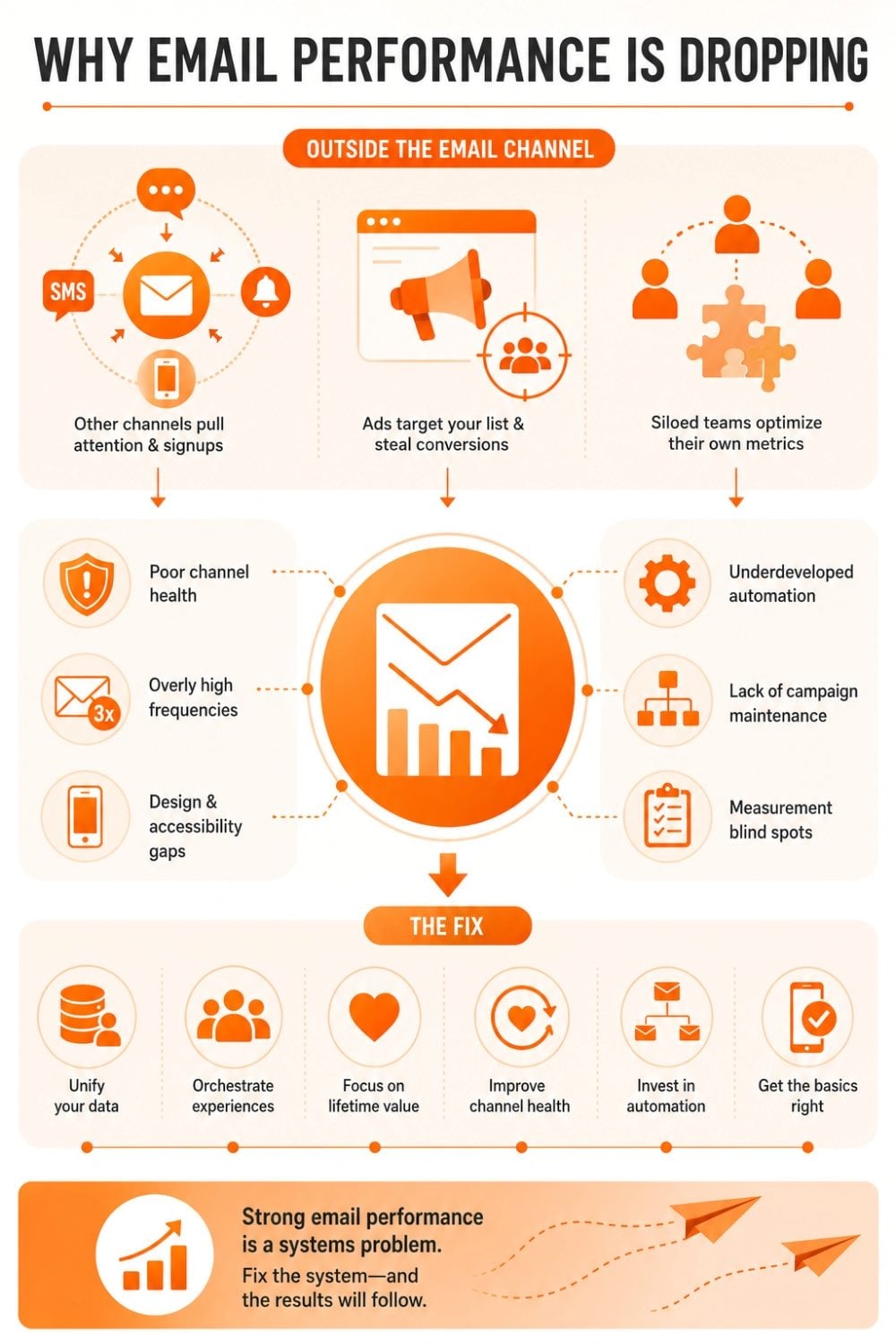
Email marketing doesn't operate in a vacuum. It's affected by all the other channels your brand operates, including SMS and push marketing.
As brands have ramped up those two channels in recent years, we've seen them undermine email marketing. Not only are some email signup forms replaced by SMS signups, which dampens email list growth, but the brand's email marketing campaigns are used to nudge subscribers to sign up for SMS and to download their mobile app, creating an opportunity for push opt-ins.
Of course, nudging customers to opt into additional channels is smart. I've found that customers who have opted into two or three of the major marketing channels (email, SMS, and push) are anywhere from two to nine times more engaged and valuable than single-channel subscribers. That's a huge opportunity.
However, if your messages across channels aren't thoughtfully differentiated and orchestrated to minimize redundancies, then you're just cannibalizing email for the sake of the other channels, instead of generating additional value.
It's also worth noting that while the email channel is expected to support the growth of SMS and push, that expectation is rarely reciprocated. It's nearly impossible to find examples of brands using their SMS and push programs to nudge those subscribers to sign up for email.
Related Article: 4 Stakeholders Every Email Marketing Program Has & What They Want
Just as other channels can cannibalize email marketing, advertising can, too. For instance, I've seen marketers alarmed by a sudden downshift in email performance who then discover that their advertising team used their email list to power targeted digital ads. It's not that this can't be effective, but in many ways they paid money to generate some conversions they would have captured with their owned media in time.
It also clouds attribution by making the ad team look like superstars. But it's only because they've targeted consumers who are highly qualified thanks to the nurturing the email marketing program has done. At the same time, the cannibalization puts budgetary pressure on the email team, essentially penalizing them for successful nurturing.
Sometimes the advertising, SMS and push teams are aware that they're simply shifting conversion attribution from one part of the ledger to their part of the ledger, and do it because they're rewarded for doing it. Sometimes, they're unaware.
Regardless, it's a failure of the brand to adopt a true omnichannel marketing approach that focuses on increasing customer-centric metrics such as customer lifetime value rather than channel-specific metrics, which allow gamesmanship across channels.
As brands grow additional channels beyond email, it becomes increasingly vital to unify and orchestrate as many marketing channels as possible from a single, highly integrated platform. Along with deploying a customer data platform, adopting a best-of-suite approach to your martech stack allows tighter orchestration, more cohesive messaging and performance visibility that reveals true growth and exposes zero-sum attribution shifting.
Related Article: 4 Ways Brands Go Wrong With Digital Marketing Metrics
With those big non-email-related issues out of the way, let's turn to problems we often see in email programs themselves.
Marketers should primarily focus on bottom-of-the-funnel metrics instead of surface metrics like opens and clicks. However, if your conversion rates and email revenue numbers are flagging, it's wise to look at your open and click rates. If your open rates (stripping out auto-opens from Apple) are under 10%, that may be a sign of deliverability problems or impending issues.
That's because engagement is a major component of spam filtering algorithms. So, low engagement can lead to your emails being blocked or routed to the spam folder, which reduces your engagement further.
Related Article: 7 Factors That Determine Email Deliverability
Related to poor channel health, there's the issue of email frequency. Since I first joined the email marketing industry in 2006, email frequency has increased by roughly 10% … every year. In some ways, email marketing is a victim of its own success. It's so effective that brands just send more and more of it, which drives down per email performance.
The new wrinkle is that most B2C brands appear to be at the level where they're on the backside of the frequency optimization curve. They're now seeing significantly diminishing returns from sending an incremental email, especially when you factor in list churn and fatigue.
I've seen numerous cases where brands were able to reduce their overall email volume and increase email revenue. They accomplished this by reducing email frequency to less engaged subscribers while simultaneously sending their most engaged subscribers highly targeted campaigns using personalization, segmentation and automation.
Related Article: 4 Hallmarks of Today's Best Email Marketing Strategies
A shocking percentage of brands are sending emails that don't adapt well to dark mode, don't score well on accessibility tests and are challenging to read and engage with on mobile devices.
That last one is particularly shocking, considering that mobile-optimization has been a priority for well over a decade and that most B2C emails are now read on mobile devices. While many brands use responsive email design, which allows their email to adapt to the user's screen size, that's not enough to be mobile-friendly. The biggest opportunity is for brands to use more reasonable font sizes. I recommend 16pt as a baseline for body copy, with heads and subheads being larger.
Related Article: 13 Inclusive Design Changes to Increase Your Digital Marketing Engagement
A structured look at what’s really driving email performance declines — and what to do about it.
| Category | What’s Happening | Why It Hurts Performance | What Leading Teams Do Instead |
|---|---|---|---|
| Channel cannibalization | Email drives SMS and push growth, but those channels rarely return value to email | List growth slows and engagement shifts away from owned email programs | Design reciprocal channel flows and differentiate messaging across email, SMS and push |
| Paid media overlap | Email lists are used for ad targeting | Creates artificial lift in paid channels while masking email’s true contribution | Align attribution models and limit paid targeting of highly nurtured email audiences |
| Attribution distortion | Teams optimize for channel metrics instead of shared outcomes | Internal competition leads to zero-sum performance reporting | Shift to customer lifetime value and cross-channel performance metrics |
| Lack of orchestration | Disconnected tools and teams operate independently | Redundant messaging and customer fatigue increase | Unify channels through integrated platforms and shared data models |
| Declining channel health | Low open and click rates signal disengagement | Triggers spam filtering, reducing inbox placement and visibility | Monitor engagement thresholds and proactively clean and segment lists |
| Over-frequency | Email volume increases year over year | Diminishing returns, higher churn and subscriber fatigue | Reduce volume for low-engagement users and personalize for high-value segments |
| Design and accessibility gaps | Poor mobile optimization, weak dark mode support and readability issues | Reduces engagement despite strong content or offers | Adopt mobile-first design, accessible formatting and larger font standards |
| Underdeveloped automation | Over-reliance on batch campaigns | Misses high-intent moments that drive outsized ROI | Invest in lifecycle automation like cart abandonment and replenishment flows |
| Poor campaign maintenance | Automations go unaudited with broken assets or outdated content | Silent performance degradation over time | Regularly audit and optimize triggered campaigns for accuracy and relevance |
| Measurement blind spots | Limited visibility into cross-channel impact | Leads to misdiagnosis of email performance issues | Implement unified reporting across channels and customer journeys |
Best-in-class marketers are generating upwards of 25% of their email marketing revenue from automated campaigns, such as cart abandonment emails and back in stock notifications. Yet, at many brands, nearly all resources are spent on getting the next broadcast promotional email out the door.
Not nearly enough time is devoted to maintaining, testing and optimizing, and improving automated campaigns, or launching new automations. That's a huge shame, because these emails are among the most effective ones a brand can send. That means even small incremental improvements are multiplied by an already stellar ROI.
For instance, just last week I received a welcome email from a national retailer that had a large grayed out image in it with the letters "FPO"—For Position Only. That image was a placeholder and the final imagery never made it in before it was pushed live. The first question that sprung to mind was: How long has that been live? And the second question was: How much longer will it be live before they catch the mistake?
If you're not routinely auditing your triggered emails, then you might also have outdated or broken images, outdated or broken links or outdated copy—all of which would be hurting your program.
Related Article: 6 Ways to Review and Improve Your Automated Marketing Emails
A decade ago, if your email program was underperforming, it was almost certainly a problem with your emails. That's much less often the case today, as brands wisely lean more into omnichannel marketing.
However, with so many organizations having poor visibility into omnichannel performance and how messages from multiple channels affect their customers, it's easier than ever to get confusing or misleading signals about email channel performance. That can lead to serious misallocations of resources, which can undermine your email program, as well as your overall customer experience.
 Learn how you can join our contributor community.
Chad S. White is the author of four editions of Email Marketing Rules and Group Vice President of CRM Strategy at Zeta Global, the AI-powered Marketing Cloud. Connect with Chad S. White, 2025 Contributor of the Year: 
