Editorial
Guide
8 CX Survey Templates Built to Get Answers, Not Just Scores

The conversation about how artificial intelligence is reshaping marketing tends to happen at a pretty high altitude. Broad claims about transformation, disruption and reinvention get recycled across conferences and LinkedIn posts without much grounding in what has actually changed day to day.
So let me try to offer something more specific, based on what I've lived through and what I've observed across the industry.
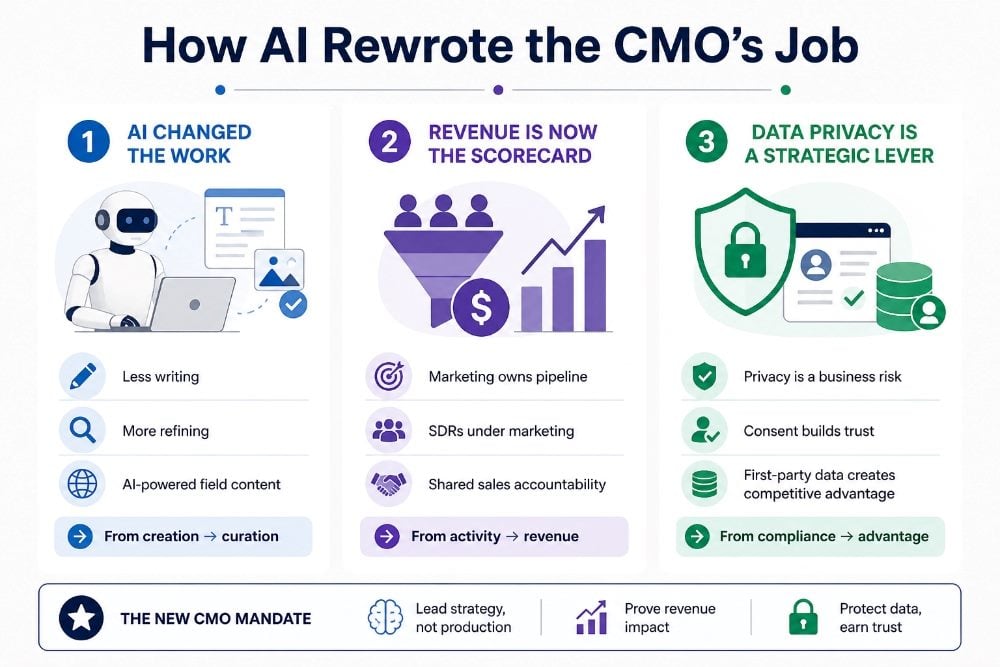
The CMO role looks meaningfully different than it did even 18 months ago. Three forces are driving most of that change: AI has restructured how marketing teams produce and distribute content; pressure to demonstrate direct revenue contribution has intensified significantly; and data privacy has evolved from a compliance checkbox into a genuine strategic variable.
Each of these deserves a clear-eyed look.
The most immediate change has been in content production. The majority of content our marketing team produces is now AI-generated or AI-augmented in some form. My teams spend considerably less time writing and editing, and more time reviewing and refining drafts that AI has produced.
That sounds straightforward, but its implications run deeper. One area where I've seen real potential is in how we serve our regional field teams. We have a field marketer in Germany, for example, who might need content tailored to auto manufacturers in a specific part of the country. In the past, that request would come to our corporate marketing team, and we'd have to build something from scratch.
What we're working toward now is training an AI agent on our core messaging and positioning materials, so that the field team can self-serve against that foundation and get outputs that are both faster and more specifically calibrated than what we could produce centrally.
As these workflows evolve, so does the CMO's focus. The job is less about producing individual pieces of content and more about maintaining the core strategic layer that everything else gets built on. The AI handles the application of that strategy to specific industries, regions and use cases. The CMO's job is to make sure the foundation it's drawing from is right.
What I've found is that the most productive thing a CMO can do right now is create the conditions for their team to experiment. That means making AI tools available and then genuinely trusting people to figure out how those tools change their work. We're not prescribing a new workflow from the top down. Instead, we're giving the team permission and space to rewrite their own playbooks. We can't continue operating the way we did even six months ago, and every marketer plays a part in figuring out what that means for their specific role.
That framing has been energizing rather than unsettling. There's something valuable about being in a moment where the rules haven't been written yet. A marketer who's willing to genuinely rethink how they work has an opportunity that didn't exist a few years ago. The playbook for AI-native marketing trends is being written right now, in real time, by teams willing to experiment. That's a remarkable position to be in.
Related Article: Why the CMO Job Is Being Rewritten in Real Time — and How to Land on the Right Side
For a long time, marketing operated under a kind of ambiguity that I think many CMOs appreciated, even if they wouldn't say so. There used to be a famous saying in the advertising world that half of advertising works, we just don't know which half. Marketing benefited from that uncertainty. We could point to brand awareness, event attendance and content downloads without being held to a clear standard of revenue contribution.
That era is ending. Now CMOs are expected to answer what we're generating in leads, how those leads convert to pipeline, how long deals are taking to close and what return we're getting on marketing investment. The ambiguity is gone. Either we can trace our activities to revenue outcomes or we can't, and, if we can't, that's a problem.
My teams have responded to this by changing team structure. SDRs and BDRs now sit under marketing. Our SDR leadership reports to our CMO, not to our sales leader. That means marketing carries quota. We're directly responsible for generating and qualifying the opportunities that our account executives then work to close. The accountability is explicit.
This has also changed the relationship between marketing and sales in ways that go beyond reporting structure. Joint OKRs have become one of the more effective mechanisms for keeping both functions aligned. One example from our own practice is customer reviews on platforms like Gartner Peer Insights and G2. Getting those reviews matters to both marketing and sales. They provide third-party validation and increasingly they get surfaced when buyers are researching us through AI-powered search tools.
Setting a shared goal, with both teams' bonuses tied to the same outcome, changes the dynamic. We succeed together or we don't succeed. That's a more useful frame than the blame-game dynamic that has historically characterized the marketing-sales relationship when results are disappointing.
Related Article: CMO Circle: Behind the Scenes of a Multi-Million Dollar Customer Marketing Program
The third major shift is one that still doesn't get enough attention at the CMO level, possibly because it tends to get handed off to legal or marketing operations.
Data privacy regulations have made compliance a genuine business risk. Something as seemingly routine as sending a marketing email to a contact who hasn't consented can damage a customer experience and trigger regulatory penalties. CMOs can no longer treat privacy as someone else's problem. It requires active coordination between marketing operations, website management and legal teams to ensure that how we handle cookies, consent and campaign targeting is compliant across every market we operate in.
With the disappearance of third-party cookies, first-party data becomes significantly more valuable. Marketing teams often have the most direct access to this data, which creates an opportunity. Figuring out how to activate first-party data effectively gives you a leg up over organizations that were primarily relying on third-party signals.
Framed this way, privacy is a reason to invest in the privacy-first personalization of the customer relationship more directly and build the kind of engagement that generates consented, first-party signals at scale. It's different from buying reach through third-party data, and I'd argue it's a more durable approach.
The throughline across all three of these changes is that the CMO's job now requires a much higher tolerance for accountability than it once did. AI makes it possible to produce more, faster, but it also raises the bar for strategy and judgment. Revenue expectations are explicit in ways they weren't before. Privacy requirements have introduced real legal and reputational stakes to decisions that used to feel purely tactical.
My advice to marketing leaders stepping into this environment is to get comfortable demonstrating value in concrete terms. We're not just producing content or running campaigns anymore. We're showing how our work connects to pipeline, revenue and customer loyalty and retention. When every budget line is under scrutiny, and AI is reducing the effort required for executional work, being able to make that case clearly is essential to meeting the moment.
The role has genuinely changed. The good news is that it's changed in ways that give marketing a seat at the table it historically had to fight for. The catch is that you have to earn it every quarter.
 Learn how you can join our contributor community.
Bryan Cheung, co-founder of Liferay and its current CMO, is a seasoned entrepreneur and technology leader with over 20 years of experience. Driven by a passion for understanding the business challenges facing today’s companies, Bryan helps Liferay meet its commitment to deliver tailored, effective digital solutions to its customers. Connect with Bryan Cheung: 