Editorial
Guide
8 CX Survey Templates Built to Get Answers, Not Just Scores

Consider the marketing analyst who spent years building customer journey dashboards in Google Data Studio, only to watch the platform disappear into "Looker Studio" branding in 2022. The confusion reflected a deeper challenge facing organizations pursuing journey-led transformation: maintaining analytical continuity while embracing AI-powered customer experience orchestration.
Google's April 2026 announcement restoring the Data Studio name represents more than brand nostalgia. It signals a fundamental evolution in analytics infrastructure for journey-led transformation—the strategic alignment of customer experience, employee experience and business strategy through unified data platforms that serve both human decision-makers and AI agents.
This article examines how Google's strategic repositioning reflects emerging requirements for customer journey analytics, explores the implications for marketing teams building AI-ready experience orchestration and provides practical guidance for organizations navigating the shift toward unified data platforms that support both exploration and automation.
Editor’s note: Key questions surrounding Google’s Data Studio restoration and what it means for AI-driven analytics, platform consolidation and customer journey orchestration.
Google's decision to revive the Data Studio brand addresses a fundamental challenge that emerged during the three-year Looker Studio experiment: how to position analytics tools for the AI era without losing user equity built over years of platform adoption. The original 2022 rebranding attempted to unify Google's business intelligence portfolio under the Looker umbrella, but inadvertently created confusion about product boundaries and capabilities.
The restoration acknowledges that "Data Studio" represents more than a product name—it embodies an entire ecosystem of user knowledge, training materials, organizational processes and institutional memory that marketing teams developed over nearly a decade. According to Gartner research, 60% of large enterprises will have Total Experience initiatives by 2026, making platform continuity critical for successful implementation.
More significantly, the rebrand positions Data Studio as the central hub for Google Data Cloud assets, expanding beyond traditional visualization to include BigQuery conversational agents, Colab data apps and AI-powered analytics tools. This evolution reflects growing enterprise recognition that journey-led transformation requires integrated platforms capable of supporting both human exploration and automated orchestration.
Related Article: The Google Search Console Upgrade Every Marketing Team Needs
The timing of Google's Data Studio restoration aligns with a broader recognition that traditional analytics approaches cannot support the complexity of modern customer journeys. Organizations pursuing journey-led transformation face the challenge of orchestrating experiences that span marketing, sales, service and support while incorporating AI agents that operate autonomously across touchpoints.
Research from Orange Business indicates that customer journey management has evolved from a design exercise to become the operating system of customer experience performance. This evolution demands analytics platforms that can serve as unified command centers rather than collections of disconnected tools.
Data Studio's expanded role addresses this requirement by providing a single interface for multiple data experiences. Marketing analysts can build traditional dashboards while accessing BigQuery conversational agents for natural language exploration and Colab notebooks for advanced modeling. This consolidation reduces the cognitive overhead of switching between platforms while ensuring consistent access to underlying data sources.
The AI implications prove particularly significant. According to eGlobalis research, 94% of business leaders consider AI critical for success, yet many struggle with fragmented implementations. Data Studio's unified approach enables organizations to deploy AI capabilities within familiar interfaces rather than requiring separate AI platforms that operate in isolation from existing analytics workflows.
Google's strategic repositioning transforms Data Studio from a visualization tool into a comprehensive data experience platform. The two-edition structure—free Data Studio and enterprise Data Studio Pro—provides scaling capabilities while maintaining the unified interface that supports journey-led transformation objectives.
The following framework illustrates how Data Studio's expanded capabilities address different aspects of customer journey analytics, helping organizations understand how unified platforms support transformation initiatives across the customer experience technology stack.
| Platform Capability | Data Studio (Free Edition) | Data Studio Pro (Enterprise) |
|---|---|---|
| Data Experience Scope | Reports, BigQuery agents, Colab apps in unified interface | AI features, enterprise security, and Google Cloud integration |
| Journey Analytics Integration | Direct connections to Google Ads, Sheets, and Analytics ecosystems | Enterprise data governance with multi-cloud orchestration capabilities |
| AI Orchestration | Basic conversational agents and automated insights | Advanced AI workflow automation and agentic decision-making |
| Transformation Application | Campaign optimization and initial journey mapping initiatives | Enterprise-scale journey orchestration and value optimization |
This unified platform approach addresses a critical challenge facing organizations pursuing journey-led transformation: the need to support both human exploration and AI automation within consistent data environments. Traditional approaches that separate visualization tools from AI platforms create integration complexity that undermines the speed and agility required for effective customer experience orchestration.
Related Article: What Is Customer Journey Analytics Software?
The Data Studio restoration introduces capabilities that extend far beyond traditional business intelligence visualization. Google's reimagined platform positions Data Studio as the primary interface for interacting with the complete Google Data Cloud ecosystem, fundamentally changing how marketing teams approach customer journey analytics and AI-powered orchestration.
The most significant addition involves native integration of BigQuery conversational agents directly within Data Studio reports. Marketing analysts can now ask natural language questions about customer behavior patterns without leaving their dashboard environment. This capability transforms Data Studio from a consumption-focused visualization tool into an interactive exploration platform that supports both structured reporting and ad-hoc investigation.
Equally important is the seamless incorporation of Google Colab data applications within the Data Studio interface. Teams building predictive models for customer lifetime value or churn detection can embed their Colab notebooks directly into operational dashboards, creating unified environments where analytical insights connect immediately to business decision-making workflows.
Data Studio Pro introduces enterprise-grade features designed for organizations deploying AI agents across customer touchpoints. The platform includes semantic layer consistency tools that ensure AI systems interpret "customer value," "engagement score," and "conversion probability" definitions uniformly across marketing, sales and service applications.
This semantic consistency becomes critical as organizations scale journey orchestration initiatives. AI agents managing email personalization, web content optimization and customer service routing must operate from shared understanding of customer attributes and behavioral signals. Data Studio Pro's governance framework provides the foundation for this consistency while maintaining the flexibility required for tactical campaign optimization.
The platform also introduces multi-cloud orchestration capabilities that allow Data Studio to serve as the control interface for customer data distributed across Google Cloud, AWS, and Azure environments. This advancement addresses enterprise customer experience implementations that require hybrid cloud architectures.
Perhaps most significantly for journey-led transformation, Data Studio Pro enables the deployment of agentic workflows that can autonomously respond to customer signals in real-time. Marketing teams can establish decision trees where AI agents automatically adjust campaign targeting, modify website personalization or trigger service interventions based on customer journey stage transitions detected through the analytics platform.
These agentic capabilities represent a fundamental evolution from traditional analytics approaches that required human interpretation and manual action. Organizations can now build customer experience systems where insights automatically translate into optimized experiences, reducing response times from hours or days to milliseconds while maintaining oversight through Data Studio's governance framework.
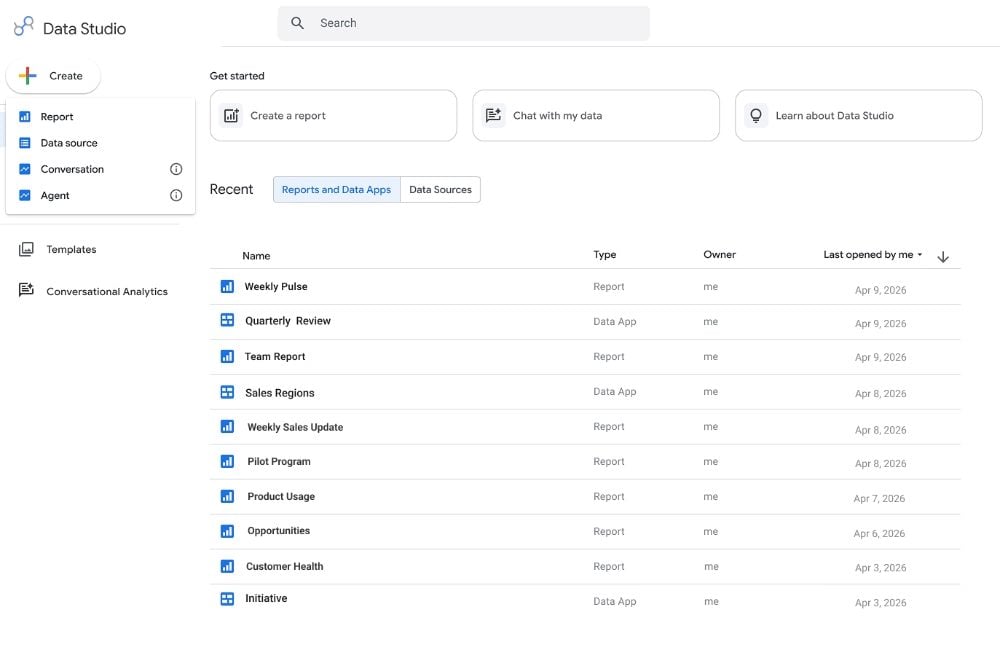
Google's Data Studio consolidation occurs within a rapidly evolving market where customer experience platforms are converging around unified architectures. Traditional boundaries between business intelligence, customer data platforms and AI orchestration tools continue to blur as vendors recognize that journey-led transformation requires integrated rather than fragmented approaches.
This trend reflects growing enterprise recognition that successful customer journey management depends more on platform interoperability than individual tool capabilities. Organizations building transformation initiatives need analytics infrastructures that can adapt to changing requirements while maintaining operational consistency across marketing, sales and service functions.
The competitive implications prove significant. Vendors that can provide unified experiences across multiple data interaction modes—traditional dashboards, conversational agents and automated workflows—gain advantages over those requiring customers to integrate disparate tools. Data Studio's expanded scope positions Google favorably in this consolidation trend.
The Data Studio restoration also highlights critical change management considerations for analytics transformations. Organizations that invested heavily in building "Looker Studio" competencies discover their institutional knowledge transfers directly to the restored platform, minimizing transition costs while providing access to expanded capabilities.
This experience demonstrates the importance of evaluating analytics platforms for long-term adaptability rather than current feature sets alone. The most resilient strategies focus on developing portable skills—data modeling concepts, visualization principles and analytical thinking—that remain valuable regardless of platform evolution.
Three strategic actions organizations can take to transition toward AI-ready, unified analytics environments.
| Strategic Area | What to Do | Why It Matters |
|---|---|---|
| Audit analytics workflows | Assess current tools and map them against future AI and automation needs. Identify opportunities to consolidate platforms while preserving usability. | Reduces fragmentation, lowers operational overhead and ensures the analytics stack can support both human and AI-driven decision-making. |
| Invest in team development | Train teams in both traditional analytics (dashboards, reporting) and AI interaction (conversational querying, agent collaboration). | Prepares analysts for hybrid workflows where human insight and AI-driven exploration operate together. |
| Design pilot programs | Test unified platform approaches in focused use cases like campaign attribution or customer health scoring before scaling. | Reveals infrastructure gaps, validates value and builds momentum for broader journey orchestration initiatives. |
The Data Studio evolution provides a roadmap for how analytics infrastructure must develop to support journey-led transformation in the AI era. Marketing leaders should prepare for three key developments that will reshape how teams approach customer experience analytics and orchestration over the next eighteen months.
Organizations will increasingly expect analytics platforms that integrate AI capabilities as core features rather than add-on modules. Data Studio's inclusion of BigQuery conversational agents within the primary interface represents this evolution. Marketing teams should begin developing competencies in natural language data exploration alongside traditional dashboard creation, as AI-assisted analysis becomes the standard approach for customer journey investigations.
The complexity of managing multiple analytics tools will drive adoption of unified platforms that provide multiple data interaction modes within single interfaces. According to Gartner research, Customer Journey Analytics and Orchestration platforms are emerging as strategic priorities for enterprises seeking to unify real-time decision-making. Marketing leaders should evaluate their current technology stacks for consolidation opportunities that reduce operational overhead while expanding analytical capabilities.
Enterprise adoption of AI-powered customer experience orchestration will require data governance frameworks that operate within analytics platforms rather than as separate oversight systems. Data Studio Pro's enterprise features reflect this trend toward embedded governance that maintains flexibility while ensuring consistency. Marketing leaders should begin planning governance strategies that balance exploration needs with automation requirements.
 Learn how you can join our contributor community.
Pierre DeBois is the founder and CEO of Zimana, an analytics services firm that helps organizations achieve improvements in marketing, website development, and business operations. Zimana has provided analysis services using Google Analytics, R Programming, Python, JavaScript and other technologies where data and metrics abide. Connect with Pierre DeBois: 
