Editorial
Research Report
Building the Case for Modern Public Sector Messaging


Many organizations today are trapped. Soft markets and a difficult path ahead have forced a retreat into "survival" mode, where the misguided belief that managing strictly to the quarter brings success actually creates a self-defeating, start-stop approach to growth. This linear, fragmented operating rhythm leaves an organization’s strategy completely disconnected from the actual customer journey.
The more effective strategy is to shift your focus from singular transactions to value-driven momentum, an operating model that treats the customer experience as a compounding asset rather than a line-item expense. It is the journey-led enterprise that transforms this alignment into a "forward-leading" reality, unifying your strategy, your customers and your employees into a single, momentum-driving engine that scales the business.
Editor’s note: These questions break down why CX momentum stalls — and what leaders must rethink to align strategy with customer value.
Leading organizations drive momentum at scale when value is the primary driver at the intersection of people, process and technology. However, a significant disconnect persists in many enterprises: they decouple their operating strategy from the customer experience. This creates a strategic chasm that employees must navigate daily, forced to choose between what is prioritized by the organization and what is actually important to the customer.
The result is an operating rhythm that becomes purely transactional, a fragmented culmination of individual efforts, isolated sales wins and aggressive expense reductions, all performed in the name of short-term financial goals. When we manage to the transaction instead of the journey, we inadvertently, but very pointedly, install systemic “momentum killers” that force the organization to work harder for diminishing returns.
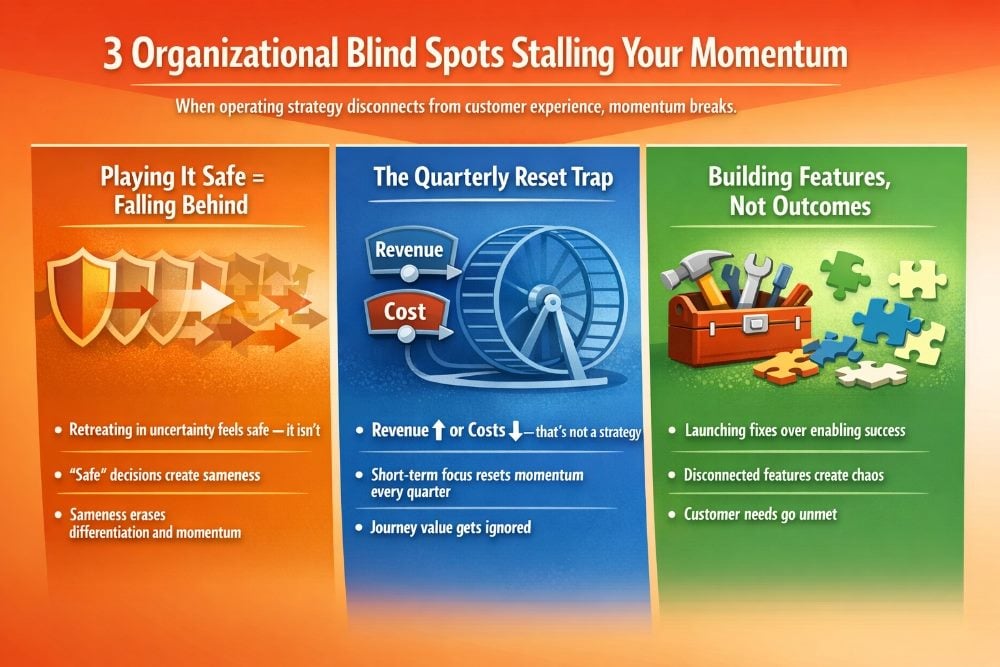
Before we can leverage a journey-led model to inject the value-driven momentum that scales a business, we must first confront the three institutional blind spots that are currently holding the flywheel stationary.
The first blind spot, foundational to the daily decisions of the C-suite, is the commoditization of risk-reward decisioning. In soft markets, the immediate executive reflex is to retreat: to pull back, lean on familiar routines and seek a perceived "safe harbor."
However, there is a professional paradox at play: when market conditions shift, the traditional "safe" path is usually the most direct route to a performance downturn, one that is often only detected once it hits the lagging indicators of a financial report. When organizations refuse to differentiate through a journey-led lens, they aren't mitigating risk; they are choosing to blend into the competitive landscape, becoming unrecognizable to both existing and potential customers. This isn’t a strategic risk-avoidance play; it is a surrender of momentum to the competitor who is more willing to solve the problems you’ve chosen to ignore.
The second blind spot is the reduction of the P&L to a binary tool. In the search for immediate results, many leaders have limited their strategic effectiveness to just two primary levers: "I will increase margin by either increasing top-line revenue and/or aggressively reducing operating expense." While these are necessary metrics, they are ultimately lagging indicators of past decisions.
When success is reduced purely to 90-day performance, the organization loses sight of the "value flow," the continuous stream of journey-led momentum that exists beyond a single transaction. This creates an institutional "start-stop" mindset. Every time the clock resets on a new quarter, the momentum stalls as teams scramble to pull those same two levers again. Journey-led relationships transcend time and do not reset to align with your financial performance reporting schedule.
The final blind spot is a preference for product output over customer enablement. Most organizations possess an exhaustive knowledge of their own features, fixes and services, yet have a startling lack of intimate knowledge regarding how their customers actually use those tools to run their businesses. This mindset is a momentum-killer. Without a disciplined mechanism to intake customer intelligence, rank it by ROI and deploy it back to the market as a value-driver, the enterprise is hoping rather than knowing that they’re solving their customers’ problems.
Rather than building compounding assets that strengthen a holistic journey, leaders bring to market disjointed features and fixes that fragment it. This isn’t executing for scale but increasing the complexity of a fractured experience. You stop fueling your own organization’s momentum the very moment you stop enabling your customer’s success.
Related Article: In 2026, Speed Is the Strategy: Designing CX Systems for Impact Velocity
Many organizations treat their customer experience as a mere operating expense, or worse, assign the responsibility exclusively to a single department, such as sales or marketing. Neither of these strategies is effective; in fact, both ultimately fuel organizational decline.
When an enterprise pivots to a journey-led model, it creates a powerful market differentiator and unlocks value-driven momentum that transactional models simply cannot replicate. The lasting benefit is the transformation of the customer experience from a cost center into the primary driver of sustainable scale.
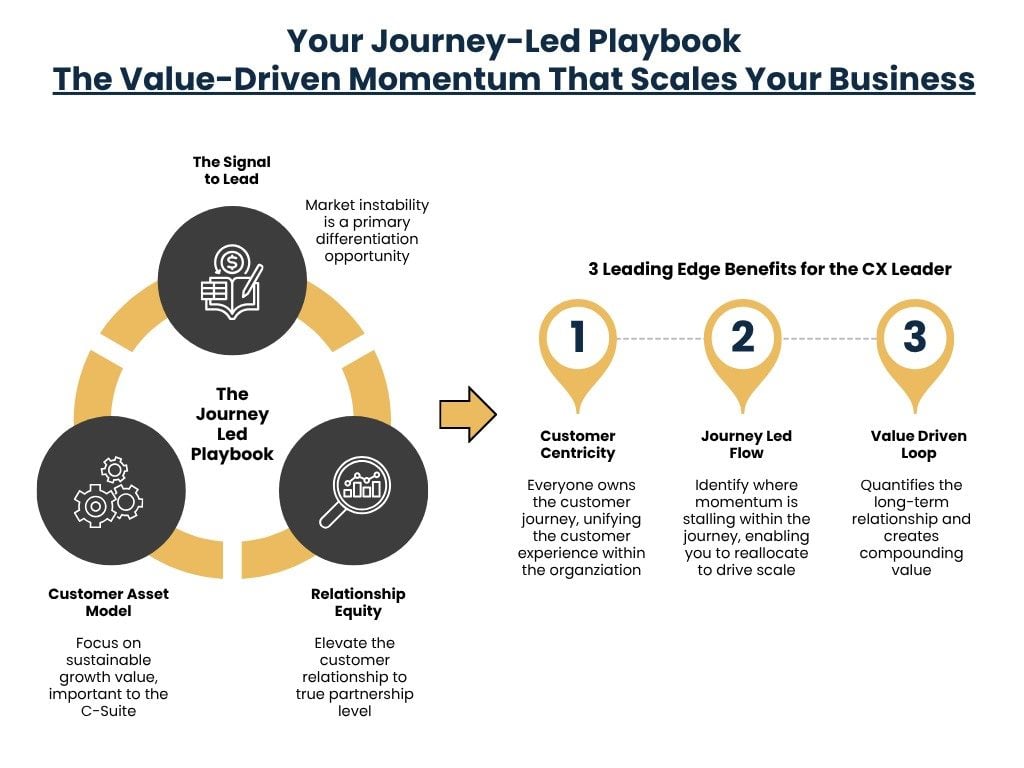
Let’s explore the three leading-edge benefits of a journey-led approach that aligns your strategy, customer experience and employee experience to drive the momentum required to scale your business.
Organizations frequently get caught flat-footed because they become absorbed in internal goals or financial metrics, failing to reflect on the fundamental reason they are in business. A journey-led model mandates true customer-centricity, where every department and team member, from the back office to the front-line representative, owns the customer experience.
This approach unites the operating strategy with the customer journey, effectively closing the strategic "chasm" that typically separates the two. By aligning these forces, you create operational velocity: the necessary momentum that straightens internal misalignment and places a premium on meeting the customer exactly when and where they need the organization most.
This "reset" of the organization-customer relationship eliminates the tendency toward shallow, transactional interactions, unifying them, and ensures the enterprise is focused on value delivery at every touchpoint.
Related Article: Should You Move on From Customer Journey Mapping?
The second momentum benefit of a journey-led model is the ability to track and gauge “value flow” in real-time, equipping the organization with a leading-edge dashboard. While the P&L tells you what occurred 90 days ago, journey-led data provides the immediate context that sets a high-performance organization apart.
This real-time performance visibility does two things to drive scale:
These benefits provide predictive yield: the ability to identify exactly when and where momentum is stalling within the journey, enabling you to reallocate resources to the milestones that actually drive scale. In this model, you are no longer gambling on features; you are investing in calculated, intended outcomes.
You will always be hard-pressed to quantify the standalone economic value of every feature and fix you bring to market, but you are far better equipped to quantify the long-term value of a customer relationship. When you pivot from product output to true “enablement,” you are operating in an arena that transforms a relationship into a compounding asset.
You create and scale relationship equity when your business is focused, committed and organized around solving for your customer’s success, and then disciplined enough to communicate that realized value back to them. This value-driven Loop builds a competitive moat around your business and fuels the perpetual momentum required to scale. In this model, you align growth with a journey-led approach, treating your operating strategy, customer experience and employee experience as equal pillars to drive mutual benefit.
Unlike linear models and traditional systems that reset every 90 days, the Journey-Led Flywheel is built to compound value, driving the perpetual momentum required to scale your business. This flywheel aligns shifting market conditions and customer expectations with the internal infrastructure required to run your organization. It transcends the shallow, transactional customer experiences that many organizations are notoriously known for, delivering a model of sustainable enablement that turns every touchpoint into a strategic asset.
Let’s explore the three key strategies in your journey-led playbook: leading through market instability, aligning value to satisfy both the customer and the C-Suite, and building the Relationship Equity that scales your business.
In times of volatility, the most dangerous move an organization can make is to mirror the instability of its customers. When markets shift, customers become reactive; their needs fluctuate, their confidence wanes and their loyalty wavers. For the forward-thinking leader, these are not reasons to retreat; they are a mandate to lead. This is the moment to elevate your leadership signature and view market instability as a primary differentiation opportunity.
By doubling down on the customer journey, you provide the one thing your customer craves most in a chaotic market: predictability. You actively mitigate risk for both the customer and your business by solving the complex problems your competitors are too hesitant to confront. This shift transforms you from a vendor into an indispensable partner. By leaning in when others pull back, you generate the value-driven momentum required to meet the customer’s evolving needs and secure a dominant market position.
Your C-Suite wants results this quarter, and your customer wants value today. The mistake most leaders make is believing these are competing interests. It can be dizzying to consolidate the incongruent initiatives that comprise a typical revenue or expense-reduction strategy, pulling those same two P&L levers until they break.
But there is a better way: a customer asset model that doesn’t replace the P&L; it enhances it. The customer asset model improves your investment performance by focusing directly on sustainable value and growth, measured by the business outcomes the C-Suite demands. To activate it, you must ask a single, high-leverage question: “Which insights, if deployed, will most significantly accelerate my customer’s success?” When you ask and answer this question through a disciplined financial framework, you aren't just "improving CX," you are driving the effective momentum that solves customer problems while providing the requisite financial performance your C-Suite requires.
The final strategy in a journey-led model is to strengthen the customer relationship until it transcends vendor status and achieves true partnership. Execution is only half the effort; the remainder is the generation of the relationship equity required to drive the momentum of a scaling business. This is achieved through the disciplined communication of every ounce of realized value back to your customer.
This practice demonstrates empathy, active listening and a servant-leader mindset, proving to your customer that you are directly in business to solve their specific needs. When a customer sees the undeniable link between your partnership and their own business success, the friction of the next renewal or expansion vanishes. This "value-linked" relationship adds massive energy to the flywheel, powering the next rotation toward “what’s next.”
Level up your CX program and execute the journey-led playbook, which delivers value-driven momentum that scales your business.
This table distills the article’s core concepts on journey-led momentum, which aligns your business strategy, customer experience and employee experience, enabling CX leaders to deliver value at faster rates and drive towards better business outcomes.
| Strategy Element | Insight | Why It Matters |
|---|---|---|
| Commoditized Risk/Reward | Traditional management to the quarter has increased our start/stop nature and limited our ability to drive continual momentum. | Quarter-end performance has reduced CX to something of an expense to be managed, rather than a value to be delivered. |
| CX Suffers From Fragmental Ownership | Most companies hold Sales or Marketing solely responsible for CX, limiting the organization’s ability to provide the customer with service throughout every touchpoint. | Customer-centric means customer-led, when the organization organizes CX around the journey rather than traditional organization structures. |
| The P&L Version of Performance | Traditional P&L is two levers comprising of increasing sales or reducing operating expense, neither of which can calculate or provide context to customer value. | “Value Flow” transcends the P&L; it doesn’t replace it, but it does give real-time performance and greater context to it. |
| Only One Winner, the C-Suite or the Customer | With many companies struggling, performance is limited to measures that the C-Suite values rather than what the customer needs. | Journey-led unites both perspectives, increasing LTV focus and solving customer problems, which directly and positively impact the P&L and C-Suite performance measures. |
| Relationship Equity | Customer relationships are reduced to transaction counts and singular, disparate interactions. | Relationship Equity is full circle, where organizations focus on solving specific customer needs and problems, and close the loop to communicate the value and worth of meeting customers where they are in the journey. |
You cannot scale your business by chasing a single impactful quarter or waiting to become the recipient of a fortunate market shift; scale is generated through a Leadership Signature that refuses to cast the customer aside. By bringing the customer into the center of your operation, you begin the market-defining work of solving their most critical problems. Implementing a journey-led model is more than an incremental improvement; it is the installation of an operational engine designed to thrive in uncertainty and generate compounding value over time.
To lead in 2026 is to forward-lead. Scale isn’t found in a transaction count; it is found in the momentum you generate when a journey-led approach aligns your business strategy, your customer experience and your employee experience as equal, inseparable pillars of growth.
 Learn how you can join our contributor community.

Ryan Mayes is a transformation specialist with a distinguished track record of industrializing high-risk operations for Fortune 500 companies and PE-backed growth firms. As the Founder of Business Leaders Field Guide, he serves as an industry-recognized and trusted bridge between boardroom strategy and field execution, architecting the P&L rigor and scalable operating systems required to drive predictable, double-digit growth.