Feature
Research Report
Building the Case for Modern Public Sector Messaging


For years, Spirit Airlines built its business around a simple value proposition: ultra-low fares in exchange for a stripped-down travel experience. Customers tolerated smaller seats, added fees and minimal service because the price difference often justified the inconvenience.
But as operational disruptions mounted, customer frustration intensified and competitors improved their own budget offerings, the balance between cost savings and customer tolerance began to shift.
And Spirit officially began to disband as a company in a May 2 announcement, saying it's "started an orderly winddown of operations."
Spirit’s struggles highlight a broader customer experience challenge facing many businesses: when does aggressive cost optimization stop feeling efficient and start feeling like friction?
To what did Dave Davis, Spirit’s president and chief executive officer, attribute the shutdown of his company?
“For more than 30 years, Spirit Airlines has played a pioneering role in making travel more accessible and bringing people together while driving affordability across the industry,” David said in the statement. “In March 2026, we reached an agreement with our bondholders on a restructuring plan that would have allowed us to emerge as a go-forward business. However, the sudden and sustained rise in fuel prices in recent weeks ultimately has left us with no alternative but to pursue an orderly wind-down of the Company. Sustaining the business required hundreds of millions of additional dollars of liquidity that Spirit simply does not have and could not procure. This is tremendously disappointing and not the outcome any of us wanted.”
This article examines Spirit Airlines’ decline through a customer experience lens, exploring how pricing strategy, operational reliability, trust and perception all contributed to the erosion of customer goodwill.
Editor's note: Key questions surrounding customer tolerance, operational friction and the long-term risks of aggressive cost-cutting strategies.
Spirit Airlines built much of its business around a customer experience model that was based on trade-offs. Travelers were offered significantly lower base fares in exchange for reduced comfort, fewer included services and a more stripped-down travel experience. Rather than competing primarily on premium service or customer loyalty, the airline focused heavily on price-sensitive travelers willing to tolerate inconvenience in exchange for lower upfront costs.
So the cost was great and the customer experience stunk. That was the business model.
Ultra-low-cost models can work when customers understand the trade-offs and still believe the savings justify the inconvenience. Problems emerge when friction begins to outweigh perceived value.
| Low-Cost CX Trade-Off | Customer Tolerance Risk |
|---|---|
| Lower base fares | Less patience for added fees or poor reliability |
| Unbundled pricing | Perception of nickel-and-diming |
| Reduced comfort | Lower goodwill when disruptions occur |
| Limited flexibility | Higher frustration during delays or cancellations |
| Minimal service model | Greater stress when customers need help |
| Transactional relationship | Weaker loyalty when competitors offer similar prices |
This approach reflected the broader ultra-low-cost carrier model, where many services traditionally included in airline pricing became optional add-ons instead. Seat selection, checked baggage, carry-on luggage and other conveniences often required additional fees beyond the initial ticket price. The strategy allowed airlines like Spirit to advertise highly competitive fares while generating additional revenue through unbundled pricing.
Spirit’s pricing model also emerged during a broader decline in the perceived quality of commercial air travel. In the years following the September 11 attacks, airport security procedures became significantly more time-consuming and restrictive, while many airlines simultaneously reduced legroom, increased seating density and introduced additional service fees. For many travelers, flying gradually shifted from a relatively comfortable experience into a highly transactional one.
Spirit did not initiate all of those changes, but it aggressively embraced and extended them through an ultra-low-cost model built around stripping away nearly every nonessential component of the traditional airline experience.
Related Article: Exploring Air Canada's AI Chatbot Dilemma
Low-cost travel models depend heavily on customers believing the savings justify the inconvenience. Problems emerge when the friction surrounding the experience starts feeling excessive relative to the actual value being delivered. For many travelers, frustration was not caused by any single fee or inconvenience alone, but by the cumulative effect of repeated frustration throughout the customer journey.
Customer frustration often builds gradually as small service frictions combine with operational problems, unclear communication and declining trust.
| Friction Point | Customer Impact | CX Risk |
|---|---|---|
| Added fees | Customers question the true value of the fare | Perceived unfairness |
| Boarding or baggage restrictions | Travel feels more stressful before the flight begins | Higher emotional friction |
| Delays or cancellations | Plans become uncertain and stressful | Trust erosion |
| Poor disruption communication | Customers feel uninformed or abandoned | Reputation damage |
| Difficult recovery experience | Customers must work harder to resolve problems | Declining loyalty |
| Negative social media visibility | Bad experiences shape expectations before purchase | Amplified brand damage |
Customer frustration often intensifies when operational friction stops feeling occasional and instead becomes part of a recognizable pattern. As additional fees, poor communication and inconsistent service experiences accumulate, customers may begin associating the brand itself with stress and unpredictability rather than affordability alone.
Teresa Tran, chief operating officer at LaGrande Marketing, told CMSWire, "So, at what point does cost optimization begin damaging customer experience? The answer is when customers stop blaming bad luck and start blaming you. One bad experience is forgivable. But when the app doesn't work, the fees keep changing and nobody picks up the phone, that becomes a pattern. And patterns kill brands."
As competing airlines improved their own pricing strategies and budget travel options expanded, the tolerance threshold for these frustrations began shifting. Once the price gap narrowed, many travelers became less willing to accept the cumulative stress, uncertainty and perceived nickel-and-diming that began to be associated with the experience.
Tran suggested that Spirit’s pricing model initially succeeded because customers still believed the savings justified the inconvenience. Over time, however, the combination of added fees, inconsistent service experiences and growing operational stress gradually weakened that value equation.
Over time, this type of friction can gradually erode customer goodwill even among highly price-sensitive travelers. The issue is not necessarily that customers expect premium treatment from a low-cost airline, but that repeated friction eventually begins outweighing the emotional and financial value customers believe they are receiving in return.
Related Article: Privacy-First Personalization in Marketing Wins Customer Trust
For many travelers, the most damaging customer experience issues surrounding Spirit Airlines extended beyond pricing or comfort and into operational reliability itself. Flight delays, cancellations, staffing disruptions and scheduling problems created increasing frustration for customers already navigating a high-friction travel experience.
From a customer experience perspective, reliability problems become especially damaging when recovery processes break down through long wait times, inconsistent communication, difficulty reaching support or limited visibility into changing flight conditions. Customers are generally more willing to tolerate delays or unexpected disruptions when businesses provide timely updates, transparent explanations and clear next steps, but frustration often intensifies when communication becomes inconsistent or difficult to access during already stressful situations.
During operational failures, communication speed and transparency often shape customer perception more strongly than the disruption itself. Customers are generally more forgiving when businesses acknowledge problems quickly and explain what happens next.
Billy Rhyne, founder and CEO at Horseshoe Ridge RV Resort, told CMSWire, "Operational reliability is where trust actually lives. When something breaks, and it will, what people remember is whether you told them fast and fixed it without making them chase you." Rhyne emphasized that customer frustration often escalates when businesses force customers to repeatedly seek updates or solutions during already stressful situations, particularly when communication feels delayed or unclear.
This is where operational reliability and customer trust become closely connected. Travelers do not necessarily expect perfection from airlines, particularly during severe weather or broader industry disruptions. What many customers evaluate more heavily is whether the airline appears organized, responsive and transparent when problems occur.
As operational disruptions become more frequent or more visible, customer frustration can compound quickly. A business model already built around reduced comfort and added friction leaves far less margin for operational failures before customer goodwill begins deteriorating more broadly.
Customer trust is often fragile in high-stress service industries, particularly when negative experiences become highly visible online. Over time, Spirit Airlines developed a reputation that extended beyond isolated complaints and became part of a broader public perception surrounding the brand itself. Viral travel stories, social media complaints and customer frustration shared online increasingly shaped how many travelers viewed the airline before even booking a flight.
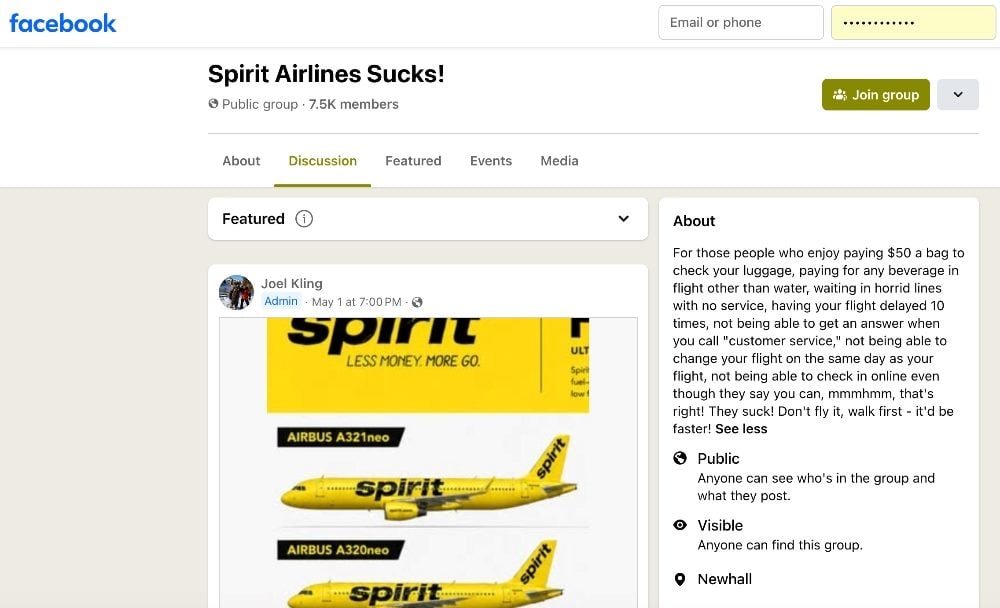
This type of reputational momentum can become difficult to reverse because customer expectations begin shifting before the experience even starts. Travelers who already expect delays, hidden fees, stressful boarding processes or poor service often approach each interaction with heightened sensitivity to additional pain points.
Customer trust often deteriorates most rapidly when businesses appear to push operational risk and recovery burdens onto customers themselves. In high-stress industries such as travel, customers may tolerate limited amenities more easily than unreliable recovery experiences during disruptions.
Justin Crabbe is CEO at Jettly, a private jet charter business, so he is in a position to understand the expectations of airline customers. He told CMSWire, "Once the customer has to spend more time and effort to recover from a problem the company created, any cost reduction starts looking like the company just pushed its operating risk onto the customer." Crabbe argued that low-cost models remain viable only as long as customers believe the core purchase remains protected and manageable when problems occur.
From a customer experience perspective, this creates a compounding effect. Small inconveniences that might otherwise feel manageable can become significantly more frustrating when customers already anticipate a negative experience. Over time, repeated friction may evolve into emotional exhaustion, where customers feel the entire experience requires excessive effort, uncertainty or stress relative to the value being offered.
Social media further accelerates this dynamic by amplifying emotionally charged experiences far more rapidly than positive or routine interactions. A single operational failure may reach millions of viewers online, reinforcing broader narratives about reliability and customer treatment. As negative stories accumulate, they can gradually influence public perception even among people who have never personally used the airline.
New survey research from Verint found that 79% of respondents said they would switch to a competitor after a single negative customer experience, which is a good indication of how quickly reputational damage can translate into customer attrition in highly visible service industries.
This erosion of goodwill matters because customer loyalty depends heavily on trust and predictability. Once customers begin expecting negative experiences, every additional friction point becomes amplified through that lens. Rebuilding trust after that shift occurs is often significantly more difficult than losing it in the first place.
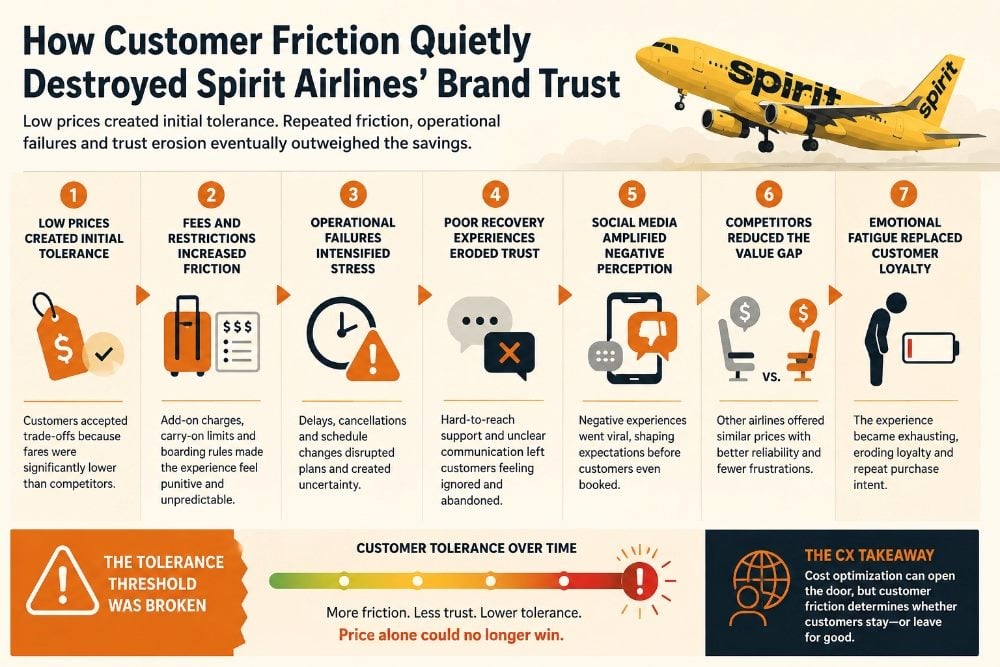
Spirit Airlines’ challenges reflect a broader customer experience reality that extends far beyond the airline industry itself. Many businesses face constant pressure to reduce operational costs, increase efficiency and optimize margins. The difficulty is that customer experience is not shaped only by operational efficiency, but also by how customers emotionally experience the accumulation of frustration surrounding a product or service.
Ultra-low-cost business models often depend heavily on customers believing the financial savings still justify the inconvenience involved. That balance can shift quickly once competitors begin offering similar pricing structures with fewer perceived frustrations.
Alys Reynders, CMO at Quickbase, told CMSWire, "The big problem with economy airlines is that they only work if customers are willing to undergo a negative experience for the scale of discount they receive." Reynders explained that Spirit’s pricing advantage weakened significantly once larger airlines introduced their own basic economy offerings, reducing customers’ willingness to tolerate the airline’s higher-friction experience.
Transparency plays an especially important role in low-cost customer experience models because the relationship depends heavily on expectation management. Customers are often willing to accept reduced comfort, limited services or added restrictions when those trade-offs are communicated clearly and the overall value proposition still feels fair.
Transparency often becomes especially important in low-cost service models because customers are generally willing to accept limitations only when expectations remain clear and consistent throughout the experience.
Linda Yang, co-founder and digital marketing strategist at TotePrint, told CMSWire, “Consumers agree to get fewer services at a lower price. It means that if the service is affordable, then consumers will assume that they will not receive full services as promised initially.” Yang noted that customers may continue accepting reduced service levels as long as businesses communicate policies clearly, avoid unexpected changes and maintain trust throughout the relationship.
Low-cost business models often operate with relatively little margin for customer frustration because the experience already involves accepted trade-offs. Clear communication, pricing transparency and setting realistic customer expectations help prevent those trade-offs from feeling deceptive or adversarial.
Customer frustration often escalates gradually as operational friction, trust erosion and emotional stress accumulate across repeated experiences.
| Customer Experience Pressure Point | What Customers Experience | Long-Term CX Impact |
|---|---|---|
| Unbundled pricing | Customers face repeated add-on fees throughout the journey. | Perceived nickel-and-diming weakens trust. |
| Operational disruptions | Travel plans become stressful and unpredictable. | Reliability concerns overshadow pricing advantages. |
| Poor recovery communication | Customers struggle to get updates or assistance. | Emotional frustration intensifies during disruptions. |
| High-friction service policies | Customers feel the experience requires excessive effort. | Customer goodwill gradually deteriorates. |
| Negative public perception | Social media amplifies operational failures and complaints. | Brand trust declines before the customer journey begins. |
| Narrowing price advantages | Competitors offer similar pricing with fewer frustrations. | Customer tolerance for inconvenience decreases. |
| Reduced transparency | Policies and fees feel confusing or inconsistent. | Customers perceive the relationship as unfair. |
| Emotional fatigue | Customers associate the brand with stress and uncertainty. | Loyalty and repeat purchase intent decline. |
Spirit Airlines’ collapse highlights a broader reality facing businesses operating under aggressive cost-optimization models. Customers are often willing to accept inconvenience, reduced service levels and transactional experiences when the value exchange still feels fair and predictable.
Problems emerge when operational instability, repeated frustration and declining trust begin outweighing the perceived financial benefit, reminding businesses that customers measure value through more than price alone.