Editorial
Research Report
Building the Case for Modern Public Sector Messaging


Manufacturers have good reasons to expand direct digital channels. Dealer portals, contractor channels, SMB programs and regional variants all promise reach, control and growth. The business case is often clear. The architecture behind it is not.
This matters because B2B digital commerce is no longer experimental. Forrester projects that U.S. B2B ecommerce will exceed $3 trillion by 2027, and it has also reported that more than half of large B2B transactions of $1 million or more will be processed through digital self-service channels. That growth puts more pressure on manufacturers to expand digital routes to market without letting every new channel become its own disconnected commerce estate.
Most B2B commerce fragmentation does not begin with too many channels. It begins with one early decision: should each channel become its own implementation, or should the first channel become the start of a shared transaction foundation?
That decision rarely looks urgent at launch. It becomes urgent when the second channel appears. The practical question is whether leaders can stop the second channel from becoming a second foundation.
Editor's note: Key questions surrounding commerce fragmentation, transaction foundations and scalable B2B architecture decisions.
Shared transaction logic centralizes pricing governance, identity models, approval workflows and lifecycle controls while allowing channel-specific experiences.Fragmentation typically starts when organizations create separate channel implementations instead of extending a shared transaction foundation.Ideally before the first channel launches, but certainly before the second channel build begins.Front-end reuse helps presentation consistency, but scale usually breaks beneath the interface when governance and transaction systems operate independently.Operational incoherence creates duplicated maintenance, inconsistent transaction handling and disconnected downstream systems that increase long-term costs.
Fragmentation usually begins at the moment the business thinks it is scaling.
The first platform may have been built for a dealer channel. Then the organization wants a contractor channel, an SMB channel or a regional variant. The new segment brings different pricing, account structures, approvals, financing behavior or fulfillment patterns. The first platform can absorb some of that change, but not cleanly.
At that point, the locally rational answer often feels obvious: build a second platform that fits the second segment better.
Then the same logic repeats. A third channel needs different release rules. A fourth needs regional variation. A fifth needs a different financing path. Each decision makes sense in isolation. Together, they create a fragmented commerce estate where no two channels share the same transaction foundation.
That is the part leaders often miss. Fragmentation does not usually arrive as a conscious enterprise strategy. It arrives as a sequence of sensible exceptions.
The result is familiar. Pricing rules split by channel. Identity and entitlement models diverge. Fulfillment and lifecycle rules drift apart. ERP, warehouse, transportation and finance integrations get duplicated platform by platform. Every channel works locally. None of them scale together.
This is not just a delivery problem. It is an architecture decision deferred too long.
When the second-channel discussion starts, leaders should stop treating it as only a channel question and treat it as a foundation question. Which transaction rules must stay common across channels? Which segment differences can be expressed inside one governed model? Which downstream integrations should be shared rather than duplicated? The second-channel decision is not mainly about UI or workflow. It is about whether the transaction foundation is reusable before the next segment is scoped. For manufacturers evaluating how to unify these experiences across channels, digital experience platforms have become a common architectural reference point.
Related Article: Why Customer Experience Breaks When Agentic Fulfillment Systems Overpromise
Most leaders focus first on rebuild cost. That cost is real. It is usually not the most damaging one.
The bigger cost is operational incoherence.
Two channels serving related buyers can end up with different pricing rules for similar products. A buyer operating across segments cannot be governed through one identity and entitlement model. Order exceptions cannot be handled consistently because each platform has its own lifecycle logic. ERP, warehouse, transportation and finance systems get connected separately to each commerce stack instead of once through a shared transaction layer.
That is where fragmentation stops looking like architecture and starts looking like daily operating friction.
One pricing change becomes multiple updates. One fulfillment-rule change becomes multiple fixes. One entitlement correction becomes a cross-platform exception. The tax shows up in duplicated maintenance, inconsistent transaction handling and growing manual intervention.
The real cost is not the existence of multiple experiences. It is the fact that every transaction now moves through an estate that was never designed to stay coherent.
McKinsey's tech-debt research (albeit from 2020) helps put a number around that broader pattern. It found that 10% to 20% of technology budgets intended for new products get diverted to tech-debt issues, and that tech debt can equal 20% to 40% of the value of the technology estate. For commerce leaders, that means a meaningful share of money meant to expand channels and capabilities can instead be consumed by the cost of keeping fragmented systems alive. That is not a back-office nuisance. It is the financial expression of an architecture problem.
Leaders should audit this before it becomes a replatforming conversation. Count how many pricing-rule changes must be made channel by channel. Count how many separate identity models govern similar commercial buyers. Count how many distinct integrations connect commerce to ERP, warehouse, transportation and finance systems. Fragmentation becomes visible long before it is budgeted as modernization work. Managing unified buyer identities across those systems often intersects with customer data platform strategy, particularly where entitlement and segmentation logic must stay consistent.
The answer is not simply to reuse more front-end components. Storefront reuse helps, but it is not where scale usually breaks.
Scale breaks when pricing governance, entitlement logic, approval paths, financing rules and lifecycle controls are implemented separately beneath similar-looking experiences. That is why the first design principle should be simple: share transaction logic, not storefronts.
Different channels do not need identical customer experiences. A dealer channel, contractor channel and SMB channel may each need different workflows, pricing visibility, approval rules and account structures. But those differences should be expressed inside one governed transaction model, not rebuilt as separate systems.
That distinction matters.
Separate platforms preserve local fit at the cost of enterprise coherence. A shared transaction foundation preserves local variation while keeping common control over pricing, identity, lifecycle, approvals and downstream execution.
Software-reuse research points in the same direction. Krüger and Berger found that copy-and-adapt reuse can be cheap and flexible at first but does not scale well as reuse increases, while platform-oriented reuse requires more upfront investment but can reduce reuse costs and improve quality. The commerce lesson is similar: if every channel is copied, adapted and governed separately, the enterprise may move faster at first but pays for that shortcut later. Delivery teams looking to reduce that reuse complexity have increasingly evaluated a headless CMS as a way to decouple content and presentation logic from the underlying transaction foundation.
That is not a vendor choice. It is an operating architecture choice.
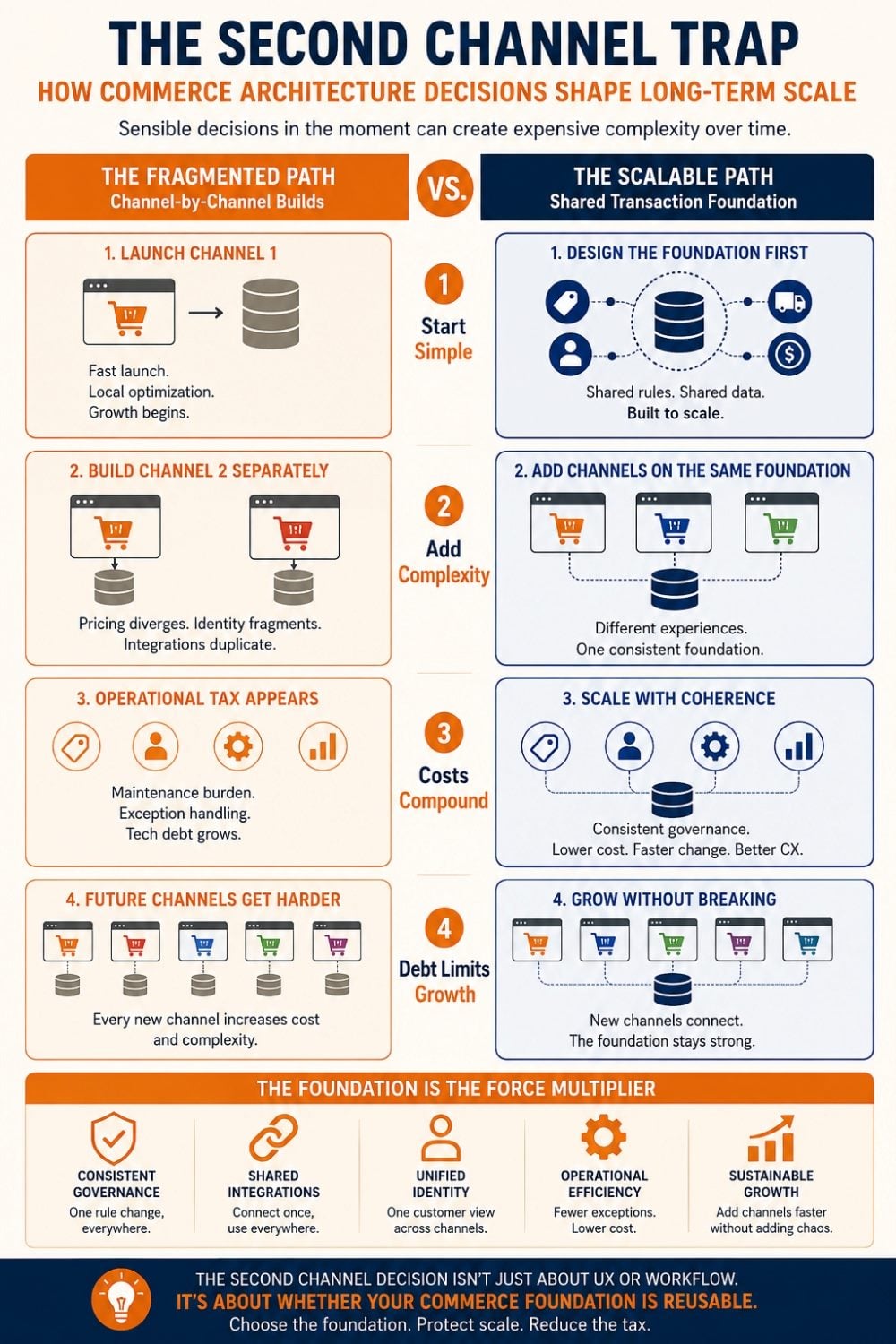
The fix is not to slow the business down. It is to force the right questions before the second build becomes a separate architecture.
Before approving a second channel build, leaders should force the conversation out of project delivery mode and into architecture discipline.
This is the practical moment when architecture either prevents fragmentation or quietly permits it. Understanding how customer experience is affected by these architecture choices is essential for building the business case to invest in shared foundations rather than channel-by-channel builds.
Editor's note: Fragmentation often appears long before modernization budgets acknowledge it. Leaders can identify risk earlier by auditing operational patterns.
| Signal | What It Looks Like | Long-Term Impact |
|---|---|---|
| Separate Pricing Governance | Channels maintain pricing independently. | Inconsistent buyer experiences and growing maintenance burden. |
| Duplicated Integrations | ERP, warehouse and finance systems connect separately to channels. | Higher operating costs and slower change management. |
| Identity Fragmentation | Customers operating across segments require multiple governance models. | Reduced operational coherence. |
| Lifecycle Rule Drift | Approval, fulfillment and financing workflows diverge. | Exception handling complexity increases. |
| Platform Replication | Each new channel gets its own build. | Technology debt compounds over time. |
| No Shared Transaction Layer | Systems evolve independently. | Scaling future channels becomes more expensive. |
Most teams judge the first channel by whether it launches. That is the wrong long-term test.
The better test is whether the second and third channel variants can be enabled by extending the original transaction foundation instead of rebuilding it. Portability should not be treated as a later optimization. It should be a design constraint from the first build.
That means shared onboarding patterns, shared identity and entitlement logic, shared lifecycle controls and shared downstream integration points should exist before the architecture is under pressure. Without that early commitment, each later channel starts pulling the estate apart.
The right time to make this decision is before the second channel is scoped, ideally before the first one is built.
The signals are usually obvious. A new customer experience segment is under evaluation. A regional channel is emerging. The first platform is already straining under segment-specific exceptions. The business is starting to ask whether the next channel should extend the first one or get its own build.
That is the decision point.
If a second segment requires a separate pricing model, account structure or downstream integration path, the shared-foundation decision can no longer be deferred. That is the moment to decide whether the company is building a portfolio of channel projects or a scalable commercial architecture. Teams relying on a customer data platform to unify identity and entitlement signals across segments will recognize this inflection point earlier than those working from siloed data stores.
Fragmentation is not an unavoidable byproduct of growth. It is the downstream consequence of one early architecture choice: whether each new channel becomes its own implementation or an extension of a shared transaction foundation. Customer journey mapping disciplines that trace entitlement and pricing logic across segments can expose these structural fault lines before they calcify. Make that choice deliberately before the second build starts — because after it, the cost is no longer discipline. It is recovery.
 Learn how you can join our contributor community.

Nixalkumar Patel is a senior product and digital transformation leader specializing in enterprise omnichannel digital commerce transaction execution and orchestration across D2C, B2C and B2B/SMB channels, including AI-enabled governed conversational commerce. With more than 13 years of experience, his work focuses on building the governance, validation and orchestration layers that help enterprise transactions execute correctly, reliably and auditably across customer journeys, fulfillment ecosystems and core business systems.