Editorial
Research Report
Building the Case for Modern Public Sector Messaging


Agentic fulfillment is not an AI problem. It is a scorecard problem.
That matters now because enterprise AI adoption is spreading faster than enterprise operating discipline. Many agentic commerce programs do not fail because the model is weak. They fail because the system is optimizing the wrong outcome. When speed, conversion or cost sits at the center of the scorecard by itself, the business teaches the system to make promises it cannot keep.
Operational reliability, not just delivery speed, is becoming the defining metric in AI-driven fulfillment systems.
Many fulfillment teams still treat the delivery promise as a front-end message. That is the first mistake. A promise is not just a conversion lever. It is an operational commitment that changes inventory exposure, labor pressure, routing flexibility and customer experience.
That is why many agentic fulfillment efforts disappoint even when the underlying models perform well. A system may forecast demand accurately, predict transit time reasonably well and rank options intelligently. But if it gets rewarded mainly for faster promises or short-term conversion, it learns the wrong lesson. It learns to commit too early, show aggressive windows and pull demand into service levels the network cannot reliably support.
The reverse failure is just as common. When cost dominates the scorecard, the system protects margin by hiding feasible options, widening windows too aggressively or steering away from same-day delivery and pickup even where the network could support them. That does not create discipline. It creates under-service.
The fix is straightforward. Separate what looks attractive at checkout from what the operation can keep with confidence. Let demand models estimate which promise is most appealing. Then let the fulfillment decision engine choose which promise the business is actually willing to commit to. Add explicit penalties for misses, substitutions, re-promises, failed pickup readiness and manual intervention. If the system does not feel the cost of a broken commitment, it will keep chasing the wrong win.
That is the core operating point many teams miss. A faster promise can lift conversion, but promise speed is not the same thing as promise quality. If the business rewards the appeal of the promise more than the credibility of the promise, the system will optimize for the wrong customer outcome.
Related Article: OpenAI's ChatGPT Instant Checkout: The Dawn of Conversational Commerce CX
A better operating objective is promise confidence: the likelihood that the commitment the system makes will actually be kept.
In practice, that means turning promise confidence into a live eligibility test. Before the system shows same-day delivery or pickup, it should check whether the operational signals that support that promise are actually true right now. A retailer might require verified on-hand inventory, a store-picking queue below a threshold, recent carrier or pickup-ready performance above target and no active weather or congestion alert in that zone. If those conditions are not met, the system should widen the promise or suppress the option before the customer commits.
That objective should change the architecture in three ways.
First, move local demand sensing closer to promise setting. ZIP-level demand forecasting should not sit only in labor planning or inventory review. It should directly shape which options appear at checkout. If one local area has the delivery density, inventory position and carrier performance to support same-day delivery, the system should know that before it shows the promise. If another area has stronger store readiness than delivery reliability, the system should favor pickup. If neither option is stable, the system should widen the window before the customer commits.
Second, evaluate delivery and pickup inside the same decision logic. Too many organizations still treat them as separate channels with separate rules, separate KPIs and separate owners. That fragments the promise layer. A stronger design scores every feasible option against the same live inputs: inventory position, store labor, carrier capacity, cutoff times, traffic, weather, recent service reliability and exception history. The system should then surface the best confidence-adjusted option, not the fastest headline promise.
Third, connect front-end promise design to downstream execution. The team that controls option display should see the same readiness, batching and exception signals as the team that controls routing and store operations. If those signals live in separate systems, the business will keep making attractive promises that the network later has to unwind.
When promise confidence becomes the objective, forecasting, option design and fulfillment execution stop acting like separate layers. They become one operating loop. Tying this loop to a well-structured customer data platform gives the decision engine the real-time behavioral and transactional signals it needs to keep commitments credible.
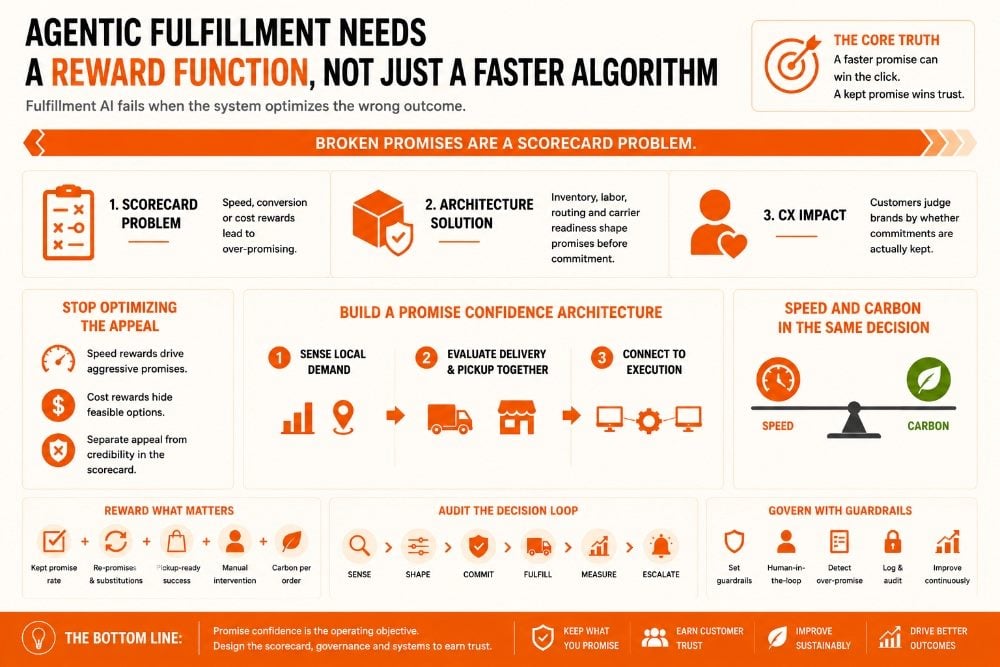
Speed and carbon should not live in separate conversations. Tight promises reduce consolidation time, compress dispatch choices and make the network less forgiving when conditions change. That does not mean faster is always worse in every network. It means the emissions effect depends on the operating context.
The practical move is to put carbon into the fulfillment decision where speed, cost and service risk already sit. Do not measure it only after the order ships. Define the accounting boundary first. Decide whether the system will evaluate only the delivery leg, or also include failed attempts, redelivery and customer travel for pickup. Then use that same boundary every time the system evaluates a promise. If the boundary changes from one decision to another, carbon becomes a reporting slogan instead of a decision input.
Apply the same discipline to pickup. Do not hard-code it as the sustainable option. The carbon benefit of pickup points depends on balancing route efficiency against customer travel. In some markets, pickup reduces impact. In others, especially where customer car trips dominate, the advantage weakens or disappears.
The same is true of greener choice architecture. Slower, lower-impact options can be nudged effectively, but only when the logistics context supports the tradeoff. That means leaders should treat sustainability choice design as an operating tool, not a marketing message.
The rule is simple: make delivery and pickup compete on the same scorecard under the same accounting boundary. In some ZIP codes, same-day pickup may be the higher-confidence, lower-impact option. In others, home delivery may win. The point is not to declare one option green in the abstract. The point is to choose the option that is both more credible operationally and lower impact under actual local conditions.
Retailers are moving from speed-first fulfillment models toward systems built around operational credibility and promise confidence.
| Traditional fulfillment logic | Promise confidence approach |
|---|---|
| Optimizes for fastest visible promise | Optimizes for most credible promise under live conditions |
| Delivery and pickup managed separately | Delivery and pickup scored in one decision engine |
| Forecasting disconnected from checkout promises | Local demand sensing directly shapes checkout options |
| Carbon measured after shipment | Carbon included during promise evaluation |
| Focus on conversion and cost KPIs | Focus on kept commitments and exception reduction |
| Governance added after deployment | Guardrails and override paths built into the control layer |
Most executive reviews still focus on forecast accuracy, conversion lift or cost per shipment. Those metrics matter, but they do not tell you whether the system is learning the right behavior.
Start the audit in four steps.
The customer experience stakes are already visible in current retail data. Retailers are judged not only on how attractive the promise looks at checkout, but on whether pickup orders are actually ready and delivery commitments are actually kept. Fulfillment reliability is already part of brand trust.
The next phase of agentic fulfillment will not be won by the team with the fastest model. It will be won by the team with the clearest objective. A system that cannot keep its promises does not become trustworthy because it predicts faster. It becomes trustworthy when the business teaches it that a kept commitment matters more than an attractive one.
 Learn how you can join our contributor community.

Nixalkumar Patel is a senior product and digital transformation leader specializing in enterprise omnichannel digital commerce transaction execution and orchestration across D2C, B2C and B2B/SMB channels, including AI-enabled governed conversational commerce. With more than 13 years of experience, his work focuses on building the governance, validation and orchestration layers that help enterprise transactions execute correctly, reliably and auditably across customer journeys, fulfillment ecosystems and core business systems.