Editorial
Research Report
Building the Case for Modern Public Sector Messaging


In an era where many organizations struggle to define exactly where "CX" resides, most CMOs instinctively conclude they have either a data problem or a creative problem.
The sobering reality, however, is a continuity crisis. When customer experience is siloed, organizational momentum flatlines. Doubling down on traditional "go-to" plays, fragmented measurements and transactional relationships, only increases the friction leaders are desperately trying to eliminate. Without a unified strategy, the enterprise is reduced to managing a series of costly, disconnected "starts and stops" that drain resources and erode trust.
A more effective strategy addresses this fragmentation with the customer momentum map, a framework that bridges the creative-data divide and identifies the specific value models required to close market gaps. But before we can architect a map that scales your momentum, we must first diagnose the momentum killers: the three organizational fractures that quietly stall enterprise growth.
Editor’s note: Key questions about how customer momentum mapping helps CMOs connect customer identity, value delivery and enterprise growth.
Organizations can reduce CX fragmentation by aligning sales, marketing, service and operations around shared customer context rather than isolated departmental metrics.Customer journey mapping often documents touchpoints. Customer momentum mapping focuses on whether those touchpoints help customers move faster toward the outcomes they need.A customer momentum map is a strategic framework that helps organizations connect customer identity, business context, pain points and value delivery across the full relationship.Value velocity measures how quickly and effectively an organization solves the customer’s defined operational problems.CMOs need customer momentum because fragmented experiences weaken trust, slow growth and make it harder to connect brand strategy with measurable customer value.
True momentum at scale remains elusive for many organizations because of a fundamental disconnect in how they perceive and manage the customer relationship. Growth initiatives designed to unify the journey and deepen customer intimacy frequently collapse, not for lack of intent, but because of deep-seated structural fractures. These "momentum killers" create a systemic misalignment between creative vision and data-driven execution, stifling the organization's ability to truly know, serve, and retain its most valuable assets.
Many organizations treat the customer experience as a line item rather than a lifeblood to nurture. They fall into one of two traps: they either commoditize the relationship into a series of disconnected transactions, or they "orphan" the experience within a single silo, usually relegating it to sales or marketing. When CX is relegated to a "department," it ceases to be a strategy and becomes a boundary.
This becomes fatal for the leader trying to drive momentum. Momentum stalls at every internal handoff because no one outside of the designated silo recognizes the mandate to foster the relationship. The result? The customer doesn't experience a journey; they experience a series of fragmented hurdles. When the bare minimum effort to acknowledge the customer is all there is, the organization hasn't built a bridge to the customer but a bottleneck.
The direct casualty of siloed CX is the transition from journey management to "touchpoint measurement." When organizations lack a unified horizontal view, they default to measuring isolated incidents — a single click, a resolved ticket, a standalone survey — rather than the velocity of the overall customer relationship. This creates a dangerous and false impression of delivering customer excellence.
Because individual touchpoints may appear optimized, leadership overestimates the health of the brand. In reality, these are lagging indicators that offer zero insight into real-time customer sentiment or future customer loyalty. By the time a singular touchpoint registers a failure, the customer's momentum has already flatlined. For the enterprise seeking to scale, this is a terminal error: you cannot drive momentum if you are only documenting the problems after they occur.
The most resilient customer relationships are forged through deep enablement, investing the capital of time and insight to solve our customers' problems, enabling them to run their business better.
However, under the pressure of shrinking margins and quarterly P&L obligations, many organizations retreat from the customer when they should actually be leaning in. When you prioritize the immediate transaction over the long-term partnership, you stop owning the market and start "renting" your customers. This is the ultimate momentum killer. This quarterly "churn-and-burn" model forces the leadership team to start at zero every ninety days, sacrificing any potential future growth for immediate, fleeting gains. By neglecting the feedback loops and forums, like QBRs, that transform a buyer into a partner, you lose the compounding value of a loyal base.
Related Article: Why Agentic AI Is the Next Step in Customer Journey Orchestration
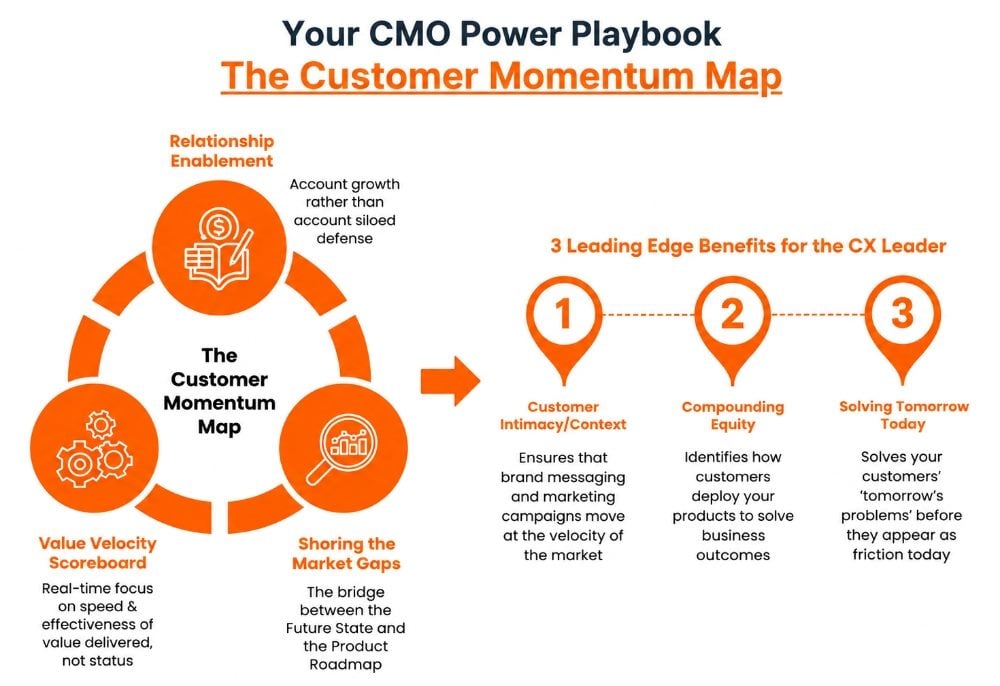
Implementing a customer momentum map transcends traditional customer journey mapping. Momentum mapping converts static, disparate data points into a consolidated, dynamic engine for enterprise growth. When you anchor your organization to a unified view of customer identity and utility, the effective leader systematically dissolves the operating friction that commonly stalls large-scale execution.
Let's explore the three leading-edge benefits of the customer momentum map that aligns your organization to your customer, successfully bridging the creative-data gaps that drive the momentum required to scale your business.
Despite the best of intentions, most enterprise organizations remain functionally siloed, allowing critical customer context to evaporate during inter-departmental handoffs. The customer momentum map effectively removes these boundaries by anchoring the organization to the journey touchpoint rather than the internal department.
The immediate result is the elimination of discovery, the redundant and costly cycle of re-learning customer needs at every transaction — and the frustration tax it places on your customer. By integrating a deep identity (who the customer is) with real-time contextual intelligence (the specific problems they require solving), the CMO ensures that brand messaging and marketing campaigns move at the velocity of the market. When you stop guessing and start knowing, you move from indiscriminate "broadcast marketing" to precision engagement, allowing the organization to scale its intimacy without sacrificing its momentum.
The second dimension of the customer momentum map moves beyond the transaction to identify not just what a customer purchases, but precisely how they deploy those products to drive their own business outcomes. Many leaders make a critical mistake and assume that every customer use case is identical, missing critical insight that dulls differentiation and stalls market momentum.
For the CMO who captures this critical utility insight, every interaction transitions from a "support ticket" that provides little context to a Strategic Enablement Opportunity to drive value. Precision Enablement shifts your organization from a replaceable vendor to an indispensable business partner. You also stabilize the P&L through increasing customer elasticity, because you lower your acquisition costs and accelerate customer lifetime value.
The final and most sophisticated benefit of the customer momentum map is the structural shift from reactive reporting to predictive problem solving. When a leader achieves total clarity on customer identity, pain points and utility use cases, they gain the high-ground required to solve "tomorrow's problems" before they appear as friction today.
Instead of waiting for a failure signal, the lagging indicator of a support ticket or a churn notice, the CMO can proactively deploy creative and operational resources to meet the customer at the next inflection point. This predictive advantage allows the enterprise to scale with aggressive confidence. You are no longer merely documenting the customer's journey but proactively shaping it. By aligning your organization's roadmap with the customer's future direction, you transition a defensive position into a proactive, momentum driving stance that anticipates and resolves future obstacles in real time.
Related Article: Fix the Disconnect: Customer Experience Analytics That Actually Drives Change
Many CMOs are caught in a persistent dilemma: the tension between delivering a creative strategy that influences the market and articulating a data-driven position that differentiates the brand. However, a leader cannot be truly effective at either responsibility if the organization lacks the structural capacity to actually partner with its customers. This is where the customer momentum map bridges the creative-data gap, providing the CMO with a definitive "Power Play" to align internal operations with external market reality.
Let's explore the three foundational pillars of the customer momentum map, the strategic framework designed to eliminate friction, bridge the creative-data divide, and drive organizational momentum at scale.
From the customer's perspective, "sales" implies a singular transaction, whereas "account management" often connotes reactive maintenance and appeasement. To drive true momentum, the CMO must lead a transition to relationship rnablement, a partnership model that speaks the language of growth rather than defense. The mandate in Pillar 1 is to move every department beyond "tracking" the customer and toward equipping them.
By standardizing a profiling approach integrating the customer's identity, specific pain points and utility use cases, your organization stops managing the "current state" and starts architecting the customer's future trajectory. When sales, marketing and operations act on the same contextual intelligence, momentum is no longer lost in the seams of departmental handoffs; it is fueled to scale through every intentional interaction.
Pillar 2 enables your operating frame to influence your financial outcomes. While the P&L remains the ultimate measure of success, it is a trailing reflection of past performance. To drive sustained momentum at scale, the CMO must deploy a value velocity scoreboard, a real-time instrument focused not on sStatus," but on the speed and effectiveness of value delivered.
When you shift from monitoring lagging indicators to managing leading signals, you’re beginning to focus on value delivered today = value received today. This scoreboard measures a singular, high-stakes metric: How quickly is the organization solving the customer’s defined operational problems?
This approach offers a dual strategic advantage. It allows the CMO to identify and capitalize on growth opportunities while simultaneously mitigating churn risks long before they manifest in the quarterly report. When you use the scorecard, you are no longer reacting to the P&L but engineering the outcomes that define it.
Most organizations fail their customers in two distinct ways: they binge on reactive feature requests, and they neglect the strategic effort required to understand the customer’s "future play." This double failure creates a market fap, a structural void where the organization’s delivery fails to keep pace with the customer’s evolving needs.
Pillar 3 is strategic at its core but operational in execution, serving as the bridge between the customer’s future state and the product roadmap. By transforming traditional QBRs and intake sessions into market gap analysis forums, the CMO can identify the specific operational hurdles preventing a customer from scaling. The objective is to seamlessly tighten the loop between what the customer needs to achieve momentum at scale and what the organization delivers. In this model, you aren't just shipping software or services; you are providing the relationship-building solution that ensures both your customer and your organization maintain momentum in lockstep.

This table distills the article’s core concepts on the customer momentum map, the CMO’s Power Playbook that bridges creative-data gaps and drives momentum at scale.
| Strategy Element | Insight | Why It Matters |
|---|---|---|
| Relegated CX | Many organizations fragment the customer experience and silo the responsibility of nurturing the relationship. | Each touchpoint increases the friction with your customer, distancing the relationship to mere transactional. |
| Customer Intimacy and Context | Relegated CX provides a lack of context about who your customer is, what problems they have, and how they use your products and services to run their business better. | The creative-data gaps widen with each transaction, prohibiting you from tailoring your branded message and ability to have direct, contextual conversations with your customers. |
| The Disconnect Between Identity and Value | The gaps we create prevent us from knowing our customer with respect to the current and future value that we can provide. | The customer momentum map units deep customer identity with identifiable value that you can deliver that meet current and future state needs. |
| Value Velocity Scoreboard | Many CMOs are tracking lagging touchpoint indicators, providing very little context in terms of customer value. | The value velocity scoreboard doesn’t focus on status but illuminates your ability to deliver value today as value received today. |
| Solving Tomorrow’s Problems - Today | Fragmentation and a lack of context doesn’t provide the CMO with insight on how to tailor messaging and content to solve the customer’s evolving problems. | The customer momentum map closes the market gaps, enabling the CMO to identify the specific operational hurdles preventing a customer from scaling. |
Scale and influence are no longer driven by the volume of marketing activity, but by the velocity of value delivery across every departmental handoff. For the modern CMO, this presents a foundational leadership challenge: transitioning from traditional, reactive measures to a proactive operating frame focused on systemic problem-solving. By institutionalizing the customer momentum map across the enterprise, you are doing more than altering internal operations; you are fundamentally redefining the manner in which the organization relates to its market.
In an era of rapid disruption, success will not be defined by the static performance metrics of the past, but by the precision with which you architect the customer’s future. When you enable your customers to run their businesses more effectively, you cease being a vendor and become the catalyst of their growth. This is the ultimate mandate for the strategic leader: driving Momentum at Scale by turning customer success into your own competitive advantage.
 Learn how you can join our contributor community.

Ryan Mayes is a transformation specialist with a distinguished track record of industrializing high-risk operations for Fortune 500 companies and PE-backed growth firms. As the Founder of Business Leaders Field Guide, he serves as an industry-recognized and trusted bridge between boardroom strategy and field execution, architecting the P&L rigor and scalable operating systems required to drive predictable, double-digit growth.