News Analysis
Guide
8 CX Survey Templates Built to Get Answers, Not Just Scores

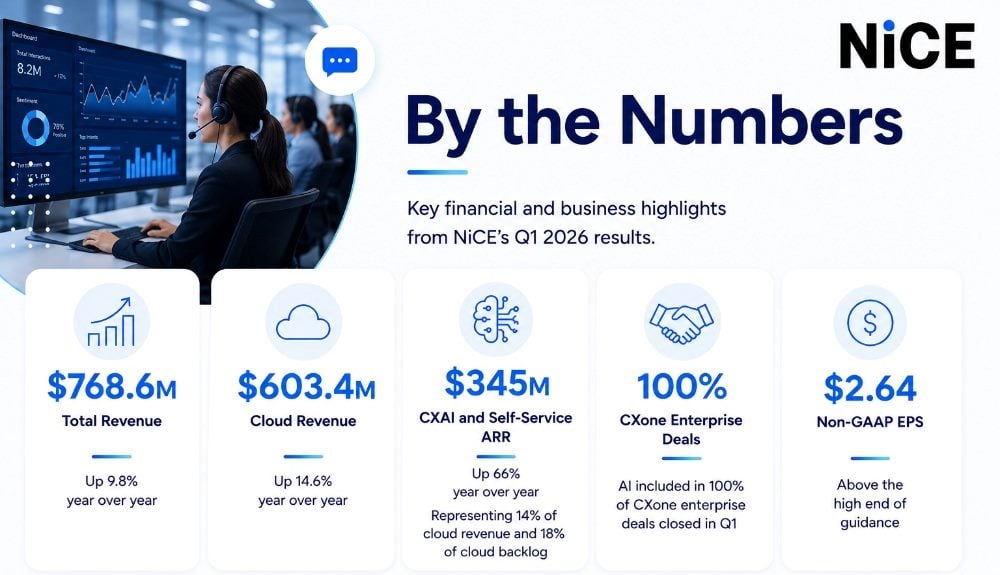
NiCE reported first-quarter 2026 results that offer a clear window into where enterprise AI in customer experience is heading — and what it actually takes to get there. Revenue of $768.6 million grew 9.8% year over year, cloud revenue climbed 14.6%, and AI annual recurring revenue surged 66% to $345 million, now representing 14% of total cloud revenue.
More telling than any single metric: AI was included in 100% of CXone enterprise deals closed in the quarter. Stock didn't rally after the strong Q1 numbers; it was down around 8% over the past five days as of Thursday morning, May 7.
The results arrived alongside a May 7 ServiceNow integration announcement and a candid earnings call on which CEO Scott Russell and CFO Beth Gaspich talked through the messy, unglamorous realities of deploying agentic AI at enterprise scale — the data problems, the governance requirements, the organizational readiness gaps and the commercial structures that are emerging as enterprises move from AI pilots to production.
Russell opened the call by pointing to two customer deployments that illustrate what production-grade agentic AI looks like in practice. Openreach, the UK's largest wholesale broadband network, deployed NiCE Cognigy proactive AI agents to redesign customer engagement across 15 million customer journeys. The results: a one-third reduction in missed appointments, a Trustpilot rating that climbed from 2.0 to 4.7 based on hundreds of thousands of customer reviews, and tens of millions of GBP in combined revenue and operating expense benefits.
Lufthansa presented a different kind of test. When labor strikes triggered a surge in customer interactions, NiCE Cognigy handled nearly 2 million interactions over seven days — completing rebookings, processing refunds, providing food and train vouchers and supplying hotel accommodation information end-to-end, while delivering hundreds of thousands of euros in direct cost savings and eliminating more than 1,000 hours of manual handling at a critical operational moment.
"This is not a pilot and it isn't a proof of concept," Russell said on the call. "This is production-grade agentic AI delivering outcomes at a scale no other player in this market can match."
Those outcomes are increasingly what enterprise buyers are demanding as the baseline. Early adopters of NiCE Cognigy's agentic AI solutions are reporting approximately 20% improvements in CSAT scores, containment rates above 80% for tier-one inquiries and double-digit reductions in cost per contact, according to the company.
Related Article: Can NiCE Hit the Jackpot With Agentic AI and New Brand Vision?
Customer wins aside, an analyst asked Russell about Sierra AI's $950 million fundraising round, which landed earlier that week. His answer got at something CX leaders evaluating the vendor landscape should think carefully about.
"It validates that we are in an incredible market," Russell said. "If you think about the world of AI, there is no better example of how AI can create durable value for customers than in the CX market."
But Russell drew a sharp line between what AI point solutions can deliver and what enterprises actually need once deployments move beyond simple use cases.
"Creating automated agents for simple flows — it is easy, simple to do, and frankly, that's not what enterprises need at scale," he said. "As those interactions deal with more complex scenarios, more complex needs that require the security, the observability, the guardrails, the ability to interoperate with other ways of interacting with their customers — that's where an enterprise platform that handles all of the engagement rather than just the AI becomes critical."
What the results, earnings call and ServiceNow announcement mean for CX and contact center leaders.
| Theme | What NiCE Reported | What It Means for CX Leaders |
|---|---|---|
| Agentic AI is in production, not pilot | Openreach redesigned 15 million customer journeys with proactive AI agents; Lufthansa handled 2 million interactions in 7 days during a strike, end-to-end | The ROI case for agentic AI is no longer theoretical. Benchmark your own deployment readiness against what peers are already running at scale |
| AI point solutions validate the market but don't solve enterprise complexity | Russell cited Sierra AI's $950M raise as market validation, then drew a hard line: simple agent flows are easy; security, observability, guardrails and interoperability are not | Evaluate AI vendors on governance and integration depth, not just demo performance. The gap between a working pilot and a compliant production deployment is where point solutions most often fall short |
| The deployment bottleneck is organizational, not technological | Russell said generating production-ready AI agents takes a click; what takes time is clean data, defined guardrails, security testing and auditability sign-off | Invest in data infrastructure and AI governance before committing to a platform. Organizations that do this work upfront close the gap between contract signature and live deployment significantly faster |
| Consumption pricing carries risk without committed floors | Gaspich confirmed NiCE structures AI contracts around committed minimums, with usage-based consumption layered on top; outcome-based pricing is available for certain customers | When negotiating AI contracts, secure committed pricing baselines with clearly defined expansion terms. Uncapped consumption models without minimums are where surprise bills originate |
| AI deals are being structured at renewal, not greenfield | NiCE offered discounts on existing CX products — call recording cited as one example — to lock in long-term agentic AI commitments with marquee enterprise customers | Renewal time is now an AI negotiation. CX leaders have leverage at contract renewal to accelerate AI adoption at favorable pricing; vendors are actively competing to get embedded before evaluations reopen |
| The contact center boundary is dissolving | The ServiceNow integration connects CXone with ServiceNow CSM to trigger back-office workflows the moment a customer interaction begins | CX platform selection is no longer a contact center decision alone. Integration with enterprise workflow systems — ServiceNow, CRM, ERP — is becoming a baseline requirement for AI to deliver end-to-end resolution |
| Early AI adopters are reporting strong results | NiCE cited approximately 20% CSAT improvements, containment rates above 80% for tier-one inquiries, and double-digit reductions in cost per contact among early Cognigy adopters | Use these as internal benchmarks when building the business case for agentic AI investment. ROI is measurable and increasingly defensible at the board level |
One of the most practically useful exchanges on the call came in response to an analyst question about whether enterprises risk surprise bills as AI usage scales on consumption-based pricing models — a concern that is showing up across enterprise software conversations right now.
Russell's answer reframed the real constraint.
"The rollout of agents is simple," he said. "For Cognigy, at a click of a button, we will generate production-ready AI agents. That's not the difficulty. What happens, though, is that the customers, before they're prepared to deploy, they need to make sure the data is correct, that there are appropriate guardrails. They test the security. Is the observability correct? Does it have the auditability? Things that are a part of our platform — which I will highlight our AI point solution competitors may not fare so well on — are really important because you can't have errors when you're dealing with customer service. You can't respond to the customer in an incorrect way."
The gap between a signed AI contract and live revenue-generating deployment is almost never a technology problem. It is an organizational readiness problem — data hygiene, security review, compliance sign-off, defined guardrails and audit trail requirements. Organizations that invest in that infrastructure move faster from contract to production. Those that don't find themselves with committed spend and no deployed capability.
On the billing surprise question specifically, Gaspich noted that NiCE structures AI contracts around committed minimums, with consumption upside layered on top.
"When a customer goes live, ... the commitment that they have signed up for ... is what will initially start going into the revenue stream," she said. "As the customers continue to adopt and have further consumption, that consumption or usage is on top of their commitments." NiCE is also offering outcome-based pricing models for certain customers, providing more predictability as deployments scale.
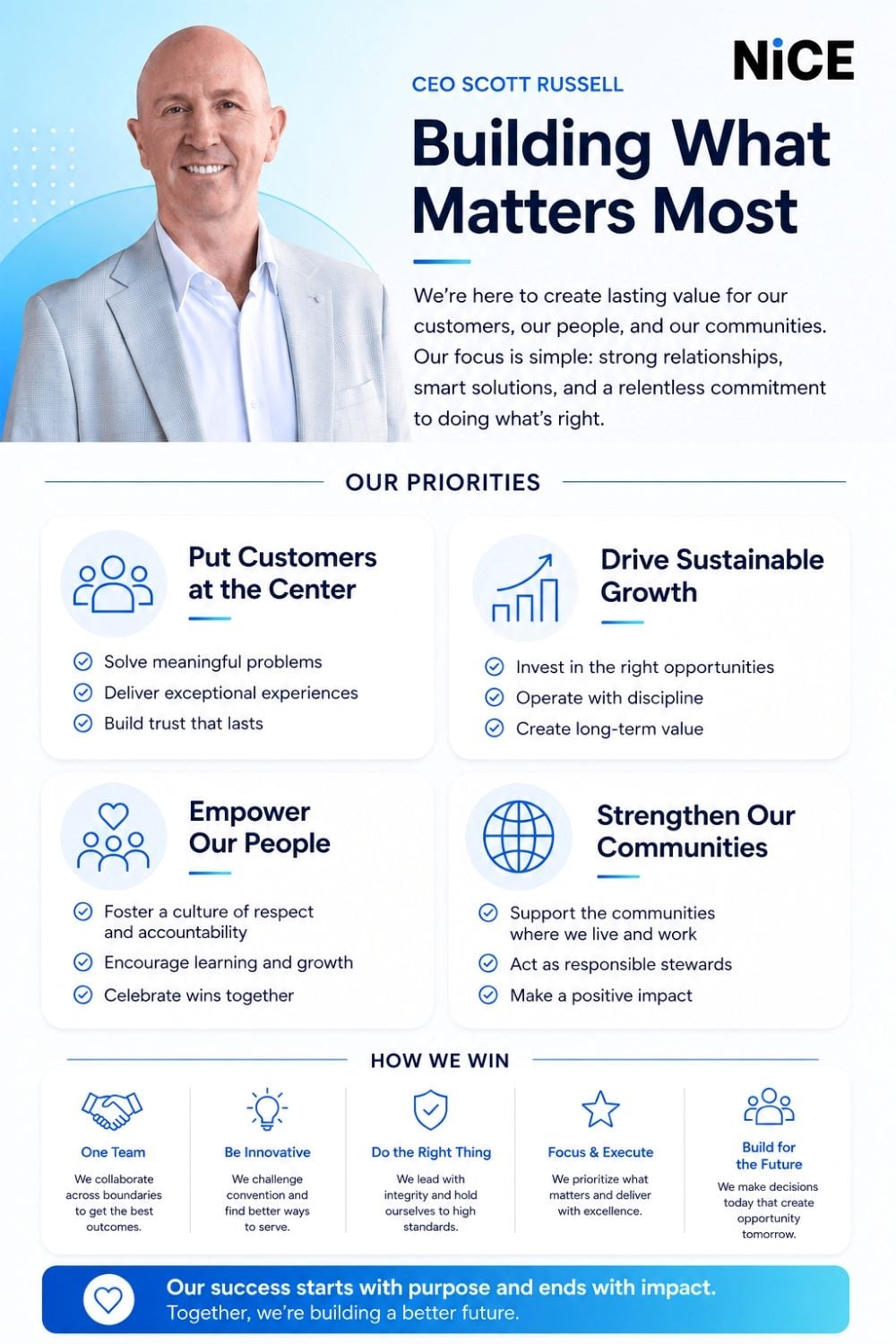
Russell offered a window into the commercial mechanics of enterprise AI deals that reveals how the market is evolving in real time. NiCE proactively worked with a small number of large enterprise customers during Q1 — at renewal time — offering favorable pricing on existing CX products in exchange for long-term agentic AI commitments. The discounts register immediately in revenue; the AI deployments contribute on a later timeline.
"There was a customer that came to us — a large financial services customer — where we secured a broader commitment to deploy Cognigy for automation," Russell explained. "We added one additional year on the total term, and to get the deal done faster, we provided attractive pricing on some of our existing CX products. The AI deployment will begin contributing to revenue later on in the year, and more significantly in 2027, but the discount is felt right away."
Russell framed the move as offense, not defense. Large enterprises are making AI platform decisions now, and NiCE is using its installed base as leverage to get embedded before competitive evaluations open up.
"Companies are making AI decisions now," he said. "They're making them right now. When they're making those decisions, they're not only considering what's the best AI platform, but it's very clear that they're trying to figure out how do I get bankable savings as I'm making long-term commitments?"
The AI backlog numbers reflect that strategy: AI-specific backlog grew 78% year over year in Q1, and AI already represents 18% of NiCE's total cloud backlog — ahead of its current 14% share of cloud revenue, indicating that future AI monetization is running ahead of what current revenue figures reflect.
Related Article: NiCE Unveils Cognigy Simulator for AI Agent Testing
Key themes from the Q1 2026 earnings call Q&A, distilled for context.
| Investor Concern | The Question | NiCE's Response |
|---|---|---|
| Q2 guidance deceleration | Why did cloud revenue growth guidance drop from 9+% in Q1 to 5% in Q2, and was this anticipated? | Gaspich confirmed it was not in the original plan. NiCE proactively discounted existing CX products for a small number of marquee customers at renewal to lock in long-term AI commitments. The discount hits revenue immediately; the AI contribution comes later in the year and more significantly in 2027. Q3 recovery is expected. |
| Competitive pressure vs. strategic offense | Is the commercial discounting a sign of buying power shifting to customers, or genuine competitive pressure on legacy products? | Russell pushed back firmly, calling it an offensive move. NiCE identified large enterprise customers approaching renewal who were also making AI platform decisions, and chose to accelerate those decisions rather than let them go to open evaluation. "It's not about need, it's about taking advantage of a competitive strength," he said. |
| Sierra AI's $950M raise and point solution competition | What does a competitor raising nearly $1 billion mean for NiCE's position? | Russell said it validates the CX AI market broadly, then argued the real enterprise need — security, observability, guardrails, interoperability across voice, digital, and AI — is not what point solutions deliver. NiCE's install base and domain data are what he argued no point solution can replicate at enterprise scale. |
| AI backlog to revenue conversion timeline | How long does it take for AI commitments in backlog to show up in revenue, and what controls the pace? | Gaspich said the technology is ready to deploy immediately. The timeline is driven by customer readiness — data preparation, security sign-off, guardrail configuration. Customers start at their committed minimum and consumption grows as adoption expands. NiCE frames backlog as a conservative floor, with upside as interaction volumes and use cases scale. |
| Consumption pricing and billing surprises | As AI usage scales on consumption models, how do customers avoid unexpectedly large bills? | Gaspich said NiCE structures contracts around committed minimums with consumption on top. Russell added that NiCE is offering outcome-based pricing for certain customers, and that its quantified ROI model — built on billions of interactions — allows the company to go in with high confidence on benefit projections before customers commit. |
| Cognigy contribution and cross-sell opportunity | Is NiCE still expecting 200 basis points of cloud revenue growth contribution from Cognigy this year, and what is the cross-sell opportunity? | Gaspich confirmed the 200-plus basis points expectation. The biggest cross-sell opportunity is in the Americas, where Cognigy penetration into NiCE's large existing install base remains early. Pipeline is described as growing faster than bookings. |
| International growth durability | With international revenue up 30%, how durable is that growth given macro uncertainty? | Russell said international pipeline is growing faster than the reported growth rates, bookings are at record levels, and the combination of CCaaS transformation plus AI is driving every major enterprise conversation in those markets. NiCE's local delivery capability in those markets is cited as a differentiator for large enterprise customers making long-term commitments. |
| Non-CX asset exploration | What is NiCE looking for as it evaluates its Financial Crime and Public Safety units, and what would a divestiture signal? | Russell declined to provide specifics, saying only that the process is exploratory, no decisions have been made, and the guiding principle is maximizing long-term shareholder value. Both units had strong Q1 results. The subtext is a sharpened focus on CX AI as the primary growth platform. |
The day after earnings, NiCE announced the availability of its joint solution with ServiceNow, connecting CXone directly with ServiceNow Customer Service Management to trigger enterprise workflows from the moment a customer interaction begins. The move extends the platform's reach beyond the contact center into the back-office workflow layer — closing what NiCE and ServiceNow describe as the gap between front-office engagement and enterprise-wide execution.
"Customer experience is entering a new era that is defined by speed, intelligence, and execution," said Jeff Comstock, NiCE's President of CX Product and Technology, in a press release. "With this release, we are helping organizations turn AI innovation into everyday impact by connecting customer conversations directly to the people and processes that deliver outcomes."
The integration delivers two primary capabilities: a unified intelligent routing system that combines ServiceNow's case and customer data with NiCE's real-time engagement intelligence to route interactions across front, middle, and back-office teams; and an AI-powered agent Copilot providing real-time guidance, automated summaries, and next-best-action recommendations grounded in customer intent and behavioral patterns.
On the earnings call, Russell connected the ServiceNow announcement to a broader argument about where the CX market is heading. As basic automation becomes increasingly commoditized, he argued, enterprises are prioritizing platforms that can orchestrate end-to-end customer journeys — not just handle the AI layer, but connect it to the systems and workflows required to actually resolve issues.
"We are the digital front door," Russell said. "Most enterprise software companies monetize internal users, and some monetize only the AI flows. We monetize all consumer interactions with a brand — be it voice, digital, or AI — and that digital front door has no ceiling."
Eight months after closing its $955 million acquisition of Cognigy, NiCE reports integration ahead of schedule. Cognigy is now tightly embedded in CXone and sold, deployed, and scaled as part of the unified platform. The quarter saw the launch of Automated Insights, a capability made possible by the integration: it analyzes structured and unstructured data across voice, digital, self-service and workflows to identify where AI can deliver the greatest business impact, quantifies the ROI upfront, and automatically generates production-ready NiCE Cognigy AI agents within the same platform.
Cognigy contributed approximately 240 basis points to cloud revenue growth in Q1, with NiCE expecting 200-plus basis points for the full year. Cross-sell penetration into the Americas install base — where Cognigy adoption remains early — is a primary growth lever for the remainder of the year.
In March, Forrester named NiCE Cognigy a leader in its Wave for Conversational AI Platforms for Customer Service — one of only three vendors to earn that designation, with the highest combined score across current offerings and strategy, and the only vendor to stand out on customer feedback relative to peers.
The organizational readiness challenge Russell described on the earnings call has a product corollary that Philipp Heltewig, NiCE's Chief AI Officer and former Cognigy CEO, walked through in a February interview with CMSWire. The question of how enterprises validate AI agents before deploying them at scale — and monitor them once live — is one Heltewig said the industry is still working through.
The core problem is that large language model-powered agents are nondeterministic. Unlike legacy chatbots, where a given input reliably produces a given output, LLM-driven agents reason dynamically. You cannot test them the way you tested their predecessors.
NiCE Cognigy's answer is what Heltewig described as a simulator — an AI performance lab that generates synthetic customers with defined personas: happy ones, angry ones, detail-oriented ones, privacy-focused ones. Those synthetic customers are then run in batches against an AI agent, producing thousands of simulated conversations and a graphical analysis of where the agent stayed on course and where it did not.
"You can really define all these personas and then you can let them loose on your AI agent," Heltewig told CMSWire. "So you can have thousands of synthetic conversations that simulate real customer interactions hitting your AI agents and then you get a very graphical analysis of how did it go. How how often did the AI agent hit all the goals? How often did they veer off course? And then you can use that information to go in and improve your AI agents to make sure that they're actually doing what they're supposed to do."
The simulator also surfaces scenarios developers never anticipated. Because different LLMs reason differently, running a simulation with one model against an agent built on another can expose edge cases that a single-model testing environment would miss. Heltewig gave the example of a flight rebooking agent: a simulator powered by a different LLM might spontaneously ask about seat preferences — a scenario no one wrote into the test plan, but one that real customers will eventually raise.
Heltewig described a three-tier evaluation framework: pre-deployment simulation, post-call analytics on live conversations and real-time monitoring of agents in production. The third tier — monitoring AI agents as they operate — is where he said the most active R&D investment is currently focused, and where enterprises have the most pressing governance questions.
On who actually owns AI agent implementations inside large enterprises, Heltewig pushed back on the assumption that it is primarily an IT project.
"In most cases where we're dealing with large enterprises, it's not the IT departments that are doing this," he said. "It is really CX and contact center specialists — the ones that actually know about the customer processes, the reasons why they're calling, who have all of that insight." IT still plays a role — API access, telephony integration, backend system connectivity, security and compliance sign-off — but the domain expertise driving agent design sits in the contact center, not the data center.
NiCE's Q1 results, earnings call and ServiceNow announcement describe a CX AI market that is moving faster than most organizations are ready for. The ROI is real and increasingly well-documented.
Heltewig, in the February CMSWire interview, put a finer point on the trajectory.
"I think 2026 is really the year where we're going to see a massive emergence of truly agentic behavior in CX and other areas," he said. "The proliferation of AI is happening at a speed that is unlike anything that we've seen before."
Dom Nicastro is editor-in-chief of CMSWire and an award-winning journalist with a passion for technology, customer experience and marketing. With more than 20 years of experience, he has written for various publications, like the Gloucester Daily Times and Boston Magazine. He has a proven track record of delivering high-quality, informative, and engaging content to his readers. Dom works tirelessly to stay up-to-date with the latest trends in the industry to provide readers with accurate, trustworthy information to help them make informed decisions. Connect with Dom Nicastro: 