Editorial
Guide
8 CX Survey Templates Built to Get Answers, Not Just Scores

There’s a proverb that often gets tossed around to describe the unchanging nature of people: “The more things change, the more they stay the same”. The phrase coined by Jean-Baptiste Alphonse Karr (and quoted by singer Corrine Bailey Rae) muses on the fact that, despite the whirlwind of societal changes, human behavior and the solutions we come up with are ultimately the same as they always were.
For life, and business, this should be seen as a warning. When the world around you moves forward, staying “the same” is the quickest way to lose.
The reality I see too often in the scale-up ecosystem is a dangerous divergence. Companies are investing millions into product R&D and aggressive performance marketing, yet they are still leaning on a brand strategy that was drafted when they were five people in a coworking space.
If your brand strategy is static while your business is dynamic, you aren’t just standing still. You’re falling behind.
A common pain point I hear from B2B leaders is a sense of frustration: “Our customers don’t perceive us the way we want them to.”
Often, this is because the company has outgrown its brand strategy. You might have matured your product, set new commercial milestones, or pivoted your roadmap, yet your brand identity is still anchored to who you were years ago. This creates a perception mismatch. You know you’re an enterprise-level solution, but the market still sees you as a scrappy, unproven startup, or doesn’t see you at all.
This isn’t just a marketing problem; it manifests as operational bottlenecks. When a brand strategy is outdated, internal alignment suffers. It leads to slow signoffs, contradictory feedback on creative work and a constant need to re-educate your own team on what the business actually stands for.
And when your pitch isn’t clear internally, it's no surprise that sales suffer as a result.
Related Article: Why Brand Strategy Isn't Dead — It's Becoming the Only Moat That Matters
Investing in your brand strategy doesn't mean a total reinvention. In fact, your core proposition and values shouldn't change dramatically. A lack of brand integrity in the form of reactive positioning can be just as damaging to your audience perception.
That being said, it's natural and necessary for things to adapt over time.
In fact, your audience expects you to evolve. If you don't move with the times, your brand loses its impact. Your visuals start to feel outdated, your methods appear archaic and you begin to look like a laggard compared to more agile competitors. You'll find you're simply no longer in tune with your audience's needs or the current landscape.
So instead of treating brand strategy like a one-off, you should treat it like your business plan. Like a living framework that requires continuous nurturing to remain relevant.
As a B2B tech business scales, its requirements change. Your commercial goals shift, your KPIs move, and what works from a marketing perspective must adapt accordingly. Evolving your brand strategy is a natural lead-on to this growth, ensuring your identity reflects your current stage of maturity.
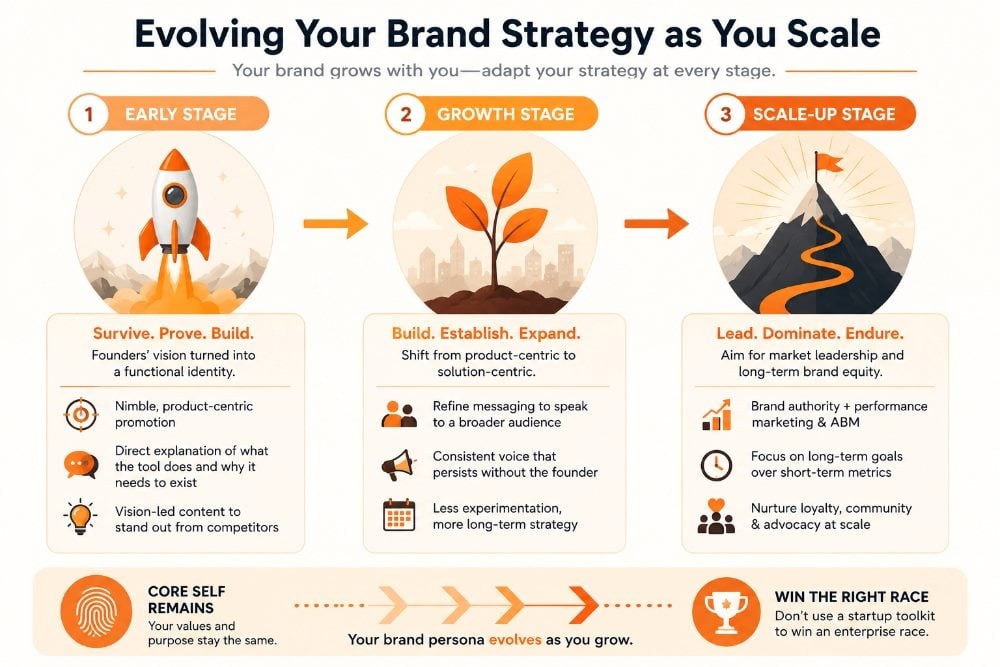
The Early Stage: At this point, your brand is effectively the founders’ vision translated into a functional identity. It’s about surviving, proving the concept and building a core narrative that resonates with early adopters. Implementation often looks like:
The Growth Stage: Once you’ve found product–market fit, the strategy must shift from being product–centric to being solution–centric. This represents that you’re past justifying your existence and focused on building a reputation for reliability and sector expertise. Implementation involves:
The Scale-up Stage: At this level, you’re aiming for market dominance and category leadership. Implementation requires a sophisticated, multi-layered brand strategy that prioritises authentic storytelling and long-term equity. Your brand strategy is focused on continually honing its competitiveness, authority and community to become an indispensable industry partner rather than just another vendor. This looks like:
At each stage of the roadmap, who you need to be and how you communicate must evolve. Your core self remains the same, but like a human, your persona develops as you age. If you don't update your brand strategy, you're trying to win an enterprise-level race with a startup-level toolkit.
We’re currently navigating a digital landscape where people are craving more human, considered interactions. The purely performance-based approach to B2B marketing is losing its edge as buyers look for brands that stand for something more.
Authentic brand strategy is the antidote to this fatigue. By continuing to invest in your brand as you grow, you ensure that your story remains relevant, your team remains aligned, and your customers perceive you exactly as you intend: as a forward-thinking and relatable leader in your space.
The world will continue to change. The question is: will you change with it, or will you stay stuck in the past?
 Learn how you can join our contributor community.
Tanya Estrella has over 25 years of experience marketing technology businesses for scale resulting in numerous mergers & acquisitions, IPO’s and more, and is now running her own B Corp Certified technology marketing agency with a sustainable approach: Estrella Ventures. In her writing she shares what she’s learned in her own journey about what works in marketing and business, and what’s she’s witnessed while rubbing shoulders with so many inspiring (and some not so) technology innovators. Connect with Tanya Estrella: 