Editorial
Buyer's Guide
Your Legacy Systems Aren't the Problem. Leaving Them Alone Is.

On April 22, Thoma Bravo, the largest software-focused private equity firm in the world, reportedly walked away from Medallia. Control is being handed over to a creditor group led by Blackstone, with KKR, Apollo, and Antares alongside. Yesterday, it was reported Blackstone would inject $100 million into the Voice of the Customer (VOC) provider.
The headlines have framed this as a leverage story and there are many moving parts to it. But, I want to share what I believe the message is to the market.
Thoma Bravo, which acquired Medallia for $6.4 billion in 2021, is one of the smartest software investors on the planet. They don't blink at a hard quarter. They don't walk away from $5 billion because the model needs another year. When a firm with that track record decides the math no longer works on the company that institutionalized Net Promoter Score (the Fortune 500 gold standard for measuring customer loyalty), the signal isn't "this asset got over-leveraged." The signal is "the category underneath this asset is expiring."
And there are a lot of legacy incumbents not far behind.
(Disclaimer: The author works for a company that offers products in this space).
The reflex response across the industry is already forming, and it's wrong. It goes something like this: "Surveys are dead. Customers are fatigued. Stop bothering them. Use AI to observe behavior. If you do observability right, you don't need to ask your customers anything."
I think that's the most dangerous take possible right now, and I think it's going to cost a lot of brands a lot of growth over the next 24 months.
Here's why. Customers aren't fatigued by being asked. They're fatigued by being asked badly, and they're fatigued by being asked into the void. Two different problems, both fatal.
The "asked badly" part is the 2003 playbook. A static landing page pops up after a transaction and says "we value your feedback, please take 5 minutes." Their voice gets dumbed down to a number on a 1-to-10 scale. Their loyalty (which is emotional, contextual, full of nuance) gets flattened into a Likert score. Or there is a game being played for the ask to harvest 5 stars. The customer can feel it. They're being treated like a data point.
Related Article: Is Medallia's Debt Tale a Stress Test for Voice of the Customer Market?
The "asked into the void" part is worse, and it's the one most CX teams underestimate. The customer fills out the survey. They never hear back. Nothing changes. The product doesn't get better. The next quarter the brand is chasing a higher NPS score instead of actually solving the thing they spoke up about. So the customer learns the lesson ... my voice doesn't go anywhere. The next ask hits an inbox that has already filed feedback under "ignored."
What they're not fatigued by? Being heard. Look at what people do on social media every single day. They share opinions, share stories, share frustrations, share love for brands they care about, completely unprompted. And here's the part that matters: social has a response mechanism built in. You post, your followers react, a conversation happens, sometimes the brand itself replies. Something happens. The act of sharing connects to an outcome you can see.
Surveys are the opposite. You give your time, you give your voice and the loop closes in a black box you'll never see inside. Multiply that by the dozen brands asking the same week, and the math stops working for the customer.
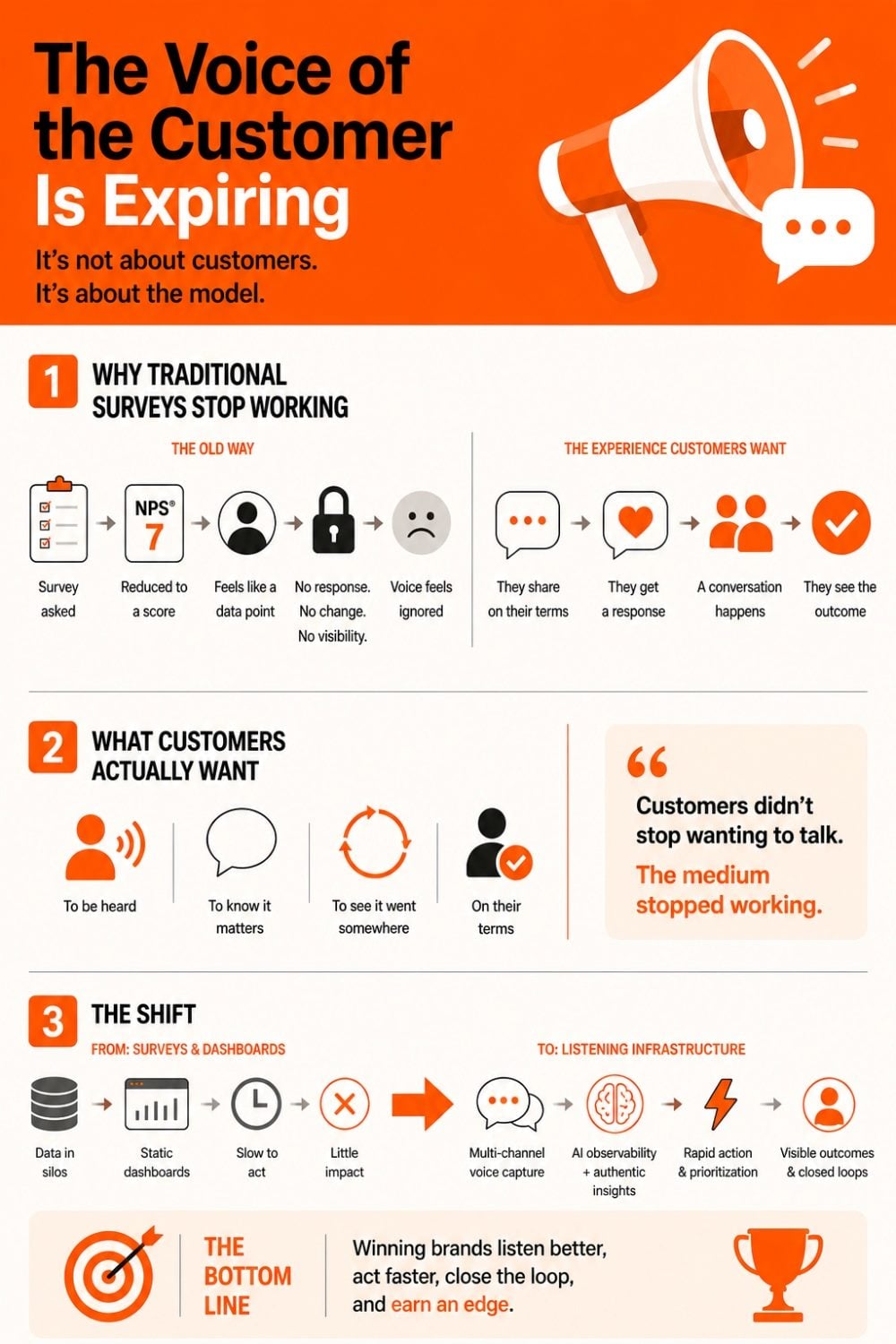
Survey response rates didn't drop from 30% to 5% because customers stopped wanting to talk. They dropped because the medium stopped working. People want to share their voice on their terms. Not yours. And they want to know it actually went somewhere.
That's the shift in human behavior the legacy CX category did not adapt to. And it's why organizations continue spending millions of dollars dragging customers onto Zoom calls, paying them to sit through interviews, running synthetic audiences, doing anything they can to get around their own VoC platforms to get the qualitative depth they actually need.
Traditional Voice of the Customer programs built around surveys and static dashboards are losing effectiveness as customers demand faster responses, authentic engagement and visible action.
| Legacy VoC Model | What’s Breaking Down | What Customers Actually Want | The Emerging Model |
|---|---|---|---|
| Static post-transaction surveys | Customers feel reduced to scores and data points | Authentic conversations on their terms | Multi-channel voice capture |
| NPS and satisfaction dashboards | Feedback disappears into a black box | Visible responses and outcomes | Fast, closed-loop action systems |
| Periodic reporting cycles | Slow decision-making and delayed fixes | Rapid acknowledgment and change | Real-time listening infrastructure |
| Observability-focused AI | AI summarizes data but misses emotional context | Human stories and qualitative insight | AI plus authentic customer voice |
| Quant-only feedback collection | Nuance, intent and unmet needs stay hidden | The ability to explain “why” | Insight-driven experience strategy |
| Quarterly CX score chasing | Teams optimize metrics instead of solving problems | Brands that visibly act on feedback | Performance-focused listening loops |
| Centralized dashboards few people use | Insights fail to influence product or marketing decisions | Faster action across the organization | Voice data embedded into workflows |
| One-size-fits-all outreach | Survey fatigue and declining response rates | Personalized, contextual outreach | Targeted engagement powered by AI |
| Feedback as a CX department task | Voice of customer remains disconnected from growth strategy | Evidence their input matters | Customer voice as business infrastructure |
Related Article: Your Customers Aren't Quiet—They've Given Up on Your Surveys
Here's the other thing the industry is getting wrong, and it's the one I really want CX, product and marketing leaders to sit with.
Every AI tool on the market right now claims to deliver "insights." Almost none of them do. What they deliver is observability. They watch the data, they cluster the data, they summarize the data, they tell you what's already in the data. That's useful. It's also table stakes in 2026.
The difference between observability and insight is enormous, and most leaders have stopped being able to tell them apart.
Observability tells you what happened. Insight makes you stop in your tracks and say, "Huh, I haven't thought about it that way before."
A real example. You point your AI at session data, and it tells you customers are struggling to click out of a particular screen in your UI. Good observation. The reflex move is to assign a ticket and fix the X button. Now you go and ask 20 of those customers about their actual experience, in their own voice, on their own time. You find out they never should have been routed to that screen in the first place. What they were actually trying to do was something completely different that your product doesn't even support yet.
Now you're not fixing a button. You're building the next feature that drives retention.
Another one. A CPG brand has four new flavors in development and is torn on which to launch. They could send the four out to a synthetic audience. They could run a quant survey and pick the winner by margin. Instead they ship all four to their most loyal customers, ask them to talk (actually talk, in their own words) about what each one means to them. They get directional preference data, sure. But they also surface why their loyalists love the brand in the first place. That second thing is the insight. That's the creative brief for the next campaign, the next pack design, the next year of brand work. You don't get that from a star rating.
The pattern is the same in both. AI observation tells you what to fix. Authentic human voice tells you what to build.
Related Article: The Evolution of Customer Loyalty Programs in an Always-on World
When the company that institutionalized NPS can't keep up with shifts in human behavior, that's not a Medallia problem. That's a category problem.
The next category isn't "AI-powered surveys" or "AI-powered VoC." Slapping a language model on a 2003 questionnaire doesn't fix the medium. The next category is listening infrastructure built for performance. And the design principles are very different from what came before.
It looks like this. You use AI to observe what's actually happening in the business and find the gaps (where retention is leaking, where a feature is underused, where a segment is going quiet). You use AI to build the audience and reach out with a very personal, direct question. You let them respond on their terms and in their medium of choice. Then you actually do something about what they said ... fast. You ship the fix, you change the journey, you brief the campaign. And then you close the loop back to the customer who raised it. "You said this. We did this. Thank you."
That last step is the one almost nobody does, and it's the one that compounds. The velocity of action is what turns a respondent into a contributor. Slow loops kill participation. Fast, visible loops earn the right to ask again. It's the same mechanic social runs on, just pointed inside your business.
That's the loop. Observe to find the gap. Reach out personally to the right person at the right moment. Capture authentic voice. Extract the insight. Push it to the decision-maker. Act, fast. Close the loop. Repeat.
It is not "set it and forget it." It is not a 30-question form. It is not a satisfaction score that goes on a dashboard nobody opens. It is targeted, qualitative and built to feed decisions, not vanity metrics.
I had a conversation recently with a former CMO of a Fortune 50 company. He told me that any time a meeting opened with the words "as we expected, the data tells us ..." he would walk out.
Leadership doesn't need more confirmation of what they already think. Leadership is starving for the thing that makes them stop and reconsider. That comes from a human voice, with emotion in it, telling a story you didn't see coming. It does not come from a pie chart and word cloud.
We are at the beginning of an AI cycle where every model gets better the more high-quality, contextual, first-party data you can feed it. The brands that are going to differentiate are not the ones with the most observability tooling. They're going to be the ones with the richest, rawest, most authentic library of customer voice. That's the moat. That's what your AI runs on. That's what makes your personalization actually personal, your product roadmap actually customer-led, your creative actually resonant.
Voice of customer stops being a bug-squasher. It stops being a feedback loop bolted onto a CX team's quarterly report. It becomes infrastructure. It drives growth. It drives retention. It drives the decisions leadership is actually trying to make.
Medallia likely handing the keys to its creditors is the loudest possible signal that the old version of this category is over. The mistake would be reading that signal as "stop listening to your customers." The right read is "start listening to them in a way that respects how humans actually want to be heard in 2026."
Listening infrastructure for performance … that's the new era.
 Learn how you can join our contributor community.
Fran Brzyski is the CEO and Co-Founder of Hark, a New York City-based startup pioneering a new video-first approach to customer feedback. Fran has over a decade of experience working in many customer facing roles from startups to fortune 50 companies. Connect with Fran Brzyski: 