Editorial
Research Report
Building the Case for Modern Public Sector Messaging


The customer journey was once something we could diagram. We understood how attention formed, how objections surfaced and how trust accumulated. Influence followed a recognizable pattern. For years, the work centered on how a person moved from awareness to conviction, and us marketers designed to support that progression.
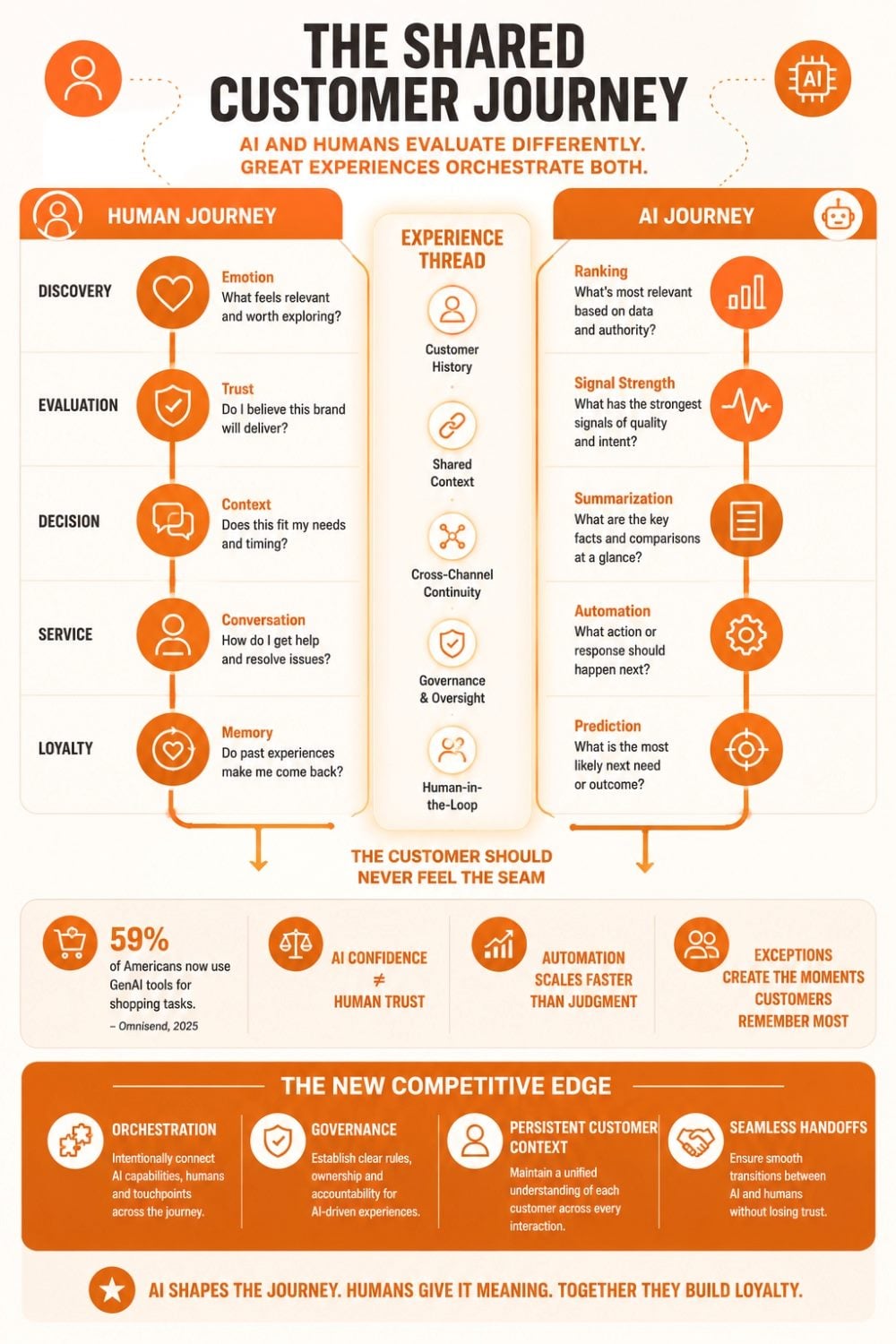
No more. The customer journey now has two travelers — humans and AI — traveling in parallel, and both need to be considered with equal intention.
Norbert Wiener, the MIT mathematician who first mapped the relationship between human systems and machines, observed, "We have modified our environment so radically that we must now modify ourselves to exist in it." His work covered systems and the way structures begin to shape the behavior of those operating within. With the rapid rise of AI, much of the customer evaluation now unfolds inside such a system. What those systems surface, rank and filter shapes what the human interprets. And what the human interprets shapes judgment, long before any brand gets to make its case.
Underneath the new mechanics, the fundamentals haven't changed. Human nature endures. The questions endure. The act of judgment endures. What has changed is the terrain in which those judgments get formed. Much of the journey now unfolds in places the customer never sees and the brand does not fully control.
Editor's note: AI systems increasingly shape how customers evaluate brands, forcing organizations to rethink customer journey design, governance and orchestration.
Customer experience evaluation happens simultaneously across both human judgment and AI-driven systems. These systems continuously search, summarize, filter and rank — distilling reviews, structuring comparisons and determining what deserves attention. The core customer experience is shaped by that activity long before a brand gets a chance to shape it directly. At worst, a brand is eliminated from consideration without the user ever knowing there was a choice to make.
A 2025 Omnisend survey found that 59% of Americans now use generative AI tools for shopping tasks, and one in four say ChatGPT beats Google for product research. Evaluation is moving into curated environments before brands are ever directly encountered. This trend will only grow.
And AI isn't just shaping what the human sees. It's also making decisions outside human awareness. Subscriptions renew, inventory replenishes, recommendations adjust. The customer still holds the authority to buy, but the AI is the one deciding whether and when there's a decision to make. Which means AI is now doing real evaluation across the journey, and it doesn't evaluate the way humans do.
AI optimizes for clarity and confidence. It ranks, filters and decides based on signal strength. Humans evaluate based on intent, context and feeling. These aren't competing priorities; they're both required.
A brand tuned entirely to what the AI rewards can be confident, structured and completely forgettable when the human actually lands on the page. A brand built for human connection can be moving, original and invisible to the AI that decides what gets seen. When those two logics fall out of sync, or over index to one side, the customer experiences the result without ever understanding the cause. That gap is where risk lives.
Related Article: Brands Are Having a 'Crisis of Faith.' AEO Isn't Making It Easier.
As automation expands, risk moves to places it didn't used to sit.
Routine, high-volume interactions tend to stabilize under automation. Transactions become more predictable and responses more consistent; throughput increases. Across much of the journey, steadiness becomes the norm and that steadiness can create a false sense of security. Risk gathers elsewhere unseen.
Scale also introduces its own pressures. The more decisions AI executes across the journey, the more exceptions emerge, even as overall accuracy improves. Many go unnoticed, but the ones that rise up don't tend to happen in exactly the moments customers remember: a declined transaction, a missed renewal, a recommendation that feels wrong at the wrong time.
That's where humans come back in. When the system breaks down or gets it wrong, somebody must pick up the pieces — usually a rep, a manager, a support team, or an account owner, carrying the weight the machine couldn't.
The bigger risk, though, is the one that accumulates slowly, in the drift. Small adjustments to how automation handles edge cases compound across thousands of interactions, gradually reshaping how customers experience a brand long before anyone inside the organization sees it coming.
Related Article: Where AI Wins — And Where It Still Falls Apart in Customer Service
Editor's note: AI systems increasingly influence customer evaluation before brands ever directly engage consumers, creating parallel journeys that organizations must intentionally orchestrate.
| Core theme | What’s changing | Business implication | Leadership challenge |
|---|---|---|---|
| Shared customer journey | AI systems now summarize, rank and filter options before humans directly engage brands. | Brands can lose consideration before customers ever visit a website or speak to a rep. | Ensure brand visibility and trust survive AI-mediated discovery. |
| Human vs. AI evaluation logic | AI prioritizes structure, confidence and signal strength; humans prioritize emotion, trust and context. | Experiences optimized for one audience can fail the other. | Balance discoverability with authentic human connection. |
| Automation risk | Routine interactions stabilize while exceptions and edge cases become more consequential. | Failures become highly memorable moments that damage trust. | Determine where human intervention must remain essential. |
| Governance gaps | AI deployments are outpacing governance and oversight frameworks. | Organizations risk compliance failures, inconsistency and reputational drift. | Create clear ownership for AI-driven customer experiences. |
| Experience continuity | Persistent customer context becomes critical across channels and systems. | Disconnected interactions erode loyalty and confidence. | Build a unified conversational experience thread across human and AI touchpoints. |
| Competitive differentiation | AI capabilities are rapidly commoditizing. | Technology alone will not create lasting advantage. | Compete through orchestration, governance and customer trust. |
Designing for this environment means deciding in advance where the system acts independently, where human judgment takes precedence, and what happens when the two intersect.
Keeping the two journeys aligned is now the center of customer journey mapping and design.
Most organizations have made the automation decisions. Far fewer have been as deliberate about the human "in the loop" — where people show up, what they're there to do, and how those moments are experienced.
Those decisions are more consequential than they appear. They reflect assumptions about where errors are acceptable, where human judgment is irreplaceable and where the cost of getting it wrong — financially, reputationally, or with a regulator — is too high to automate. Getting them right requires treating them as real decisions, during design and not downstream consequences of the tech build.
The PwC 2025 Global Digital Trust Insights report found that while 78% of organizations have increased their GenAI investment, 37% still lack standardized internal policies governing its use. Governance and oversight are lagging capability and rushed deployment is outpacing discipline.
These gaps persist because organizations have treated this as a sequence. In the rush to "do AI," many organizations designed their automation first and assumed the human experience would adapt around it. For those already well into that build, the question isn't where to start over, but rather where to look honestly at the journeys that already exist and ask whether those moments were ever actually decided or simply accumulated.
Wiener observed that systems shaped the behavior of those inside them. The same is true here. When automation deploys without deliberate human design alongside it, organizations create experience gaps that customers feel at exactly the moments that matter most. In most organizations, if you ask who owns those moments, the answer is unclear. Unfortunately, that ambiguity (and its consequences) doesn't stay internal for long.
The organizations doing this with intention have made a deliberate choice about where each journey leads and what happens when they meet. The customer should never feel the seam.
What binds the seam is a continuous record of the customer — a conversational experience thread that holds everything they have expressed, done and committed to, and keeps it legible to every system (human or AI) that serves them. Without that persistent thread, each handoff or engagement starts from something closer to zero and the gaps compound. With it, AI and human travelers are both working from the same understanding.
Every organization will eventually have access to essentially the same AI capabilities. The core technology is becoming table stakes and will keep moving toward becoming a commoditized utility. What won't be evenly distributed is the judgment to use it well. (And remember, automation scales much faster than judgment does.)
Customers never see how the journey is built, but they feel it when the pieces don't fit. They notice when an answer in one channel contradicts an answer in another, when a hand-off drops them, when the same question gets asked three times. They may not be able to name what's wrong, but they know when something is.
At scale, the structure of decision-making determines whether customer loyalty and trust holds or erodes, which puts a real demand on leadership. Leaders are now accountable not just for the outcomes, but for the architecture of decisions that produces them — what got handed to machines, what stayed with people, and whether the two work together. AI expands what can be decided. The customer journey will be defined by how intentionally organizations design for both travelers, AI and human, and how well those two journeys are built to work in concert.
That work happens in the leadership decisions made around the technology, not inside it. It also happens in the experience thread that runs between them, the accumulated, living record of the customer that lets every interaction pick up where the last one left off. The brands that get this right will earn the kind of trust that compounds, because their customers will feel the difference, even if they can never quite explain why.
 Learn how you can join our contributor community.

Eric Dean is the Founder and CEO of Whereoware, a digital experience consultancy with a relentless focus on business outcomes. He leads the company’s vision, helping clients harness technology to drive growth, optimize customer experiences, and navigate digital transformation.