Feature
Research Report
Building the Case for Modern Public Sector Messaging


Growing scrutiny around leading Voice of Customer platforms such as Medallia and Qualtrics is raising broader questions about the category. For years, these platforms have largely built their value on collecting feedback, generating insights and helping businesses close the loop on customer experience.
But as AI rapidly lowers the cost of gathering and analyzing feedback, and as buyers face increasing pressure to prove measurable business impact, that model is being reexamined.
The focus is shifting from what these platforms can do to what businesses actually do differently because of them, exposing a growing gap between insight and action. This article is about how that shift is reshaping the VoC market, and what it means for businesses evaluating Medallia and Qualtrics—and the role of VoC platforms in 2026.
Editor's note: Medallia and Qualtrics remain two of the biggest names in Voice of Customer technology, but AI disruption, financial pressure and changing buyer expectations are reshaping how enterprises evaluate both platforms.
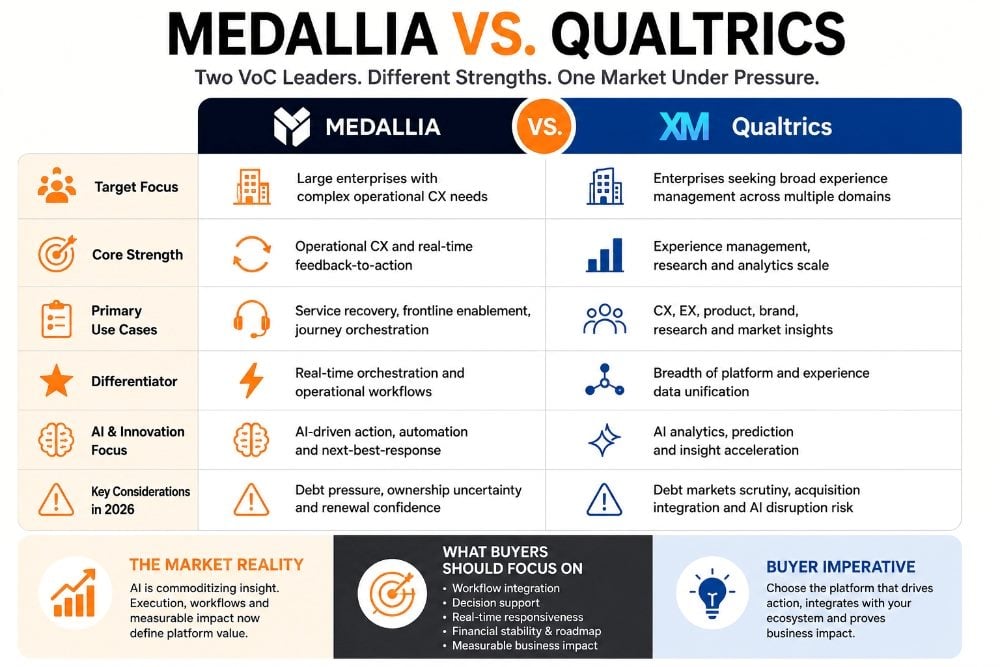
Medallia is generally positioned around operational customer experience and real-time workflow execution, while Qualtrics is broader in scope, focusing on experience management, analytics and structured research across customer, employee and brand programs.Medallia emphasizes frontline responsiveness, journey orchestration and real-time operational action. Qualtrics emphasizes large-scale measurement, analytics, benchmarking and enterprise-wide experience management.Increasingly, the bigger question is whether traditional Voice of Customer platforms can continue to justify their value as AI makes feedback analysis more accessible and businesses prioritize orchestration and execution over reporting alone.Medallia is facing scrutiny tied to debt and ownership uncertainty, while Qualtrics has faced debt-market pressure related to financing its Press Ganey Forsta acquisition amid broader investor concerns about AI disruption in enterprise software.Buyers should evaluate operational fit, workflow integration, AI strategy, roadmap stability, pricing structure and the platform’s ability to connect customer insight directly to business outcomes.AI is reducing the cost and complexity of insight generation, forcing buyers to focus less on dashboards and surveys and more on workflow integration, operational execution and measurable business outcomes.
A subtle shift is beginning to take shape in the VoC space, one that extends beyond any single vendor. What is unfolding around platforms like Medallia and Qualtrics reflects a broader reassessment of the Voice of Customer category itself. For years, the value proposition was straightforward: collect feedback, generate insights and help businesses “listen, learn and act.” That model supported large contracts, recurring revenue and strong valuations.
Today, that foundation is being questioned, and investors are beginning to make moves affecting the future of companies like Medallia and Qualtrics. More on that in a bit.
The expectation is no longer that technology provides value in theory. The focus has shifted to measurable outcomes.
Voice of the Customer platforms are shifting from a focus on feedback collection and insight generation toward decision support, workflow integration and measurable business outcomes.
| Capability Area | Traditional VoC Model | 2026 Market Expectation |
|---|---|---|
| Feedback collection | Core differentiator | Table stakes, widely accessible |
| Insight generation | High-value capability | Increasingly commoditized by AI |
| Reporting and dashboards | Primary output | Baseline expectation |
| Decision support | Limited or indirect | Critical requirement |
| Workflow integration | Optional or secondary | Essential for impact |
| Business impact | Assumed or indirect | Must be measurable and provable |
Despite continued investment in CX platforms and initiatives, a growing disconnect is emerging between how businesses evaluate their performance and how customers experience it. Medallia's 2026 State of Customer Experience Report indicated that 66% of brands believe CX is improving, while only 17% of consumers agree. This suggests that many CX programs are measuring internal indicators of progress rather than outcomes that resonate with customers, reinforcing the need for stronger alignment between insight, action and business impact.
At the same time, the impact of these technologies on customer experience outcomes has been uneven, particularly in customer-facing applications. According to the Qualtrics 2026 Consumer Experience Trends Report, nearly one in five consumers who have used AI for customer service saw no benefits from the experience. This is a good indication that while AI is making insight generation more accessible, it is not consistently improving the customer experience, reinforcing concerns that efficiency gains are being prioritized over resolution.
The shift from collecting feedback to acting on it is not new, but AI is accelerating the urgency around it.
Haris Azmi, CRO at Sogolytics, told CMSWire, "The job of a VoC platform is to drive change, and AI hasn't changed that goal. When data collection and basic reporting can be easily automated, any platform providing insight without workflow integration is an expensive reporting subscription." Azmi emphasized that platforms that stop at insight risk becoming difficult to justify, as the expectation shifts toward systems that connect feedback directly to action.
When data collection and basic reporting can be easily automated, any platform providing insight without workflow integration is an expensive reporting subscription.
- Haris Azmi, CRO
Sogolytics
Investor and lender sentiment is reinforcing this shift. As financial stakeholders begin to question valuations and growth assumptions in the CX software space, the entire category is being pulled into sharper focus. Businesses that once benefited from strong narratives around customer-centricity are now being evaluated on their ability to deliver tangible results. In this environment, platforms that cannot clearly demonstrate business impact risk being seen less as strategic investments and more as discretionary spend.
Demonstrating ROI has become central to how VoC investments are evaluated. Azmi said, "If you cannot draw a line from your NPS movement to a change in churn rate or revenue, your VoC program has a measurement problem." Additionally, he emphasized that VoC programs must connect experience metrics directly to financial outcomes to remain credible.
What emerges is a market in transition. The core need to understand customers has not diminished, but the way that need is addressed is evolving rapidly. As AI reduces the cost of insight and financial pressure increases expectations around ROI, the VoC category is being forced to redefine where it creates value, and whether it can keep pace with a new set of buyer demands.
The comparison between Medallia and Qualtrics is no longer only a product or platform debate. In 2026, both companies are also being viewed through the lens of financial pressure, investor confidence and the changing economics of enterprise software. The pressure does not mean either platform is disappearing. But it does show how quickly the Voice of Customer market is being re-priced around AI disruption, execution risk and provable business impact.
Related Article: Medallia's AI Bet in Vegas: Can Customers Move From Insight to Action?
Medallia’s financial situation has become one of the clearest stress tests for the VoC category. CMSWire reported earlier this month that Thoma Bravo was nearing a deal to hand Medallia to its lenders, a move tied to roughly $3 billion in debt and the potential wipeout of $5.1 billion in equity. Medallia declined to comment on that report.
The implications go beyond Medallia’s balance sheet. Gartner told CMSWire that Medallia customers should not expect the platform to stop functioning, given how deeply VoC platforms are embedded in enterprise governance, measurement and workflows. But renewal confidence is a different matter. The same CMSWire report noted that Gartner has heard of renewal challenges from Medallia clients, even as Medallia remains a Leader in Gartner research and continues to serve a global enterprise customer base.
Qualtrics finalized the Press Ganey Forsta acquisition for $6.75 billion today, a good financial sign. Earlier this year, it faced a financial test around the acquisition. Bloomberg reported May 6 that a JPMorgan Chase-led group of banks was expected to take more than $500 million in paper losses on debt tied to Qualtrics’ acquisition of Press Ganey Forsta. The banks were preparing to use their own balance sheets to fund $5.3 billion of debt, which Bloomberg described as the biggest “hung” deal in the leveraged finance market this year.
The Financial Times previously reported that JPMorgan had halted the $5.3 billion Qualtrics debt deal amid investor concern over AI disruption in enterprise software. That concern is notable because Qualtrics is not being scrutinized only as a VoC vendor, but as part of a broader software category where investors are reassessing how durable legacy analytics, survey and workflow platforms remain as AI changes the economics of insight generation.
But the deal went through after all, with Qualtrics CEO Jason Maynard stating in a press release today: “AI permanently changed what people expect from every experience in their lives. That’s why the future will be won in the Experience Gap. Leaders want to deliver intelligent, responsive, and predictable human experiences. In the age of AI, experience is now the differentiator in every industry, and for the first time ever that problem can be solved in healthcare. The rich data and context intelligence we are building raises the standard for what experience management can do across every industry we serve.”
The Medallia and Qualtrics stories point to a broader market reset. Medallia’s pressure reflects concerns around debt, execution and roadmap focus. Qualtrics’ debt situation reflected investor caution around software valuations, AI disruption and acquisition financing. The common thread is that VoC platforms are being asked to justify their value in a market where feedback collection and analytics are becoming easier to automate.
For enterprise buyers, the financial news does not necessarily mean immediate platform risk. It does mean due diligence is changing. Buyers evaluating Medallia, Qualtrics or any major VoC provider should ask harder questions about roadmap continuity, support commitments, pricing durability, data portability, AI strategy and the platform’s ability to connect customer insight to measurable business outcomes.
Related Article: Can Qualtrics Close the Customer Experience Execution Gap?
As for the platforms themselves, let's dive into what Medallia and Qualtrics were originally designed to solve. Both emerged when customer feedback was fragmented, difficult to analyze and often underused. Their core value was bringing structure to that process, giving businesses a consistent way to capture, interpret and act on customer input.
This model has been the foundation of VoC for years. It provided a clear framework for how businesses could operationalize customer experience and helped establish Medallia and Qualtrics as leading platforms in the space. While both share this foundational model, their approaches to execution and integration differ in ways that become more relevant as the market shifts toward action and measurable outcomes.
Here is an inside look at two such reports Medallia and Qualtrics continue to be named as leaders:
Based on the 2026 Magic Quadrant for Voice of the Customer Platforms, focusing on execution, integration and enterprise scalability.
| Evaluation Area | Medallia Strengths | Medallia Weaknesses | Qualtrics Strengths | Qualtrics Weaknesses |
|---|---|---|---|---|
| Data integration & CX visibility | Unifies direct, indirect and inferred signals into “Total Experience Profiles” for deep customer visibility | Complex architecture can increase implementation burden | Strong data capture with unified account identifiers and native product analytics | Less emphasis on unified real-time orchestration across all signals |
| Action & operational execution | Strong in real-time, frontline-triggered actions and workflow orchestration | Advanced configurations often require technical expertise | Insight generation is strong, but action depends more on organizational follow-through | Lacks cross-agent orchestration (no MCP support yet) |
| Ease of use & deployment | Enterprise-grade but slower implementation timelines | Longer time to value vs. peers | Intuitive insights tools like AI-driven reporting and Insights Explorer | Complex pricing and packaging can slow adoption decisions |
| AI & innovation | Investing in agentic messaging and autonomous action centers | Requires services support to fully unlock advanced capabilities | Strong AI roadmap (synthetic panels, recommendation agents, simulators) | Still catching up in orchestration across AI agents |
| Cost & commercial model | High-touch enterprise platform with strong capabilities | Higher total cost of ownership and reliance on managed services | Flexible interaction-based pricing model | Among the most expensive solutions; risk of cost overruns |
| Market positioning | Operational CX leader focused on real-time execution | Less self-service flexibility for smaller teams | Broad XM platform across CX, EX, brand and research | M&A activity introduces uncertainty and integration risk |
Based on the 2026 Customer Feedback Management and Analytics Solutions Landscape, emphasizing market dynamics, AI disruption and buyer behavior.
| Evaluation Area | Medallia Strengths | Medallia Weaknesses | Qualtrics Strengths | Qualtrics Weaknesses |
|---|---|---|---|---|
| Core value proposition | Strong at unifying feedback and operational data to enable action | Heavier enterprise footprint can limit flexibility | Broad analytics and research capabilities across CX programs | More insight-heavy than action-driven in practice |
| Analytics & AI capabilities | Advanced analytics across structured and unstructured feedback | Dependent on organizational readiness to extract value | Strong text analytics and AI-driven insights widely adopted | Facing commoditization as LLMs lower cost of analytics |
| Market differentiation | Strong enterprise CX platform with integrated workflows | Differentiation eroding as AI makes capabilities more accessible | Large ecosystem, strong brand and research-driven positioning | Also facing “build vs. buy” pressure from AI-native solutions |
| Integration & ecosystem | Designed for integration across CX, operations and journey data | Requires strong governance and data strategy | Extensive ecosystem and cross-functional use cases | Complex ecosystem can create fragmentation |
| Buyer considerations | Best for enterprises seeking operational CX execution at scale | Higher cost and complexity require maturity | Best for organizations focused on measurement, benchmarking and research | May require additional layers to drive execution |
| Market pressure & risks | Must prove ROI as insight becomes commoditized | Vulnerable to “build-first” AI strategies | Strong position but exposed to pricing pressure and AI disruption | Risk of becoming an insight layer vs. execution engine |
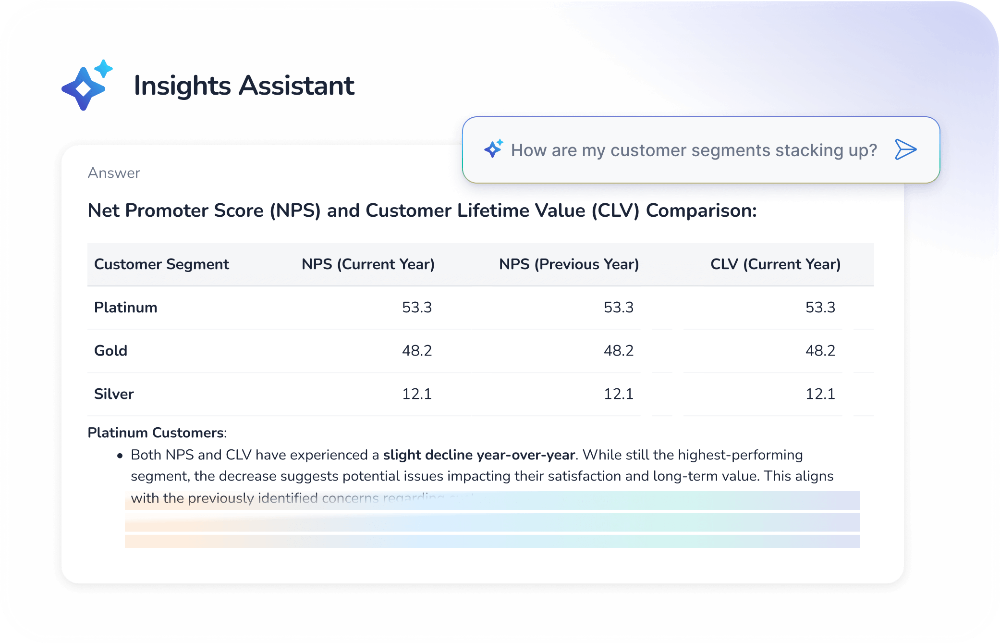
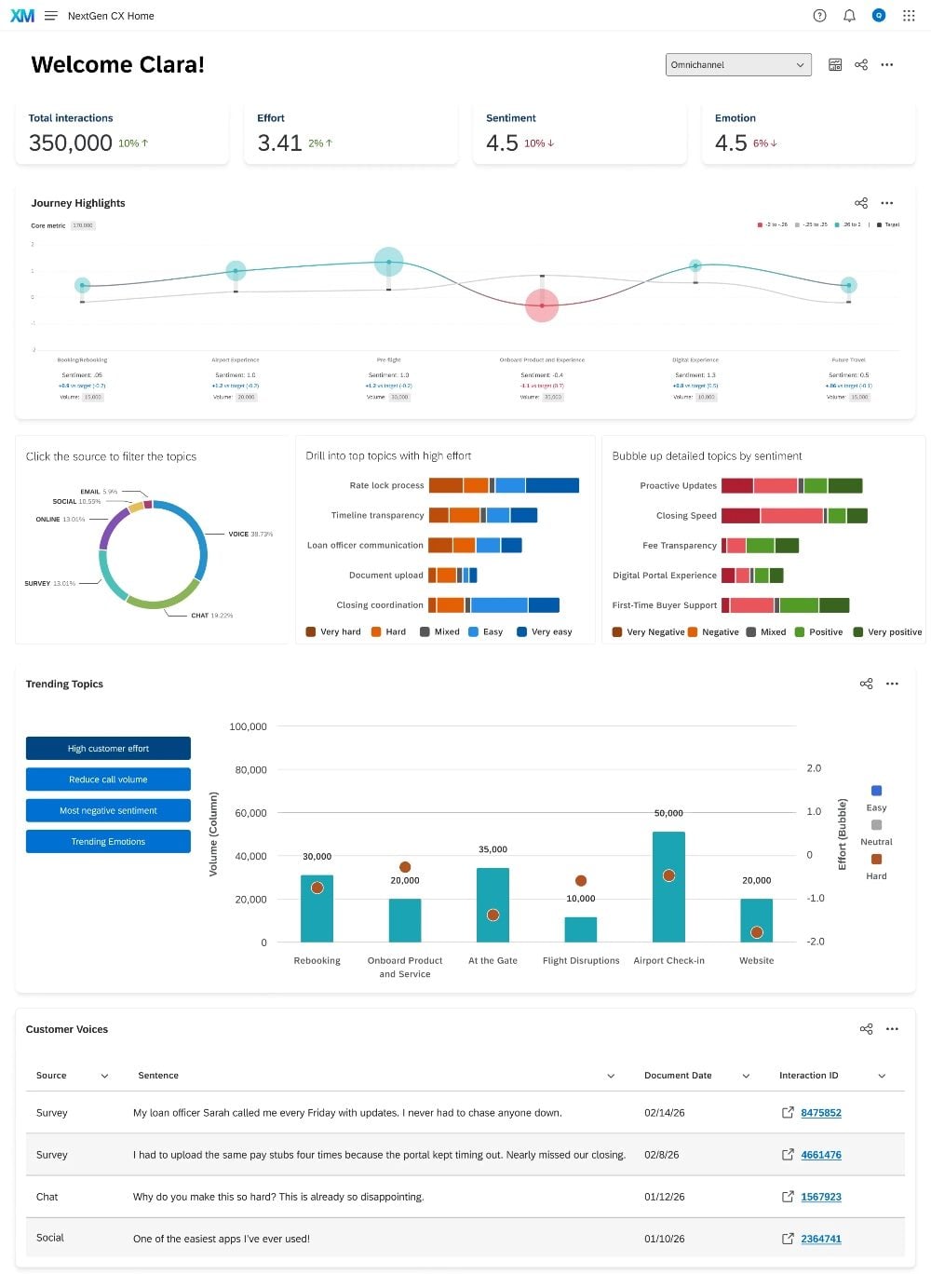
Medallia and Qualtrics differ in how they approach customer experience, with one oriented toward real-time operational response and the other toward structured analysis across multiple experience domains.
| Area | Medallia | Qualtrics |
|---|---|---|
| Core positioning | Operational customer experience platform | Experience management platform |
| Primary strength | Real-time feedback and frontline action | Structured research and broad experience analysis |
| Scope | Customer experience focused | Customer, employee, brand and research |
| Approach to insight | Interaction-level and event-driven | Aggregated, trend and benchmark-driven |
| Approach to action | Workflow-triggered, operational response | Dependent on organizational execution |
| Best fit | Service-driven, real-time CX environments | Strategy, research and multi-domain experience programs |
Beyond zeroing in on Medallia vs. Qualtrics, the traditional VoC model was always compelling in theory, but in practice, the final step has consistently been the weakest link. Most enterprises have become very good at collecting feedback and generating insights. The breakdown happens when those insights are expected to translate into coordinated action across teams and systems.
Even when issues are identified, organizations often struggle to act on them consistently. Medallia’s own research found that 30–40% of departments take no action on CX insights, highlighting a gap between visibility and execution.
Ram Swery, global VP of VoC solutions at Verint, told CMSWire, "Most organizations already have enough insight. The problem is that acting on it is slow and fragmented. Closing that gap requires embedding insights directly into workflows and using AI to trigger actions in real time, rather than relying on dashboards that tell teams what happened weeks later."
Bill Staikos, founder of Be Customer Led, argued that many VoC programs identify problems without fixing the operational issues behind them. Staikos recently stated on LinkedIn that "VoC platforms have spent years turning obvious problems into premium subscriptions," adding that some systems become "a more expensive way to admire a problem."
The challenge is becoming more visible as feedback behavior changes. According to Qualtrics’ 2026 Consumer Experience Trends Report, 30% of consumers now stay silent after a bad experience, while only 3 in 10 customers directly explain what went wrong. That raises the stakes for organizations trying to operationalize insight before customer frustration turns into churn.
At the same time, AI is changing the economics of insight generation. Capabilities such as text analytics, sentiment analysis and trend identification are becoming more accessible through generative AI tools, reducing the exclusivity of features that once differentiated major VoC platforms.
That shift is forcing buyers to focus less on dashboards and reporting and more on operational execution. Swery told CMSWire that the key question is no longer which platform has the best survey tools, but which platform can identify customer friction and help resolve it in real time.
As buyers and investors push harder on ROI, the conversation is shifting toward measurable outcomes. The expectation is increasingly that VoC platforms contribute directly to retention, operational improvement and customer journey execution rather than functioning primarily as reporting systems.
As the VoC market shifts, the criteria buyers use to evaluate platforms need to shift with it. Traditional checklists focused on survey features and dashboards no longer capture where the market is moving. Buyers are increasingly evaluating how platforms integrate into workflows, support operational decisions and contribute to measurable business outcomes.
Many platforms can surface insights, but far fewer can help organizations prioritize actions and operationalize them quickly. Swery told CMSWire that buyers should focus on platforms that can "detect where customer effort is occurring across all interactions and actually fix it."
That is increasing pressure on VoC vendors to position themselves less as standalone feedback systems and more as orchestration layers that connect customer signals to workflows, frontline teams and business operations.
Buyers are also scrutinizing whether platforms can clearly connect customer feedback activity to outcomes such as retention, churn reduction and operational efficiency. As AI lowers the cost of generating insights, the ability to drive execution is becoming a more important differentiator than reporting depth alone.
As the economics of insight continue to shift, a more fundamental question is starting to emerge: whether businesses still need dedicated VoC platforms at all. AI has made many forms of feedback analysis and sentiment detection more accessible using tools organizations may already have internally.
At the same time, the market is shifting toward orchestration. The challenge is increasingly about connecting customer insight to workflows, decisions and operational systems rather than simply collecting feedback.
Michael Taylor, CEO at SchellingPoint, told CMSWire, "Aggregation washes out the details that are essential for quality decision-making," arguing that organizations need more decision-focused approaches rather than broad sentiment summaries alone.
Taylor distinguished between what he calls “Push” and “Pull” VoC. Push VoC reflects traditional aggregation models, while Pull VoC focuses more narrowly on decision evidence, identifying the specific viewpoints and reasoning that drive action.
For enterprises evaluating VoC investments in 2026, the central question is becoming less about collecting more feedback and more about whether their systems help the organization act on customer signals faster and more effectively.
Related Article: Everyone Has a Take on the Medallia-Thoma Bravo Story. Here's Mine.
The comparison between Medallia and Qualtrics ultimately illuminates a broader shift in how businesses evaluate customer experience technology. As AI reduces the cost of insight and raises expectations around speed and impact, the value of VoC platforms is defined by how effectively they help businesses act on it.
For buyers, the decision is about understanding what role, if any, a VoC platform should play within a more connected, outcome-driven approach to customer experience.