Feature
Research Report
Building the Case for Modern Public Sector Messaging


Businesses have spent years assembling customer experience stacks that are made up of specialized tools for marketing, commerce, service and analytics. While these point solutions offer depth, they often operate in isolation, creating fragmented journeys and inconsistent customer interactions.
A new report from ISG out this month suggests that enterprises are increasingly shifting toward end-to-end platforms that unify these capabilities into a single operational framework. This move is not just about consolidation. It reflects a growing need to connect data, workflows and decision-making across the entire customer lifecycle.
This article examines why end-to-end platforms are gaining traction and what this evolution means for customer experience strategy.
Editor’s note: Key questions surrounding the shift from fragmented customer experience stacks toward orchestrated end-to-end platforms.
Integration allows systems to exchange data, while orchestration enables systems to coordinate actions using shared customer context across channels and workflows.The biggest risks include vendor lock-in, reduced flexibility, dependence on a single data model and potential challenges integrating specialized external tools.An end-to-end customer experience platform connects marketing, commerce, customer service and data functions within a unified operational framework designed to support coordinated customer journeys.Many enterprises are reducing fragmented systems because maintaining integrations, reconciling data and coordinating workflows across disconnected tools has become operationally expensive and difficult to scale.Fragmented customer data prevents systems from maintaining a consistent understanding of customer behavior, leading to disconnected interactions, weak personalization and inconsistent engagement.
In the 2026 ISG Buyers Guides for Customer Experience Management, end-to-end platforms are not defined by the number of features they offer, but by how effectively they connect the functions that shape the customer experience. Rather than operating as a collection of loosely integrated tools, these platforms bring together marketing, commerce, customer service and data into a single operational layer. The goal is not just to centralize capabilities, but to ensure that each function is working from the same context and contributing to a coordinated experience.
In retail environments, this coordination increasingly extends beyond digital channels into fulfillment, point-of-sale systems and in-store engagement, where disconnected systems can break continuity just as quickly as fragmented online experiences.
This represents a departure from traditional point solutions. For years, businesses assembled customer experience stacks by selecting best-of-breed tools for each function, often resulting in systems that performed well individually but struggled to operate as a unified whole. In contrast, end-to-end platforms are designed to reduce fragmentation by aligning workflows and data across the entire customer lifecycle.
A key element of this model is the use of shared data. Instead of maintaining separate records across systems, these platforms rely on unified customer profiles that can be accessed and updated in real time. This allows interactions in one area, such as a purchase or support request, to immediately inform decisions in another, such as marketing outreach or service prioritization. The result is a more consistent and responsive experience across channels.
Unified workflows are equally important. End-to-end platforms enable actions to move across functions without requiring manual coordination or system handoffs. A customer interaction does not begin and end within a single department. It flows across marketing, commerce and service as part of a continuous process. This is what allows businesses to move from isolated engagements to orchestrated journeys.
In this context, end-to-end platforms are less about consolidation for its own sake and more about enabling execution. By connecting data, workflows and decision-making within a single framework, they create the conditions for more consistent, real-time and coordinated customer experiences.
Related Article: Adobe Goes All-In on AI Agents at This Year's Summit
For years, businesses built customer experience stacks by selecting specialized tools for marketing, commerce, service and analytics. While these point solutions offered depth within individual functions, they were rarely designed to operate as a coordinated system. As a result, many CX environments evolved into collections of loosely connected platforms, each maintaining its own view of the customer and its own workflow logic.
Keith Dawson, director of research, customer experience at ISG, said in a statement, “Customer-facing technology has been fragmented across channels and business units for decades, but enterprises cannot create coherent end-to-end experiences with tactical tools alone.”
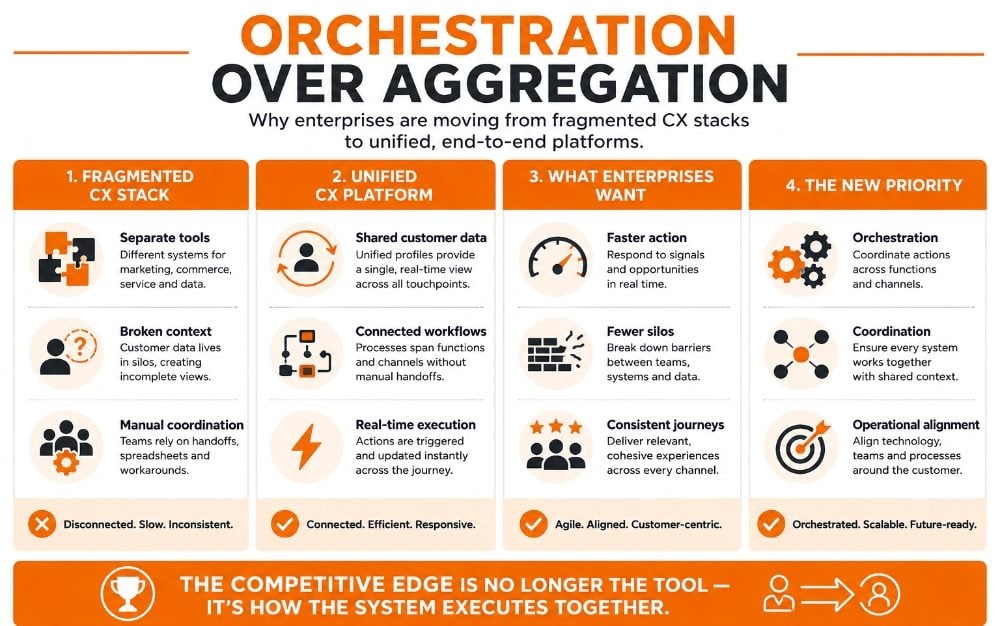
Fragmented CX stacks often create disconnected experiences because each system works from its own data and workflow logic. Unified platforms aim to connect those functions through shared data, coordinated workflows and a consistent customer view.
| Dimension | Fragmented CX Stack | Unified CX Platform |
|---|---|---|
| Data Flow | Data moves between disconnected tools | Data is shared across connected functions |
| Customer View | Partial records across separate systems | Unified customer profile across touchpoints |
| Execution Model | Teams act within individual platforms | Actions are coordinated across functions |
| Personalization | Limited by incomplete or outdated context | Informed by current customer behavior |
| Customer Journey | Channel-specific and inconsistent | Connected across marketing, commerce and service |
| Operational Impact | Higher complexity and manual coordination | Shared workflows and faster execution |
Siloed systems are at the center of the problem. When customer data is stored and processed independently across tools, each system acts on partial information. A marketing platform may not reflect recent purchases. A service system may not have visibility into prior engagement. These gaps lead to inconsistent interactions that are immediately visible to customers.
In many enterprise environments, the challenge is not the quality of individual tools, but the operational burden of keeping disconnected systems aligned over time.
Christopher Lee, founder and editor at Contractor Software Hub, told CMSWire, “The whole ‘best-of-breed’ promise quietly assumes someone is going to keep all those integrations clean: the data flows, the shared definitions, the API changes when one vendor updates without telling you. In every contractor business I’ve looked at, that work is underfunded and broken in at least one place.”
This operational overhead becomes increasingly difficult to manage as CX stacks expand. Over time, maintaining integrations and reconciling fragmented systems can consume more effort than the value that has been created by the additional specialization.
Data fragmentation further limits what businesses can do with the technology they have. Personalization depends on having a complete and current understanding of the customer, while orchestration requires that this understanding be shared across channels. When data is fragmented, both capabilities break down. Messages become misaligned, timing becomes inconsistent and engagement feels disconnected rather than intentional.
Channels also tend to operate independently in these environments. Web, mobile, email and support interactions are often managed through separate systems with limited coordination. Even when integrations exist, they frequently pass data without reconciling it into a unified context. The result is a series of interactions that may be individually functional but fail to connect into a coherent experience.
Customers experience these breakdowns directly. They are asked to repeat information, receive messages that do not reflect recent actions or encounter delays when systems fail to communicate with one another. Over time, these inconsistencies erode trust and reduce the perceived value of the experience, regardless of how many tools are in place.
As customer expectations move toward real-time, connected interactions, the limitations of fragmented CX stacks become more pronounced. The issue is no longer whether individual systems perform well, but whether they can operate together as a unified system that supports consistent, context-aware engagement.
Related Article: The Martech Landscape Has Plateaued. The Real Crisis? What AI Exposes Underneath It.
For many businesses, integration has been the primary goal of their customer experience architecture. Systems are connected, data flows between platforms and APIs enable basic interoperability. While this creates the appearance of cohesion, it often falls short of enabling meaningful coordination. Integration ensures that systems can exchange information. It does not ensure that they act on that information in a coordinated way.
Integration allows systems to exchange data, but orchestration enables those systems to act together. This distinction is central to understanding why end-to-end platforms are gaining attention.
| Dimension | Integration | Orchestration |
|---|---|---|
| Core Function | Connects systems and transfers data | Coordinates actions across systems |
| System Behavior | Platforms remain functionally separate | Platforms respond as part of a shared workflow |
| Data Usage | Data is passed between tools | Shared context guides next actions |
| Customer Impact | Interactions may still feel disconnected | Experiences feel more consistent and responsive |
| Business Value | Improves connectivity and visibility | Improves execution and journey continuity |
| Primary Limitation | Does not guarantee coordinated outcomes | Requires aligned data, workflows and ownership |
The distinction between integration and orchestration often becomes visible when businesses attempt to coordinate actions across channels in real time without relying on manual intervention.
Rafael Sarim Oezdemir, head of growth at EZContacts, told CMSWire, “A good test is to ask: could I perform actions in one channel triggered by signals in another channel without involving developers? If a customer is abandoning a cart, could we instantly alert a service agent who can then pick up the conversation from where the customer left off? If not, I’m looking at aggregation, not coordination.”
This difference highlights why orchestration depends on more than shared connectivity. Systems must be able to act collectively using shared context rather than simply transferring information between platforms.
This is where orchestration becomes the differentiator. Orchestration builds on integration by enabling systems to respond collectively, using shared data and context to guide actions across channels. Rather than treating each interaction as an isolated event within a single platform, orchestration allows customer engagement to unfold as a connected sequence, shaped by what has already occurred and what is happening in the moment.
End-to-end platforms play a critical role in enabling this transition. By unifying data across marketing, commerce and service functions, they create a shared context that can be accessed in real time. This allows decisions and actions to be aligned across touchpoints. A customer browsing behavior can influence a support interaction. A service issue can adjust marketing outreach. These are not manual handoffs, but coordinated responses driven by a common understanding of the customer.
Real-time responsiveness depends on this shared context. Without it, systems may act quickly, but they act independently, often producing conflicting or redundant outcomes. With it, actions can be synchronized, ensuring that engagement feels consistent and intentional regardless of channel.
AI increasingly acts as the coordination layer within these environments, helping platforms determine not just what action to take, but when, where and through which channel it should occur. This shifts AI from a supporting analytics or automation layer into an operational component of customer journey execution.
Orchestration ultimately reflects a broader rethinking of how customer experience is delivered. It is no longer defined by individual interactions or isolated campaigns, but by the ability to coordinate actions across the entire journey.
Integration connects systems. Orchestration allows them to operate as one.
End-to-end platforms are often described in terms of capabilities, but their effectiveness ultimately depends on how they manage and activate data. At the center of this model is the unified customer profile, which serves as the foundation for every interaction. Rather than maintaining separate records across marketing, commerce and service systems, these platforms rely on a continuously updated view of the customer that reflects behavior, transactions and engagement across channels.
Dawson described the cross-functional value as underappreciated. "When data is unified, different teams can work from the same customer context. A service leader can see how product issues affect churn. A marketing leader can see which campaigns create downstream service demand." He added that unified data also sharpens focus on data quality as a prerequisite — particularly as agentic AI moves from recommending actions to executing them.
This unified view depends on effective identity resolution. Customers rarely interact through a single identifier, and without a way to connect those signals, even the most advanced platforms operate on incomplete information. End-to-end systems attempt to resolve these identities in real time, reducing duplication and ensuring that each interaction contributes to a consistent understanding of the customer.
Enterprises are consolidating fragmented customer experience systems to improve orchestration, reduce operational overhead and support real-time engagement.
| Primary Driver | Why It Matters | Business Impact |
|---|---|---|
| Data fragmentation | Customer context remains incomplete across systems | Weak personalization and disconnected journeys |
| Operational complexity | Teams spend excessive time managing integrations | Slower execution and rising maintenance costs |
| Real-time expectations | Customers expect coordinated responses across channels | Pressure for faster signal-to-action workflows |
| Journey orchestration | Businesses need systems that coordinate actions together | More consistent cross-channel experiences |
| AI coordination | AI increasingly guides timing and next-best actions | Operationalized decision-making across touchpoints |
| Platform consolidation | Enterprises want fewer disconnected systems | Reduced vendor sprawl and governance burden |
| Cross-functional alignment | Marketing, commerce and service require shared visibility | Improved execution continuity across departments |
ISG identified Salesforce, NiCE and SAP as leading providers largely because of their ability to unify customer data, coordinate workflows across channels and support enterprise-scale governance. The move toward end-to-end platforms is being driven less by technology trends and more by operational pressure. Many enterprises are managing increasingly complex CX stacks that are made up of dozens of tools, each with its own data model, integration requirements and workflow logic. Over time, this complexity becomes difficult to maintain, slowing down execution and making it harder to deliver consistent customer experiences.
Dawson told CMSWire that the pain surfaces across the organization in predictable ways: "Data sits in too many places. Processes break when a customer moves from digital self-service to a live agent, from sales to onboarding, or from support to renewal. Decision-makers don't easily see where customer friction lives. AI and automation become harder to scale because they depend on clean, connected and governed data."
Dawson framed the consolidation drive as a recognition that CX has matured beyond its operational roots: "Even though CX grew up out of a best-of-breed or point solution world, making CX into something growth- and revenue-oriented requires more than a set of connected point solutions," he told CMSWire. "As people become aware of the ability to use CX for those organizational purposes, they see their fragmented stacks and start to recognize the limitations and the need to consolidate."
In many enterprises, the push toward consolidation reflects growing operational fatigue from maintaining fragmented systems rather than enthusiasm for all-in-one platforms themselves.
Colleen Goepfert, executive advisor of growth and go-to-market at Peak Line Advisory, told CMSWire, “Eventually the operational overhead of stitching everything together becomes exhausting. Teams spend more time reconciling systems than acting on customer insight.” As integration complexity grows, enterprises increasingly evaluate platforms based on how effectively they reduce coordination overhead and enable faster execution across functions.
The move toward end-to-end platforms introduces a different set of trade-offs that enterprises need to evaluate carefully. While consolidation can simplify operations and improve coordination, it also shifts control toward a smaller number of vendors. This raises concerns around vendor lock-in, where switching platforms becomes more difficult due to tightly coupled data models, workflows and integrations.
Lee told CMSWire that the bigger lock-in is in the data model. "Once your customer identity and workflow logic and reporting are all sitting in one vendor’s schema, getting out isn't a weekend export, it's a multi-quarter replatforming project." This is one reason enterprises increasingly evaluate portability and interoperability before committing to large platform ecosystems. The challenge is often less about contracts and more about how deeply workflows and identity systems become embedded within a vendor’s architecture.
Flexibility is often the first area to be affected. Best-of-breed approaches allow businesses to select specialized tools for specific functions and replace them as needs evolve. End-to-end platforms, by contrast, require a greater degree of commitment. While they may offer broad capabilities, they do not always match the depth or specialization of standalone solutions in every area. This can limit the ability to adopt new technologies or optimize individual components of the stack.
The trade-off between integration depth and modularity is central to this decision. End-to-end platforms provide deeper, more efficient integration within their own ecosystems, enabling shared data models and coordinated workflows. However, this depth can come at the expense of modularity, making it more challenging to integrate external tools or customize specific parts of the experience without introducing complexity.
These decisions are not purely technical. They are strategic. Enterprises need to determine whether their priority is maximum flexibility or greater control over execution. In some cases, a hybrid approach may emerge, where core capabilities are consolidated while select functions remain modular. The right balance depends on the business’ tolerance for complexity, its need for speed and its long-term approach to managing customer experience technology.
Ultimately, the move toward end-to-end platforms is not about eliminating trade-offs. It is about choosing a different set of constraints, ones that favor coordination and consistency over flexibility and independence.