Editorial
Research Report
Building the Case for Modern Public Sector Messaging


As AI-driven discovery becomes a core part of the B2B buyer journey, marketing teams are moving quickly to build dashboards around Answer Engine Optimization (AEO). New tools promise visibility into how brands show up in ChatGPT, Perplexity, Claude and Google’s AI overviews.
But while the tooling is evolving rapidly, the way many teams interpret these metrics hasn’t quite caught up.
The move from search to AI-generated answers marks a fundamental change in how visibility works. Instead of ranking pages, AI systems synthesize responses from multiple sources, reshaping how brands are seen and understood.
As Mike Ensing, CEO and co-founder at Revere, noted, “AI discovery shifts the focus from rankings to whether a brand is surfaced and included in generated answers.”
That shift requires a different way of thinking about metrics and adjusting our understanding of what they are actually signaling. I spoke to a collection of leaders and founders pioneering the most advanced AI and AEO tools to get their takes on what matters most in this new landscape. And across tools, models and methodologies, three main metrics consistently emerged as the foundation of AEO measurement: visibility, representation and sentiment.
Editor's note: AI-generated discovery is reshaping how marketers measure visibility, positioning and brand influence.
SEO focuses on rankings and clicks. AEO focuses on inclusion, interpretation and narrative consistency across AI-generated responses.Representation measures whether AI systems describe a brand using its intended positioning, differentiation and messaging.AEO measurement evaluates how brands appear and are interpreted within AI-generated answers across platforms like ChatGPT, Gemini, Claude and Perplexity.Sentiment influences whether a brand is framed as credible, trustworthy or recommended during buyer research and decision-making.Because AI systems synthesize and interpret information instead of simply ranking webpages. Brands also need accurate representation and positive sentiment within generated answers.
The first question is the most fundamental: are you present in AI-generated answers? Unlike traditional SEO, where position is everything, AEO starts with inclusion. If your brand isn’t appearing across relevant prompts, it’s effectively invisible in that layer of discovery.
And visibility in this context isn’t about a single query but about patterns across prompts. “Visibility is best understood as prompt coverage,” said Jason Patel, co-founder and CEO at Open Forge AI. “Understanding how often your brand appears across relevant queries tells you how broad your AI visibility really is.”
In the AI landscape, visibility needs to be approached as a pattern, not a snapshot. Only 30% of brands stay visible from one answer to the next, and just 20% remain present across five consecutive runs.
Inclusion is now the baseline for consideration, but this is where many teams need to recalibrate. A single strong appearance doesn’t mean much. What matters is consistency across variations of how buyers ask questions.
Related Article: Brands Are Having a 'Crisis of Faith.' AEO Isn't Making It Easier.
If visibility gets you into the answer, representation defines your role within it. In AI-generated responses, your brand is no longer presented exactly as you position it. It’s interpreted and synthesized alongside competitors, third-party sources and broader category context.
Preston Melle, customer success manager at Scrunch, referred to this as “message pull-through” — the extent to which a brand’s positioning appears intact in AI outputs.
In other words, when you show up, are you described the way you want to be described?
“Your positioning isn’t what’s on your website anymore,” observed Johannes Notheis, co-founder at Rankzero. “It’s what the model says about you.”
This is where AEO becomes more than a technical exercise. It becomes a test of narrative clarity and consistency. Brands need a strong, differentiated point of view that is corroborated across all channels to avoid being flattened into generic descriptions, regardless of visibility.
The third layer is sentiment, or how your brand is being framed. In AI-generated answers, sentiment often appears through subtle cues, such as which strengths are emphasized, whether your brand is recommended or simply listed, or how you compare to others in the category.
“Sentiment matters more than people realize,” said Tomek Rudzki, GEO expert at Peec.ai. “Especially when buyers are asking about your brand right before making a decision.”
It’s also critical to track sentiments over time; shifts in how a brand is described can signal broader changes in market perception. It can also be a powerful tool to highlight competitive advantages: sentiment can show you how you stack up against others in your industry, providing key insights into areas that you can hone in on and own versus competitors.
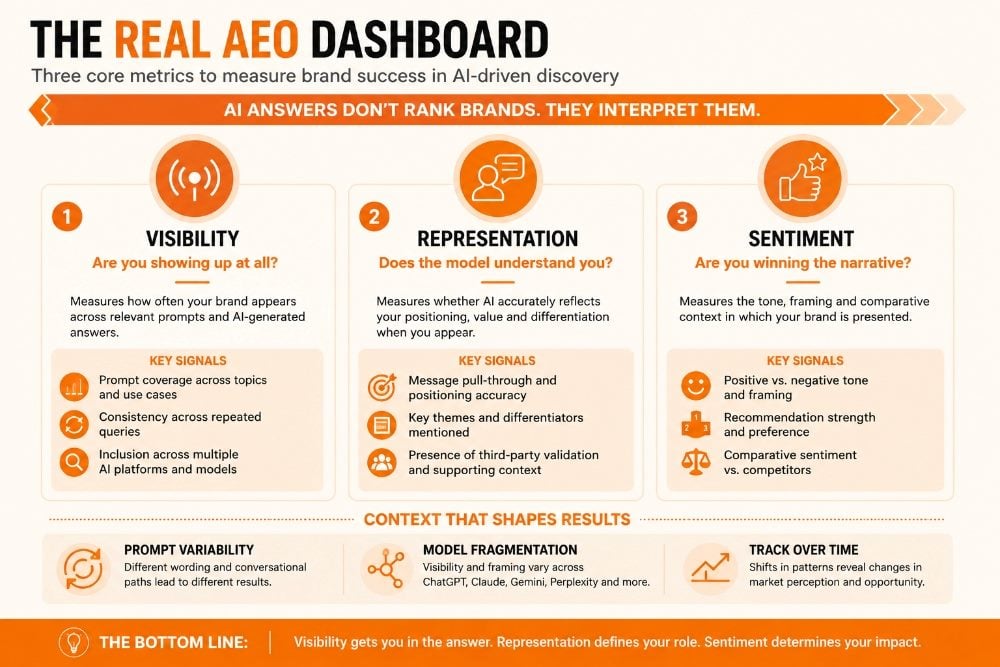
Taken together, these three metrics form a simple but powerful framework: visibility gets you into the answer, representation defines your role and sentiment determines your impact.
And while these may feel familiar, they behave very differently from traditional marketing KPIs. Large language models are probabilistic systems, not deterministic ones. The same query can yield different results depending on phrasing, context or model.
That means a single output is never the full picture. Prompt variability plays a much larger role than most teams expect. Buyers don’t ask questions in a uniform way, and small changes in phrasing can significantly impact which brands end up appearing. These subtle shifts in phrasing, intent or timing can change which sources are pulled in, and which brands end up appearing.
Model fragmentation adds another layer of complexity. Different AI systems draw from different data sources and apply different weighting mechanisms, meaning visibility can vary across environments.
“You have to look at each model independently,” said Will Robinson, AI Insights Editor at Evertune. “ChatGPT, Claude and Gemini don’t behave the same way. They’re trained differently, they pull from different sources, and they’ll often tell a very different story about your brand.”
Related Article: AEO, SEO, GEO: What's the Best Search Playbook?
Visibility metrics become meaningful only when viewed in aggregate. As a result of this shift, marketing leaders can’t rely on only tracking presence or single outputs. They must also be able to understand and interpret patterns.
“Semantic analysis is key,” said Ran Alter, co-founder and CEO at Mindshare AI. “Out of all my brand mentions for relevant user queries, how often is my brand recommended as the best solution? What are the top advantages and disadvantages?”
This is an important shift. It moves AEO measurement closer to brand tracking than performance tracking. The more relevant questions become:
In this sense, the value of AEO metrics lies less in precision and more in pattern recognition.
For CMOs, this doesn’t mean abandoning measurement. We just need to evolve how it’s structured and applied. At its core, an effective AEO framework centers on three questions: Are we showing up? How are we being understood? And are we winning the narrative?
Around that core, supporting signals help provide additional context. These include the breadth of prompt coverage, the types of sources influencing AI outputs and emerging indicators like AI-driven referral traffic. Each of these adds depth, but none replaces the need to interpret the core metrics in combination.
“Tracking and managing brand presence on LLMs is more about brand marketing than performance marketing," said Ensing. “It is far less about whether your content shows up and whether you get referral traffic or not; it is about whether you will be recommended and what the LLMs are saying about you.”
The three core metrics shaping how brands are evaluated in AI-generated discovery environments.
| Metric | Core Question | What It Measures | Why It Matters |
|---|---|---|---|
| Visibility | Are we showing up? | Prompt coverage and inclusion across AI-generated answers. | Without consistent inclusion, brands effectively disappear from AI-driven discovery. |
| Representation | How are we being understood? | Whether AI models accurately reflect a brand’s intended positioning and differentiation. | Brands risk becoming flattened into generic category descriptions if positioning lacks consistency. |
| Sentiment | Are we winning the narrative? | How positively or negatively a brand is framed within AI-generated responses. | Subtle framing can influence buyer trust and final purchase consideration. |
| Prompt variability | How stable is visibility? | How results change across different query phrasing and conversational contexts. | AI systems are probabilistic, meaning small wording shifts can change which brands appear. |
| Model fragmentation | How consistent are results across AI platforms? | Differences in visibility and representation between systems like ChatGPT, Claude and Gemini. | Each model uses different data sources and weighting mechanisms. |
| Semantic interpretation | What patterns emerge over time? | Recurring themes, advantages, disadvantages and recommendation patterns. | Long-term interpretation reveals how market perception evolves inside AI systems. |
The rise of AI-driven discovery requires a different kind of discipline: one that prioritizes context over counts, patterns over snapshots and interpretation over automation. In a world where answers are generated (not ranked), visibility alone isn’t enough.
What matters is how your brand is understood and how consistently that understanding shows up wherever buyers are asking questions.
That requires a shift toward measurement as interpretation—understanding not just what the data shows but what it means. And ultimately, that’s what will separate teams that simply track AEO metrics from those that know how to act on them.
 Learn how you can join our contributor community.

Versatile, senior marketing leader, Lora Kratchounova is the founder and CEO of Scratch Marketing + Media, an integrated marketing and communications agency servicing B2B technology game-changers – distributed systems, quantum computing, AI/ML, healthcare IT, data center technologies and solutions, security and infrastructure. Scratch provides go-to-market and growth strategy, visibility and reputation services covering branding, positioning, go-to-market, demand gen/ABM, public relations and thought leadership.