Feature
Research Report
Building the Case for Modern Public Sector Messaging


For years, marketing leaders focused primarily on campaigns, messaging and brand positioning while data infrastructure remained largely under the control of IT and engineering teams. That separation is becoming increasingly difficult to sustain.
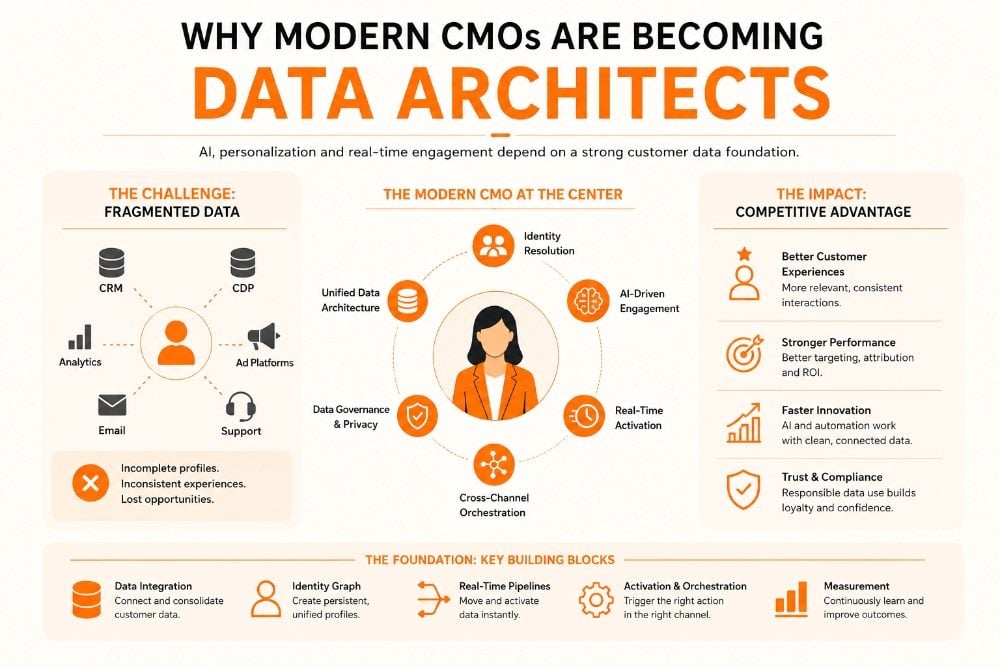
As personalization, AI-driven engagement and real-time customer interactions become central to growth strategies, many CMOs are discovering that fragmented data environments limit their ability to deliver consistent experiences, measure performance accurately and act on customer signals in real time.
This article examines why modern CMOs are becoming more deeply involved in the data layer itself and how control over customer data architecture is emerging as a competitive advantage.
Editor’s note: Modern marketing increasingly depends on unified customer data, real-time infrastructure and AI-ready systems.
For years, marketing operated on a rhythm that was defined by campaigns. Teams planned quarterly initiatives, segmented audiences by broad demographic categories and measured performance through periodic reporting cycles. Data existed, but it was often retrospective, used to evaluate what had already happened rather than to shape what should happen next.
The shift from campaign execution to continuous engagement reflects a deeper change in how marketing operates, moving from periodic, segment-based activity to real-time, data-driven orchestration.
| Dimension | Traditional Campaign Model | Modern Data-Driven Model |
|---|---|---|
| Execution Model | Planned campaigns launched at fixed intervals | Continuous, event-driven engagement |
| Segmentation | Broad demographic or static segments | Dynamic behavioral and contextual targeting |
| Data Usage | Historical and retrospective analysis | Real-time data activation |
| Personalization | Rule-based and limited | AI-driven and adaptive |
| Customer Journey | Linear and channel-specific | Non-linear and cross-channel |
| Decision Timing | Periodic reporting cycles | In-the-moment decisioning |
| Orchestration | Channel-by-channel execution | Coordinated omnichannel experiences |
That approach is no longer sufficient. Customer expectations have shifted toward immediacy, relevance and continuity across every interaction. A static campaign cannot adapt in real time to a customer browsing behavior, abandoning a cart or switching channels mid-journey. As a result, marketing has moved away from executing campaigns toward orchestrating interactions.
This shift has been driven by the growing dependency on data. Real-time personalization requires continuous access to behavioral signals, not just historical profiles. Behavioral targeting depends on understanding what a customer is doing now, not what segment they were assigned to last quarter. AI-driven engagement introduces systems that can recommend, generate and respond dynamically, but only if they are fed with accurate, unified data.
Omnichannel orchestration further complicates the picture. Customers no longer move through linear journeys. They move between web, mobile, email, chat and in-store interactions, often within the same session. Without a shared data layer, each channel operates with partial context, forcing customers to repeat themselves and fragmenting the experience.
The result is a fundamental change in how marketing operates. Campaigns have not disappeared, but they are no longer the primary unit of execution. Instead, they sit on top of a data-driven foundation that determines when, where and how engagement occurs. In this model, data is not a supporting asset. It is the system through which marketing decisions are made and delivered in real time.
Related Article: The CX Stack Is Breaking. Are End-to-End Platforms the Fix?
If modern marketing depends on data, most businesses are operating with a fractured foundation. Customer information is spread across CRM systems, CDPs, analytics platforms and ad networks, each capturing a different version of the same individual. What should function as a unified profile instead exists as a collection of partial records that rarely align in real time.
AI systems do not compensate for poor data environments. They reflect and amplify the quality, accuracy and timeliness of the data they receive.
| Data Condition | AI Behavior | Customer Impact |
|---|---|---|
| Clean, structured data | Accurate predictions and recommendations | Relevant and timely personalization |
| Unified customer profiles | Context-aware decisioning across channels | Consistent cross-channel experiences |
| Real-time signals | Adaptive responses to current behavior | Interactions feel immediate and connected |
| Fragmented data sources | Partial or conflicting outputs | Inconsistent messaging across channels |
| Outdated or delayed data | Decisions based on stale context | Irrelevant or mistimed engagement |
| Inaccurate or low-quality data | Faulty recommendations and targeting | Erosion of trust and reduced effectiveness |
Fragmentation often shows up not as a technical failure, but as a breakdown in coordination between systems that should be aligned.
Reilly Renwick, chief marketing officer at State of the Wall, told CMSWire, "If your ad platform and your CRM aren't sharing data in real time, you will end up spending money retargeting people who already bought something from you yesterday, because the purchase has not yet been synced across. This is one of the most prevalent and costly data gaps in e-commerce marketing."
This disconnect turns data fragmentation into a direct cost issue, where marketing spend is misallocated not because of poor strategy, but because systems operate on different versions of the same customer reality.
Attribution is where these issues become most visible. When data is fragmented, no system has a complete view of the customer journey. Marketing teams struggle to determine which interactions influenced a conversion, leading to conflicting reports across platforms. One system credits paid search, another credits email and a third credits direct traffic. Without a unified view, optimization becomes guesswork.
The impact extends beyond reporting and targeting into the customer experience itself. Fragmented data creates inconsistent interactions across channels. Customers are asked to repeat information, receive messages that contradict recent actions or are treated as unknown despite prior engagement. These moments accumulate, eroding trust and making personalization feel artificial rather than helpful.
Incomplete customer data does not just limit visibility, it distorts how performance is interpreted.
Laura Beussman, chief marketing and revenue officer at CallRail, told CMSWire, "When data is fragmented, you’re making decisions with blind spots. You might see clicks or form fills, but you’re missing the full context of the customer journey, especially the conversations that actually drive outcomes. Without connecting those data points, personalization falls short, and performance metrics become less meaningful."
Similarly, when personalization breaks down, the issue is often not effort but the absence of a complete and reliable customer view.
Dmytro Kononov, co-founder and CMO at Hily, told CMSWire that "Fragmented customer data weakens personalization because brands cannot build a complete, accurate view of each customer. This leads to irrelevant offers, mistimed messages, duplicate outreach, and inconsistent experiences across channels."
What appears to be poor execution is often a structural issue, where each system contributes only partial signals and no unified profile exists to guide consistent engagement.
In a marketing environment defined by real-time expectations, fragmented data is not just inefficient. It actively undermines the ability to deliver coherent, relevant experiences. Until businesses address the underlying data fragmentation, even the most advanced tools will continue to produce inconsistent results.
As marketing becomes increasingly dependent on real-time data, CMOs are being pulled deeper into decisions that were once considered the domain of IT or data engineering. The shift is not about expanding responsibility for its own sake. It is a direct response to the realization that marketing outcomes are now tightly coupled to how data is collected, unified and activated.
The shift toward data ownership is being driven by accountability for performance, not just increased technical interest. Renwick suggested, "A CMO is in charge of conversion rates, customer acquisition costs, retention and marketing revenue. Each of those metrics is computed based on data. When that data is not complete, is delayed or inconsistent across your tools, every decision you make from campaign spend to audience segmentation is made on a shaky foundation."
As core marketing metrics become inseparable from data quality, CMOs are being pulled into infrastructure decisions because the reliability of those metrics depends on the systems that they run on.
AI has accelerated what was already a growing dependency on data, but it has also removed any margin for error. Where traditional marketing systems could tolerate delays, gaps or inconsistencies, AI systems cannot. They operate continuously, make decisions in real time and depend entirely on the quality of the data they receive.
Clean data is the baseline requirement. AI models trained or prompted with incomplete, outdated or inaccurate information will produce outputs that reflect those flaws. In marketing, that translates into irrelevant recommendations, incorrect personalization and messaging that fails to align with the customer’s actual behavior. The issue is not that AI is ineffective. It is that it faithfully amplifies the quality of the data it is given.
AI does not introduce new risks as much as it accelerates existing weaknesses in data environments.
Andrei Romanescu, CMO at LumaDock, told CMSWire, "Garbage in, garbage out now happens at machine speed and with model confidence, which is much worse than a spreadsheet error a human can eyeball." What was once a manageable issue becomes significantly more damaging when automation scales those errors across customer interactions without human oversight.
Contextual accuracy introduces another layer of dependency. AI does not just need data, it needs the right data at the right moment. A recommendation engine, for example, must account for what a customer is doing now, not just what they did last week. Without accurate, timely context, AI outputs become disconnected from the customer’s intent, reducing relevance and, in some cases, creating friction in the experience.
Real-time signals bring these requirements together. AI systems rely on continuous streams of events, page views, clicks, transactions and interactions, to adjust behavior dynamically. If those signals are delayed, missing or inconsistent across systems, the AI’s ability to respond breaks down. What should feel like adaptive engagement instead becomes static and out of sync.
The gap between AI adoption and AI effectiveness is often rooted in the readiness of the underlying data environment.
Zeyuan Gu, CEO and founder at Adzviser, told CMSWire, "If your data is messy, delayed, or incomplete, the outputs aren’t reliable. That’s where a lot of teams get stuck—they adopt AI tools but realize their data foundation isn’t ready." This creates a scenario where businesses successfully implement AI tools but fail to generate value because the data layer cannot support consistent, context-aware decisioning.
Businesses that attempt to layer AI onto disconnected systems often see disappointing results, not because the models lack capability, but because the underlying data cannot support real-time, context-aware decisioning.
Related Article: AI Won't Save Marketing If Customers Don't Trust It
As marketing shifts toward real-time engagement and AI-supported marketing decisions, the unified customer profile has become a central requirement rather than a technical aspiration. Personalization and orchestration both depend on having a consistent, continuously updated view of the customer across every interaction.
Identity graphs play a critical role in making this possible. Customers rarely interact through a single identifier. They move between devices, channels and states of authentication. Identity resolution systems attempt to connect those signals into a coherent profile, reducing duplication and enabling a more accurate understanding of the individual behind the interactions.
This foundation enables cross-channel continuity. When profiles are unified, interactions in one channel can inform behavior in another. A product that is viewed on mobile can influence an email recommendation. A support interaction can shape future messaging. Without this continuity, each channel operates independently, and the experience becomes fragmented.
Modern marketing execution increasingly depends on infrastructure decisions once handled primarily by IT and engineering teams.
| Pressure Area | Why It Matters | Impact on Marketing |
|---|---|---|
| Real-time personalization | Requires live behavioral signals and unified profiles | Drives more relevant engagement and adaptive journeys |
| AI-driven engagement | Depends on clean, accurate and contextual customer data | Improves recommendations, targeting and automation |
| Identity resolution | Connects customers across channels and devices | Reduces duplicate outreach and fragmented experiences |
| Cross-channel orchestration | Requires systems to share a common customer view | Creates continuity between web, mobile, email and support |
| Data governance | Controls consent, privacy and data quality standards | Balances compliance with personalization effectiveness |
| Real-time data pipelines | Enable in-the-moment decisioning and AI responsiveness | Reduces latency in customer engagement |
| Organizational alignment | Marketing, IT and governance must share priorities | Prevents siloed systems and conflicting customer data |
Disconnected systems create subtle but costly breakdowns in timing and decision-making across the customer journey.
Beatriz Gomez, chief marketing officer at Ontop, told CMSWire, "You follow up too late. You qualify the wrong leads. You send campaigns that don’t reflect real behavior. You miss the exact moment someone was ready." These gaps accumulate into missed opportunities, where incomplete visibility prevents marketing teams from acting at the precise moment when customer intent is highest.
Persistent customer memory extends this concept further. Rather than treating each interaction as a distinct event, marketing systems can build on prior context over time. Preferences, behaviors and past engagements become part of an evolving profile that informs future decisions. This is what allows personalization to feel cumulative rather than repetitive.
The connection to orchestration is direct. Unified profiles provide the context that is required to determine not just what message to deliver, but when and through which channel. Without that foundation, orchestration becomes a series of disconnected actions rather than a coordinated experience.
In this environment, the unified customer profile is not simply a data construct. It is the mechanism through which personalization and orchestration become possible at all.
The shift toward data-driven marketing is not just a technical challenge; it is an organizational one. Control of the data layer sits at the intersection of marketing, IT, security and data governance, each with different priorities, incentives and definitions of success.
Marketing is focused on speed, flexibility and the ability to act on customer signals as they occur. Campaigns have given way to continuous engagement, and that requires rapid access to data and the ability to activate it across channels without delay.
IT, by contrast, is responsible for system stability, scalability and long-term architecture. Changes to data pipelines, integrations or platforms are evaluated in terms of risk and maintainability, not just immediate business impact. What marketing sees as urgency, IT often sees as potential disruption.
Security and data governance teams introduce another set of constraints. Their focus is on protecting customer data, ensuring compliance with privacy regulations and maintaining strict controls over how data is accessed and used. As a result, governance processes are often deliberately cautious, which can slow down data access and activation.
These perspectives are all valid, but they are rarely aligned by default. Marketing may push for broader access to first-party data, while governance teams restrict usage based on consent policies. IT may prioritize a multi-year architecture roadmap, while marketing needs near-term integration to support current initiatives. Security may limit real-time data sharing across systems, even when it would improve the customer experience.
The result is often a fragmented approach to the data layer, not because of technical limitations, but because of organizational friction. Decisions are distributed across teams that are not always working toward the same operational model or goals.
In many businesses, the issue is not access to data, but the absence of clear ownership across teams.
Andrea Dyan Brown, chief strategy officer at 360 Veritas, told CMSWire, "Most companies’ data are in silos because ownership is unclear. IT owns infrastructure, marketing owns KPIs and CRMs, and no one really owns alignment." This lack of accountability reinforces fragmentation, where each function manages its own systems without responsibility for maintaining a consistent, unified customer view.
Addressing this requires more than better tools. It requires clearer ownership, shared objectives and a common understanding of how the data layer supports business outcomes. Increasingly, CMOs are stepping into this role, not to replace IT or governance, but to align these functions around the requirements of modern marketing.
Without that alignment, even well-funded data initiatives can stall. With it, businesses can begin to move from isolated capabilities to coordinated execution.
Executives across marketing, analytics and customer engagement say fragmented data is increasingly undermining personalization, attribution and AI performance.
| Source | Key Insight | Why It Matters |
|---|---|---|
| Reilly Renwick, State of the Wall | Disconnected ad and CRM systems create costly retargeting inefficiencies and delayed customer updates. | Highlights how fragmented systems directly waste marketing spend and weaken customer targeting accuracy. |
| Laura Beussman, CallRail | Fragmented data creates blind spots that obscure the full customer journey and reduce personalization quality. | Shows how incomplete customer visibility weakens attribution and makes performance metrics less reliable. |
| Dmytro Kononov, Hily | Without unified customer profiles, brands deliver mistimed, repetitive and irrelevant experiences. | Reinforces that personalization failures are often structural data issues rather than messaging problems. |
| Andrei Romanescu, LumaDock | AI amplifies flawed data environments at scale instead of correcting them. | Demonstrates why poor data quality becomes significantly more dangerous in AI-powered marketing systems. |
| Zeyuan Gu, Adzviser | Many companies adopt AI tools before their data foundations are ready to support them. | Explains why AI initiatives frequently underperform despite strong technology investments. |
| Beatriz Gomez, Ontop | Disconnected customer systems cause businesses to miss key engagement and conversion moments. | Illustrates how fragmented visibility weakens real-time orchestration and customer responsiveness. |
| Andrea Dyan Brown, 360 Veritas | Data silos persist because ownership and alignment across marketing, IT and governance remain unclear. | Shows that organizational structure and accountability are often bigger barriers than technology itself. |
The modern CMO is no longer responsible only for messaging, campaigns and brand growth. As marketing becomes more dependent on real-time personalization, AI-driven engagement and cross-channel orchestration, the ability to influence the data layer has become central to the role.
CMOs do not need to replace IT, security or data teams, but they do need enough ownership to ensure that customer data is unified, governed and usable across the systems that shape the customer experience. The future CMO will still be a strategist, but strategy will increasingly depend on the architecture beneath it.