Editorial
Research Report
Building the Case for Modern Public Sector Messaging


Think of a company's knowledge base the way a city thinks about water infrastructure. The reservoir that supplies drinking water to homes is the same one that feeds fire hydrants and irrigation systems. Nobody argues for three separate reservoirs serving the same watershed.
Yet many enterprise CX teams are, in effect, doing exactly that — building separate content pipelines for external AI brand discovery and for internal agentic service delivery, even though both draw from the same underlying source: the brand's structured, authoritative, up-to-date knowledge.
Two significant pressures are accelerating toward this realization simultaneously. The first is the steady shift in consumer discovery behavior toward generative AI platforms.
Similarweb data shows that 35% of US consumers now use AI during the product discovery stage, compared to just 13.6% who use traditional search for the same purpose. AI platforms referred 226.8 million US visitors to third-party sites in January 2026 — 15% fewer than in October 2025 — which means brand influence is increasingly concentrated in the AI conversation itself, upstream of any website visit.
The second pressure is the rapid integration of task-specific AI agents into enterprise operations. Gartner predicts 40% of enterprise applications will be integrated with task-specific AI agents by the end of 2026, up from less than 5% in 2025, with customer service among the earliest and most active deployment categories.
For CX leaders, the strategic insight is this: the content authority that earns GenAI brand mentions and the knowledge infrastructure that makes AI agents accurate and trustworthy are not parallel investments. They are the same investment. This article examines how each pressure works, where the two roadmaps intersect, and how CX teams can make the case for a unified content and knowledge strategy — one that generates returns on both fronts simultaneously.
Editor's note: CX leaders increasingly face the same challenge across AI discovery and AI-powered service delivery: maintaining trustworthy, structured knowledge at scale.
For nearly two decades, the customer journey started at a search bar. A consumer typed a query, scanned 10 blue links and made a shortlist. Search engine optimization existed precisely to shape that shortlist.
The arrival of conversational genAI platforms — ChatGPT, Gemini, Perplexity, Claude and others — has moved that search entry point upstream, transforming the search experience into a dialogue that resolves product questions, compares alternatives and surfaces brand names before a single search result is seen.
Adobe Analytics data from early 2025 revealed that consumers' leading use of GenAI is conducting product research (55%), followed by receiving product recommendations (47%). Those two use cases together capture the precise moment when a brand either enters or exits a consumer's consideration set.
Related Article: Brands Are Having A 'Crisis of Faith.' AEO Isn't Making It Easier.
The downstream behavior data adds further weight to the shift. eMarketer reported that online retail traffic from GenAI sources grew 4,700% year over year in July 2025, and that referral traffic from these platforms demonstrates materially stronger engagement — roughly 12% more pages viewed, 8% longer dwell time, and a 23% lower bounce rate compared to retailer averages. The consumer arriving from a GenAI conversation has already been briefed on the category and the options. They arrive with intent shaped by a conversation the brand never saw.
For CX teams managing post-conversion experience, that invisible upstream conversation is consequential in a direct way. When AI platforms describe a brand's products, policies, or service capabilities incorrectly, customers arrive with misaligned expectations — and the CX team absorbs the fallout in the form of returns, complaints and escalations. Brand visibility in AI and brand accuracy in AI are not separate concerns. They are two versions of the same information quality problem, and both land on the CX function's operational radar.
The internal agentic AI story has developed in parallel, and at pace. Gartner's August 2025 analysis outlines a five-stage evolution of enterprise AI agent adoption, from basic AI assistants embedded in every application (2025) to collaborative multi-agent ecosystems (2027–2028), and ultimately to a state where at least half of knowledge workers will be expected to create, govern and deploy agents on demand (2029).
Customer service is among the earliest and most active deployment categories in this trajectory. When agentic AI is applied at scale in customer service, the financial returns are measurable: Gartner projects that agentic AI will autonomously resolve 80% of common customer service issues without human intervention by 2029, driving a 30% reduction in operational costs. For contact centers, adding agentic AI to reduce staffing and escalation costs is appealing to dominate better profit and loss.
The same knowledge infrastructure increasingly drives both AI brand visibility and AI-powered service delivery.
| Priority Area | Why It Matters for GenAI Discovery | Why It Matters for Agentic CX |
|---|---|---|
| Structured FAQs | Improves AI citation and recommendation visibility | Reduces escalations and improves self-service accuracy |
| Product Metadata | Helps AI platforms compare and surface products accurately | Powers recommendation and guided-support workflows |
| Governance Workflows | Prevents stale or contradictory AI brand information | Reduces hallucinations and incorrect agent responses |
| Technical Documentation | Expands AI authority for specialist queries | Enables autonomous troubleshooting resolution |
| Unified Ownership | Aligns marketing and CX messaging consistency | Creates a single source of operational truth |
Early adopters are already reporting returns ahead of those forecasts. Companies that have deployed agentic workflows are seeing an average of 1.7x ROI, with US enterprises reporting 1.92x, according to research compiled across agentic deployment benchmarks. Those figures reflect gains that go beyond simple deflection — they encompass resolution accuracy, handle time reduction, and the elimination of agent-to-agent handoffs that degrade both cost and customer satisfaction. The ROI story for agentic CX is real, and it is compounding for organizations that got their knowledge foundations right before scaling their agent deployments.
The momentum, however, runs into a consistent barrier: knowledge quality. When AI agents produce incorrect responses, recommend unavailable products, or cite superseded policies, organizations absorb costs in escalation, rework and customer attrition.
Gartner has warned that more than 40% of agentic AI projects will be canceled by the end of 2027, citing escalating costs, unclear business value, and inadequate risk controls. In practice, the risk controls that fail most visibly are those surrounding the quality, consistency and governance of the content that agents consume. Many organizations invest heavily in the agent orchestration layer while underfunding the knowledge governance layer that determines what the agent actually knows and says. The 30% cost reduction and the 1.7x ROI benchmarks belong to organizations that did not make that mistake.
The convergence between GenAI brand visibility and agentic CX service delivery is not theoretical — it is architectural. Both capabilities draw from the same pool of structured, accurate, retrievable brand information. A well-maintained knowledge base answers customer questions asked through an AI agent in the contact center. The same well-maintained knowledge base is what gets cited when a consumer asks ChatGPT to compare warranty policies across three electronics brands. The structured FAQ that reduces live escalation rates is also the structured FAQ that earns the brand a mention in a product discovery conversation the marketing team never tracked.
The divergence in most organizations arises from organizational relationship. Marketing-adjacent teams own the GenAI visibility roadmap, focused on content authority, AI optimization and brand mention metrics. CX operations teams own the agentic service roadmap, focused on deflection rates, resolution accuracy and agent performance.
Each team treats its content investment as proprietary infrastructure. The result is duplicated effort, inconsistent information across consumer-facing and agent-facing surfaces and a missed opportunity to build a single authoritative asset that serves both purposes.
The following table outlines where the overlap is most direct and what the shared infrastructure looks like in practice.
There are five capabilities that blend brand visibility in AI platforms and agentic service delivery in a common infrastructure asset. The table below outlines those capabilities and their interections of usage Investment in any one row produces returns on both fronts.
| Capability | GenAI Brand Visibility Use | Agentic CX Service Use | Shared Infrastructure Asset |
|---|---|---|---|
| Knowledge Base & FAQs | Cited by GenAI platforms when consumers ask product or category questions | Powers AI agent self-service resolution and reduces live agent escalation | Structured, up-to-date product and policy content |
| Product & Service Descriptions | Surfaced in AI-generated product comparison and recommendation responses | Feeds agentic recommendation engines in guided selling and support flows | Accurate, schema-rich product data with clear attribute tagging |
| Customer Reviews & Social Proof | Cited by GenAI platforms as third-party validation signals for brand trust | Used by sentiment models to inform agent tone calibration and issue routing | Centralized review corpus with structured sentiment metadata |
| Technical Documentation | Referenced by AI for how-to queries; specialist depth earns AI citation share | Enables AI agents to resolve configuration and troubleshooting requests autonomously | Consistently versioned, accessible documentation with clear information hierarchy |
| Content Governance & Refresh Cadence | Brands with stale or inconsistent content lose AI mention momentum over time | Outdated knowledge bases produce incorrect agent responses and erode customer trust | Editorial workflow for scheduled content review, accuracy auditing, and retirement |
As you read across each row, you will notice a pattern. In every case, the "Shared Infrastructure Asset" is a content or data governance capability that most organizations already have in some form, but manage inconsistently. Keeping them accurate, structured and accessible to both internal agents and external AI retrieval systems becomes the objective. The customer experience function is the natural owner of that discipline, because it already manages the operational consequences when the information is wrong.
The practical question for CX leaders is how to position this convergence as a funded priority for a CMO or CTO audience that may be running two separate roadmaps. The argument does not require a reorg or a technology replacement — it requires surfacing the shared cost structure, quantifying the return and connecting both to assets the organization already owns.
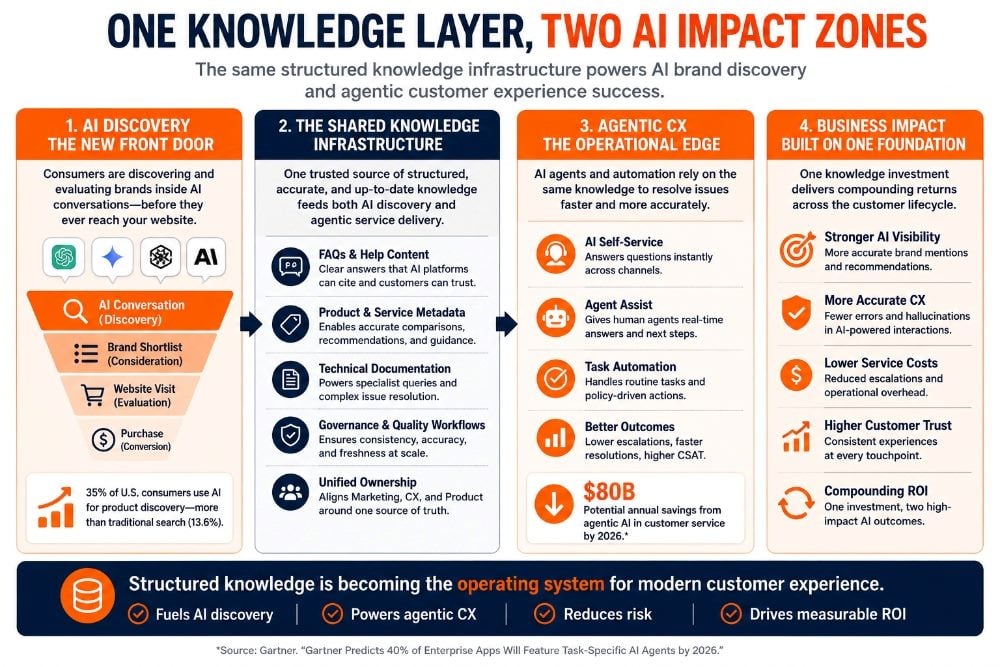
For CX leaders, the challenge is no longer proving that AI matters. The challenge is proving that the same structured knowledge investment can improve both customer acquisition and customer service performance at the same time. That requires reframing AI knowledge infrastructure not as a marketing initiative or a contact center initiative, but as a shared operational asset with measurable business impact across the customer lifecycle.
The financial case is already taking shape. Gartner projects agentic AI could reduce customer service operational costs by 30% by 2029, while deployment benchmarks show organizations already seeing average returns approaching 1.7x ROI. At the same time, eMarketer-cited GenAI referral traffic data points to stronger engagement quality, including higher page views, longer dwell time and lower bounce rates.
Together, those signals position structured knowledge as infrastructure capable of improving both operational efficiency and revenue quality simultaneously.
The organizations pulling ahead in AI are increasingly the ones treating structured knowledge as a long-term operational discipline rather than a one-time content project.
CX teams that establish a trusted, governed knowledge foundation before that shift accelerates will be positioned to influence both the discovery experience and the service experience from the same infrastructure investment.
 Learn how you can join our contributor community.

Pierre DeBois is the founder and CEO of Zimana, an analytics services firm that helps organizations achieve improvements in marketing, website development, and business operations. Zimana has provided analysis services using Google Analytics, R Programming, Python, JavaScript and other technologies where data and metrics abide.