Editorial
Research Report
Building the Case for Modern Public Sector Messaging


The most dangerous lie in modern business is the belief that your "creatives" and your "data people" belong in separate rooms. For decades, organizations have operated under a false dichotomy: the creatives in marketing handle the brand, while the data people in IT or finance handle the metrics.
As the digital customer experience (DCX) becomes the primary battlefield for growth, this division is no longer just inefficient – it’s a strategic liability. Today’s most successful CEOs aren't choosing between intuition and analytics. They’re mandating a permanent marriage of the two.
To lead a modern organization, you must become a "Creative-Data Leader."
Editor's note: Key questions surrounding the rise of Creative-Data Leadership and its role in modern customer experience strategy.
What exactly is a Creative-Data Leader? It’s not a requirement to be an expert in both graphic design and Python. Rather, it’s the ability to architect a culture where data informs the creative spark and creativity gives data a human purpose. It’s a fundamental shift from viewing data as a "check" on creativity to viewing it as the essential fuel for it.
In the old model, data was used to grade performance after the fact. In the new mandate, data is used to illuminate the path before a single image is moved.
These days, customer experience is the product. Whether you’re in B2B SaaS, information management, or global franchising, the way a customer feels when interacting with your digital touchpoints drives long-term retention and customer lifetime value.
However, feeling is famously hard to measure, while clicks are easy to track but often lack context. This creates a critical friction point that stalls growth:
The mandate for leadership is to close this gap by building an integrated digital workplace where silos are dismantled and insights are democratized across every department.
Data tells you what happened, and creativity tells you why it matters. High-level professionals must understand that data is a trailing indicator of human behavior. To bridge this gap, leaders must implement three specific strategic shifts:
Audit the Tech Stack for Collaboration
Is your CRM accessible to your creative directors? Does your data science team understand the brand’s core pillars? Integration isn't only about APIs – it’s also about visibility. A Creative-Data Leader ensures that the "why" and the "how" are visible to all stakeholders, preventing the fragmentation of the customer journey.
Reframe Metrics: From Vanity to Intent
We must move beyond "vanity metrics," such as likes or impressions. The modern leader focuses on high-intent engagement. These are specific data points, like interaction rates with personalized CX modules, that show a creative asset actually moved a customer closer to a transaction or solution.
Encourage 'Data-Backed Risk'
Innovation requires failure, but corporate culture often punishes it. Use data to create a strategic safety net where creative teams can experiment with bold ideas. By having the instrumentation to pivot quickly if the numbers don't align, you lower the cost of creative exploration and encourage true market breakthroughs.
Related Article: How Smart CMOs Transform Data Into Emotional Loyalty
For IT and information management leaders, the mission has shifted from "maintenance" to strategic enablement. The modern digital workplace must be a canvas for storytelling, not a warehouse for raw bits.
From Monolithic to Composable
To support the Creative-Data mandate, organizations are moving away from rigid, monolithic systems toward composable architecture. This modular approach gives marketing teams the freedom to swap out tools and move at the speed of culture without waiting for a massive IT overhaul. If your technology doesn't allow for rapid iteration, it’s an anchor on your brand.
The Power of Self-Service Insights
If a creative team has to put in a ticket and wait three weeks for a data pull, your organization has already lost the window of relevance. The goal is self-service Insights. When the brand team can see real-time customer sentiment on their own, they can adjust the narrative instantly to meet the customer's needs.
To transition your organization toward this dual mandate, follow this implementation roadmap to ensure the shift is structural:
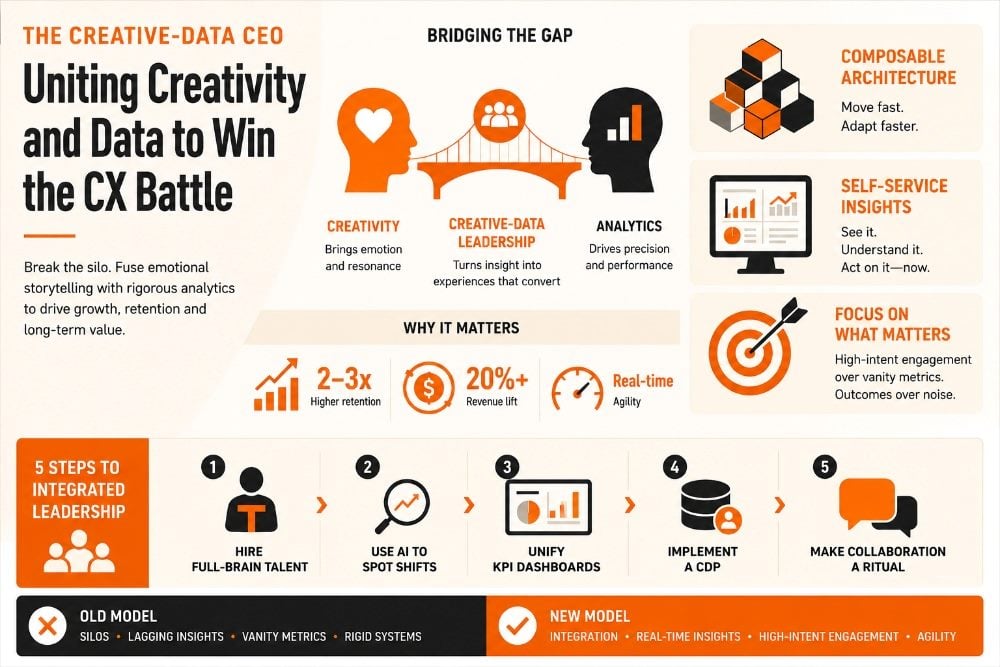
Organizations are increasingly restructuring customer experience operations around integrated creative and analytical decision-making.
| Traditional Model | Creative-Data Leadership Model |
|---|---|
| Creative and analytics teams operate separately | Cross-functional collaboration shapes CX strategy |
| Vanity metrics dominate reporting | High-intent engagement becomes the priority |
| Rigid monolithic platforms slow execution | Composable architecture enables agility |
| Data is used after campaigns launch | Data informs creative decisions before launch |
| IT focuses on maintenance | IT becomes a strategic CX enablement partner |
| Creative risk is minimized | Data-backed experimentation is encouraged |
Artificial intelligence is the ultimate bridge between the creative and the analytical. We use LLMs not just to generate content, but to analyze it. AI can identify which specific visual or linguistic "hooks" are driving engagement — a task impossible for humans but essential for the modern CEO.
This is the essence of modern digital customer experience — it’s no longer a static campaign. It’s a living, breathing dialogue powered by machine learning and human intuition.
We’re entering an era where the distinction between "digital" and "physical" business is evaporating. Your brand is your data, and your data is your brand. The CEOs who try to keep these worlds separate will find themselves outpaced by leaner, more integrated competitors who understand that agility is the new currency.
The mandate is clear: Lead with the heart of a creative, but manage with the mind of a data scientist. By embracing this duality, you turn raw operational data into actionable creative strategies that drive real-world, sustainable growth.
 Learn how you can join our contributor community.

Adam Povlitz is CEO & President of Anago Cleaning Systems, one of the world’s leading franchised commercial cleaning brands and a leader in technological advances relating to business operations and facilities services.
Adam is an experienced business writer and industry thought leader with more than a decade of published work in top-tier outlets.