Editorial
Research Report
Building the Case for Modern Public Sector Messaging


I think we can all agree that the traditional B2C engagement model has shifted significantly. Up until recently, the dominant logic in B2C customer engagement was simple: more contact equals higher probability of customer conversion and retention i.e. the more emails I send, the more customers I convert and ultimately retain.
Marketers would build a lifecycle, fill the calendar and cadences with content and continually fire. If a customer hasn't been "touched" in two weeks, then that becomes a gap to close. Customer support and success teams were staffed and measured based on touchpoint volume – full stop. Sophistication of content drip and cadence was the order winner for marketing automation and customer engagement platforms. Optimizing reach was the end goal.
But then some things changed. Yep, you guessed it, AI.
What changed? With AI, brands can create "content" (some would call it slop) at alarming rates and volumes, couching it as highly personalized, when in many cases, it isn't personalized at all. What didn't change? Many brands are still using dated ways of thinking: sending check-in emails that don't check in, dropping customers into re-engagement campaigns based on time periods expiring, offering new products via dated if-then next best offer logic, etc. — and seeding these sequences with AI-generated content.
And, unfortunately for brands, these approaches still don't really work.
With the power of AI at our disposal the model has changed from calendar-driven engagement to signal-driven engagement. Signal-driven engagement means that engagement should only occur when something meaningful has changed, and AI makes that operationally possible. Teams monitor behavioral signals across an entire customer base in real time, segment not just by demographics or lifecycle stage but by what the customer actually needs right now. And this includes when that answer is nothing.
Related Article: Brands Are Having a 'Crisis of Faith.' AEO Isn't Making It Easier.
So if we flip that model, if we start to use silence as a positive data signal, not a negative warning sign, we must flip how we engage. Because what is often still happening is teams are adopting signal-driven methodologies and still using it to fire more targeted outreach. They're still optimizing for contact. The real unlock is using those signals to know when to hold back and building the organizational discipline to act on that.
The visual below shows 4 cohorts of customer categorized by both signal strength and churn risk. Let's discuss how we should engage each of them in the future. Understanding each cohort requires a solid grasp of customer experience fundamentals — particularly how engagement patterns map to satisfaction and loyalty.
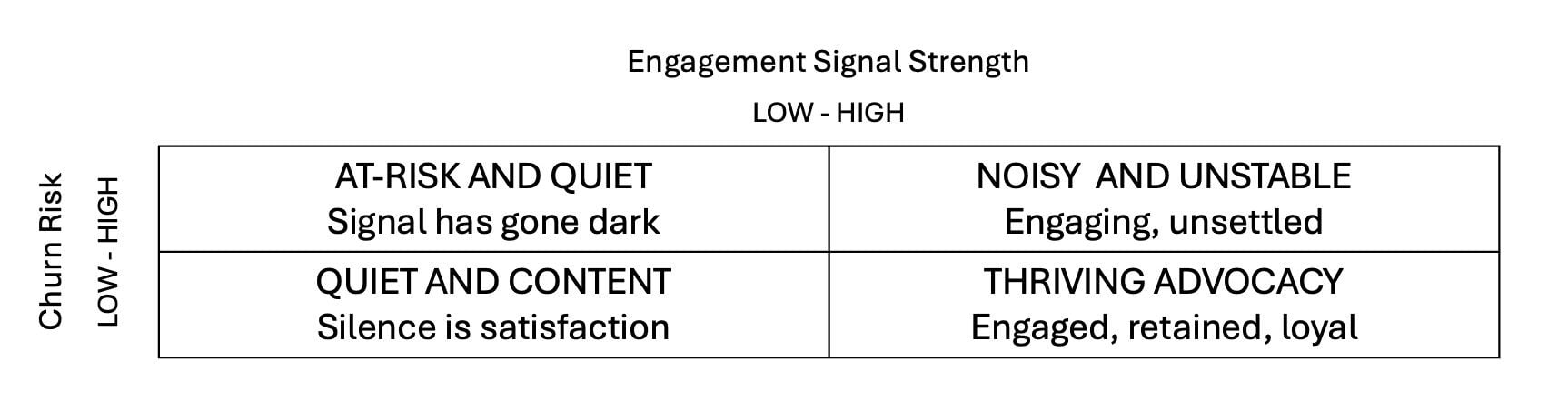
Over contact is corrosive and can be hard to see in your data. Customers who feel bothered don't always churn immediately. Instead, they take small steps by unsubscribing from your emails and mentally checking out. Tracking metrics like CSAT and NPS over time can help surface these gradual disengagement patterns before goodwill is gone. And if your marketing department ever catches it, it's usually too late and the goodwill is gone.
Editor's note: Questions below reflect how CX and marketing practitioners are approaching AI-driven engagement strategy in 2026.
In today's customer engagement world, most marketing teams segment for who to contact. They should be looking at who to leave alone, and for how long. We have all heard of holdout control groups within segmentation, but now is the time for "hold quiet lists". These are contacts where AI has assessed engagement signals as healthy and the customer gets flagged for a silence window or 30, 60, 90 days, etc. That's not ignoring, that's respect.
The teams that are getting this right have trust in both their data and AI decisions. They have the discipline to know that when their data tells them to do nothing, they should listen. Maturing organizational decision intelligence backed by AI and strong data takes time. And it can be a hard organizational sell to make, one of "let's stop contacting our customers".
But in the end, implementing AI decisioning to adapt and learn from customer behavior and engage accordingly will reap many benefits.
 Learn how you can join our contributor community.

Jonathan Moran, Head of MarTech Solutions Marketing, covers global product marketing activities at SAS, with a focus on customer experience and marketing technologies. Prior to SAS, Jon gained over 20 years of marketing and analytics industry experience at both Earnix and the Teradata Corporation in pre-sales, consulting and marketing roles.