News
Guide
8 CX Survey Templates Built to Get Answers, Not Just Scores

Databricks made a significant move into the marketing technology industry today, announcing CustomerLake, a new agentic Customer Data Platform (CDP) built natively inside the Databricks lakehouse. The announcement, made at the company's Data + AI Summit in San Francisco, positions Databricks as a direct competitor in a martech category long dominated by standalone CDP vendors.
It also wakes up those vendors a bit, if you ask marketing technology analysts and observers. Will this lead to more CDPs building on top of the enterprise data layer stack? Yes, says at least one outlet. More on that later.
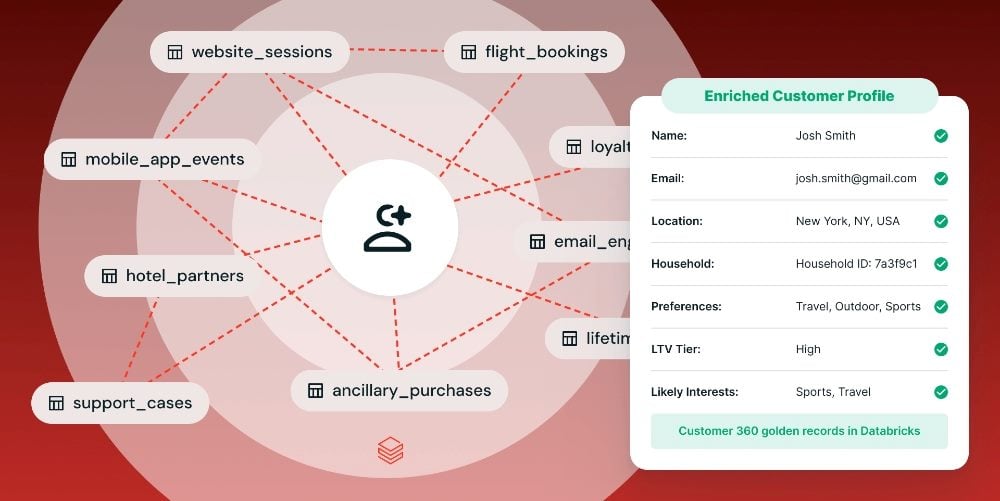
Meanwhile, CustomerLake brings core CDP capabilities — including Customer 360 profile building, identity resolution, audience segmentation, campaign automation and channel activation — into the same governed data environment where enterprises already manage their AI models and customer data assets. The product is currently available in Private Preview, with early customers including HP, Circle K, AB InBev, and Getnet by Santander.
Databricks frames CustomerLake as a structural fix, not just a feature addition. The company's position is that existing CDPs create a fundamental architectural flaw: they sit outside the core data and AI platform, requiring data to be duplicated, moved and re-governed in a separate system. That separation, Databricks argues, slows marketing teams, creates security exposure and limits the personalization that AI-era marketing demands.
"Marketers need to reimagine their entire foundation," said Ali Ghodsi, co-founder and CEO of Databricks. "Not just the campaigns they run, but also the customers they run them for, which now include agents. With CustomerLake, we're replacing legacy software with an open, Agentic CDP built directly on the Lakehouse. When customer data, AI models, and agents live in one governed platform, marketing stops being a series of campaigns and becomes a continuous loop — agents that constantly analyze, decide, and act on every customer in real time."
CustomerLake is governed by Unity Catalog and supports Lakehouse Federation, which allows teams to query customer data where it already resides — whether in Databricks, Snowflake, Google BigQuery, cloud storage, or operational databases — without creating new data silos.
At the center of CustomerLake are two agentic capabilities:
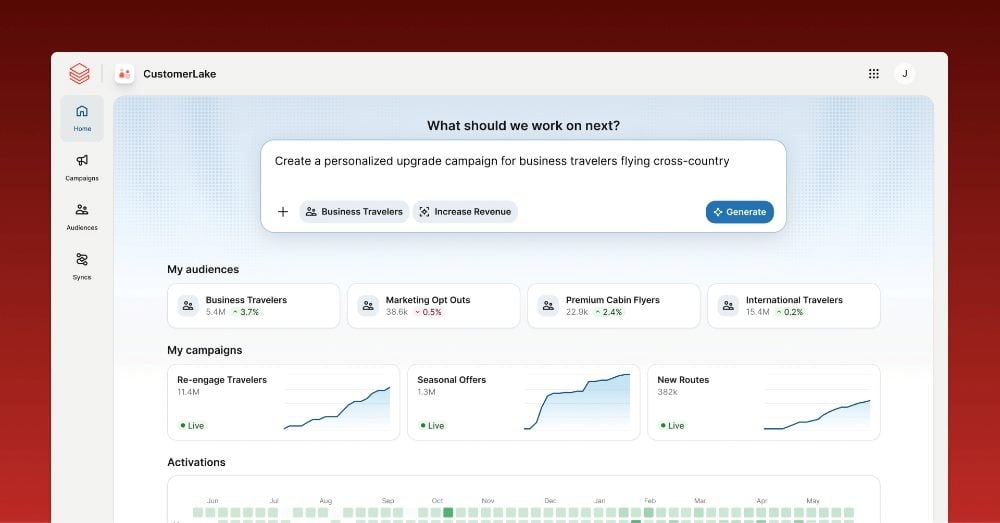
The two agent types power what Databricks is calling "infinity campaigns": continuous, agent-driven engagement loops that replace the traditional manual campaign workflow. Rather than defining a segment, building a journey and launching a one-time campaign, marketers using CustomerLake set a business goal — grow loyalty enrollment, reactivate lapsed customers, increase revenue — and agents operate continuously against that objective, reacting to real-time customer signals.
Related Article: Is the CDP Still Queen? Exploring the Future of Customer Data
CustomerLake brings customer data, AI models, identity resolution and campaign execution into the Databricks lakehouse, positioning the platform as an agentic alternative to traditional standalone CDPs.
| Capability | What It Does | Why It Matters |
|---|---|---|
| Customer 360 Profiles | Creates unified customer profiles directly within the Databricks lakehouse. | Eliminates the need to move customer data into a separate CDP environment. |
| Agentic Identity Resolution (AIR) | Combines deterministic, probabilistic and AI-driven matching to connect fragmented customer records. | Produces more accurate golden records for personalization and analytics. |
| Profile Agents | Automatically transform raw customer data into business-ready profiles. | Reduces manual data preparation and accelerates time to insight. |
| Campaign Agents | Build audiences, recommend next-best actions and activate engagement across channels. | Allows marketers to shift from manual campaign execution to autonomous optimization. |
| Infinity Campaigns | Runs continuous, goal-driven customer engagement loops instead of one-time campaigns. | Enables real-time adaptation based on customer behavior and signals. |
| Lakehouse Federation | Queries customer data across Databricks, Snowflake, BigQuery, cloud storage and operational systems. | Reduces data duplication and minimizes new silos. |
| Unity Catalog Governance | Applies centralized security, permissions and governance controls. | Helps marketing teams maintain compliance and trust in customer data. |
| Audience Segmentation | Creates dynamic audiences from unified customer profiles. | Improves targeting precision and personalization efforts. |
| Channel Activation | Pushes campaigns and content across email, web, SMS and partner ecosystems. | Connects customer intelligence directly to execution channels. |
| AI-Native Architecture | Places customer data, AI models and agents on the same platform. | Supports real-time decision-making and large-scale personalization. |
| Open Partner Ecosystem | Integrates with platforms such as Bloomreach and other martech tools. | Allows organizations to extend existing marketing investments rather than replace them. |
Bloomreach was one of the partners announcing today its collaboration with CustomerLake, integrating the platform with its Loomi marketing agent. The partnership connects CustomerLake's governed data foundation directly to Loomi's execution layer, enabling unified customer profiles built in CustomerLake to power personalized campaigns across email, web, SMS, and other channels without manual data handoffs.
Anirban Bardalaye, chief product officer at Bloomreach. "CustomerLake gives our agentic platform, Loomi, the governed enterprise data foundation it needs to personalize every channel, without any tradeoffs between data quality and speed."
Bloomreach is one of more than 20 launch partners in the CustomerLake ecosystem, which also includes Adobe, Meta, Braze, Acxiom, Epsilon, The Trade Desk, LiveRamp, Iterable, Snapchat, Magnite, TransUnion, Adstra, Twilio, IAS, Unity, Accenture Song, Deloitte, Lovelytics, Slalom, and Stitch — spanning activation, identity, advertising and systems integration.
Bloomreach also said it is building new insight capabilities directly into Loomi using the Databricks platform, with the integration designed to compound personalization across interactions using Loomi's commerce-specific AI, which was trained on more than a decade of data from major ecommerce brands.
"Our customers are asking for simple and scalable ways to combine and activate otherwise siloed customer data into personalized, intelligent experiences alongside the myriad of tools they already use," said Stephen Orban, SVP Product Partnerships and Ecosystem at Databricks. "Databricks has always been built on openness and customer choice, and partners have a significant opportunity to integrate directly with CustomerLake."
Gartner characterized the CustomerLake announcement as a signal of structural change in the CDP market. In an email to CMSWire, a Gartner official said the move marks an important shift: customer data management is moving closer to enterprise data platforms, putting direct pressure on standalone CDP vendors. The analyst firm predicts that by 2030, 80% of net-new enterprise CDP deployments will be embedded in or composable with data platforms, rather than deployed as standalone products.
Gartner's position is that CMOs should approach CustomerLake as a data infrastructure decision rather than a traditional CDP procurement. The firm also anticipates that Snowflake and others will follow Databricks into this space, creating what it describes as a platform-layer race for marketing infrastructure ownership. Gartner advises enterprise marketing leaders to reassess their long-term martech and data strategies before signing extended CDP contracts, particularly those with 2027 and beyond renewal cycles.
Scott Brinker, editor of chiefmartec.com and creator of the Martech Supergraphic, weighed in on LinkedIn shortly after the announcement, describing the move as the convergence of two forces he has been tracking for years.
"I've been saying for years that the most exciting thing happening in martech — if you set aside AI — was the convergence of the stack happening within a universal data layer across the enterprise," Brinker wrote. "After years of wrangling with the pain of integrations across the app layer, being able to smoothly move data across different experiences and workflows — not just marketing, but with sales, service, product, finance, operations — was opening up a whole new horizon for marketing and its technical capabilities."
Brinker noted that AI and data infrastructure, rather than developing separately, are now reinforcing each other — and that Databricks has long operated at the intersection of both. He described the agents within CustomerLake as "the stars of the show," and framed the announcement as a reversal of a trend he has been tracking in 2026.
"I've been saying that the big shift in martech happening this year has been application platforms transforming into more infrastructure platforms," Brinker wrote. "Now we've got an infrastructure platform that's expanding into a martech application platform."
Related Article: Which Is Broken: Your CDP or Your Customer Data Management?
The Databricks CustomerLake announcement lands at a pivotal moment for the customer data platform industry. According to the CMSWire Insights 2025 CDP Market Guide, the CDP market reached a valuation of $2.95 billion in 2024 and is projected to reach $10.12 billion by 2029 — yet the path to that growth is looking less like standalone CDP expansion and more like platform-layer consolidation.
The guide found that the CDP landscape entered 2025 in a state of relative stability, with fewer new entrants, slower funding activity, and larger vendors capturing the lion's share of investment. The top 25% of companies hold 12 times more funding per company than the rest of the field, a dynamic that has steadily squeezed smaller, standalone players. Consolidation has been a persistent theme — nearly all of the companies that appeared in the CDP Institute's original vendor list have since been acquired.
Perhaps more telling is where product development energy has been flowing. The guide identified a clear market-wide shift from campaign CDPs toward delivery CDPs, with delivery-type platforms now accounting for 67% of companies, 75% of employees, and 74% of industry funding. That shift reflects what enterprises are actually demanding: not just a place to store unified customer profiles, but a system that activates that data continuously and at scale — which is precisely the capability Databricks is now claiming with CustomerLake's "infinity campaigns" model.
The guide also flagged a growing tension at the heart of the traditional CDP value proposition. While most enterprises still use their CDPs primarily as data consolidation tools, demand is accelerating for analytical and activation capabilities that push well beyond that baseline. AI and machine learning are increasingly central to vendor differentiation, with the guide noting that an increasing number of CDPs are emphasizing AI/ML capabilities — especially in data analysis — to generate datasets, evaluate relationships, and deliver recommendations at a speed and scale previously out of reach.
That trend line points directly at the structural challenge CustomerLake is designed to exploit. The CMSWire guide observed that CDPs are developing into enterprise business systems where the ability to ingest, store, manage, and distribute rapidly growing volumes of customer data is the core requirement — and that many enterprises, facing economic pressure to consolidate technology stacks, are actively seeking solutions that reduce vendor sprawl rather than add to it. An agentic CDP embedded natively in the data platform where AI models already live is a direct answer to that pressure.
CustomerLake marks Databricks' second major move into a traditionally separate enterprise software category. The company previously entered the security market with Lakewatch, an agentic SIEM product. The pattern suggests a broader strategy: use the lakehouse as a foundation to absorb adjacent software categories rather than integrate with them.
For the CDP market specifically, the move raises direct questions for vendors whose entire value proposition is purpose-built customer data management. If enterprises can accomplish the same objectives without moving data out of their existing data platform, the calculus around standalone CDP procurement changes — particularly for large enterprises already running on Databricks or Snowflake.
CustomerLake is available now in Private Preview. Databricks has not announced general availability timing.
 Have a tip to share with our editorial team? Drop us a line:
Dom Nicastro is editor-in-chief of CMSWire and an award-winning journalist with a passion for technology, customer experience and marketing. With more than 20 years of experience, he has written for various publications, like the Gloucester Daily Times and Boston Magazine. He has a proven track record of delivering high-quality, informative, and engaging content to his readers. Dom works tirelessly to stay up-to-date with the latest trends in the industry to provide readers with accurate, trustworthy information to help them make informed decisions. Connect with Dom Nicastro: 