Feature
Research Report
Building the Case for Modern Public Sector Messaging


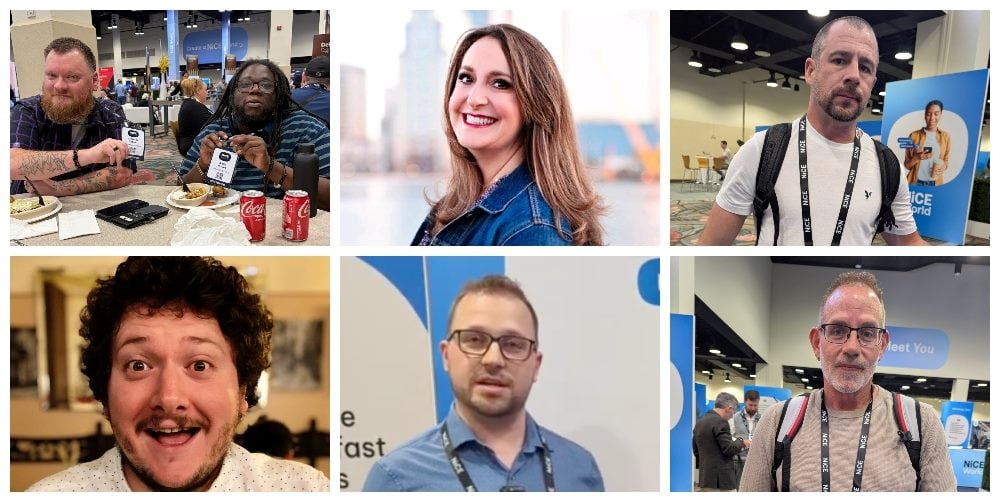
ORLANDO, Fla. — The customers Amin Hayes and Anthony Gilbert serve don't want to talk to a bot. They're elderly, hard of hearing, and they've spent their lives picking up the phone and expecting a person on the other end.
That's the baseline reality at ClearCaptions, where the contact center isn't just a support function — it's the product.
And yet both Hayes, a workforce analyst, and Gilbert, a WFM manager, made the trip to NiCE World the Walt Disney Dolphin Resort this week genuinely curious about what AI could do for their agents and their customers — if deployed with the right kind of care.
As Gilbert put it, an AI agent trained properly could act as "a white glove servicer liaison" routing patients to exactly where they need to go. Hayes, meanwhile, is thinking about the agent side. WFM teams, he noted, are too often cast as "the big bad wolf" in contact center culture, and AI-powered process simplification might finally change that dynamic.
Their perspective captures something hidden behind the bigger keynote moments at NiCE World this week in the Land of Mickey and Minnie: the human stakes on both ends of the contact center equation. Hayes and Gilbert were two of approximately 2,800 practitioners, executives and technologists who descended on the horribly-hot Sunshine State city for the two-day event, and they weren't just evaluating AI as a cost-reduction tool. They were asking whether it could make a hard job more meaningful — and a vulnerable customer's experience more dignified.
NiCE came to Orlando with answers — or at least a very large swing at them.
The company announced that agentic AI is now native at the core of its CX One platform, with the near-$1 billion Cognigy acquisition now embedded as the conversational and agentic AI layer underpinning the entire suite.
NiCE also launched NiCE Labs, a dedicated AI innovation engine designed to close the gap between what frontier AI can do in a research environment and what it reliably delivers inside a complex enterprise. The vision: human agents and AI agents working as one hybrid workforce, with every interaction feeding intelligence back into the platform to improve the next one.
Whether that vision reaches the ClearCaptions agents of the world — and the Geisinger patients, and the TruGreen supervisors, and the Citi compliance teams — is the test that matters most. And the practitioners on the show floor this week were a useful reality check on how far that gap still is.
The "why NiCE" argument was made plainly from two directions at NiCE World. From the main stage on the morning of June 9, CEO Scott Russell put it directly to the audience: any vendor can give you an AI agent — "you can build one in an afternoon," he said — but "running AI at scale in customer experience, now that is hard."
"And you've got to ask yourself," Russell continued, "what happens when 10x the volume kicks in across channels, regulatory environments, the full operational complexity of a global CX enterprise, different time zones, different setups. Will that AI agent hold up? What about when every customer reaches out all at once at the same time?"
In a separate interview with CMSWire on the show floor the next day, Heltewig made the same case from an engineer's vantage point when asked about the threat of the $20/month ChatGPTs and Claudes.
"You can vibe code a user interface," he said, "but in an enterprise application that has to work at the scale, at the compliance, at the performance of a NiCE CXOne or a NiCE Cognigy — that is not something that is possible to vibe code." The demo that holds up in a browser, he said, is not the system that holds up under 20,000 concurrent calls and compliance audits.
"You need a harness around that of a certain robustness," Heltewig said, "which is exactly what we're delivering."
Back to the practitioners who need to manage this wil tech convergence.
Jake Wilcox came to NiCE World with a deceptively simple mission: make navigating a health system feel like ordering something on Amazon. Not easy. Amazon-easy.
The omnichannel solutions architect at Geisinger Health told CMSWire spends his days designing patient experiences for a voice-first contact center, threading together disparate back-end systems so the person on the other end of the line never feels the seams.
"From the patient side it's got to be clear, obvious, and succinct," he said.
AI is supposed to help get there. But Wilcox isn't ready to hand over the wheel. He spent time this week at NiCE World evaluating Cognigy, thinking through what agentic AI could mean for healthcare — a sensitive, highly regulated environment where the stakes of a misstep are high.
"It's easy to say we're going to tell the bot not to do something," Wilcox said. "It's another to say, how do we make sure it doesn't do anything?" His framework: discrete validation steps the AI cannot bypass, and a second layer of verification on top of the first.
"Trust, but verify," he said, "but verify a second time too, because you gotta make sure your verification is actually verifying."
It's a posture that maps directly to what NiCE introduced this week with Guardian Agent — a governance layer that monitors AI and human actions in real time, applies compliance guardrails and detects risk. Whether the tooling satisfies practitioners like Wilcox in a healthcare environment is a different question, but the pressure is clearly the same on both sides of the conversation.
Related Article: NiCE Makes Its Move at NiCE World 2026: Agentic AI Is Now the Architecture
Timothy Hackett and Jason Martin manage workforce for TruGreen, a lawn care company owned by private equity. They came to NiCE World with a different set of pressures: how do you make a contact center agent's day sustainable enough that they actually stay in the job, and how do you convince a PE board to fund the tools that make that possible?
On the retention side, Hackett was direct. Nobody wants to sit at a phone and take call after call. Nobody wants to work until 11 p.m. Nobody is calling the contact center to pay a compliment. The job is hard, and the turnover is relentless.
"How do I make their time more enjoyable?" Hackett said. "How do I make it more palatable? How do I make it more valuable to them outside of just coming here and making X dollars an hour?"
Martin added the business case: "That agent doesn't have a good experience, we've got to hire someone next year to do the same thing." Turnover and onboarding costs in the contact center space, he noted, are probably some of the highest in business — even as the function remains one of the most operationally critical.
On the budget side, Hackett's challenge is one the keynote speakers didn't dwell on. Getting AI greenlit at a PE-backed company is a translation problem.
"How do I take that to a private equity board and get them to understand why we should invest x amount of dollars?" he said. "They're essentially running a hedge fund."
Related Article: NiCE Launches Dedicated AI Innovation Lab to Push Agentic CX to Enterprise Scale
Back at ClearCaptions, Hayes and Gilbert are navigating a version of the AI question that doesn't come up much in the big keynote narratives: what does responsible AI deployment look like when your customer base is elderly people with hearing loss?
Hayes has thought hard about it. The white-glove service expectation is non-negotiable for this demographic. But he's also seen how far conversational AI has come.
"I think some AI products have gotten so good that sometimes you can't tell it's AI," he said. "And that would make a world of difference, and they'll be more inclined to be comfortable and talk to them."
Gilbert's take on agent retention is process-first.
"I'm getting paid to do this process that's so simple, yet so meaningful to the people that we're serving," he said. "I think that's where the win would be, as far as retaining workforce." Simplify the process, make the work feel purposeful, and the turnover math starts to shift.
Hayes also surfaced something that rarely makes it into vendor keynotes. WFM teams, he said, are seen inside contact centers as the enforcers — "the big bad wolf," in his words — always watching, always measuring, never on the agent's side. If AI can change that perception by giving workforce managers better tools to advocate for their people rather than just police them, that's a use case worth more than any automation rate statistic.
Related Article: The CX Reckoning of 2025: Why Agent Experience Decided What Worked
Two practitioners took the main stage at NiCE World and made the vendor case in ways no vendor could.
Jack Roberts, senior global director of GMS Technology and Applications at Fabletics, told the audience Tuesday morning, June 9, that the instinct to start with easy automation targets is exactly wrong.
"Don't start with what's easy, start with something that matters," he said. "Start with the friction points that are a genuine problem for your customers today." Two and a half years into Fabletics' AI journey with NiCE Cognigy, he said the roadmap is more packed than it was at the start — full of problems they didn't know they had when they began.
"Failure in AI is not proof of incompetence," he said. "It's a sign of ambition."
Mia Carraro, head of customer service excellence at Citi, came to NiCE World with receipts. Her team runs CX strategy across 74 million customers and 65 million agent interactions annually. She used AI-powered complaint classification to solve a problem Citi had quietly accepted for years — 10,000 agents applying inconsistent standards across millions of calls, producing unreliable data that created downstream regulatory exposure.
The result: 90% of complaints now run through automation, a 150% improvement in complaint identification, $7 million in savings, and 1 million fewer complaints.
"Complexity isn't the reason to wait on AI," Carraro told the audience. "It's the reason you can't."