News Analysis
Research Report
Building the Case for Modern Public Sector Messaging


ORLANDO, Fla. — NiCE touched down this week in the Land of Mickey and Minnie at the Walt Disney Swan & Dolphin Resort to tout its latest innovations in the customer service and support and contact center software space.
Wanna talk impressive numbers and integrations to kick off the convo here this week at NiCE World?
A major ServiceNow integration. A massive deal last month with the UK government to leverage CXone, NiCE’s AI customer experience platform. An earnings call last month that revealed $768.6 million in quarterly earnings to kick off the fiscal year, up 9.8% year over year, and AI annual recurring revenue up 66% to $345 million. And let's not forget the near $1 billion acquisition of Cognigy last year to vault NiCE near the top of the conversational AI mountain.
Even with all that, I can't get my head around one number: six. That's the number of customer experience software innovators locked up in a garage somewhere perhaps posing $5 billion NiCE's next threat.
“Likely the biggest threat (to NiCE) is six guys in a garage who are figuring out something we are not thinking of,” Max Ball, principal analyst covering customer service for Forrester, told me ahead of the conference.
“ChatGPT,” Ball told me of another threat. “I used them to troubleshoot a problem with my cable box. It was SO MUCH BETTER than what Xfinity did for me. This is likely the quickening of personal bots changing the game here.”
We're not talking about a Wozniak-Jobs duo in a 1970s California garage. We're talking anyone with a WiFi connection and $20 spare bucks a month.
Innovation's for everyone these days, no?
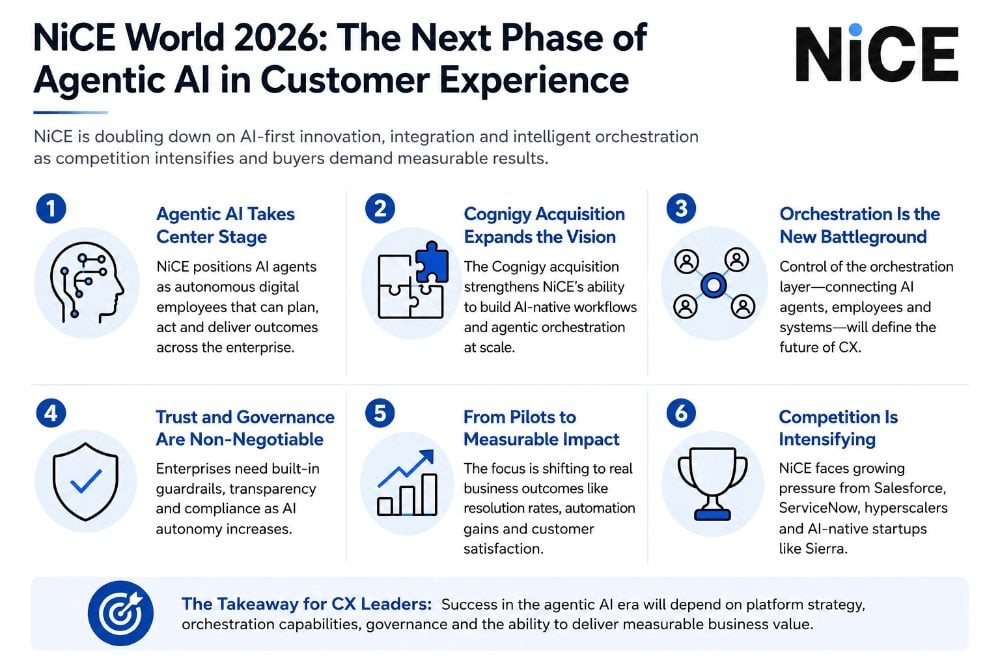
Ok, maybe no one's taking down NiCE or its competitors today. But we'd be remiss to come to Orlando and not to address the growing challenges from AI forces for Contact as a Service (CCaaS) providers like NiCE. As if it didn't have enough to contend with Five9, TalkDesk and Genesys knocking at the door, along with Amazon Web Services, Microsoft and now Salesforce with its Agentforce Contact Center offering.
In SaaS today — CCaaS specifically for this dialogue in Florida this week — it's all about who's challenging the incumbents with their artificial intelligence play. And how are the incumbents embracing the bot wave themselves.
How about 2-year-old Sierra, perhaps making the most noise in conversational AI with $950 million in funding last month at a valuation of $15 billion. Four of the 14 vendors in Forrester’s Conversational AI Wave Q2, 2026 have “AI” in their title.
Sierra? It wants to be "the global standard for companies wanting to transform their customer experiences with AI." It crept into the Forrester Conversational AI Wave as a strong performer, granted it’s still playing catch up to the leaders (Kore.ai, Omilia and NiCE Cognigy).
Among self-service centric vendors growing into something significant, Ball called Sierra the most significant with their market cap "and lots of money to spend."
"Assisted service could become a relatively small adjunct to these folks," Ball added, "and if agent counts really do go down that may be sufficient.”
The biggest threat to NiCE is third-party AI vendors (Sierra, etc.) that could leapfrog NiCE Cognigy in terms of capabilities and get more mindshare, according to Blair Pleasant, CX analyst at COMMfusion LLC & UCStrategies. “There are tons of conversational and agentic AI companies out there,” Pleasant told CMSWire, “and some of them are raising significant funding. A hyperscaler could acquire one of these companies and set its sights on CX, and become a challenger to NiCE.”
Related Article: What NiCE's Q1 2026 Results Reveal About Agentic AI in the CX Enterprise
What could bring NiCE down from its long-standing CCaaS leaders perch? NiCE loses the lead if it loses the platform, according to Derek Top, principal analyst & research director for Opus Research.
The talk of AI as platform transformation is blurring the lines between the contact center and the rest of the business, Top said, adding, “The vision is an orchestration layer that listens to every interaction, understands intent, decides what should happen next, and executes across CRM, ERP and back-office systems with a mix of human and AI agents.”
It’s what Top and Opus call a “Conversation Experience Orchestration (CXO).” In that world, he said, the old CCaaS stack (routing, telephony, recording) becomes legacy plumbing, and the value moves up to the layer that governs AI behavior and proves outcomes.
“A year from now NiCE wants to be that orchestration layer,” Top said. “Conversation data becomes a governed enterprise asset and ‘AI talking to AI’ (via protocols like MCP) becomes a normal interaction mode.”
The biggest threat? The orchestration layer being claimed by someone above the contact center entirely, Top said, citing the CRMs and systems-of-record like Salesforce, ServiceNow and Microsoft, the hyperscalers, or other disruptors pushing to own the resolution layer.
“If the control plane consolidates around the system of record, the contact center risks becoming the commoditized plumbing,” Top said. “NiCE also stumbles with a clumsy Cognigy integration, leaning into lock-in just as buyers demand portability, getting the pricing model wrong, or a trust failure. Unleashing autonomous AI agents comes with some systemic risk and a visible governance failure (wrong refunds, compliance breach, data exposure) could chill enterprise adoption across the whole category.”
Meanwhile, NiCE is working on locking down major AI deployments, even taking a hit on revenue to do so. Last month in its quarterly call, NiCE confirmed it offered discounts on existing CX products — call recording cited as one example — to lock in long-term agentic AI commitments with marquee enterprise customers.
Investors pushed NiCE to explain why cloud revenue growth guidance dropped from 9+% in Q1 to 5% in Q2. NiCE confirmed it was not in the original plan. NiCE proactively discounted existing CX products for a small number of marquee customers at renewal to lock in long-term AI commitments. The discount hits revenue immediately; the AI contribution comes later in the year and more significantly in 2027. Q3 recovery is expected.
“NiCE is discounting the rails to sell the train engine,” said Ian Jacobs, VP, Lead Analyst at Opus Research. “Its AI is only really valuable and differentiated when it’s fed by recordings, transcripts, workflows and QA data from the core CX stack. So the strategy is simple: take some pricing pain now, lock in the system of record, then monetize the higher-margin AI layer later. Not sure why more vendors wouldn’t make that short-term pain/long-term gain trade other than public market pressure.”
Editor's note: NiCE World 2026 highlighted a changing competitive landscape for customer experience technology. While vendors race to establish leadership in agentic AI, enterprise buyers should focus on platform strategy, governance and measurable business outcomes rather than product announcements alone.
| Priority | Recommended Action | Expected Outcome |
|---|---|---|
| Scrutinize AI Platform Claims | Ask vendors to demonstrate production results, not just agentic AI roadmaps and demos. | More realistic expectations and stronger technology investments. |
| Prioritize Governance Early | Establish controls for AI oversight, compliance, security and escalation management. | Reduced operational risk and greater stakeholder confidence. |
| Evaluate Orchestration Capabilities | Assess how platforms connect AI agents, employees and enterprise systems across workflows. | Improved customer experiences and operational efficiency. |
| Demand Open Integration | Favor vendors that support interoperability and third-party AI ecosystems. | Greater flexibility as AI technologies evolve. |
| Measure Business Outcomes | Track resolution rates, automation gains, containment and customer impact metrics. | Stronger ROI visibility and more successful AI scaling efforts. |
NiCE is certainly embracing AI tailwinds, or, perhaps more fitting in this city, an AI innovation and integration roller coaster. NiCE's big play from the stage at the Walt Disney Swan & Dolphin Resort? Agentic AI is no longer a feature NiCE is bolting on. It's the architecture.
NiCE announced today at NiCE World 2026 that agentic AI is now native at the core of its platform — meaning enterprises can run AI agents, human teams, workflows, data and systems as what the company calls "one intelligent operating model." That's a significant reframe from the contact center software of even two years ago, where AI was largely an assist layer on top of routing and recording infrastructure.
The announcement puts four new or expanded capabilities on display here in Orlando.
Citi is using the platform to connect AI agents, human expertise and intelligent workflows at financial services scale. Arizona State University is operationalizing AI across student and constituent journeys. Fabletics is running AI-powered customer journeys to drive both relationship quality and operational efficiency.
Whether the platform can deliver on that vision — and keep the Sierras and Salesforces of the world from claiming that ground first — is the question hanging over every session here this week.
“Running AI at the scale, security, and compliance that enterprise customer operations demand takes more than a demo,” Jeff Comstock, president of CX product & technology at NiCE, said in a statement. “It takes deep, real-world experience with mission-critical CX data, workflows, and governance, and it takes AI built into the architecture rather than added on top. That is exactly what we have built: a platform where agentic AI is native at the core, with AI as the architecture, governed and measurable at enterprise scale."
Related Article: Adobe Doubles Down on Agentic AI — But the Hard Work May Be the Operating Model
The Cognigy integration is job one, according to every analyst in the conversation. NiCE acquired Cognigy for $955 million last year and the early returns are ahead of schedule — but "ahead of schedule" and "done" are different things. Ball put it plainly: NiCE executed the InContact acquisition well, and they need to do the same here.
"They need to deeply integrate that technology and team in order to transform themselves into a truly AI-first business," he said.
Pleasant credited NiCE for moving faster than competitors had to.
"Genesys needed to scramble a bit after NiCE acquired Cognigy," she told CMSWire. The acquisition gave NiCE an advantage in AI technology, talent and expertise that rivals are still chasing."
But the integration work, she said, still has to show up in production. "NiCE needs to go beyond cool demos to real-world examples across verticals and use cases," she said.
Top framed the integration test in terms of what to watch: evidence that Cognigy and CXone become one AI-native platform, not a bundle. The proof will be in demonstrated resolution rates, handover reduction and automation percentages — value metrics per interaction, not per seat.
Openness is the other pressure point. Pleasant noted that Genesys may have an edge in open architecture — its A2A and MCP strategy makes it easier to integrate third-party agentic capabilities. NiCE has moved in that direction, she said, but still takes a comparatively less open approach.
Pleasant also pushed back on the idea that the traditional CCaaS competitive set is where the real threat originates.
"The main challengers won't likely come from traditional CCaaS players, but from hyperscalers or companies that we haven't even heard of yet," she said. And she flagged something the flashy agentic demos tend to obscure: many of the new AI entrants focus exclusively on digital interactions.
"Voice is more challenging," Pleasant noted.
Enterprises that need voice — which is most of them — need vendors with the staying power and technical depth to support it. "It's important to work with a company that has staying power," she said.
There's also the question of who the buyer actually is — and whether they're ready. Ball offered a number that reframes the entire AI conversation: more than 60% of contact centers are still on premises, not on SaaS. The core customer service buyer, he noted, is an operations team that is historically conservative and slow to adopt new technology. "I see a lot more involvement of IT in contact center purchase decisions," Ball said, "but I don't see the budget moving yet."
Related Article: The Acceleration of Voice AI: Where Customer Service Goes From Here
The path from pilot to production is where the real work lives. Pleasant spelled out the barriers plainly: fragmented IT environments, siloed and outdated data architectures, governance requirements, change management as staffing models evolve. Trust and governance top her list. "Organizations need confidence that AI agents will act appropriately, follow policies, protect data," she said. "No matter how great the technology may be, if it's too complex and complicated to actually use, then adoption will be low."
Top added a structural caution about what he calls agent sprawl — enterprises accumulating AI agents across CCaaS, CRM and homegrown applications, each with different rules and memory.
"It's fragmentation with a polished UI," he said. NiCE's job, in his view, is to help customers govern that sprawl, prove value per interaction and let the enterprise own the control layer rather than rent it.
That last part — who owns the orchestration layer — may be the defining question of the next 18 months in this market. NiCE is betting it can claim that ground before the CRMs, hyperscalers or the next well-funded startup gets there first. The discounting strategy, the Cognigy integration, the Guardian Agent governance layer, the Agentic Engagement Plane — it all points to the same wager.
"The thing to watch," Top said of NiCE's AI backlog strategy, "is whether the 2027 AI backlog turns into real revenue or just sits as committed-but-dormant spend."
Six guys in a garage are watching, too.