Feature

Research Report
Building the Case for Modern Public Sector Messaging


Customer service platforms are undergoing a fundamental shift as AI moves from a supporting role into the core of how interactions are managed, routed and resolved.
Salesforce has positioned its Salesforce Agentforce Contact Center offering at the center of that transition, combining its CRM foundation with AI-driven capabilities designed to automate routine work while enhancing human-led interactions.
This article takes a closer look at Salesforce Agentforce Contact Center, examining how it is structured, where it delivers value and how it fits into today’s AI-driven customer experience.
Editor's note: Key questions surrounding Salesforce’s CRM-first approach to AI-driven contact centers and what it means for CX leaders.
Salesforce Agentforce Contact Center isn’t a single product. It’s a set of integrated cloud services that function as a customer support platform, built on the same customer relationship management (CRM) foundation many businesses already use. Rather than separating data, workflows and AI, Salesforce brings them into a unified environment where agents and automation operate against a shared customer record.
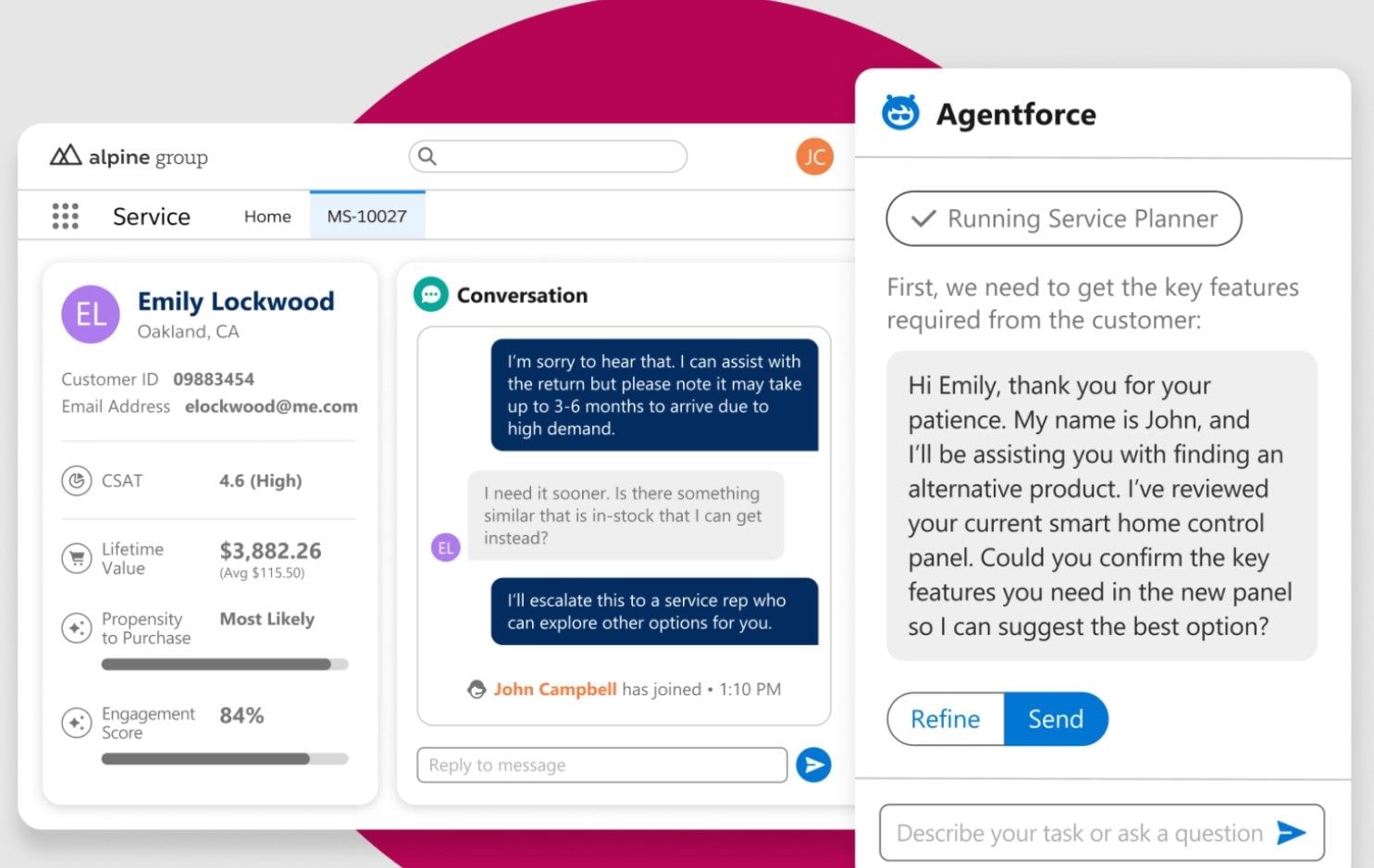
At the center is Service Cloud, which manages cases across phone, chat, email and social channels. Companies like Adidas have used Salesforce Service Cloud to give agents a more complete view of customer interactions across channels, helping them deliver faster, more consistent service.
Einstein AI is embedded directly into those workflows, providing real-time summaries, suggested responses and automation. These capabilities help agents quickly uncover relevant information, reduce manual effort and shorten resolution times.
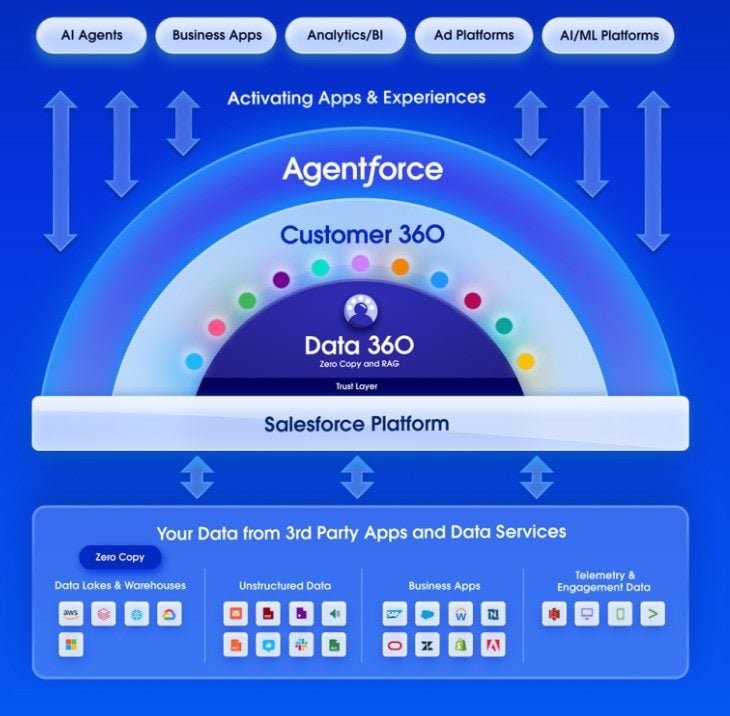
Data 360, formerly called Data Cloud, underpins the system by unifying customer data across interactions, transactions and behavioral signals. This allows agents to see a complete picture of the customer in real time. Companies such as L'Oréal have used Salesforce to bring service data into a single view, improving both agent efficiency and customer experience.
Salesforce’s omnichannel routing ties everything together, dynamically assigning work based on availability, skills and priority rather than static queues. Compared to platforms like Genesys or Five9, Salesforce starts with customer data and CRM, then layers communication and automation on top. The result is a model that is focused less on managing interactions and more on orchestrating the overall service experience.
Related Article: Salesforce Launches Agentforce Contact Center to Unify AI, Voice and CRM
The orchestration model Salesforce describes in Agentforce Contact Center depends on a platform shift the company formalized April 15 with the announcement of Salesforce Headless 360. The initiative exposes the entire Salesforce platform — data, workflows, business logic and trust controls — as APIs, MCP tools and CLI commands, making it accessible to agents without requiring a browser or UI navigation.
For contact center operators, the practical implication is that the orchestration layer described in Agentforce Contact Center is no longer dependent on human-navigated interfaces. Agents can call workflows, retrieve customer context from Data 360, trigger case updates and surface decisions directly — across Slack, voice, WhatsApp or any MCP-compatible surface — without a service rep ever opening a console.
Salesforce frames this as the infrastructure requirement of the agentic enterprise: intelligence needs context, workflows and a trust layer to act on, not just inference. Headless 360 is how that context becomes programmable.
Salesforce is not treating AI as a standalone chatbot layer. It positions AI as an orchestration layer that coordinates data, workflows and decisions across the service operation. The shift is subtle but important. Instead of focusing on automating conversations, the focus is on automating outcomes.
This table highlights the structural differences between Salesforce’s CRM-first approach and traditional CCaaS platforms like Genesys, NICE and Five9.
| Capability | Salesforce Agentforce Contact Center | Traditional CCaaS (Genesys, NICE, Five9) |
|---|---|---|
| Platform Foundation | CRM and unified customer data | Telephony and interaction management |
| Data Model | Single customer record across functions | Often fragmented, requires integration |
| AI Role | Orchestration layer across workflows | Primarily assistive or chatbot-driven |
| Channel Management | Unified across channels with shared context | Multi-channel, but often siloed |
| Strength | Data, ecosystem, cross-functional visibility | Telephony, routing, workforce optimization |
| Complexity | High (configuration and data strategy required) | Moderate (more self-contained) |
This type of approach shows up in how Einstein AI is embedded throughout the platform. It operates within agent workflows, analyzing requests, uncovering knowledge and suggesting next best steps in real time. When a customer reaches out, the system can summarize prior interactions, identify intent and recommend actions immediately, reducing agent effort and speeding resolution.
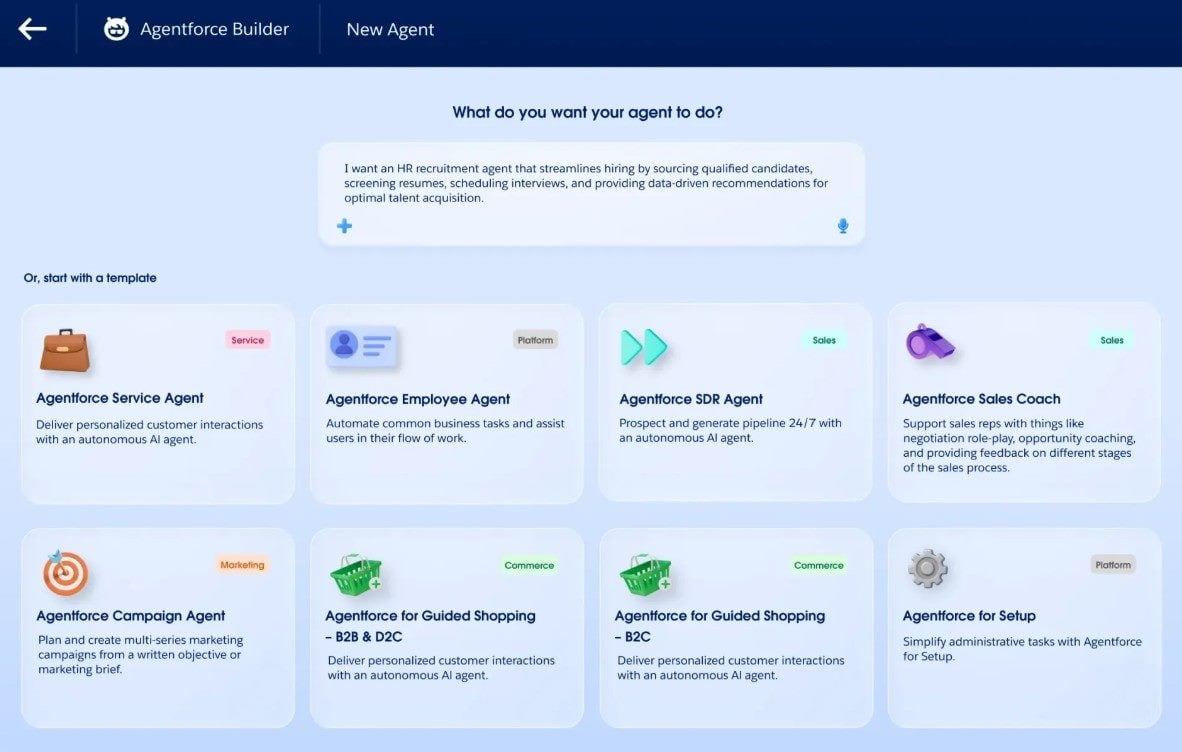
Salesforce is extending this model with Agentforce, moving beyond assistive AI into more autonomous execution. Rather than only suggesting actions, the system can trigger workflows, update records or initiate follow-ups within defined guardrails. This reflects a broader shift from copilots to more agentic workflows, where AI begins to handle routine work independently.
Real-time intelligence is central to this strategy. Einstein can generate live summaries, recommend responses and automate next steps as interactions unfold, helping compress the time between understanding an issue and resolving it.
As contact centers evolve, the role of the platform itself is shifting from managing interactions to coordinating data, workflows and decisions. That shift depends heavily on how effectively platforms can turn data into real-time insight, not just store it.
Nima Hakimi, CEO and co-founder at Convoso, told CMSWire, "AI is pushing contact centers beyond interaction management into orchestration layers, but primarily on the inbound side. Platforms like Salesforce are getting better at connecting CRM data, workflows and service interactions into a more unified system. The bigger shift is that the platform is becoming a system of intelligence."
AI is only as effective as the data it can access, he emphasized, and suggested that “when that data lives inside the platform, it creates a much larger opportunity to influence decisions—not just manage interactions."
Salesforce is not positioning AI as a full replacement for agents. Instead, it acts as a coordinating layer that manages workflows while gradually absorbing repeatable tasks. Over time, more structured interactions can be automated, but the near-term model remains hybrid, with humans handling exceptions and complex cases.
Related Article: Agentforce 3: Salesforce's Latest Bet on the Future of Agentic AI
Salesforce’s contact center capabilities are built around unifying data, channels and workflows into a single system, rather than treating them as separate tools that agents have to navigate independently. The goal is to reduce friction at every step of the service process, from the moment a customer reaches out to the final resolution.
Here's what's under the hood of Salesforce Agentforce Contact Center:

Related Article: Agentic Enterprise: With Agentforce 360, Salesforce Elevates Human Potential in the Age of AI
Salesforce’s biggest advantage in the contact center comes from its deep integration with CRM. Because service sits on the same platform as sales, marketing and commerce, agents are not working with a partial view of the customer. They are operating within the full context of the relationship, which is something most traditional CCaaS platforms have to approximate through integrations.
That foundation enables end-to-end visibility across the customer lifecycle. A support interaction is no longer an isolated event. It connects to previous purchases, marketing engagement and prior service history, all within the same system. This allows businesses to move beyond reactive support and into more informed, context-driven service experiences.
Another strength is the breadth of Salesforce’s ecosystem. The platform supports a wide range of integrations, from third-party applications to custom-built extensions, making it adaptable to different operational needs. Businesses can extend functionality without having to replace core systems, which becomes especially important in complex enterprise environments.
Finally, Salesforce is built to scale. Its cloud-based architecture supports large volumes of interactions across regions and channels, while maintaining consistency in workflows and data access. For enterprises managing high customer volumes or operating globally, that scalability is less of a feature and more of a requirement.
The same depth that gives Salesforce its advantage can also introduce complexity. Implementing a fully integrated contact center across Service Cloud, Data Cloud and AI capabilities often requires significant planning, configuration and ongoing management. For businesses without prior experience in the Salesforce ecosystem, the learning curve can be steep.
Cost is another consideration. Licensing alone can be substantial, but the larger expense often comes from integration work, customization and ongoing administration. Businesses that underestimate these factors can find the total cost of ownership higher than expected, particularly when compared to more self-contained CCaaS platforms.
Salesforce also assumes a level of data maturity that not every business has achieved. To fully benefit from unified profiles, real-time insights and AI-driven recommendations, data needs to be clean, connected and governed effectively. Without that foundation, many of the platform’s more advanced capabilities deliver limited value.
For smaller businesses or those with simpler support needs, the platform can feel like more than is necessary. In those cases, a lighter-weight solution may deliver faster time to value without the overhead of a broader enterprise system.

Data sits at the center of Salesforce’s approach to customer experience, with Data Cloud acting as the foundation that brings everything together. Rather than storing information in separate systems, Data Cloud aggregates and harmonizes customer data from across touchpoints, making it accessible within service workflows in near real time.
That foundation enables unified customer profiles, which are critical to how the platform operates. Instead of relying on fragmented records, agents and AI systems work from a single, continuously updated view of the customer. This includes interactions, transactions and behavioral signals, all tied back to the same profile. The result is a more consistent and informed service experience.
Much of Salesforce’s contact center strategy depends on the idea that AI, routing and service workflows all operate from a shared view of the customer. That promise becomes difficult to deliver when customer data remains spread across disconnected systems, which is why data unification often determines whether automation produces meaningful value or only superficial efficiency gains.
Muthuselvan Renganathan, global head of CX at Mastek Ltd, told CMSWire, "The biggest bottleneck in AI-powered automation is the availability of unified customer data. Customer data is usually stored across multiple systems (usually from three to five) before arriving at the contact center. If there is no unified view of the customer, AI automation produces only basic responses. The consolidation of customer information becomes the most difficult technical challenge in building the contact center stack. It is also where many transformation projects get stalled."
Salesforce also emphasizes the balance between real-time and historical data. Real-time signals help guide immediate decisions, such as routing a case or recommending a next step, while historical data provides the context needed to understand patterns and long-term behavior. Both are necessary, and the platform is designed to make them available within the same workflow.
Unifying customer data is only part of the challenge. The real value comes from how quickly and effectively that data can be used within live interactions, where timing often determines the outcome. Hakimi explained, "Unified data is foundational because AI depends on it. Platforms like Salesforce have an advantage here by anchoring customer interactions in a central CRM layer. The challenge is that most organizations don’t actually have clean, connected real-time data. Even when systems are integrated, latency and data quality issues limit how actionable that data is,” he said, adding that the issue isn’t just unification, it’s activation. “The real value comes from being able to use that data in the moment decisions are being made, not just storing it in one place."
Ultimately, the effectiveness of this model depends on data quality. If the underlying data is incomplete, outdated, or poorly governed, the value of unified profiles and AI-driven insights diminishes quickly. In that sense, data is not just an input into the system. It directly determines how well the entire contact center performs.
Salesforce frames the contact center as a hybrid environment where AI and human agents play distinct but connected roles. AI is positioned to handle routine, repeatable work such as answering common questions, summarizing interactions and triggering standard workflows. This allows a large portion of high-volume support to be resolved quickly without direct human involvement.
This table illustrates how Salesforce positions AI and human agents to work together within a hybrid service model.
| Function | AI (Einstein / Agentforce) | Human Agents |
|---|---|---|
| Handling Volume | Manages high-volume, repetitive inquiries | Focuses on lower-volume, complex cases |
| Decision Making | Rule-based and pattern-driven actions | Judgment-based decisions and exceptions |
| Customer Interaction | Automated responses and guided flows | Empathy, negotiation and nuanced communication |
| Workflow Execution | Triggers updates, routing and follow-ups | Resolves edge cases and escalations |
| Context Awareness | Aggregates and summarizes data in real time | Applies context with business understanding |
Human agents remain central for more complex, nuanced or emotionally sensitive interactions. Issues that require judgment, empathy or exception handling are routed to people, where context and communication matter as much as resolution speed. The goal is not to remove humans from the loop, but to reserve their time for the moments where they add the most value.
The most effective contact center models do not ask AI to handle every interaction equally. They use automation where intent is clear, and workflows are predictable, then shift to human agents when context, ambiguity or customer emotion become central to the outcome. Renganathan suggested that finding the optimal balance between automation and human involvement is crucial.
"Businesses should automate routine activities like updating the status of the request, setting appointments and responding to commonly asked questions,” said Renganathan. “Yet, when customer sentiment shifts due to regulatory concerns, dissatisfaction or other reasons, the customer service system should smoothly transition to a skilled human agent with all the information. The problem is when automation takes care of routine interactions but fails with less predictable tasks.”
Renganathan explained that even if most interactions are handled successfully, a small number of negative experiences can still shape how customers perceive the brand.
Treating deflection rates as proof of AI success can create a misleading picture of performance, especially when customers end up frustrated or forced to escalate.
Steve Blood, VP for market intelligence and evangelism at Five9, told CMSWire, "It’s important to look closely at how success is being measured in contact centers. There are too many articles where vendors and companies declare success by claiming '70-80% deflection,' meaning 70% of interactions were handled by an AI agent in place of a human agent, for which the savings in manpower can be readily calculated,” said Blood, who suggested that while one department may boast that it contained 70% of customer interactions, it’s often the customer service center which picks up the disgruntled customer who has been fobbed off by a poorly designed and executed self-service resource.
This reflects a broader shift from replacement to augmentation. AI supports agents by reducing manual effort and providing relevant information in real time, rather than acting as a standalone substitute. Agents are able to focus more on problem-solving and customer engagement, rather than on administrative tasks or information retrieval.
Renganathan described the exact fault line that many AI-led service strategies run into: automation works well on predictable tasks, but the interactions customers remember most are often the messy ones. This is why Salesforce emphasizes context sharing and handoffs, allowing AI to accelerate routine work without leaving human agents in the dark when more sensitive cases arise.
A critical piece of this model is how context is shared across AI and human touchpoints. When a conversation moves from automation to a live agent, the full history of the interaction, including summaries, intent and prior actions, is carried forward. This reduces repetition for the customer and allows agents to step in with a clear understanding of the issue.
The result is a coordinated workflow where AI manages scale and speed, while humans handle complexity and edge cases. That balance is what ultimately determines whether automation improves the customer experience or creates friction.
Salesforce approaches the contact center from a CRM-first perspective, which sets it apart from traditional CCaaS platforms that were built around telephony and later expanded into digital channels and AI. Instead of centering the platform on interactions, Salesforce centers it on customer data, then layers communication and automation on top.
That creates a different kind of differentiation when compared to platforms like Genesys, NICE, and Five9. Those platforms are often stronger out of the box in areas like workforce management, routing precision and telephony infrastructure. Salesforce, by contrast, leans into its strength in unified data, CRM integration and cross-functional visibility.
The advantage of Salesforce’s model is its ecosystem and data layer. Because service operates on the same platform as sales and marketing, businesses can connect support interactions to the broader customer journey without relying heavily on external integrations. This can create a more consistent and informed experience across touchpoints.
The tradeoff is complexity. While traditional CCaaS platforms tend to be more self-contained, Salesforce often requires deeper configuration, integration and data strategy to reach its full potential. For businesses that can support that investment, the payoff is a more connected system. For others, the overhead can outweigh the benefits.
Related Article: What Is Contact Center as a Service (CCaaS)?
Vendor positioning drawn from the Gartner Magic Quadrant for Contact Center as a Service (September 2025) and the Forrester Wave: Contact-Center-As-A-Service Platforms, Q2 2025. Salesforce characterization based on CMSWire reporting.
| Vendor | Analyst Position | Platform Foundation | AI Role | Data Model | Key Strength vs. Salesforce | Key Gap vs. Salesforce |
|---|---|---|---|---|---|---|
| Salesforce Agentforce Contact Center | CRM CEC (not evaluated in CCaaS MQ) | CRM-first; Service Cloud + Data 360 | Orchestration layer across workflows and decisions | Unified customer record across sales, service, marketing | N/A | N/A |
| Genesys | Gartner: Leader | Forrester: Leader | Telephony and interaction management | Assistive AI; agent and supervisor assistants, virtual agents | Multi-channel but often requires external CRM integration | Large, complex global deployments; customer journey analytics | AI deployment timelines often exceed expectations; native WFM gaps |
| NiCE | Gartner: Leader | Forrester: Leader | Telephony with deep WEM heritage | AI built on decades of labeled interaction data; AI studio | Strong analytics layer; data from call recordings and process mining | Advanced WEM, quality management, and analytical capabilities | AI deployment delays; some midsize customer support challenges |
| Five9 | Gartner: Leader | Forrester: Strong Performer | Telephony-first; expanding digital and AI | AI agents; first in MQ with AI studio for building and tuning virtual assistants | Fragmented without external CRM; strong Salesforce and ServiceNow integrations | Broad market fit; strong postsales support | North America-centric; native WFM insufficient for complex deployments |
| Amazon Web Services | Gartner: Leader | Forrester: Leader | Cloud infrastructure-first; Amazon Connect | AI capabilities via Contact Lens, Lex, and Q; high attach rate | Flexible but requires custom development to unify customer data | Scalability; deep AWS AI investment; customizable for large environments | Requires developer resources; reporting gaps out of the box |
| Talkdesk | Gartner: Leader | Forrester: Strong Performer | Telephony with natively built contact center capabilities | Agentic AI functionality; can run AI on other vendors' CCaaS platforms | Vertical-specific integrations; not a unified CRM data layer | Industry-specific solutions; strong account management | Geographic limitations; less inclined toward third-party partnerships |
| Sprinklr | Forrester: Strong Performer (Gartner: not included — digital CS vendor) | Digital customer service; social and digital channel-first | AI orchestration strong on digital channels | Unified digital engagement data; limited telephony-native data | Strongest digital and social channel depth in the field | No native telephony platform; limited traditional CCaaS footprint |
| Cisco (Webex CC) | Gartner: Niche Player | Forrester: Contender | UCaaS and CCaaS bundled; telephony heritage | AI agents on roadmap; AI Defense security capabilities | Fragmented admin interfaces; limited third-party integrations | Strong UCaaS/CCaaS bundling; preferred for Cisco on-premises migrations | Feature set less mature; multiple admin interfaces complicate management |
| Vonage | Gartner: Niche Player | Forrester: Contender | CPaaS and UCaaS with CCaaS overlay | AI transcription, summarization; Agentforce integration on roadmap | Historically strong Salesforce Service Cloud integration | Tight Salesforce Service Cloud embed; optimized for midmarket | English-only admin UI; native reporting gaps; relies on CRM partner for digital/AI |
| Zoom Contact Center | Gartner: Niche Player | Forrester: Not evaluated | UCaaS-first; contact center added in 2022 | Native AI architecture; auto intent discovery, agent next best actions | Limited; strong UCaaS integration but no unified CRM data layer | Ease of setup and administration; native AI built into core architecture | Newest entrant; feature breadth lags Leaders; third-party integration challenges |
| 8x8 | Gartner: Honorable Mention | Forrester: Contender | UCaaS and CCaaS combined platform | AI capabilities developing; not a differentiator at this stage | Integrated UCaaS data; limited CRM-depth | Bundled UCaaS/CCaaS simplicity; cost efficiency | Did not meet Gartner average seat size threshold; AI not a standout |
| Twilio | Forrester: Contender | Gartner: Not evaluated | CPaaS-first; developer-built contact center | AI capabilities available but require significant custom development | Highly flexible but no native unified data model | API-first flexibility; strong developer ecosystem | Requires heavy custom build; not a turnkey contact center solution |
| Content Guru | Gartner: Challenger | Forrester: Not evaluated | Highly customizable CCaaS; strong in UK and Europe | AI orchestration layer ("brain") for matching AI workflows to service use cases | Deep integration capabilities; not a unified CRM data layer | Large complex deployments; FedRAMP High accreditation; 100% availability SLA | Pricing complexity; support resolution times for complex deployments |
Salesforce Agentforce Contact Center is best suited for enterprise businesses that need to manage high volumes of interactions across multiple channels while maintaining a consistent view of the customer. Its strength shows up most clearly in environments where support is tightly connected to sales, marketing and broader customer experience initiatives.
It is also a strong fit for businesses already using Salesforce. Extending into Service Cloud, Data Cloud and AI capabilities allows them to build on existing data and workflows rather than introducing a separate platform. That continuity can reduce integration effort and make it easier to unify customer data across functions.
Data maturity plays a significant role as well. Businesses that have invested in clean, connected and well-governed data are better positioned to take advantage of real-time insights, AI recommendations and unified profiles. Without that foundation, much of the platform’s value remains underused.
For smaller teams or businesses with relatively simple support needs, Salesforce can feel unnecessarily complex. In lower-volume environments where speed of deployment and ease of use are the priority, a more lightweight contact center solution may be a better fit.
Salesforce Agentforce Contact Center reflects a broader shift in how customer service is delivered, moving from channel-based support to data-driven orchestration across the entire customer lifecycle. Its strength lies in unifying data, AI and workflows into a single system, but that same depth requires the right level of investment, integration and data maturity to pay off.
For businesses that can support it, the platform offers a more connected and context-aware approach to service. For others, simpler solutions may deliver faster results with less overhead.