Editorial
Research Report
Building the Case for Modern Public Sector Messaging


Examining labels is another distraction when competence in managing the customer base is at historical lows. But if we’re going to do it, let’s learn the language first.
Here’s the rub:
In February this year, CMSWire Contributor Brian Riback wrote a juicy article entitled: The 'Chief Experience Officer' (CXO) Is a Vanity Title. Then in April, CMSWire Contributor Trish Wethman penned a thoughtful rebuttal.
Ours is a field that can exhibit a fair amount of thin skin so kudos to Brian for poking the bear, to Trish for taking it on, and to the CMSWire team for allowing my wider posit.
Here we go:
The CFO oversees finance. The COO, operations. The CMO, marketing. The CTO, technology. The CSO, strategy. The CEO, the executive itself. As popular as the word "experience" is, the only appropriate handle, where the role is situated as a member of the executive, is Chief Customer Officer.
I’m tempted to say… duh.
That assumes, of course, that folks understand that the fundamental job is indeed to manage the customer base. Too many seem oblivious to this simple premise. We’ll get to the distractions soon.
Increasingly, though, chief-level titles are a moot point. That’s because the customer reporting line is most often owned by the CMO. 2019 research by Dentsu Aegis questioned more than 1,000 CMOs globally, finding that 53% already had the responsibility and just five years later, in 2024, Merkle found it to be 8 of 10. This is broadly reflected in my student body where marketers and digital teams, perhaps ironically, quite easily outnumber CXers.
That stat tends to make CX folks sit up, but for trained marketers who understand the importance of physical availability, a concept I won’t delve into here, their enrollment makes total sense. In most cases, their fees are paid for by their employer — the CMO — which begs the question:
Is the corporate perception of customer competency shifting away from the CX handle, and indeed, the CXO?
Consider all that in context of Gartner’s 2026 report which highlighted that most CMOs lack the budget to deliver their strategy. That means prioritization and functional cuts, which should worry those who aren’t authoritative in customer economics. If they want to remain unshuttered, no title will save the day.
Related Article: Customer Whisperers: What CMOs Know About Being Customer-Centric
For over 5,000 years, service economics have dominated trade relationships. The capacity to interact both bi-directionally and coherently, repeatably, is a pattern that historians date to the early Bronze Era. The central point is that customer economics are service-based, primarily. Not experience-based. I’ll explain that soon.
But let me first reiterate that the actual job, over and above any tactic and interaction type, is customer management. Or customering, if you like.
It’s not to behave like a self-appointed internal audit department, and it’s sure as heck not to drive company culture. Too many see the job as "fixing issues," something to detect after the fact, instead of the "customering" competence required to deliver coherent asset management from the outset. Not ambulance, but architect. Not researcher, but engineer.
This popular "fixing" miscalculation drives leaders into the arms of pseudo measures like NPS and dashboards, an ultimately retrospective and impotent reporting function at the heart of so much frustration for CXers. The assumption that customer value requires translation is a false idea, a fix to a problem that doesn’t exist once you understand that, centered on profitability, customer economics are business economics.
In truth, "signals" don’t teach you about a corporate customer base, any more than seeing a snotty nose makes you a doctor.
Service defects are supposed to be exactly that — a defect. If they feature disproportionately, it indicates a problem with the anatomy, sure, but cogent managers must understand the anatomy to begin with. They build from the front, not the back. They manage system, not symptom.
Of course, internal stakeholder management is always important, but when a company gets its model right (and if it doesn’t that’s an indicator for executive training), then most customer functions are located under central management, and/or, subject to the correct controls overseen by the same. This isn’t trivial, especially in complex and large companies, but it’s not rocket science either. It’s all about the business of "doing."
That "doing" requires a mastery of the unchanging fundamentals. The relevant science, market laws, service economics and applied practice. None of this is difficult or tricky or some kind of academic navel gazing sorcery. But if you’re starting at measurement — or God forbid describe yourself as “measurement obsessed” — and you’re laboring over gaining influence, you’ve missed the foundation that makes both possible.
Related Article: What Is the Best CX Leadership Model for You?
Now, the provocation that Brian put forward is that the CXO title is an exercise in vanity. You can be the judge of that, but my side-eye counter, is that if you want to be the chief of something, should you not understand what that thing is?
Let me explain.
Despite the copious use of the term, many are surprised to learn that most customer interactions never rise to the level of human experience in the way that we can work with. Services and experiences are quite different, both in terms of how they are consumed and in their economic effects. In fact, a useful heuristic from my earlier work, is that the ratio between the two, can be around 99/1 — in favor of service. At the same time, a well-targeted experiential treatment can have disproportionate outcomes.
And yet, the industry uses the word "experience" as a catchall to effectively subsume everything, and to mean anything, diminishing it entirely and losing the ability to manage effectively.
So, Chief Experience Officer? I think not. Let’s manage customers, shall we?
In fact, you might now deduce that the term, CX, is itself a bit imprecise. It’s not the primary reason that I use "customering," but it’s a close second. The CX horse has bolted though, and for similar reasons, there is little value in challenging the CXO moniker.
Which brings us to my central point.
There are many rabbit holes and false dawns that distract people from the real job at hand, and the necessary knowledge to do it. Ponderings on titles is just one of them. Yet, ironically, when this is replaced by higher order understanding, the ability to influence others does tend to increase.
For one example, many folks constantly debate the return on investment of CX. Well, ROI is a ratio that doesn’t measure effectiveness, so it’s entirely the wrong economic frame to begin with. In fact, the famous marketing scientist, Byron Sharp, described it as “a stupid metric that can send you broke."
What many fail to grasp, is that the management of a customer base is primarily a system of control on an existing asset. Thus, "return" is not the main concern. Understanding the economics makes all the difference — and stops you chasing fairy dust.
Speaking of economics, another refrain is that CX is a primary source of growth. It isn’t. In market-based economies — which we’ve been in for 150 years — growth is defined as the increase of market penetration. Existing customers do contribute to current penetration statistics, but aren’t materially causative to an increase in those statistics.
And no, contrary to Bain’s fiction, "promoters" don’t exist, not in a generalizable way and certainly not in most categories. In the very limited scenarios where they do, they’re dominated by new buyers, not your most loyal — a trait that disappears as the novelty does. Nor is a customer program a source of "differentiation" in the mass market, a term that the untrained tend to use very liberally, AKA, incorrectly.
I could go on. I won’t. My hope is that by firing a few shots across the bows of these popular CX narratives, we might at least agree that a good, healthy, evidence-based debate about core knowledge and competency, is a far more pressing concern.
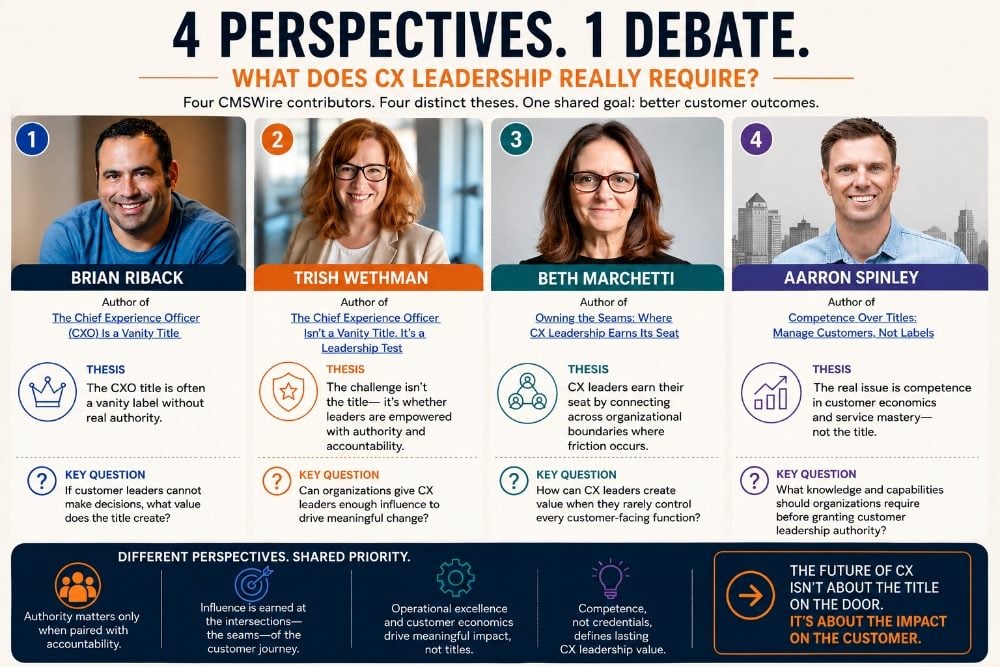
Editor's note: CMSWire contributors have approached the chief experience officer debate from different angles. Together, these articles reveal a broader conversation about ownership, authority, accountability and the future of customer leadership.
| Article | Core Argument | View of the CXO Role | Key Question Raised |
|---|---|---|---|
| The Chief Experience Officer (CXO) Is a Vanity Title, by Brian Riback | The title often lacks real authority, operational ownership and measurable accountability. | Skeptical | If customer leaders cannot make decisions, what value does the title create? |
| The Chief Experience Officer Isn't a Vanity Title. It's a Leadership Test, by Trish Wethman | The problem is not the title itself but whether organizations empower customer leaders with authority and accountability. | Supportive | Can organizations give CX leaders enough influence to drive meaningful change? |
| Owning the Seams: Where CX Leadership Earns Its Seat, by Beth Marchetti | CX leadership earns legitimacy by coordinating across organizational boundaries where customer friction occurs. | Pragmatic | How can CX leaders create value when they rarely control every customer-facing function? |
| This article, by Aarron Spinley | The real issue is not titles but whether leaders possess the customer economics, service expertise and business competence required to manage the customer base. | Competence-focused | What knowledge and capabilities should organizations require before granting customer leadership authority? |
Friends, I close by doubling down. The real gap isn’t labels, but the widespread absence of knowledge fundamentals, their practical application and the respect that their presence would otherwise engender.
If we give people a Chief title, and they represent the field, we need them to live up to it.
In his article that started all this, Brian said: “Customers don't want relationships — they want reliability”. Of course, trade relationships are nevertheless relational, but they’re not usually the overly "emotional" bond that so many breathlessly propose, which is what I think Brian was shooting at. He’s 100% right, and he went onto use the term, “radical reliability."
When you read that, think, "service." Think, 99/1.
Trish makes a good point, too. After quoting Leo McGarry from the television show, ‘The West Wing’ - “If we’re gonna walk into walls, I want us running into 'em full speed” – she comments: “The CXO is likely to be running into a lot of walls. If the role isn’t infused with authority, decision-making rights or is expected to influence without the ability to manage change, it’s going to be impossible to run with enough force to knock those walls down.”
Oh, how right she is!
But let me build on that. If the job is, I remind you, to manage the customer base, then what is the rock-solid basis upon which a business, or a CMO, can safely delegate that authority? What will ensure that confidence? And what will sustain that decision?
Title Schmitle. There are bigger fish to fry.
 Learn how you can join our contributor community.

Aarron Spinley is a Fellow at the Field Bell Institute. A champion of accessible higher education in marketing and customer management, he teaches the accredited ‘Mini MBA in Customering’ to students around the world.