Feature
Research Report
Building the Case for Modern Public Sector Messaging


The role of the Chief Customer Officer (CCO) is being redefined in real time. Once centered on advocacy and customer satisfaction, the position is now increasingly tied to revenue growth, operational efficiency and the enterprise-wide orchestration of customer experience.
As AI, automation and unified data platforms reshape how businesses engage with customers, the CCO is no longer just a voice of the customer, but is a driver of measurable outcomes across marketing, service, product and digital experience.
In 2026, the question is no longer whether businesses need a chief customer officer, but whether they are prepared to define the role in a way that aligns customer experience with execution, accountability and results.
The chief customer officer role emerged as businesses began to lose sight of the customer amid expanding digital channels and growing internal silos. Early CCOs were positioned as advocates, responsible for representing the voice of the customer (VoC), shaping experience strategy and promoting a customer-centric culture.
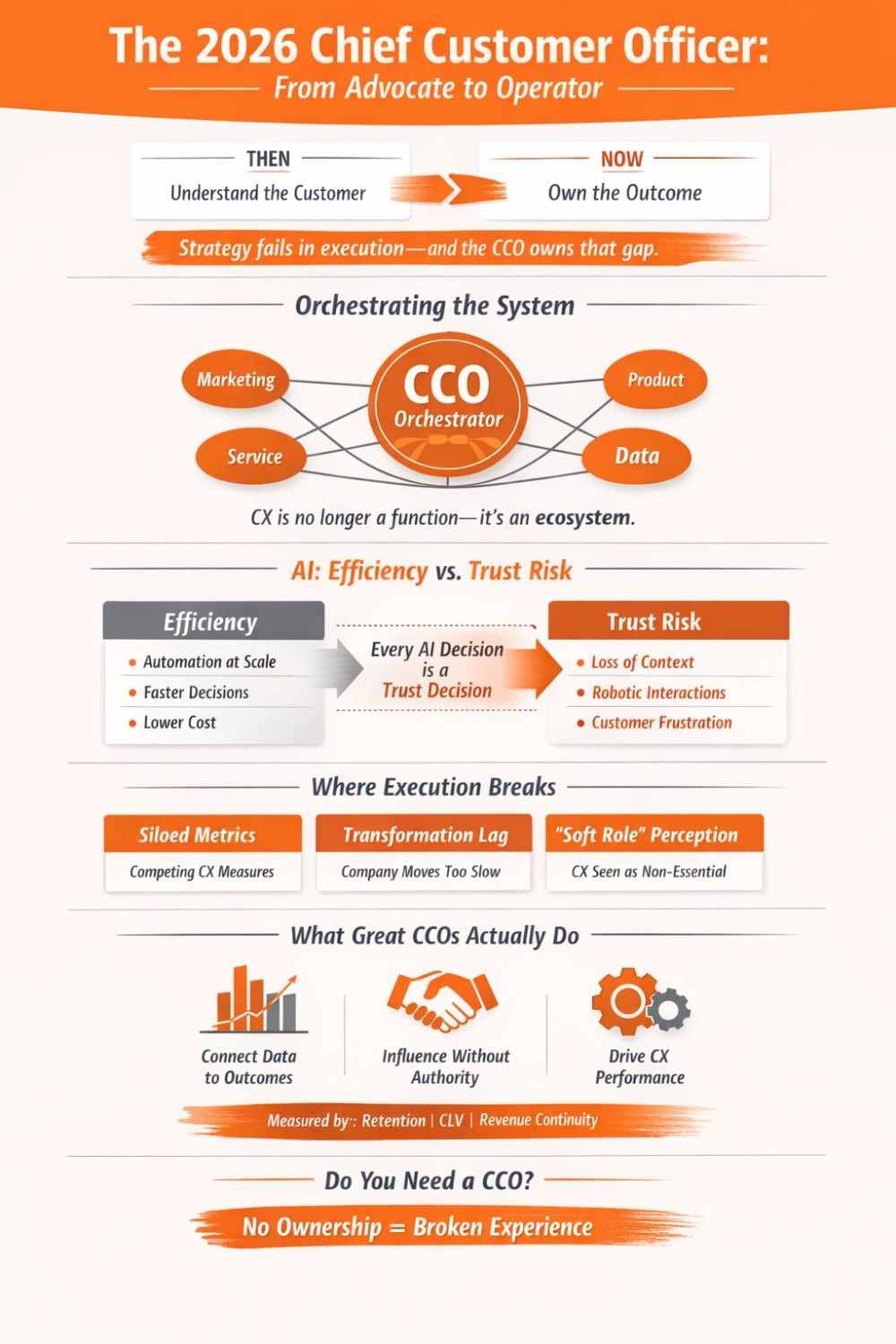
The chief customer officer role has shifted from an advisory, customer advocacy function to an operational leadership position responsible for execution, data alignment and measurable business outcomes.
| Dimension | Earlier CCO Model | 2026 CCO Model |
|---|---|---|
| Primary focus | Customer advocacy | Customer experience execution |
| Role type | Advisory | Operational |
| Data involvement | Limited visibility | Unified data accountability |
| Technology involvement | Indirect | Works closely with CIO, CTO and data teams |
| AI and automation oversight | Minimal | Core responsibility |
| Success metrics | Satisfaction and advocacy | Retention, revenue, cost-to-serve and consistency |
| Executive expectation | Represent the customer | Align teams and drive outcomes |
The shift in the CCO role is ultimately a shift in ownership. Customer experience is no longer a qualitative concept. It is tied directly to revenue growth, ccustomer retention and cost efficiency.
The modern CCO drives business impact by aligning customer experience initiatives with measurable outcomes such as retention, efficiency and revenue growth across the enterprise.
| CCO Responsibility Area | What It Affects | Business Impact |
|---|---|---|
| Customer journey orchestration | Consistency across touchpoints | Higher retention and stronger customer trust |
| Cross-functional alignment | Marketing, product and service coordination | Fewer experience gaps and better execution |
| Unified customer data | Shared customer understanding | Better personalization and decision-making |
| System integration | Connected platforms and workflows | Reduced friction and faster response |
| AI and automation oversight | Quality and control of automated interactions | Efficiency without damaging experience |
| Governance and accountability | Standards, ownership and measurement | Stronger ROI and clearer executive visibility |
The role now spans the full customer lifecycle, from acquisition to long-term engagement, requiring ownership of outcomes across marketing, product and service. This makes the role inherently operational, aligning systems, workflows and teams to reduce friction and deliver consistent results.
The shift from customer experience strategy to execution is where many businesses struggle, particularly as expectations move from sentiment tracking to measurable outcomes.
Melonie Boone, CEO at Boone Management Group, told CMSWire, "Strategy fails in execution, not design. The CCO’s job in 2026 is to close the gap between customer intent and operational reality." Boone emphasized that the role has moved beyond advocacy into operational accountability, where the CCO must influence decision velocity, reduce friction across teams and tie customer experience directly to outcomes such as retention and revenue continuity.
As a result, the modern CCO is evaluated not on sentiment alone, but on performance metrics such as retention, customer lifetime value (CLV) and operational efficiency.
Related Article: The 'Chief Customer Officer' (CXO) Is a Vanity Title
In 2026, the CCO sits at the center of execution, responsible for ensuring a consistent customer experience across interactions, channels and systems.
At its core, the role is one of orchestration. Customer journeys are no longer linear or confined to a single platform. The CCO is accountable for how interactions connect across systems, ensuring continuity rather than fragmentation.
This extends into cross-functional alignment. Marketing, product and service must operate from shared definitions and goals. The CCO ensures insights flow between teams and that customer expectations align with operational reality.
As customer experience becomes more operational, the role of the CCO increasingly centers on ensuring that decisions across the business consistently reflect customer impact.
Christina Garnett, chief customer and communications officer at neuemotion, told CMSWire, "The chief customer officer used to be the person who made sure the company understood the customer. Now the job is advocacy. Someone has to be in every room fighting for the customer when a decision is being made, asking whether it makes the experience better for the customer or just easier for the company."
AI and data governance are equally critical. As AI systems handle more interactions and sensitive data, the CCO must ensure they operate within clear boundaries, balancing efficiency with consistency and accuracy.
Ultimately, the role comes down to delivering consistency at scale.
Related Article: Chief Customer Officer Challenges: From 'Mean Girls' Politics to Real CX Power
AI has moved from experimentation to execution, and that shift has pulled the CCO directly into decisions that were once left to IT or innovation teams. In 2026, customer experience is increasingly shaped by AI-driven systems, from conversational interfaces to decision engines that determine next-best actions. The CCO is responsible for ensuring those systems reflect real customer needs, not just operational efficiency.
This includes oversight of automation and emerging agentic systems that can plan and act across workflows. These technologies are no longer limited to handling simple requests. They are resolving issues, initiating follow-ups and coordinating across channels. Without clear ownership, they can just as easily introduce inconsistency or erode trust. The CCO ensures that automation aligns with defined experience standards that determine when human intervention is required.
As AI and automation take on a larger role in customer interactions, decisions about efficiency and scale must be balanced against their impact on trust.
Garnett said, "The CCO should be the person asking the question no one else is asking: Does this erode trust or build it?" She pointed out that automation decisions are often made through an efficiency lens, but each interaction carries a trust implication, making it critical for the CCO to be involved in how these systems are designed and deployed.
The challenge is not adopting AI, but applying it responsibly. Efficiency gains are real, but they can come at the cost of frustration if interactions feel impersonal or disconnected. The CCO must strike that balance, using automation to reduce pain points while preserving the context, empathy and continuity that define a strong customer experience.
As AI adoption accelerates, businesses are no longer dealing with a uniform customer base. Different customers operate at different levels of maturity, which requires a more adaptive approach to experience design and delivery.
Satya Krishnaswamy, chief customer officer at Typeface, told CMSWire that "The CCO's role is shifting from relationship stewardship to active orchestration. Where the traditional model assumed a certain distance between vendor and customer, today's CCO is responsible for closing that gap, meeting customers where they actually are."
As the CCO role expands across departments, differences in how teams define and measure customer experience can create friction that slows execution. Rohit Agarwal, co-founder at Zenius, told CMSWire that "CCOs often struggle because various teams define, position and measure customer service effectiveness differently in their workflows." Agarwal explained that marketing, product and technical teams frequently operate with different success metrics, reinforcing the challenge of influence without authority and making cross-functional alignment more difficult in practice.
As businesses adapt to AI-driven customer expectations, internal alignment becomes a matter of speed as much as structure. "The company must move through its own transformation faster than its customers do," said Krishnaswamy, who noted that legacy ways of working can slow down cross-functional execution, making it difficult for businesses to adapt quickly enough to meet evolving customer expectations.
All of this reinforces a lingering perception of the CCO as a “soft” role. Despite increased accountability, some businesses still treat customer experience as a brand or support function rather than an operational discipline. Overcoming that perception requires the CCO to consistently connect experience improvements to financial impact, demonstrating that CX is not just about satisfaction, but about performance.
The most effective CCOs in 2026 think like operators, not advocates. They understand how customer experience actually gets delivered, across systems, teams and workflows, and they focus on making those pieces work together in practice, not just in strategy decks.
That requires a strong level of data literacy. Not in the sense of building models, but in knowing how to interpret signals, question assumptions and ensure that decisions are grounded in reliable information. They can look at customer data and quickly connect it to outcomes such as retention, cost to serve or conversion.
Equally important is the ability to lead across functions without direct control. The role depends on influencing marketing, product and service teams to align around shared goals, often without formal authority. That takes credibility, clarity and a willingness to engage in the operational details.
As the role becomes more operational, effectiveness is increasingly defined by the ability to translate strategy into execution. Boone explained that "Customer experience is an operational system, not a value statement. If it isn't measured by revenue continuity and decision speed, it isn't leadership—it's PR." She emphasized the need for CCOs to think in terms of systems, performance and measurable outcomes rather than relying on qualitative indicators alone.
Above all, effective CCOs can translate customer experience into business impact. They do not talk about satisfaction in isolation. They tie improvements to measurable results, making it clear how better experiences drive revenue, reduce costs and strengthen long-term customer relationships.
Not every business needs a chief customer officer, but most need what the role is meant to provide. The distinction matters. In larger or more complex enterprises, where customer journeys span multiple systems, teams and channels, a dedicated CCO often becomes essential. Without a single point of accountability, experience tends to fragment, with each function optimizing for its own goals rather than the customer as a whole.
In smaller businesses, or those with tightly integrated teams, the role may be unnecessary. Customer experience can be effectively managed by existing leadership, often through a founder, COO or the head of product who already has visibility across the full journey. Adding another executive layer in those environments can create redundancy rather than clarity.
There are also viable alternatives in between. Some enterprises distribute ownership of customer experience across functions, supported by shared metrics and governance frameworks. Others embed CX responsibility within operations or product leadership. These models can work, but only when accountability is clearly defined and reinforced at the executive level.
The question is less about whether a business should have a CCO, and more about whether it has clear accountability for customer experience. When that ownership is missing, the symptoms are easy to spot: inconsistent journeys, siloed decisions and a disconnect between what is promised and what is delivered.