News Analysis
Research Report
Building the Case for Modern Public Sector Messaging


A new Salesforce report out today suggests AI service agents are moving beyond simple automation and beginning to influence how customers actually experience support interactions.
While early enterprise AI adoption often focused heavily on operational efficiency, Salesforce’s State of Service: AI Agents Edition found that customer satisfaction ranked as the top KPI improving after AI agent deployment, ahead of metrics including average handle time, first response time and service rep productivity.
This article examines what Salesforce’s latest research reveals about the growing role of AI service agents in customer experience, how businesses are restructuring service operations around agentic AI and what challenges still remain surrounding trust, governance and data readiness.
Editor's note: Key questions surrounding how AI service agents are changing enterprise customer experience strategy.
AI service agents increasingly support full operational workflows rather than simple chatbot interactions, helping businesses coordinate customer experiences across channels.AI systems depend on structured knowledge, consistent workflows and accessible enterprise data. Weak governance often limits AI effectiveness.Consumers still want transparency, escalation options and confidence that AI systems can handle issues accurately and consistently.Organizations increasingly measure AI success based on reduced customer friction, faster resolution and better support experiences rather than productivity improvements alone.Enterprise deployments increasingly point toward hybrid operating models where AI handles structured workflows while humans focus on judgment, empathy and complex problem-solving.
AI service agents are rapidly moving beyond experimentation and becoming embedded within day-to-day customer service operations. According to Salesforce’s 2026 report, adoption of agentic AI in customer service businesses increased from 39% in 2025 to 66% in 2026, reflecting how quickly autonomous AI systems are becoming part of mainstream enterprise workflows.
This trend is significant because many enterprises are no longer treating AI agents as isolated pilot projects or limited chatbot deployments. Instead, businesses are increasingly integrating agentic AI directly into both customer-facing interactions and internal operational processes. Salesforce’s research found that 77% of businesses using AI agents now deploy them across both customer-facing and internal workflows.
Kishan Chetan, EVP and general manager of Salesforce Service Cloud, suggested that “AI agents go beyond predictions and automation; they can understand context, take action, make decisions and adapt in real time. That shift gives human reps more space to focus on what they do best: solving high-stakes, complex problems and building trust with customers.”
On the customer-facing side, AI agents are being used for proactive outreach, personalized recommendations and multichannel support interactions. Internally, businesses are increasingly relying on AI agents to assist with routing cases, uncovering information and supporting operational coordination behind the scenes.
Several factors are driving this acceleration. Enterprises continue facing pressure to improve customer responsiveness while controlling operational costs and managing rising service complexity across channels.
At the same time, AI systems have become more capable of handling structured workflows, retrieving enterprise knowledge and supporting agents in real-time service environments. As a result, many businesses now view AI service agents less as experimental automation tools and more as an increasingly practical layer in modern customer experience operations.
Related Article: Salesforce Launches Agentforce Contact Center to Unify AI, Voice and CRM
One of the most notable findings in Salesforce’s report is that customer satisfaction (CSAT) ranked as the top KPI improving after AI agent deployment, ahead of operational metrics including average handle time (AHT), first response time (FRT) and service rep productivity. The finding suggests AI service agents are beginning to influence how customers actually experience support interactions rather than simply improving efficiency behind the scenes.
This is even more impressive as we are well into the "Human! Human! Human!" era in the automated customer support world.
That marks a subtle but important change from Salesforce’s previous State of Service report that was released in late 2025. Earlier findings focused more heavily on projected operational improvements, including faster service, lower costs, increased case resolution capacity and productivity gains for human service reps. The newer findings suggest many businesses are now beginning to see those operational improvements translate into measurable customer experience outcomes rather than purely internal efficiency gains.
Chetan told CMSWire, "Customers don't experience a bot; they experience a problem getting solved. Speed and efficiency have always been internal wins. What agentic AI is proving is that when you remove friction at scale, the customer notices — and that signal shows up directly in satisfaction scores. Efficiency was always the means. Satisfaction is the measure."
The 2026 report instead suggests many businesses are now beginning to see those operational improvements translate into measurable customer experience outcomes. Part of the change may come from reducing friction during support interactions. AI service agents are increasingly capable of handling routine workflows, finding information quickly and supporting multichannel coordination across service environments. Faster routing, reduced wait times and more immediate responses can improve how customers perceive service quality even when interactions remain partially automated.
Personalization and proactive engagement also appear to be playing a growing role. Salesforce’s research found that businesses are increasingly using AI agents for proactive outreach and personalized recommendations alongside traditional support tasks. Rather than functioning purely as reactive support tools, AI service agents are increasingly becoming part of broader customer engagement strategies.
Convenience may ultimately be one of the most important factors driving customer satisfaction improvements. Broader consumer research from NielsenIQ similarly found that consumers increasingly expect speed, smart recommendations and low-friction digital experiences across platforms, reinforcing why responsive AI-supported service interactions may become increasingly valuable in customer experience.
Many customers care less about whether an interaction is handled by a human or AI system than whether the issue is resolved quickly, accurately and without unnecessary repetition or escalation. As AI service agents become more capable of maintaining context and coordinating workflows across channels, businesses may be beginning to reduce some of the friction that has historically frustrated customer support experiences.
Related Article: Agentic AI in CX: Friend or Foe of Human Agents?
The growing adoption of AI service agents is beginning to reshape how customer service businesses structure teams, workflows and operational responsibilities. Salesforce’s report found that 97% of customer service leaders using AI say the technology is already influencing workforce planning decisions.
Chetan told CMSWire, "The future service team won't be smaller or larger; it will be fundamentally different, organized around managing intelligent systems rather than executing repetitive tasks."
Businesses are increasingly treating AI less as a standalone productivity tool and more as part of the operational infrastructure supporting customer experience. Salesforce’s earlier 2025 State of Service research focused heavily on how AI could reduce repetitive workloads and give human reps more time to focus on complex customer interactions. The newer findings suggest businesses are now beginning to reorganize service operations more directly around agentic AI capabilities themselves.
In many cases, this means creating entirely new operational and oversight roles. Salesforce’s report suggests that businesses are increasingly adding positions focused on AI architecture, deployment oversight and data management in order to support growing AI workloads. As AI systems become more embedded into customer service operations, maintaining knowledge quality, governance controls and workflow consistency is becoming increasingly important.
At the same time, AI adoption does not appear to be eliminating the need for human service professionals. Instead, many businesses are moving toward collaborative human-AI operating models where AI systems handle repetitive coordination and structured workflows while human agents focus on more complex interactions, judgment calls and relationship-driven customer support.
As Chetan explained, "What emerges is a more integrated model: human roles shifting toward AI orchestration — ensuring clean handoffs, monitoring performance, and governing the data these systems depend on."
Editor's note: Salesforce’s latest findings suggest AI service maturity is increasingly defined by customer satisfaction, governance readiness and operational design rather than efficiency metrics alone.
| Trend | What Is Happening | Why It Matters |
|---|---|---|
| Customer satisfaction becomes the leading KPI | CSAT ranks ahead of handle time, response speed and productivity improvements. | AI measurement increasingly shifts toward customer experience outcomes. |
| AI reshapes workforce operations | Businesses increasingly build AI oversight and orchestration capabilities. | Customer service organizations evolve beyond traditional staffing models. |
| Data readiness remains difficult | Fragmented systems and inconsistent enterprise knowledge slow deployments. | Strong governance increasingly determines AI success. |
| Trust gaps remain | Businesses often express greater confidence in AI than customers do. | Transparency, escalation paths and reliability become competitive differentiators. |
| AI becomes operational infrastructure | AI increasingly supports routing, coordination and contextual support delivery. | Customer experience becomes more orchestrated across channels. |
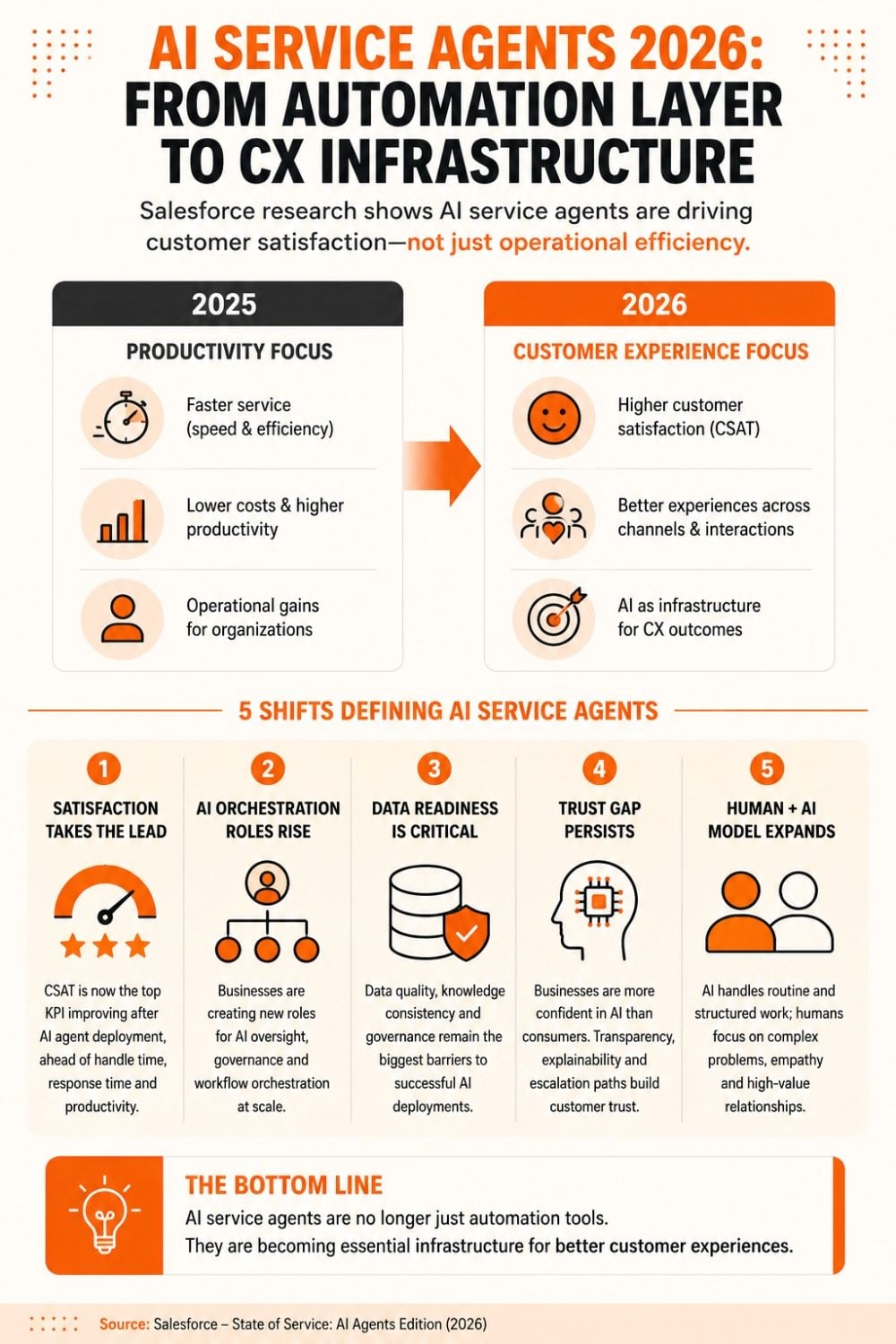
While confidence surrounding AI service agents continues growing, Salesforce’s research suggests many businesses still struggle with the operational realities required to support AI systems effectively. In particular, data readiness remains one of the most significant barriers to successful deployment.
Interestingly, the report revealed a noticeable gap between leadership perception and operational experience. While 59% of customer service leaders identified data readiness as a major challenge, concern rose to 72% among service operations professionals working more directly with enterprise data systems. The difference suggests operational teams may have greater visibility into the fragmented knowledge environments, inconsistent workflows and governance issues that often complicate enterprise AI deployments.
As Chetan noted, "Businesses consistently underestimate the ongoing operational work of cleaning, structuring and maintaining enterprise data — not just before launch, but continuously. AI doesn't forgive stale or inconsistent data the way a human agent might work around it."
These challenges become particularly important as AI service agents move beyond simple automation and begin handling more complex workflows. AI systems depend heavily on structured knowledge, accessible enterprise context and consistent operational data in order to deliver accurate and reliable responses. When information remains siloed across departments or knowledge bases are incomplete, AI systems may struggle to maintain consistency across customer interactions.
"The companies pulling ahead aren't just using AI agents. They’re building real collaboration between humans and AI agents across all their digital channels, with a unifying data strategy that makes these partnerships actually work at scale," said Chetan.
Knowledge management is emerging as an increasingly important part of enterprise AI strategy as a result. Salesforce’s report notes that businesses deploying AI agents are becoming more likely to anticipate growth in data management roles once AI systems enter production environments. In many cases, the operational challenges surrounding AI only become fully visible after deployment begins.
Governance also remains a growing concern. As AI systems become more embedded within customer-facing operations, businesses must ensure responses remain aligned with internal policies, compliance requirements and workflow standards. Poor data quality, inconsistent enterprise context or weak governance structures can quickly undermine AI effectiveness, particularly when autonomous systems begin operating across large-scale customer environments.
Despite growing enterprise enthusiasm surrounding AI service agents, trust in autonomous customer service systems remains uneven. Salesforce’s report found that 65% of customer service professionals believe customers fully trust AI-powered service interactions. However, the report also cited separate research from Metrigy showing that only 44% of consumers currently trust AI to handle their customer service needs.
Other industry research suggests consumer caution surrounding AI-powered service interactions remains significant despite growing enterprise confidence. A 2025 Cyara and Dynata report found that even when promised seamless issue resolution, 57% of consumers still preferred speaking with a human over an AI bot, while nearly half said they would prefer immediate escalation from AI systems to a human agent.
The gap suggests many businesses may still overestimate how comfortable customers feel interacting with autonomous service systems. While enterprise adoption continues accelerating, some consumers remain cautious about AI handling sensitive issues, complex support cases or situations requiring nuanced judgment and empathy. As Chetan explained, "Businesses are not misreading their technology; they are misreading their customers."
At the same time, Salesforce’s findings suggest direct experience with AI-powered support may gradually improve customer perception over time. According to the report, customers who actually interact with AI service systems often report that the experience exceeds their expectations. As AI service agents become more responsive, context-aware and capable of resolving routine issues efficiently, skepticism may begin giving way to greater acceptance in lower-friction support environments.
Related Article: AI Adoption Hinges on One Thing: Customer Trust
Transparency and escalation paths remain important factors in building that trust. Customers often want clarity regarding when they are interacting with AI systems, how their information is being used and whether they can easily reach a human agent when needed. Separate Adobe research found that 70% of consumers said they would trust a brand more if it disclosed the use of AI in marketing emails, reinforcing how transparency itself may increasingly influence customer perception of AI-powered interactions. Reliability also plays a significant role. Inconsistent responses, hallucinations or failed escalations can quickly undermine confidence in AI-powered support experiences.
For enterprises, operational trust is increasingly becoming a competitive factor rather than simply a technical concern. As Chetan suggested, AI is creating new opportunities for customers, service teams and businesses, but emphasized that "AI implementations must be grounded in security, trust, and thoughtful change management so benefits aren’t just measured in efficiency gains but in how they support the workforce as well."
According to Chetan, "The path forward isn't a marketing campaign about AI trustworthiness; it's designing interactions that earn trust repeatedly, backed by auditable governance and visible human oversight. Trust at scale is built one resolved interaction at a time."