News Analysis
Research Report
Building the Case for Modern Public Sector Messaging


Admit it. You're still optimizing content like it's 2022.
Keywords. H2 and H3 subheads. Asking your technical team to fix stuff on the backend of your content management system. Checking Page 1 results. Borrowing, copying and imitating the winners. Visiting Google Search Console regularly.
Living, pretty much, like a Search Engine Optimization Boss.
Reality: You're like Tom Hanks in Castaway (that guy above in the video) — the Dad-bod-first-half-of-the-movie Tom Hanks. Not the ripped, long-haired exceptional hunter Tom Hanks. You're the one stumbling around aimlessly on the deserted island known as Organic Content Strategy, hoping to catch just one fish to eat for the week and maybe, just maybe, start a fire.
AI's made life as a content creator as cruel as Hanks' fate on that island after his plane went down in the 2000 movie. Lonely, no compass, no sense of strategy and shoes that don't fit as you hunt for beach crabs and fruit that's probably poisonous.
Oh, and you've got a heckuva toothache with the nearest dentist a few continents away.
That's navigating content discoverability today.
But wait, there's hope and clarity.
Ok, I have to stop obsessing about Castaway and delaying the lede.
Here's the news:
Google's finally released this month some formal guidance on generative AI search, and the headline is this: SEO still matters.
"In short, yes!" Google wrote on its Google Search Central blog, responding to the question if SEO matters with generative AI search. "The best practices for SEO continue to be relevant because our generative AI features on Google Search are rooted in our core Search ranking and quality systems. These features rely on AI techniques to highlight content from our Search index."
The Google Search Gods also added this:
What about "AEO" and "GEO"? "AEO" stands for "answer engine optimization" and "GEO" for "generative engine optimization". These are both terms you may see used to describe work specifically focused on improving visibility in AI search experiences. From Google Search's perspective, optimizing for generative AI search is optimizing for the search experience, and thus still SEO.
Great. Phew. SEO is still a thing, and a term, even.
Gotta be real. That still doesn't make me feel suddenly ripped like second-half-of-the-movie Tom Hanks (Ok, NOW I'll stop). The sinking organic traffic numbers don't lie because, after all, even getting into the generative AI search party doesn't mean your site gets a visit. Brand visibility doesn't always equate to brand visits.
Hello, Zero Click Era.
But, at least we have some guidance. And some reassurance that our SEO efforts still mean something. Even if it's just to get in the generative AI search party, without being guaranteed a cup for the punch bowl.
And one kinda important thing I noticed. "Keywords" is only mentioned once in this guidance: "You don't have to worry that you don't have enough 'long-tail' keywords or haven't captured every variation of how someone might seek content like yours."
Is the keyword era over?
Oddly enough, what Google wants to remind you still matters in the search world are the same things (besides keywords) it's always said:
This "will likely influence your website's presence in generative AI search in the long run more than any of the other suggestions in this guide. While 'unique, valuable, good content' can mean different things to different people, content like this generally shares some common attributes."
Google's Great Content Compass:
"You can simplify your approach by focusing on one core principle: focus on what your visitors would enjoy, find helpful, and feel satisfied with after visiting your website," Google writes. "If you're ever unsure about a decision for your site, ask yourself: 'Is this content that my visitors would find satisfying?' If the answer is yes, then you're on the right track, as our systems are designed to connect people with exactly that kind of useful information."
Related Article: SEO Meets AI: Why Generative Engines Are the New Gatekeepers of Discovery
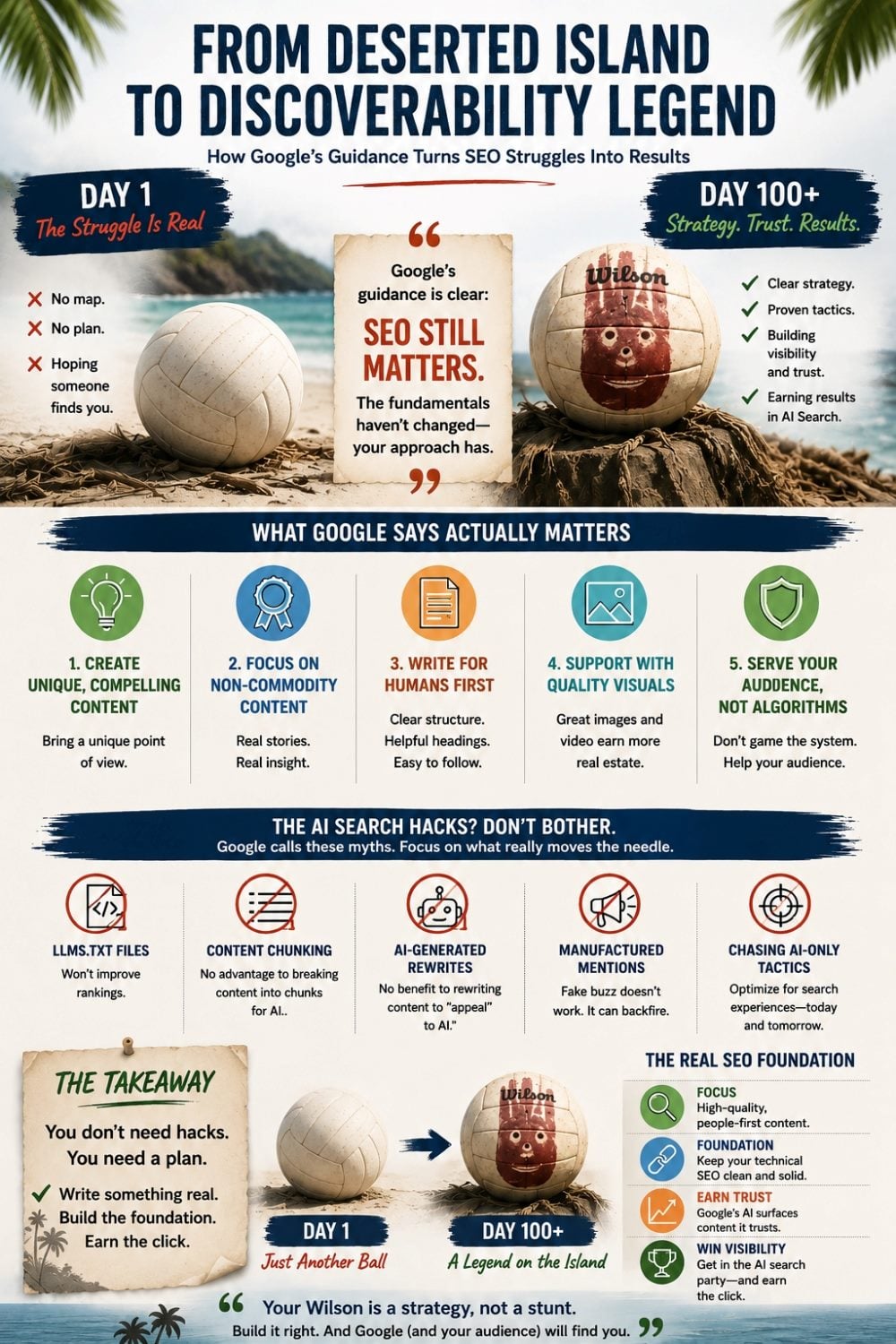
So maybe you're not totally stranded on that island after all. Google's thrown you a Wilson — not a rescue boat, but something to work with. An SEO volleyball you can paint an AI Overview on. The guidance won't reverse sinking organic traffic numbers overnight, and getting cited in an AI Overview still doesn't guarantee a site visit.
But at least the map hasn't changed as dramatically as the terrain made it feel. Write something real, keep the technical foundation solid and stop chasing AI optimization hacks that Google itself says don't work.
That's a fire even first-half-of-the-movie Tom Hanks could learn how to start.