Editorial
Research Report
Building the Case for Modern Public Sector Messaging


In the early 2000s, customer journey mapping became one of the hottest ideas in business. Suddenly, organizations everywhere were diagramming touchpoints, building personas and talking about aligning sales, marketing and service processes to the buyer’s journey. Whiteboards filled up, consultants were hired, and workshops were scheduled.
Yet for many companies, the exercise created more activity than impact.
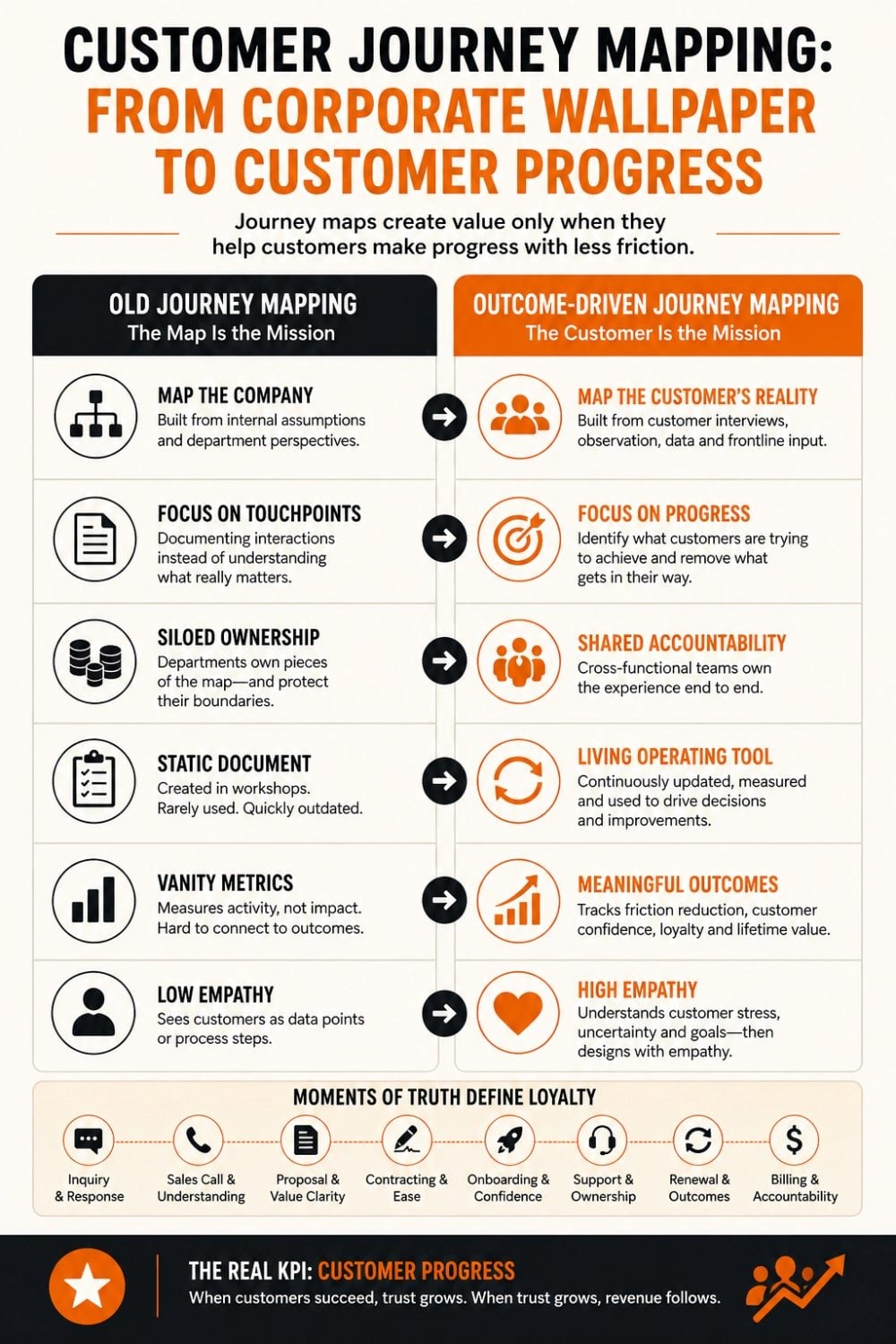
Why? Because too often the map became the mission. The artifact became more important than the outcome. Companies created polished journey maps, then went right back to delivering fragmented, frustrating experiences.
In reality, customer journey mapping was never supposed to be about the map. It was supposed to be about making customer progress easier.
That means helping people solve a problem, reduce risk, save time, eliminate friction or move forward in some meaningful way. If your journey map does not lead to that result, it is simply corporate wallpaper.
In my book “The Customer Mindset,” I wrote that businesses must stop viewing themselves as the center of the story. The customer is the story. Their pain point is the story. Their desired outcome is the story.
The company’s role is to help them get there faster, easier, and with greater confidence.
Editor's note: Key questions surrounding why customer journey mapping often fails and what organizations must do to make it operationally effective.
Organizations improve journey mapping by combining customer interviews, frontline employee input, behavioral analytics, direct observation and operational data instead of relying on internal assumptions.Moments of truth are critical interactions — such as onboarding, support issues, billing problems or renewal conversations — where customer trust is either strengthened or damaged.Empathy helps organizations understand customer stress, uncertainty and friction points more clearly, enabling teams to design experiences that solve real problems rather than optimize internal processes.Many organizations treat the journey map itself as the end goal instead of using it to reduce friction, improve responsiveness and help customers make progress more easily.Customer experience improvements often require operational tradeoffs, policy changes, technology investment and accountability across departments. Without leadership alignment, silos persist and customer friction remains unresolved.
Many organizations made a critical mistake: They mapped the journey based on what they thought customers experienced rather than what customers actually experienced.
Executives guessed, departments projected, and internal teams debated touchpoints from conference rooms. What was often missing were real customer interviews, direct observation, behavioral data, frontline employee input and genuine listening.
That inside-out mindset creates blind spots.
Customers rarely experience your company the way your org chart does. They do not care where marketing ends and sales begins or whether onboarding belongs to operations or customer success. They simply experience one brand.
When that reality feels disconnected, trust erodes.
Related Article: The Real Problem With Journey Mapping Isn't the Map
Every buyer journey and customer lifecycle contains what I call key moments of truth. These are critical points where the relationship either strengthens or weakens.
Examples include:
In these moments, you have an opportunity to create a raving fan — or damage trust and tarnish your reputation.
The economics are real. Zendesk reports that more than half of consumers will switch to a competitor after just one bad experience. At the same time, 75% of consumers will spend more with companies that provide a better customer experience. Customers whose problems are solved quickly are 2.4 times more likely to remain loyal.
Moments of truth are economic events more than they are emotional side notes.
Many companies loudly claim the customer is number one. Fewer operate that way. If customer experience is not championed across the entire C-suite, progress stalls.
Why? Because real customer experience improvement often requires tradeoffs:
That last point is often avoided, but it may be the most important. If you are genuinely committed to delivering the experience customers want, you must ensure you have the people capable of delivering it.
That requires an honest assessment of your existing team. Study the gaps between what customers expect and what your team can currently provide. Identify where the capability gaps exist, whether they can be coached, trained, or developed and how quickly progress can realistically be made.
If people are willing and able to evolve, invest in them. If they are unable or unwilling to grow with the standard customers require, leadership must make changes.
Regardless, hiring protocols should reflect these findings. Job profiles, interview questions, onboarding and performance standards should all be redesigned to attract talent that makes delivering on your promise of excellence more probable and predictable.
Many customer experience strategies fail not because the vision was wrong, but because the talent model was never upgraded to support it. If only one executive cares while others optimize for departmental metrics, the customer loses.
Jeff Bezos made customer obsession famous for a reason. Customer-centricity is truly an operating model. It requires leadership alignment, discipline, and repetition.
Without executive unity, companies say customers come first while treating them as an afterthought.
Related Article: Amazon's Customer Experience Playbook: CEO Andy Jassy Reveals Secrets
Effective journey mapping is a leadership discipline requiring multiple capabilities working together.
A willingness to ask, “What are we missing?” and “What is this experience really like?”
Knowing customers care less about your strategy deck and more about whether something works smoothly.
Interviewing buyers, studying churn, listening to calls, analyzing behavior and gathering evidence.
Using data to identify drop-off points, delays, dissatisfaction triggers, and high-performing moments.
Generating new ways to reduce friction, simplify decisions and improve confidence.
Being willing to change what no longer serves the customer.
Seeking better ways to solve old problems rather than defending outdated processes.
Sweating details others ignore — language, timing, ownership, responsiveness, clarity.
Perhaps the most important of all.
Empathy creates the ability to relate to a customer’s struggles, pressures, fears and goals. Without empathy, organizations stop short of building truly life-changing solutions because they fail to feel the weight of the customer’s problem.
Editor's note: Key operational, leadership and customer experience lessons organizations should apply when using journey mapping to reduce friction and improve customer outcomes.
| Core Idea | What the Article Argues | Why It Matters |
|---|---|---|
| Journey Mapping Is Not the Goal | Journey maps should reduce friction and improve customer progress. | Organizations avoid wasting resources on documentation that never changes customer outcomes. |
| Inside-Out Thinking Creates Gaps | Many companies map experiences based on internal assumptions instead of real customer behavior. | Disconnected experiences weaken trust and create operational blind spots. |
| Moments of Truth Drive Loyalty | Support, onboarding, billing and renewal interactions directly influence retention. | Small operational failures can quickly become revenue and reputation problems. |
| Executive Alignment Matters | Customer-centricity requires cooperation across leadership teams and departments. | Siloed incentives prevent meaningful experience improvements. |
| Talent Models Must Evolve | Organizations need hiring, onboarding and accountability systems aligned to customer outcomes. | Customer experience strategies fail when teams lack the capability or mindset to deliver them. |
| Observation Reveals Hidden Friction | Direct customer observation exposes hesitation, confusion and workarounds that surveys miss. | Real-world behavioral insight creates stronger innovation opportunities. |
| Empathy Is Operational | Empathy helps organizations understand customer pressures and emotional realities. | Teams design better experiences when they understand the weight of customer problems. |
One of the most formative lessons of my career came during my time at Intuit through its “Follow Me Home” philosophy, later reinforced by Fred Reichheld in “Winning on Purpose.”
The premise was simple: Go watch customers use your product in their real environment. Sit with the small business owner using QuickBooks while they juggle payroll, invoices, taxes, interruptions and daily chaos.
What you learn in those moments is priceless.
Customers may say the product is fine in a survey. But observation reveals hesitation, confusion, workarounds, stress and wasted time. It reveals emotional truth.
That truth is where innovation begins.
The sole purpose of journey mapping is to identify and create a path to success in reducing the pain point or problem your solution can resolve. Not to impress the board or to decorate a conference room wall. And certainly not to simply check a planning box. The goal is to make life better for the customer.
When companies do that consistently, growth becomes a byproduct. Loyalty rises. Referrals increase and employees feel more connected to purpose. This, in turn, leads to your brand earning more trust.
The companies that win in the long run have more than slide decks at their disposal. They have the customer experience in mind at all times.
 Learn how you can join our contributor community.