Feature
Research Report
Building the Case for Modern Public Sector Messaging


Kustomer CEO and Co-Founder Brad Birnbaum sat down exclusively with CMSWire on the day the company launched Kustomer Architect, a new AI-native platform built around business outcomes rather than interaction metrics. Birnbaum didn't dodge the hard questions on deflection rates, the "CX as revenue driver" talking point that's been circulating for a decade, or what bolt-on AI is actually costing brands in practice. The full Q&A is below, unedited.
Q: You're arguing that AI deflection is a flawed north star for customer experience. But deflection rates are baked into how boards and CFOs evaluate support orgs. How do you convince a CFO to stop optimizing for a metric they've used for years?
You do not convince a CFO to stop optimizing for deflection by arguing with the metric. You show them what the metric is hiding.
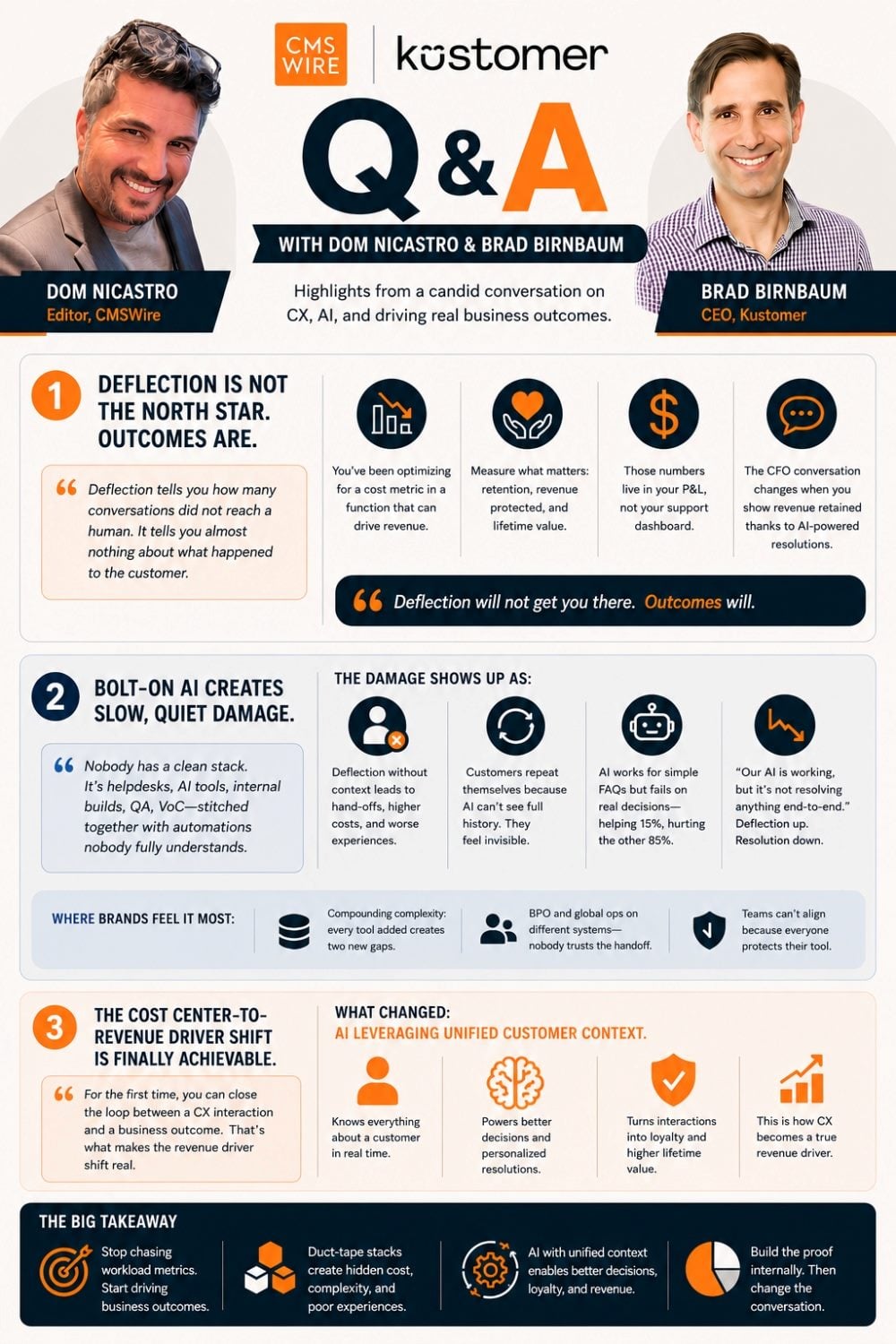
Deflection tells you how many conversations did not reach a human. It tells you almost nothing about what happened to the customer. Did they get the answer they needed? Did they stay? Did they come back? Did they spend more? Did they tell someone else to avoid your brand?
A company can have outstanding deflection numbers and still be hemorrhaging customers. Because deflection was never designed to measure customer outcomes. It was designed to measure workload distribution.
What I say to CFOs is this: you have been optimizing for a cost metric in a function that can drive revenue. That is not a philosophical argument. That is a math argument.
The brands getting this right are measuring support the same way their growth team measures product. Customer retention is influenced by support interactions. Revenue protected through CX interventions. Lifetime value correlated to resolution quality. Those numbers live in your P&L, not your support dashboard.
The CFO conversation changes the moment you can walk in and say: here is the revenue we retained because AI gave our team the context to resolve this category of issue differently. That is a conversation about investment, not cost.
Deflection will not get you there. Outcomes will.
Q: "Bolt-on AI on legacy platforms" is a pointed critique — and a lot of your potential customers are running exactly that setup. What does the damage actually look like in practice? Where are brands feeling it most?
The damage is not usually dramatic. That is actually the problem. It is slow and quiet.
And I want to be honest about something first: nobody has a clean stack. The reality we walk into is not "brand using legacy platform." It is a helpdesk plus three AI tools plus an internal build plus a QA layer plus a VoC tool, all stitched together with workflow automations that nobody fully understands anymore. That is the actual starting point for most of the companies we talk to.
So when I say bolt-on AI creates damage, I am not talking about a clean system with one bad decision. I am talking about what happens when you keep adding tools to a foundation that was never designed to support them.
It looks like an AI agent that deflects a ticket because it cannot access the customer's order history so it tells the customer to call in, which costs five times more and creates a worse experience than if it had never touched the conversation. The deflection number goes up. The customer satisfaction number goes down. Nobody connects the two.
It looks like a customer who has contacted you four times about the same issue, and your AI does not know that, because conversation history lives in one system and order data lives in another and your AI only has access to one of them. So it responds as if this is a first contact. The customer feels invisible. That feeling compounds over time.
It looks like an AI rollout that works for simple FAQ-type questions and stalls the moment you try to apply it to anything involving a real decision. Because the AI was built without access to your policies, your workflows, your edge cases, or your customer data. So you end up with an AI that handles fifteen percent of interactions reasonably well and creates a worse experience for the other eighty-five.
The thing I hear most from CX leaders who are stuck is some version of: "our AI is working, but it's not actually resolving anything end-to-end." And that is the right diagnosis. Deflection is happening. Resolution is not. The difference matters enormously to cost-to-serve, to customer satisfaction, and to whether the business can actually scale CX without adding headcount linearly with revenue.
Where brands feel it most is in the compounding complexity. Every tool added to solve a gap creates two new gaps. Knowledge lives in four places so confidence in any of them is low. BPO and global ops teams are running on different systems than the AI layer so nobody trusts the handoff. And internally, the team responsible for CX transformation cannot get alignment because everyone is protecting the tool they own.
It's not that CX leaders do not see the problem. They see it clearly. It is because they are afraid of disrupting a system that is fragile but functional, and they have not yet found a path to simplification that feels lower risk than staying with the duct tape.
What I would tell them is this: you do not have a platform problem. You have a systems and outcomes problem. And the answer is not another tool layered on top. It is replacing four to six of those tools with one system that actually closes the loop between AI, data, workflows, human agents, and measurable business outcomes.
That is a different conversation than buying software. But it is the one that actually moves the needle.
Related Article: Kustomer Architect Aims to Replace CX Deflection Metrics With Business Outcomes
Q: The cost center-to-revenue driver reframe sounds compelling, but it's also been a CX talking point for a decade. What's different now that makes it achievable, and what does HexClad's experience actually prove?
You are right that this has been a talking point for a long time. And for most of that time, it was largely aspirational. The tooling did not exist to actually close the loop between a CX interaction and a business outcome.
What changed is AI leveraging unified customer context.
For the first time, you can have a system that knows everything about a customer, their full purchase history, their previous interactions across every channel, their likelihood to return, their current order status, and use that knowledge in real time to make a decision in that interaction that affects retention, revenue, or loyalty.
That is not a reporting capability. It is an operational one. And it did not exist at scale before AI made it feasible to process that level of context in the moment.
What HexClad proves is specific. They are not a company with an abstract CX problem. They are a fast-growing brand with real operational pressure: managing high contact volume, maintaining strong customer satisfaction, and doing both without scaling headcount linearly with revenue.
What Kustomer gave them was the ability to reduce cost-to-serve without sacrificing CSAT. That combination, lower cost and better experience (not a trade-off between them) is what the revenue driver argument actually requires. Because if you are cutting costs by degrading experience, you are just deferring the churn. You have not solved anything.
HexClad is holding both simultaneously. That is what the data shows. And that is the proof point that matters.
Q: Walk me through the new AI Architect feature.
Kustomer Architect is our answer to a problem we hear from CX leaders constantly: they have a clear vision for what AI-powered customer experience should look like for their business, but they cannot get there because the path between that vision and actual production implementation is too long, too complex, and too dependent on technical resources they do not have.
What Architect does is compress that distance dramatically.
The most important thing to understand about Architect is that it is built on the belief that the people who understand your customers best, your CX operators, your team leads, the people who have been designing support experiences for years, should be the ones building your AI workflows. Not engineers. Not consultants. The people who know your business.
Architect gives those people the ability to define exactly how they want AI to behave: what it can decide on its own, where it should escalate, how it should handle edge cases, what outcomes it should optimize for. They describe how they want their business to run. Architect figures out how to make that happen inside our platform.
We built it around the concept of goals-driven AI. Rather than building a set of procedures and hoping the AI follows them, you define the outcome you are trying to reach (retain this customer, resolve this issue, protect this relationship) and the platform works backwards from that outcome to orchestrate the right combination of AI, workflows, and human collaboration.
And here is where the open platform architecture becomes critical. We are not a closed system. We speak MCP (Model Context Protocol) which means our agentic platform can connect to anything that speaks MCP. Your order management system. Your returns platform. Your recommendation engine. Your internal data sources. If it exposes an MCP server, Architect can talk to it. That is not a configuration project. That is a connection.
The reason that matters is that great AI workflows are only as good as the data they can see. Most platforms lock you into their data model. We made the opposite decision. We want customers to be able to pull in every relevant data point from across their ecosystem, not just what lives inside Kustomer today, so they can build workflows that reflect how their business actually operates. Complex, custom, end-to-end workflows. Built the way they want to build them.
What makes it all work is that Architect is not operating in isolation. It has access to the full Kustomer platform: customer data, conversation history, knowledge, workflows, and your human agents. When the AI makes a decision inside Architect, it is grounded in the complete operational and customer context behind that interaction, plus whatever external systems you have connected. That is what separates this from tools that feel powerful in demos and break in production.
And critically, brands can configure this themselves. They do not need to file a professional services request or wait for an implementation cycle. Sophisticated, complex, highly customized AI workflows. Built by the people who know the customer. Without needing an engineering team to make it happen.
That is what Architect is designed to make possible.
Q: If deflection and handle time are the wrong metrics, what should CX leaders be reporting to the C-suite instead — and are buyers actually ready to be held accountable to those new numbers?
The metrics that matter are the ones that connect to what the business is actually trying to accomplish.
Customer retention influenced by CX interactions. That is measurable. You can segment customers by resolution quality and watch cohort behavior over time. You can see whether customers who had a poor AI-handled interaction churn at a higher rate than those who had a strong one. That number belongs in the board deck.
Revenue protected through support. Every time a return policy exception is made intelligently, because AI recognized that this customer has high lifetime value and an otherwise clean record, you have a data point on revenue that CX directly saved. Most organizations are not capturing that. They should be.
CSAT correlated to AI interaction type. Not just "did we resolve it" but "how did the customer feel about the experience, and what does that predict about their next purchase decision."
These metrics are not new concepts. What is new is that AI makes them measurable at scale in ways that were simply not operationally feasible before.
Are buyers ready to be held to them? Some are. The CX leaders who are making the most progress right now are the ones who already went to their CFO with this framing and got buy-in to run a pilot measured against retention and revenue rather than deflection. They have the organizational cover to operate differently.
Others are not there yet. And honestly, that is not a technology problem. It is a political one. Changing the metric you report against means changing the accountability structure around your team. That takes organizational will, not just better tooling.
What I would tell CX leaders who are not there yet: start building the data. Even if you are still reporting deflection to the board, start tracking the retention correlation internally. Start capturing the revenue influence numbers. Build the case before you make the ask. Because the ask for a new measurement framework is a much easier conversation when you walk in with six months of data behind it.
The metric always follows the proof. Build the proof first.