Editorial
Research Report
Building the Case for Modern Public Sector Messaging


Manufacturers have strong reasons to go direct. B2B ecommerce in the U.S. is projected to exceed $3 trillion by 2027, and Forrester has predicted that more than half of large B2B purchases will move through digital self-service channels. The economics are not the problem. The readiness model usually is.
The timing matters because digital self-service is no longer limited to simple reorders or low-value transactions. Forrester predicted that more than half of large B2B transactions of $1 million or greater will be processed through digital self-service channels, while McKinsey found that 62% of B2B customers prefer to reorder products online, but only 13% of industrial OEMs said they could offer digital solutions with their current capabilities.
That gap is where direct dealer commerce becomes risky: buyer expectations are moving faster than many manufacturers' transaction architecture.
The recurring pattern is consistent. Leaders approve the go-direct strategy, look at the commerce stack they already have and ask whether it can be extended. If that stack was built around consumer transactions, that is the wrong question.
The better question is whether the architecture can govern a commercial account relationship from the first dealer login through pricing, approval, release, fulfillment and downstream financial settlement. Before launch, leaders need to test that readiness against the full dealer transaction cycle, not against whether the existing digital experience platform can be extended.
That is where the risk enters. Most go-direct strategies do not fail because the commercial direction is wrong. They fail because the manufacturer removes the intermediary layer without building the transaction foundation that intermediary once absorbed.
Manufacturers are going direct for rational reasons. Intermediated selling can dilute pricing control, slow responsiveness and limit access to demand signals. Digital direct channels can create tighter feedback loops, faster ordering paths and better visibility into buyer behavior.
Those are real advantages. But they do not prove the organization is ready to execute direct dealer commerce.
The mistake is treating go-direct as a front-end channel decision. In practice, it is an operating model transfer. The manufacturer is not only launching a new portal. It is taking direct responsibility for commercial rules that may have been handled by distributors, field sales teams, finance operations or manual exception processes.
That includes who can buy, what they can see, which prices apply, what approvals are required, which payment or financing path is valid, how fulfillment is routed and how the order is reconciled downstream.
If those questions remain vague when platform design begins, the architecture absorbs the ambiguity later through pricing exceptions, entitlement gaps, approval workarounds and order failures.
Related Article: Agentic Commerce in 3 Phases: Here's What's Coming Next.
Most go-direct strategies break when the business measures readiness against a B2C capability that was never designed for dealer commerce.
A consumer platform is optimized for shopper conversion, basket size, promotion mechanics and returns. A dealer platform has to manage account-based pricing, role-based authority, approval workflows, payment or financing logic, and coordination with ERP, warehouse, transportation and finance systems.
Those are not minor extensions. They are different transaction requirements.
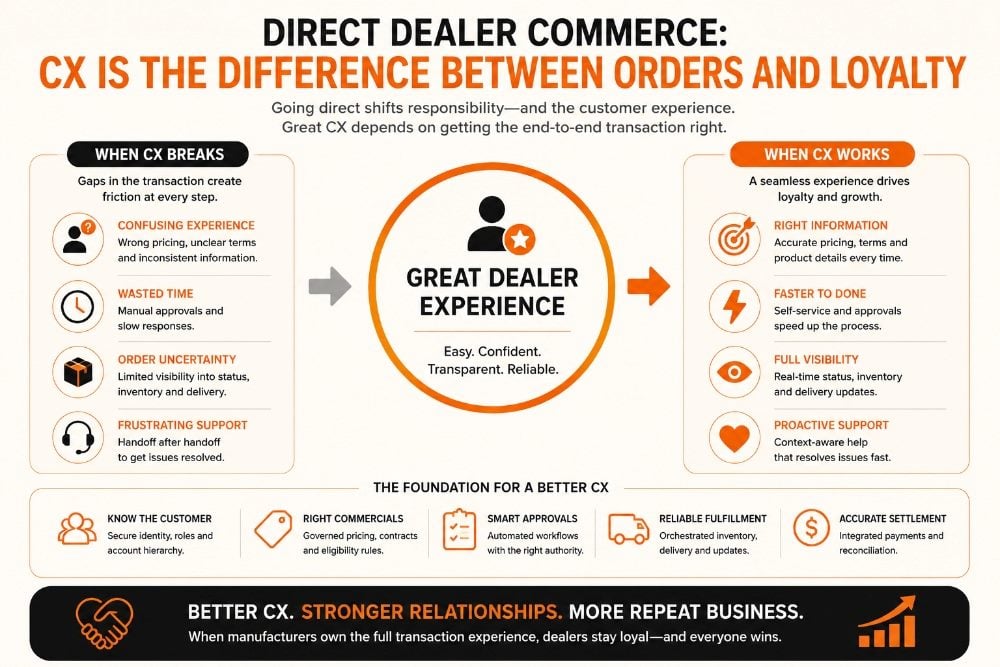
Pricing is often the first failure point. Dealer commerce rarely runs on one public price. It may depend on contract terms, dealer tier, geography, program eligibility, credit status or negotiated exceptions. If that logic is treated as a storefront configuration problem, the business quickly creates inconsistent pricing behavior across accounts and channels.
Account control is the second failure point. A dealer account is not one shopper. It may include buyers, approvers, administrators, finance users and service contacts. Each may have different rights. Some can view products. Some can build carts. Some can submit orders. Some can approve release. If the platform cannot govern that authority inside the transaction flow, the business will push the work into manual review.
Fulfillment and settlement expose the third failure point. Direct dealer commerce does not end when an order is submitted. The order still has to move through inventory checks, release rules, warehouse execution, transportation logic, invoicing, payment or financing confirmation, and exception handling. A platform can look ready in a demo and still fail the first real commercial transaction.
That is why readiness should be tested against the full order cycle, not the first happy-path screen flow.
| Test | What to check | Why it matters |
|---|---|---|
| Commercial account test | Can the platform support account hierarchy, role-based authority and contract pricing in one governed flow? | Dealer commerce is not one shopper buying at one public price. |
| Transaction control test | Can the system enforce approval, release, payment or financing logic without manual rescue? | Direct commerce fails when exceptions move outside the platform. |
| Downstream execution test | Can fulfillment, invoicing, settlement and exceptions flow through shared orchestration? | Going direct requires end-to-end transaction control, not just a new portal. |
If those tests fail, the go-direct strategy may still be valid. The platform is not ready.
The hardest part of going direct is not always visible at the start because intermediaries often absorb complexity quietly.
A distributor may manage localized account knowledge, buying behavior, exception handling, credit exposure, substitution decisions, delivery coordination and communication with the dealer. A field team may handle pricing explanation or special approvals. A finance team may resolve credit or settlement issues outside the digital flow.
When the manufacturer goes direct, those responsibilities do not disappear. They move.
The question is whether they move into a governed digital transaction model or into a growing set of manual workarounds.
This is where many manufacturers underestimate the change. They assume the direct channel will reduce friction because the intermediary is removed. But if the platform cannot govern the complexity the intermediary previously handled, friction does not disappear. It shifts to internal teams, contact center agents, finance operations, warehouse coordinators and dealer support teams.
That shift creates a different kind of cost. It may not show up as a failed launch. It shows up as exception volume, manual pricing corrections, order release delays, fulfillment disputes, credit holds, duplicate integrations and dealer frustration.
In other words, the intermediary may be gone, but the operating complexity remains.
When manufacturers remove the intermediary layer, the customer experience consequences often surface before the architecture failures do.
| Watch Area | What's Happening | CX Risk |
|---|---|---|
| Contact Center Exception Volume | Pricing errors, approval gaps and order release failures that the platform can't resolve push into human queues | Dealer frustration spikes; agent workload grows without clear ownership or resolution paths |
| Fulfillment Visibility | Direct channels often lack end-to-end order tracking when ERP and warehouse integrations are incomplete | Dealers can't self-serve order status; inbound contact volume rises and trust erodes |
| Onboarding Friction | Account hierarchy and role permissioning built late creates inconsistent access and delayed activation for new dealers | First impressions of the direct channel are defined by what dealers can't do yet |
| Pricing Consistency | Contract, tier and exception pricing handled outside the platform creates conflicting quotes across channels | Dealers lose confidence in the direct channel; shadow processes and workarounds return |
| Channel Trust | When exceptions routinely escape the platform, dealers learn the digital channel is unreliable for complex transactions | Adoption stalls; high-value orders revert to phone, email or rep-assisted paths |
| Data Fragmentation | Disconnected commerce, ERP and fulfillment systems produce incomplete dealer behavior signals | CX teams lose visibility into where experience breaks down and can't close the feedback loop |
Direct dealer commerce requires a different foundation from consumer commerce.
McKinsey's research on technology debt describes technical debt as both the deferred modernization work itself and the ongoing complexity tax created by fragile integrations, nonstandard data and workarounds. For go-direct programs, that drag shows up quickly when the commerce platform was not designed as shared transaction infrastructure. A customer data platform strategy faces the same risk when data contracts are defined after channels go live rather than before.
The answer is straightforward, even if it is not easy: design shared transaction services, shared orchestration points and shared data contracts before the first dealer channel goes live. Otherwise, the first platform becomes the legacy problem the second platform inherits.
Editor's note: Manufacturers often evaluate storefront capability first when transaction governance determines long-term scalability.
| Area | Consumer Commerce Focus | Dealer Commerce Requirement |
|---|---|---|
| Identity | Individual buyer profile | Commercial account hierarchy and permissions |
| Pricing | Public pricing and promotions | Contracts, tiers and negotiated pricing rules |
| Approvals | Simple checkout flow | Role-based purchasing authority |
| Fulfillment | Order completion | Inventory, release rules and orchestration |
| Integration | Storefront systems | ERP, warehouse, transportation and finance coordination |
| Scaling Risk | Conversion optimization | Exception handling and governance control |
The most expensive mistake in go-direct commerce is making the architectural commitment after the first platform has already been built on the wrong foundation. The same pattern applies to customer experience programs more broadly: governance decisions deferred to a second build cycle always cost more than decisions made before the first channel went live.
The right time to make the architectural commitment is before the first dealer channel launches. If a go-direct strategy has been approved, if dealer-channel scope is being defined, or if a second segment is already under discussion before the first launch is complete, the decision point has arrived.
The practical rule is simple: if the first platform is being designed without a governed model for commercial identity, pricing, lifecycle and shared downstream integration, the organization is not building a scalable direct channel. It is building the future rebuild.
Most manufacturers do not fail because going direct is the wrong strategy. They fail because they launch direct dealer commerce without a governed transaction foundation for commercial identity, pricing, lifecycle and downstream execution.
That is the gap. The transaction foundation is what closes it. Without it, go-direct becomes a sequence of exceptions, workarounds and rebuilds. With it, direct commerce becomes scalable across segments, systems and years.
 Learn how you can join our contributor community.

Nixalkumar Patel is a senior product and digital transformation leader specializing in enterprise omnichannel digital commerce transaction execution and orchestration across D2C, B2C and B2B/SMB channels, including AI-enabled governed conversational commerce. With more than 13 years of experience, his work focuses on building the governance, validation and orchestration layers that help enterprise transactions execute correctly, reliably and auditably across customer journeys, fulfillment ecosystems and core business systems.